





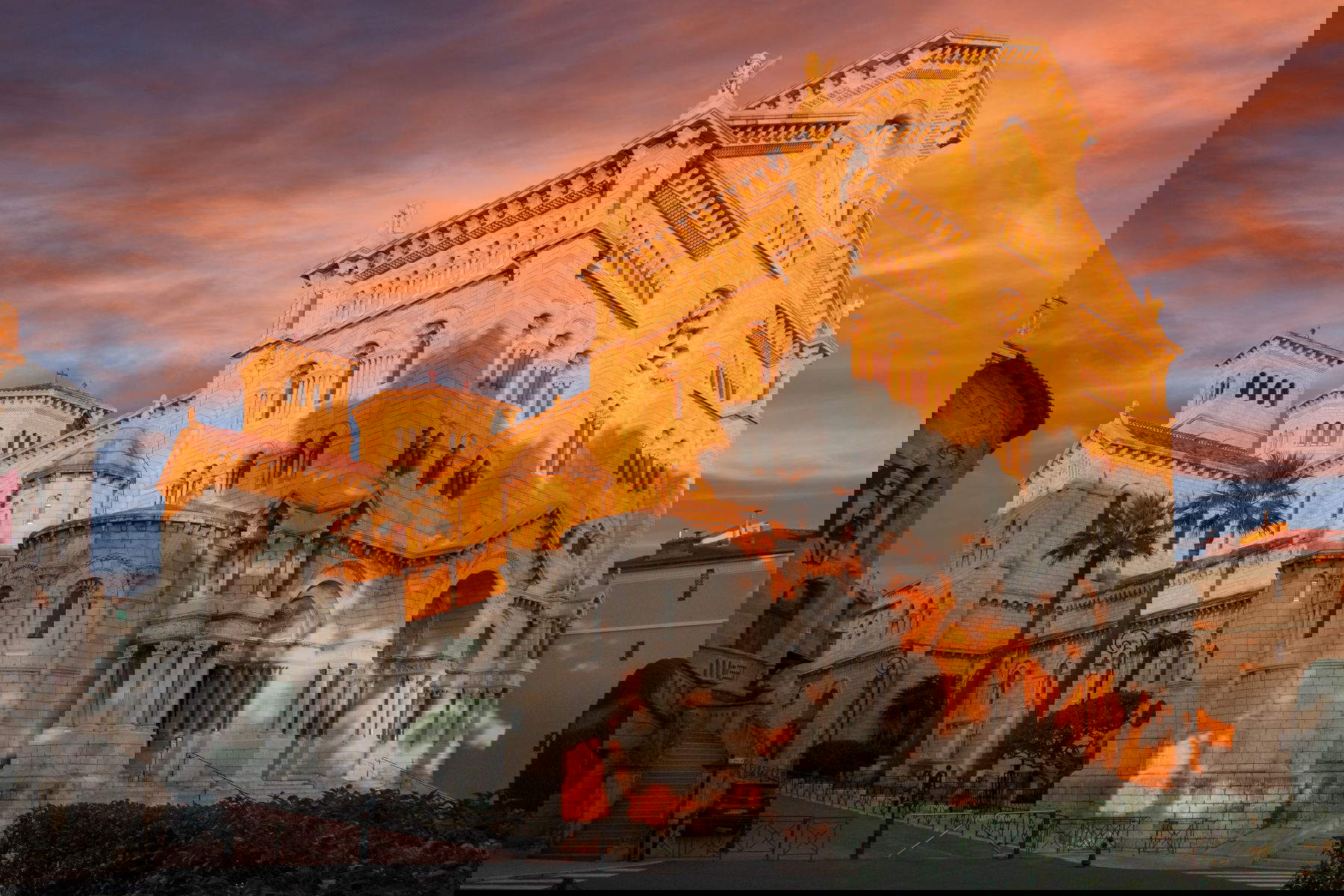
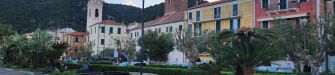
The Cathedral of Our Lady of the Immaculate Conception stands majestically on the Rock of Monaco, the historic and scenic center of the Principality. Its location makes it possible to admire, with a short walk, the Saint-Martin gardens overlooking the sea, enjoying bright views of the bay. A short walk away is the Princes’ Palace, a symbol of the Monegasque dynasty, and the entire area invites walking routes through historic alleys and charming little squares. The Cathedral represents the center of the spiritual life and very identity of the Principality, as the albeit young history of the building we see today is closely intertwined with that of the princes and the entire community.
This imposing neo-Romanesque-style house of worship is not only the main church of the Monegasque archdiocese, but also constitutes a profound symbol of the citizens’ attachment to their Christian roots, the state religion, as even Prince Albert II himself has pointed out. The history of this sacred place has its roots as far back as the 13th century, when in 1247 Pope Innocent IV authorized the construction of a first church on the Rock, where a fortress already existed. At that time the cult of St. Nicholas, patron saint of sailors and children, was rapidly developed and the parish in the upper town was dedicated to him. The old church of St. Nicholas, completed in 1321 (it was the first Cistercian Gothic church in the area southwest of the Alps), served the community for more than five hundred years before it was demolished in 1874 on the orders of Prince Charles III, who intended to build a new cathedral. Valuable architectural vestiges of that original structure remain today, such as capitals, small columns and balustrades arranged along the left side of today’s building, as well as a bell cast in 1484 that stands in the adjacent alley and rang in 1641 to celebrate the expulsion of the Spanish garrison by Prince Honoré II Grimaldi. The desire to build a new and larger cathedral arose under the principality of Charles III, at a time of great transformation for Monaco, and the foundation stone was blessed on January 6, 1875. Construction, directed by architect Charles Lenormand, lasted nearly 30 years and was officially completed on November 12, 1903, although the solemn consecration did not take place until June 11, 1911.
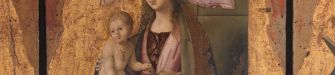
The architecture of the cathedral is distinguished by the use of white stone from the quarries of La Turbie, which gives the building an understated majesty. The dimensions of the structure are imposing, with a length of seventy-two meters, a width of twenty-two meters, and a height reaching eighteen meters. The main facade features three splayed portals decorated with carved lunettes and supported by small columns, while above the central portal dominates a large triple lancet window with a circular rose window and a bas-relief depicting Christ Pantocrator between two angels. Noble and varied materials were used in the construction of the interior, including red and blue porphyry from the Esterel massif, Vosges granite, Biella granite for the chancel, and fine white Carrara marble. Inside are numerous artistic treasures of immense value, such as the high altar and the episcopal throne carved from Carrara marble. Notable pictorial works include the altarpiece dedicated to St. Nicholas, created in 1500 by the Nice artist Ludovico Brea, which consists of eighteen compartments and is a fundamental testimony to the Mediterranean artistic heritage of the Renaissance. Other notable works include the St. Devote altarpiece, the Pieta del curato Testa dating from 1505, and works attributed to Francesco Brea’s atelier, such as the White Penitents and St. Roch altarpieces. The stained glass windows in the nave illustrate female figures from the Old Testament, while those in the side aisles depict scenes from the lives of Jesus and Mary.
The cathedral houses three main chapels charged with significance for the Monegasque community: the chapel of the relics of St. Devote, patroness of the princely family and the Principality; the chapel of St. Romanus, martyr protector of Monaco; and the chapel of the Blessed Sacrament, which serves as the burial place for bishops and archbishops. A central role in the life of the cathedral is played by music, thanks to the presence of two exceptionally well-made organs. The large monumental organ located on the tribune above the narthex was originally built in 1976 by Jean-Loup Boisseau in collaboration with Pierre Cochereau and Canon Henri Carol. Between 2009 and 2011 this instrument was radically rebuilt by the Belgian firm Thomas, becoming a unique work in Europe in terms of architectural and musical innovation. The organ now has four keyboards, seventy-nine registers, and nearly seven thousand pipes, with the use of selected materials such as Vosges fir for the bellows, maple for the console, and oak for the facade. A distinctive feature is the LED-backlit Plexiglas panels that visually translate the color of the sound, creating a multisensory experience during concerts and celebrations. A second choir organ, made by the Tamburini firm of Crema in 1976, on the other hand, accompanies the daily services with greater restraint. The choral tradition is equally prestigious and belongs to the Maîtrise de la Cathédrale, founded in 1904, which includes the celebrated Petits Chanteurs de Monaco conducted by Pierre Debat, who enliven the solemn mass every Sunday morning.
The cathedral is, as anticipated, inextricably linked to the Grimaldi dynasty, having been the scene of historical events such as the wedding between Prince Rainier III and Princess Grace Kelly in 1956. The building also serves as a family pantheon, as it houses, in the ambulatory, the tombs of most of the deceased monarchs. Among the buried personalities are the Lords of Monaco John II, Lucien I, Augustine Grimaldi and Honoré I, as well as Princes Honoré II, Louis I, Anthony I, Honoré IV, Honoré V, Florestan I, Charles III, Albert I and Louis II. Also resting there are the princesses consorts Maria Landi, Ippolita Trivulzio, Marie de Lorraine, Louise d’Aumont, Antoinette de Merode and Caroline Gibert, as well as Princess Grace and Prince Rainier III, whose tombs are the destination of constant homage by visitors reminiscing about the society life of the 20th century. Also interred in the cathedral are such figures as Antonio Grimaldi, known as “Chevalier de Grimaldi,” who was governor general of Monaco in the 18th century. Religious life in the Principality is marked by the major liturgical feasts celebrated with pontifical offices, notably January 27 for St. Devote and November 19 for National Day. The Archdiocese of Monaco, elevated to that rank by Pope John Paul II in 1981, is currently led by Archbishop Dominique-Marie David, who succeeded Bernard Barsi in 2020. The cathedral parish, led by Canon Daniel Deltreuil, archdeacon, coordinates numerous services ranging from catechesis and outreach to chaplaincies for the hospital, public forces and nursing homes.
Access to the cathedral is free daily, outside of church services, as long as visitors wear clothing respectful of the sacred place. The cathedral thus remains an indispensable landmark, capable of harmoniously blending neo-Romanesque architectural beauty with a vibrant cultural life and a deep spiritual legacy that continues to unite the Monegasque people around faith and art.
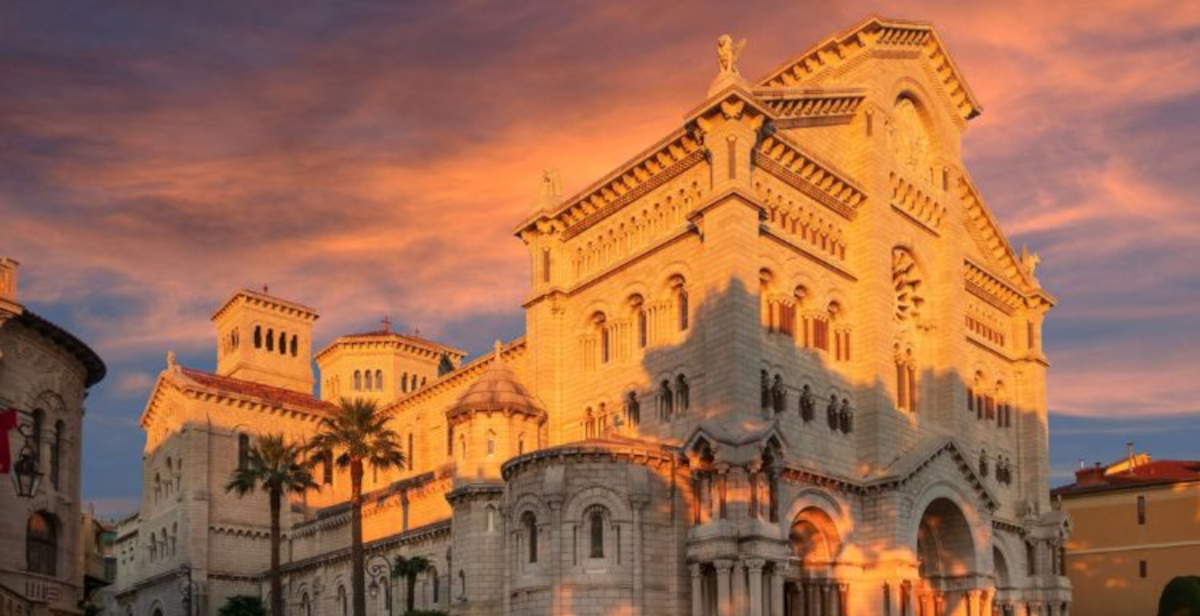 |
| The Cathedral of Monaco: art, history and faith on the Rock of the Principality |

Warning: the translation into English of the original Italian article was created using automatic tools. We undertake to review all articles, but we do not guarantee the total absence of inaccuracies in the translation due to the program. You can find the original by clicking on the ITA button. If you find any mistake,please contact us.



















 IT
IT FR
FR DE
DE ES
ES CN
CN


