





It had been withdrawn a few hours before the Feb. 5 sale at Sotheby’s: Antonello da Messina’sEcce Homo , which was about to go to auction with an estimate of $10-15 million, was already shaping up to be one of this year’s highlights on the market. And according to rumors that have been running on social media since yesterday afternoon, the work would be purchased by the Italian state. The news comes from authoritative sources. Announcing the purchase yesterday was the Fondazione “Federico Zeri” of Bologna with a post on its Facebook page: “Just auctioned by Sotheby’s, from today it is the property of the Italian State. Federico Zeri first attributed it to the great master: ’the Christ takes on, with this extraordinary grimace, even an aspect that today would be defined as mafioso. It is an early work still unknown to artistic literature.’”
In fact, those who followed the auction last Thursday know that the painting was not beaten, but was withdrawn, despite the fact that it was guaranteed: similar cases usually happen when a major private negotiation is underway. Lending a patina of officiality to the indiscretion was the acting director of the National Gallery of Umbria and the National Art Gallery of Bologna, Costantino D’Orazio, who wrote on his Facebook page a post (later deleted) a few minutes ago: “A new Antonello da Messina returns to Italy thanks to the Ministry of Culture. Those who work at the MiC know how complicated it is for the Italian state to participate in an auction, but this time the Ministry has played ahead, securing a true masterpiece by private treaty, even netting a more advantageous price. Thanks to the colleagues who managed the operation, to the minister who wanted it and to the owner who welcomed the idea of the work returning to Italy, earning less than he could have.” The cost of the operation should be around 12 million euros, according to what Angelo Loda, an art historian official at the Brescia Superintendency, wrote, also on social media.
Official confirmation from the Ministry is still lacking, but art lovers are already celebrating an acquisition that, if confirmed, would be one of the most important in MiC’s recent history. The reasons for this importance are at least twofold. On the one hand, there are very few works by Antonello da Messina coming on the market: the Sicilian master’s corpus is extremely small and most of his paintings are now kept in public museums. On the other hand, theEcce Homo offered in recent days by Sotheby’s is a celebrated work, repeatedly exhibited in contexts of the highest international importance, with a vast bibliography and a critical history that includes a presentation by Federico Zeri, who made it known to the public in 1981.
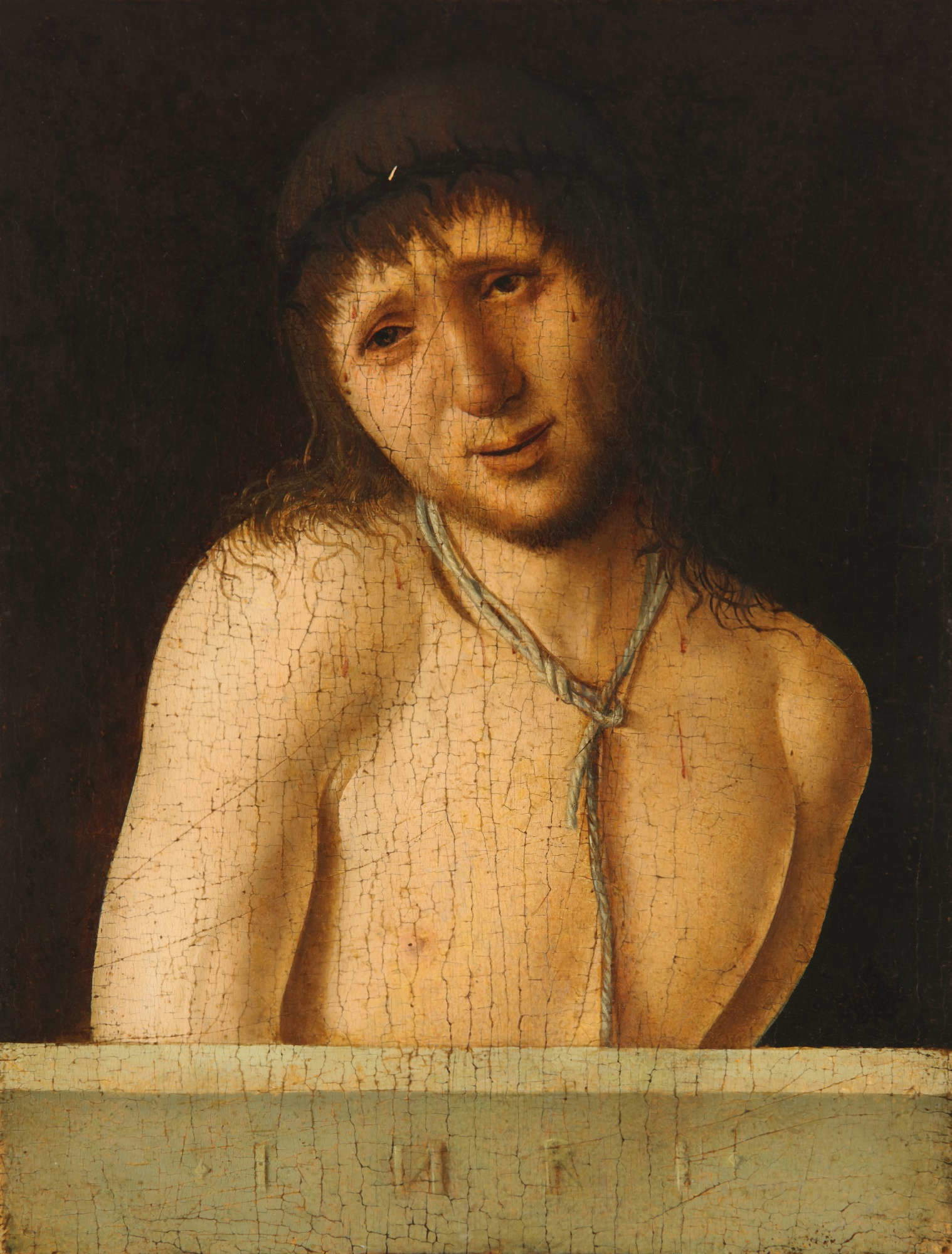
The work is a small opisthograph panel, that is, painted on both sides, datable to around 1470. On the recto Antonello depicts a half-length Christ, placed behind a parapet and facing the viewer frontally. The gaze is fixed, direct, devoid of narrative mediation. The expression is charged with pathos: the reddened, swollen eyes narrow in pain, the lips are slightly parted, while thin rivulets of blood trickle from the crown of thorns down the forehead and chest. A thin rope is tied around the neck, suggesting physical restraint, while the face emerges with luminous force from the surrounding darkness, accentuating the twisting of the torso, evidently caused by the hands tied behind the back.
Antonello also inserts a typically Nordic motif, the fictitious parapet, on which appears the relief inscription “INRI,” an acronym for “Jesus of Nazareth, King of the Jews.” This is a frequent device in Flemish portraiture, which here becomes an element of contact between the space of the image and that of the viewer, reinforcing the sense of physical and emotional proximity.
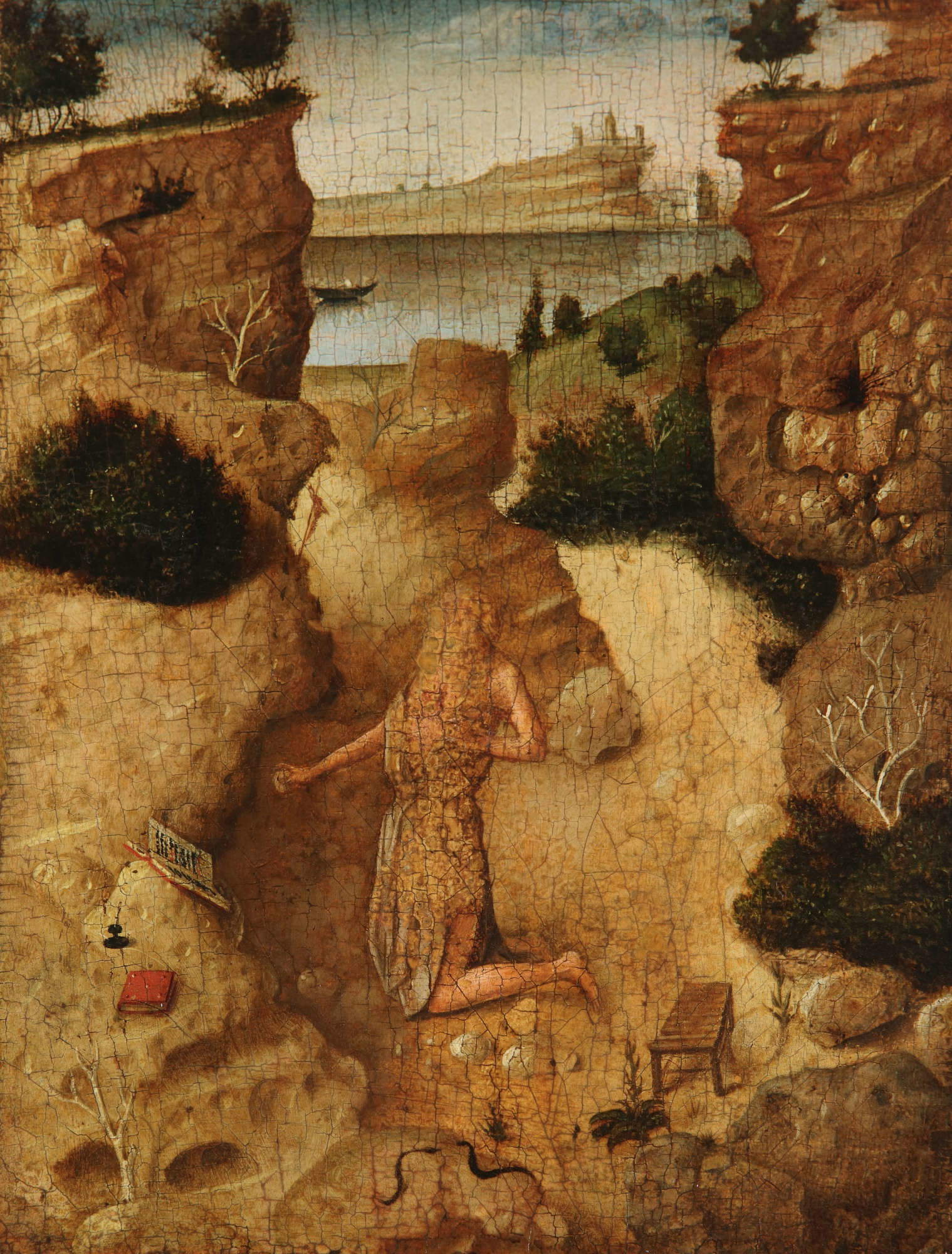
On the verso of the panel, Antonello paints a penitent Saint Jerome, immersed in a landscape rendered with extreme precision. The saint is placed at the bottom of a gorge that opens onto a calm body of water, beyond which a fortified castle and a small boat glide silently past. In the foreground, Jerome is genuflected before a small crucifix and beating his chest with a stone. The presence of a codex, an open book, and an inkwell identifies him as the author of the Vulgate, the Latin translation of the Holy Scriptures, while the austere setting emphasizes his asceticism.
The dialogue between recto and verso is theologically and conceptually sophisticated. The self-inflicted physical suffering of the penitent saint echoes Christ’s sacrifice, creating a mirroring that reflects the influence of modern devotio and particularly Thomas of Kempis’Imitatio Christi, composed between 1418 and 1427. The work’s small format and double face suggest a private devotional function, a hypothesis already advanced by Federico Zeri, who considered the panel a portable object, probably kept in a leather bag and intended for personal meditation. As such, the work would have been touched, caressed and even kissed, establishing a direct physical and spiritual relationship with the image.
From an iconographic point of view, Antonello’s Ecce Homo sits somewhere between theAndachtsbild, in which the sacred figures are isolated from any narrative context, and the depiction of a specific biblical episode. Although Christ is depicted in isolation, the crown of thorns and the rope place him at a specific moment in the Passion, after the scourging and mockery by Roman soldiers and before the ascent to Calvary. This typological ambiguity amplifies the viewer’s emotional response.
One of the most distinctive elements of Antonello’s poetics lies precisely in the dissolution of boundaries between pictorial genres. In this work, the artist loads the devotional image with narrative allusions and, at the same time, imbues it with portrait qualities, creating a direct, almost face-to-face encounter between Christ and the viewer. A similar approach is found in the almost contemporary Portrait of a Man from the Mandralisca Museum in Cefalù, where the subtlety of expression suggests the inner life of the subject. The parapet plays a central role in this dynamic, serving as a visual boundary and a tangible bridge between the real and represented worlds.
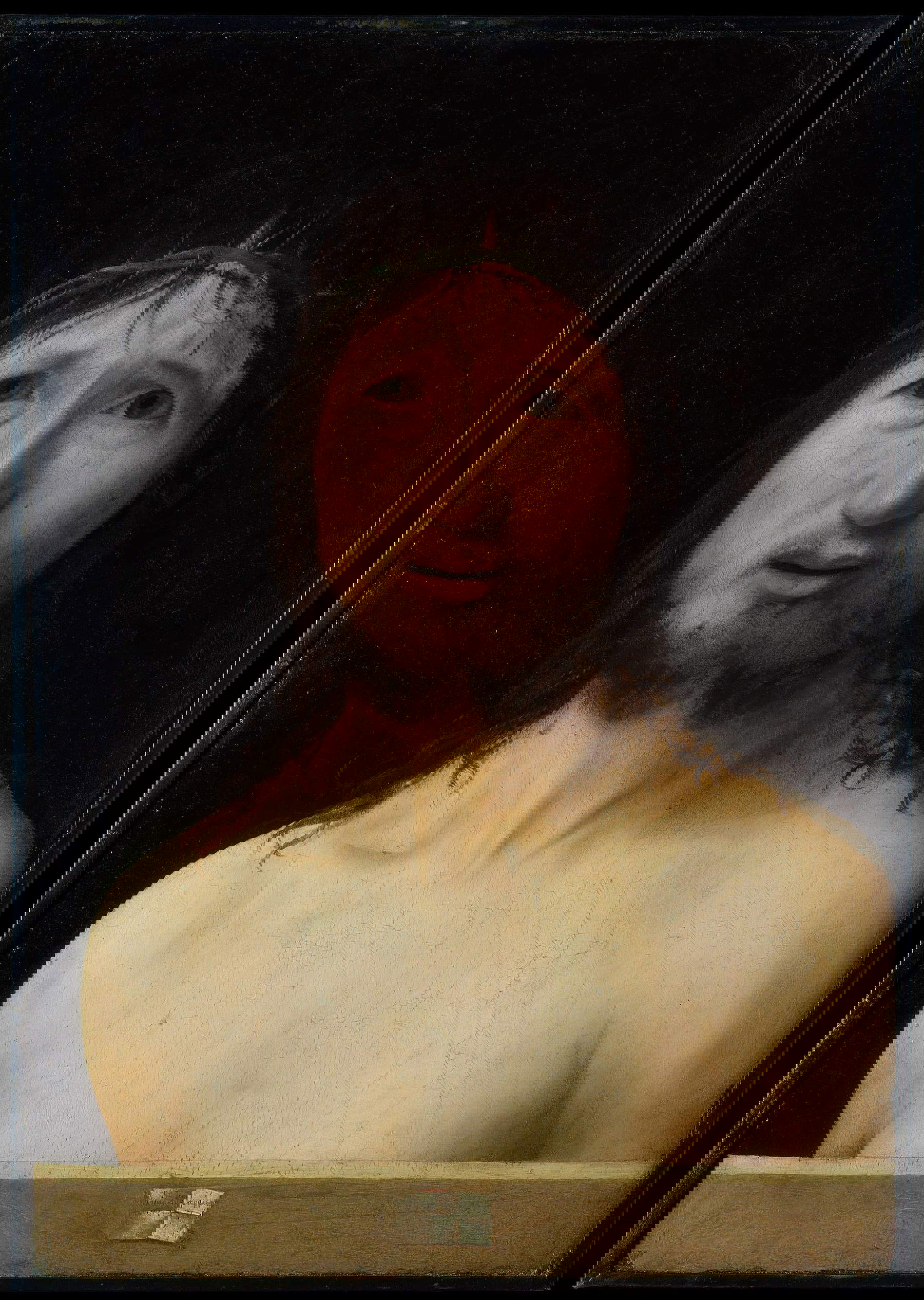
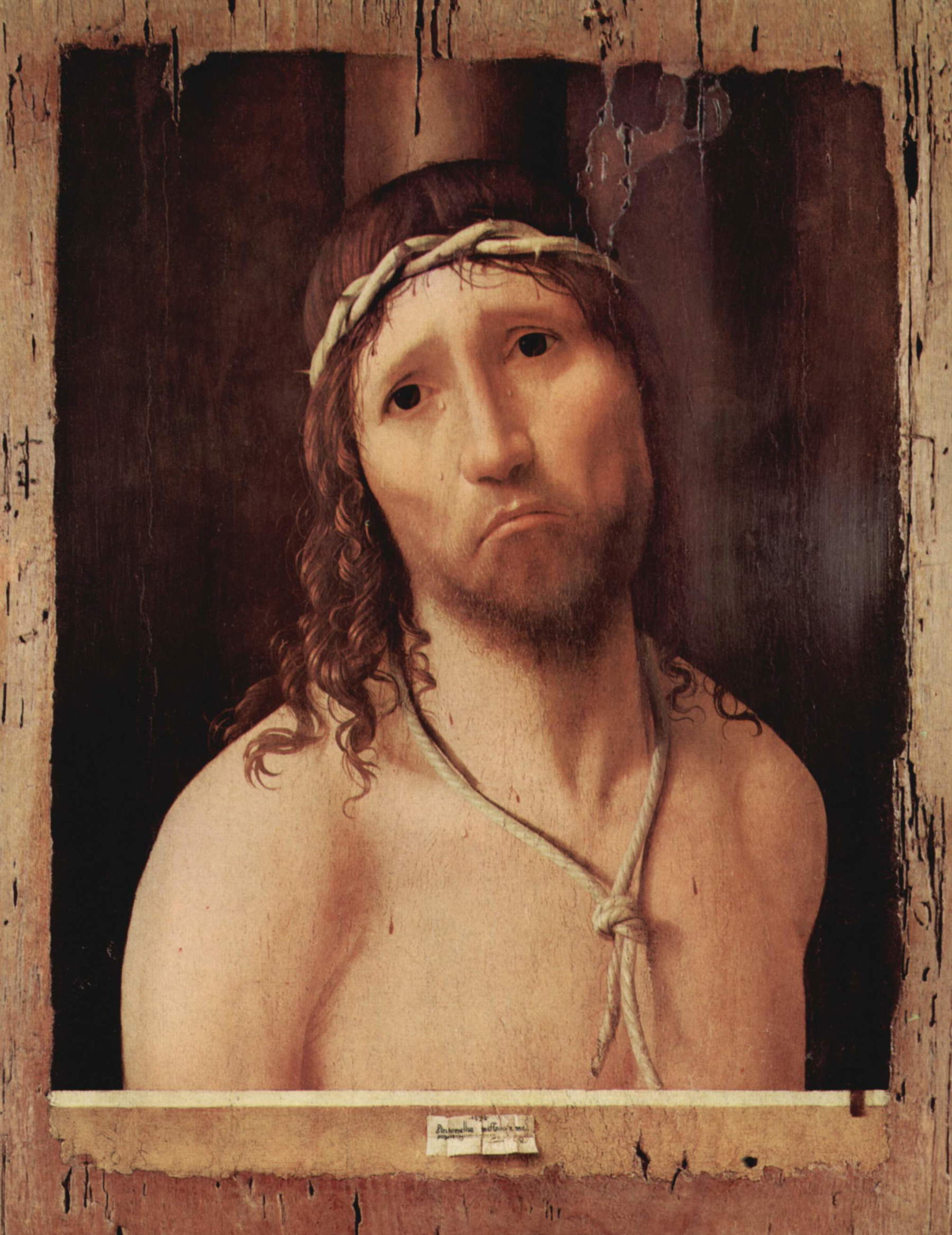
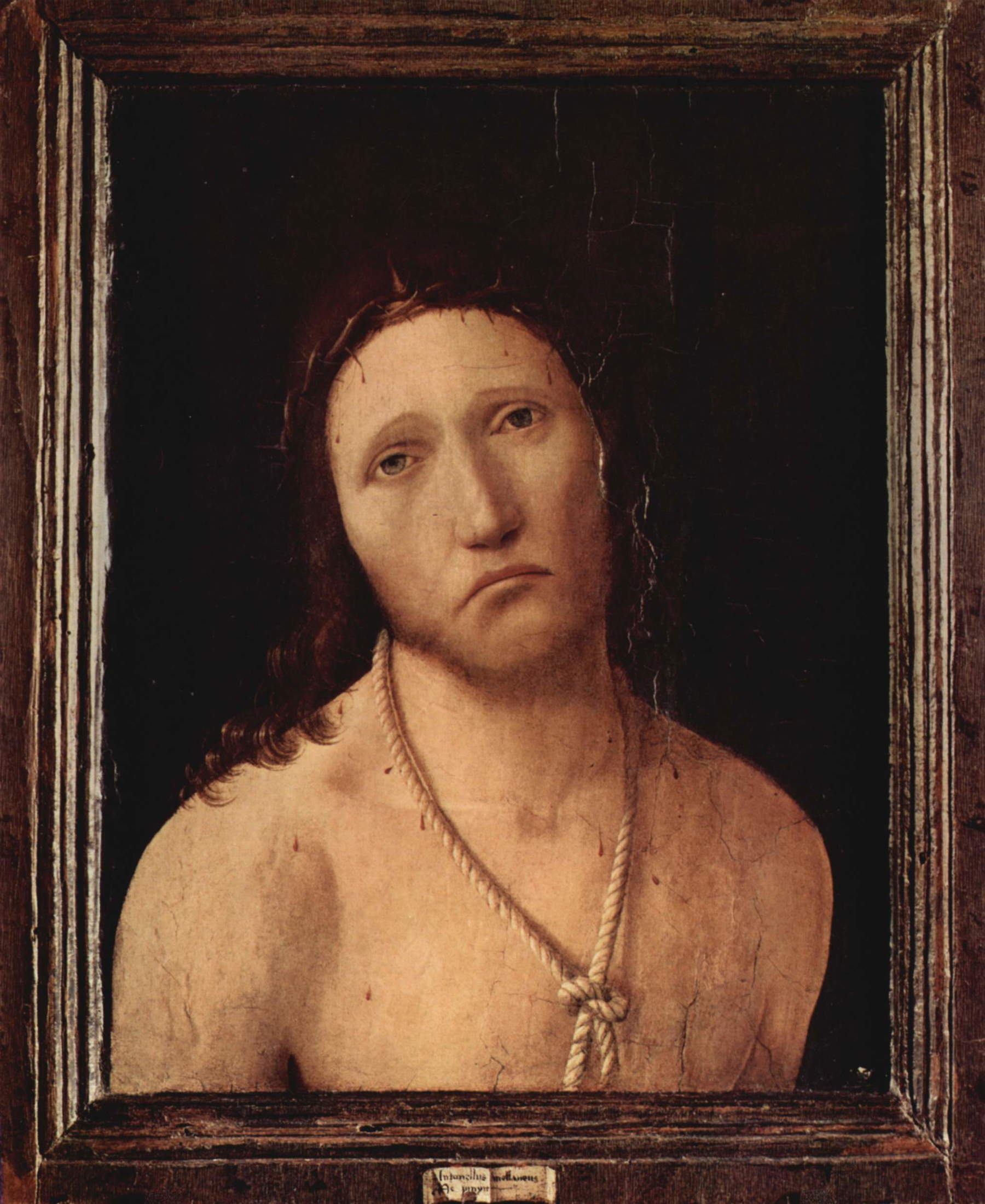
Antonello’s engagement with theEcce Homo theme spanned more than a decade, and the work for sale marks the first and only known opisthograph elaboration of the subject. According to Sotheby’s, this would be the first version in the series. An Ecce Homo documented in 1653 in the collection of Don Giulio Alliata of Palermo, now at the Metropolitan Museum of Art in New York, is considered a later reworking. Signed “Antonellus messaneus me pinxit” and once dated 1470, the painting reduces the torsion of the torso and omits the rope, but keeps the expressive intensity intact.
A version preserved at the National Gallery of Liguria in Palazzo Spinola, Genoa, marks an emotional recalibration toward a more composed and accepted grief. Here Antonello reintroduces the rope and signs the work on a card painted on the frame, the only surviving original. In 1473 the artist made the largestEcce Homo of the group, now at the Alberoni College in Piacenza, signed and dated, with the introduction of the column, which places the scene more explicitly in the context of the Flagellation. The last version, dated 1474 and now lost, is known only through historical photographs.
The provenance of the work for sale is documented from around 1900, when it was in a private Spanish collection. It later passed through Wildenstein & Co., then was purchased in 1967 through private sale at Sotheby’s by antiquarian Fabrizio Moretti, who sold it to the current owner. Ecce Homo has a relevant recent exhibition history, culminating in the monographic exhibition on Antonello da Messina at the Palazzo Reale in Milan in 2019, where it was featured as work number 2 in the catalog, in addition to exhibitions at the Scuderie del Quirinale, the Metropolitan Museum, and the exhibitions devoted to the Renaissance in the Mediterranean held in 2001 at the Museo Thyssen-Bornemisza and the Museu de Bellas Arts in Valencia.
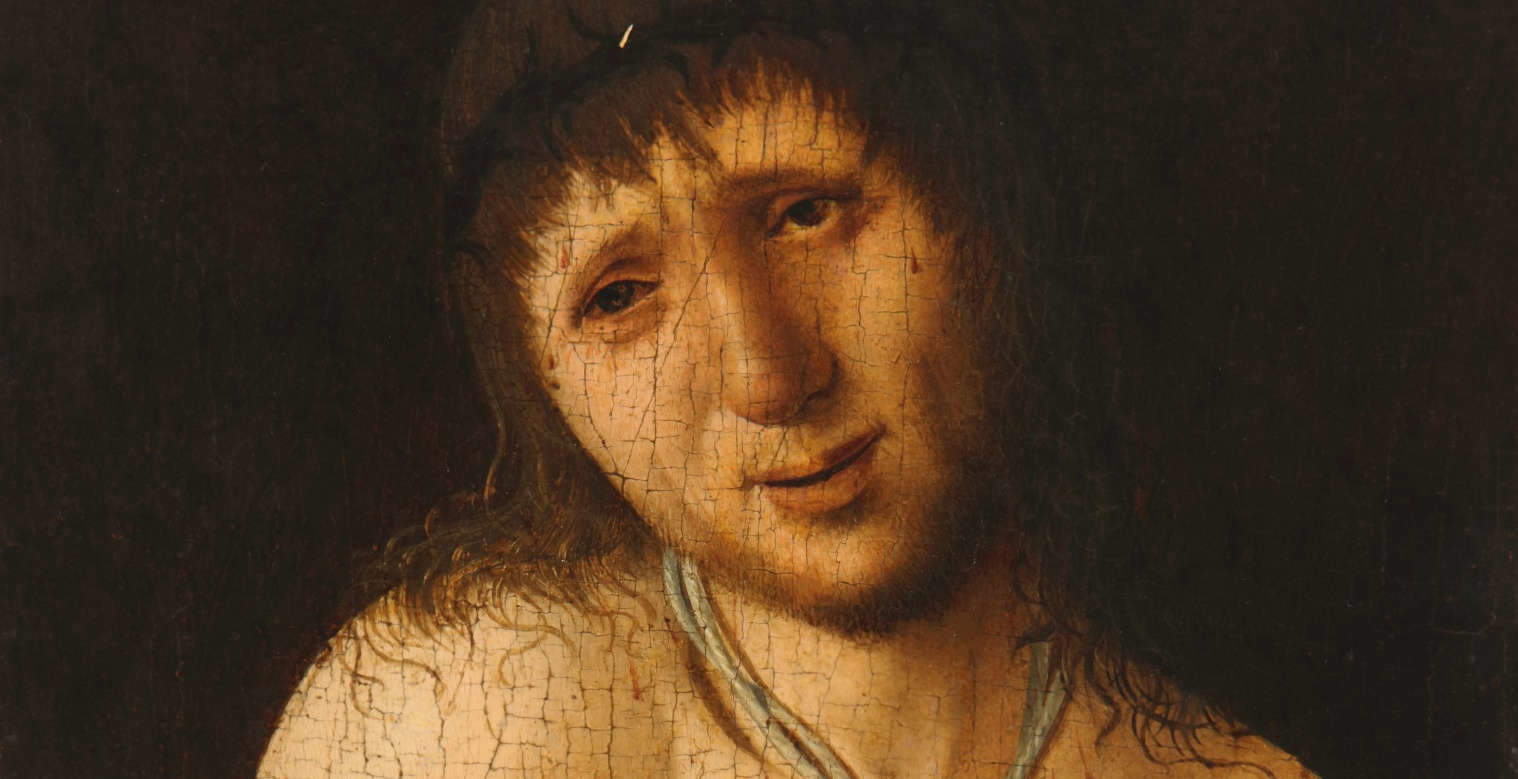 |
| According to authoritative sources, the state would purchase Antonello da Messina's Ecce Homo |

Warning: the translation into English of the original Italian article was created using automatic tools. We undertake to review all articles, but we do not guarantee the total absence of inaccuracies in the translation due to the program. You can find the original by clicking on the ITA button. If you find any mistake,please contact us.























 IT
IT FR
FR DE
DE ES
ES CN
CN


