




by Redazione 08/03/2026



Categories: Ancient art / Disclaimer
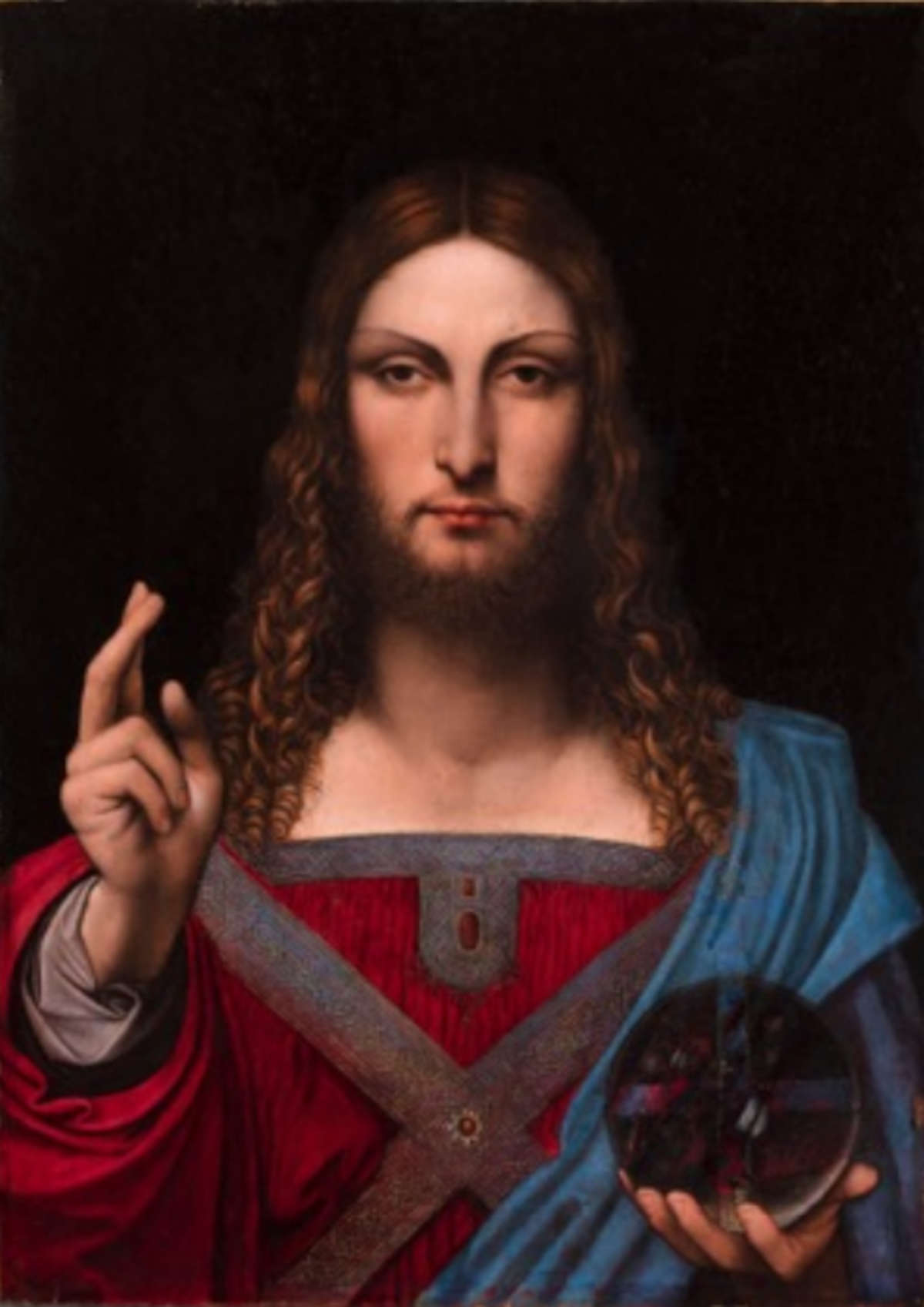
Agnews Gallery will present at Tefaf Maastricht 2026 the Salvator Mundi "de Ganay," a work attributed to Leonardo da Vinci's workshop and probably made under the master's supervision. The painting, which has been studied by the Louvre and the Prado, boasts a distinguished collecting history.

Leonardo’s Salvator Mundi theme returns to the center of attention in the international art-historical market and research. In fact, on the occasion of Tefaf 2026, the important antiques fair held in Maastricht, London ’s Agnews Gallery is presenting Salvator Mundi “de Ganay,” a painting attributed to Leonardo da Vinci’s workshop that depicts Christ as the Savior of the world and has long been considered one of the most important versions of Leonardo’s composition. The presentation comes at a time when the iconography of the Salvator Mundi has become one of the most debated in recent art history. Indeed, in 2017, the celebrated Salvator Mundi attributed to Leonardo da Vinci from the Cook Collection was sold by Christie’s in New York for a record $450 million to a Saudi prince, setting the highest price ever paid for a work of art. That sale marked a turning point in international market perception, leading the work to become a true contemporary icon as well as a symbol of Western painting.
Prior to the Cook Collection’s rediscovery of the painting in 2005, the Salvator Mundi now known as “de Ganay” was often considered the best of the known versions of the composition and, according to some scholars, even the prototype image. The canvas depicts Christ frontally, with his right hand raised in a gesture of blessing and his left hand holding the globe, according to an iconography that was widely used in the Renaissance but that achieves in Leonardo’s conception a particularly refined balance between spirituality, naturalism and technical research.


A crucial moment in the critical history of the work came on the occasion of the major exhibition dedicated to Leonardo da Vinci organized by the Louvre in 2019. In preparation for that exhibition, the Parisian museum’s curatorial team had the opportunity to study the Salvator Mundi “de Ganay” up close for the first time in nearly a century. The result of these analyses was the framing of the painting as a work from Leonardo’s workshop, defined in the exhibition catalog as “a version made by a faithful pupil of the master, probably painted under his supervision and with possible direct intervention.”
Scientific investigations have played a key role in clarifying the process of the work’s creation. Indeed, analysis by infrared reflectography revealed the use of a perforated preparatory cardboard, used to transfer the drawing to the pictorial surface by means of the dusting technique in the folds of Christ’s red robe. This procedure consists of passing charcoal dust through the small holes in the cardboard to bring the drawing back onto the pictorial support and is known as a customary practice within Leonardo’s workshop.
A further step in the study of the work occurred with the exhibition organized by the Museo Nacional del Prado between 2021 and 2022, dedicated to copies of the Mona Lisa and workshop practices related to Leonardo. In the exhibition catalog, scholars suggested that the Salvator Mundi “de Ganay” was probably executed under the master’s supervision in his Milanese workshop. The authors also speculated that the workshop artist responsible for this painting was the same one who made the famous early copy of the Mona Lisa preserved at the Prado and dated between 1507 and 1516.
The presentation organized by Agnews Gallery at Tefaf Maastricht 2026 aims to offer the public an opportunity for direct confrontation with the creative process of Leonardo’s workshop. In fact, the painting will be displayed alongside a life-size infrared image that allows the viewer to observe the preparatory drawing underneath the pictorial surface. This visual comparison will be further enhanced by reference to two drapery studies made in red chalk and preserved in the Royal Collection in Windsor, with which the painting’s underlying drawing shows close relationships.
From a conservation point of view, the Salvator Mundi “de Ganay” is in a particularly favorable condition. Indeed, the painting is still mounted on its original walnut panel, a circumstance that allows a direct appreciation of the pictorial quality of the composition and the technical complexity of the work. The good conservation of the work makes evident the refinement of the formal construction, the delicacy of the transitions of light and shadow, and the emotional dimension of the figure of Christ, elements that have contributed to the fortune of Leonardo’s composition over the centuries.
In addition to technical and stylistic aspects, the work also boasts a prestigious collector’s provenance. The first secure documentary record dates back to 1866, when the painting was exhibited in Paris as part of the collection of Baron de Lareinty of Nantes. According to the collector’s statement, the painting originally came from a convent that was dispersed during the French Revolution. In 1902 the work became part of the collection of Countess Martine de Béhague, one of the most important Parisian collectors of the early 20th century. Her collection included masterpieces by artists such as Albrecht Dürer and Titian, including the monumental Portrait of Alfonso d’Avalos now housed at the J. Paul Getty Museum in Malibu, as well as works by Watteau, Fragonard, Guardi, Ingres, Degas, and Renoir.
Martine de Béhague’s passion for Leonardo da Vinci was particularly strong. Nearly two decades before she purchased the Salvator Mundi, the collector had already acquired four fine drapery studies made by Leonardo in tempera on linen, which are now preserved among the Fondation Custody, the Louvre, and private collections. Her connection with the artist was also manifested in 1905, when she donated the Renaissance frame that still frames the Mona Lisa to the Musée du Louvre. The countess’s collection was famous for the quality of the works in it and the variety of genres represented. As her biographer Jumeau-Lafond wrote, Salvator Mundi ’s image of the blessing Christ offered “an image at once sacred and consoling.”
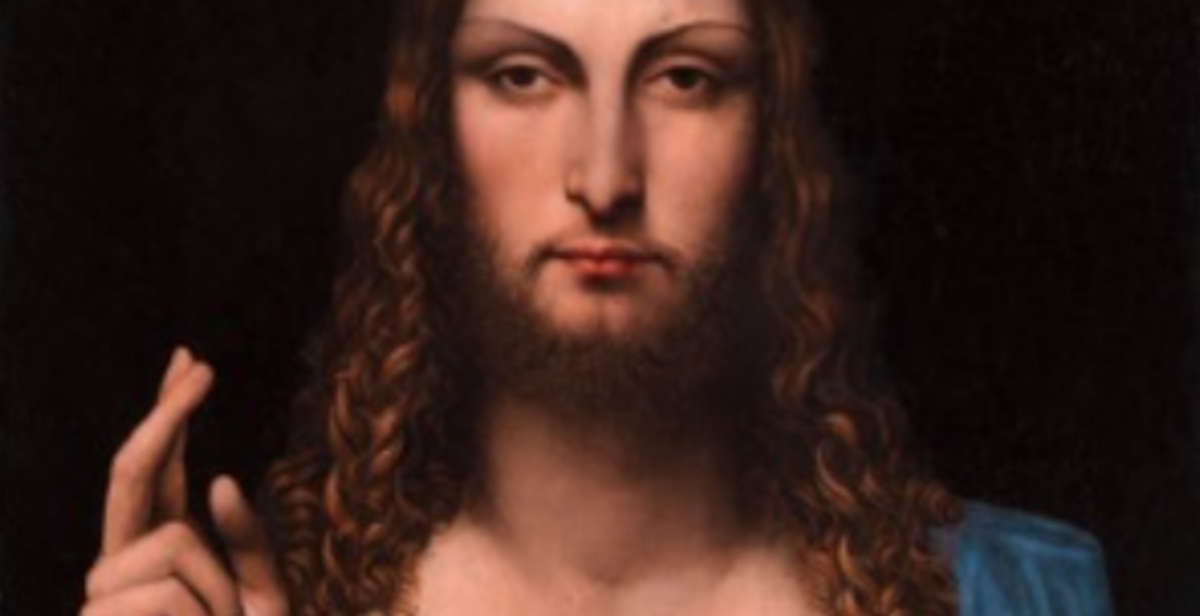 |
| Salvator Mundi "de Ganay" from Leonardo's workshop will be at Tefaf Maastricht 2026 |
Warning: the translation into English of the original Italian article was created using automatic tools. We undertake to review all articles, but we do not guarantee the total absence of inaccuracies in the translation due to the program. You can find the original by clicking on the ITA button. If you find any mistake,please contact us.