



by Redazione 13/04/2026



Categories: Contemporary art / Disclaimer
At the Vistamare gallery in Milan, Rosa Barba's second solo exhibition explores cinema as physical and perceptual space. On display is the film "Charge," presented at MoMA in 2025 and previously unseen in Italy, along with new sculptural works that dialogue with light, memory and environment.
From April 18 to June 20, 2026, Vistamare Gallery, in its Milan location, is hosting Tangible kinships, the second solo exhibition by Rosa Barba (Agrigento, 1972) in the gallery’s Milan spaces. The exhibition, which will be inaugurated on Friday, April 17, from 6 to 9 p.m., offers an articulated project that develops around the artist’s research on cinema, understood not only as a visual language, but as a physical and perceptual system involving light, projection, performance and space. At the center of the exhibition is a new nucleus of works that weave a complex dialogue with Charge, a film made in 2025 and premiered at the Museum of Modern Art in New York, remaining unpublished in Italy until now. The work constitutes the starting point for a broader reflection that expands beyond the traditional boundaries of cinema, turning into an articulated environment in which images, sound and matter intersect.
The film, shot in 35mm with optical sound, assumes a central role not only as an autonomous work, but as a device capable of generating a further space, a dimension that goes beyond the screen and spreads into the exhibition environment. In this context, cinema is rethought as a spatial and sensory experience, in which the relationship between vision and perception opens up to new interpretative possibilities.


Charge takes shape through landscapes marked by the presence of research facilities and industrial infrastructure, places where energy, scientific experimentation and the built environment intertwine. The camera moves through these liminal spaces, where human activity and natural systems meet and overlap, generating a reflection on the way light acts as a transformative force, capable of affecting both technological and environmental processes.
Light, a pivotal element in Barba’s practice, is investigated as a measure of distance and time, but also as a perceptual phenomenon that exists only in relation to darkness. As the artist points out, the very possibility of perceiving light depends on contrasting it with its surroundings, a condition shared by both astronomy and cinema. This relationship becomes an entry point for exploring broader themes, ranging from landscapes to environmental changes, from memory to archives, and the link between filmic image and cosmic observation.
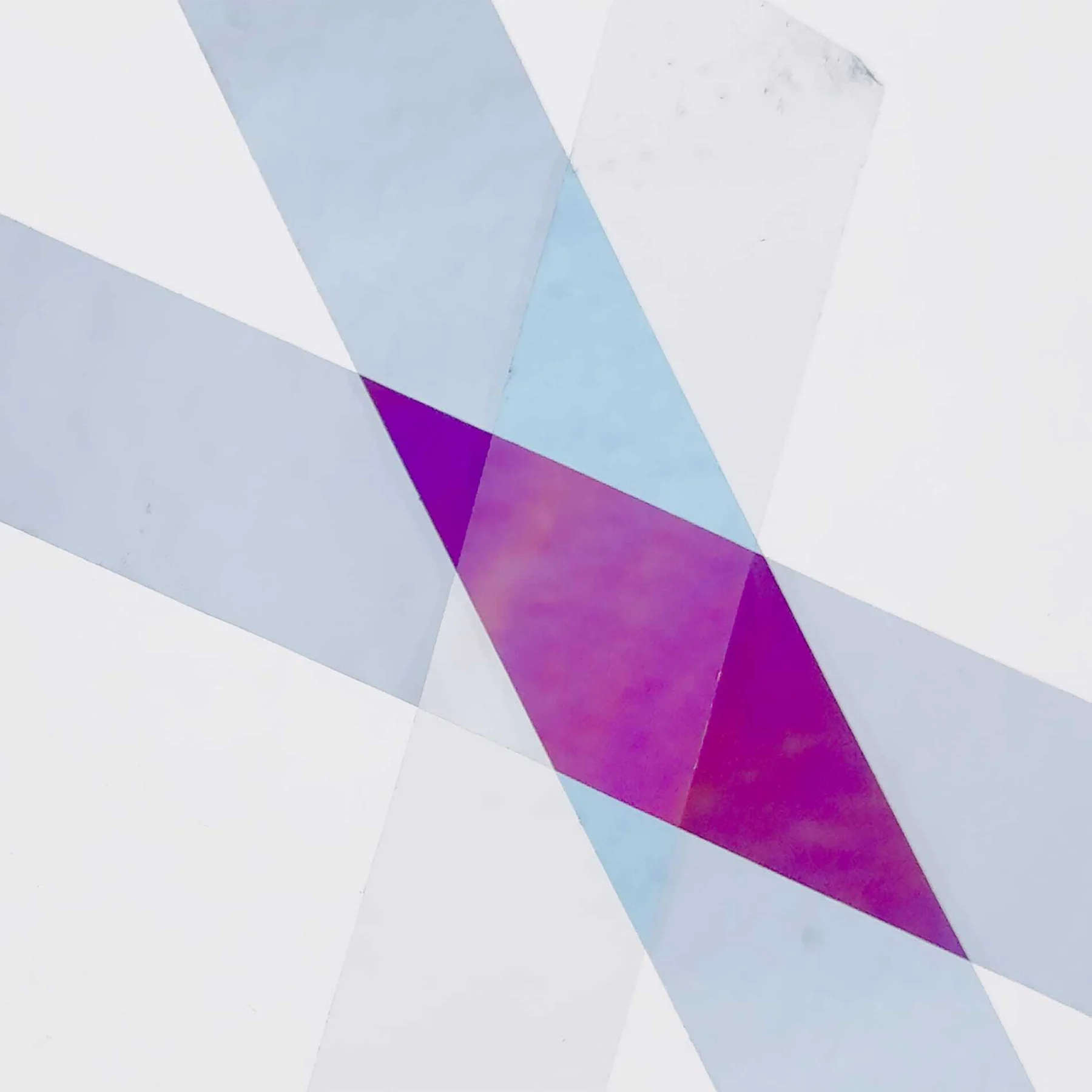
Within the exhibition, film is thus configured as a kind of generative matrix, a structure from which further elements branch out to expand its meaning. Indeed, the exhibition introduces a series of new sculptural works, made using glass, transparent and porous materials, films and kinetic mechanisms. These works are arranged in the space in such a way as to establish a dialogue with each other and with the audience, creating a dynamic environment in which perception is constantly solicited.
The works interact with light actively, reflecting and refracting it within the gallery, helping to extend the film beyond its traditional limits. In this way, the projected image does not remain confined to the screen, but spreads throughout the space, engaging the viewer in an experience that challenges habitual modes of enjoyment.
The installation presents itself as an unstable system, in which light phenomena and reflections are influenced by what happens in the surrounding space. The movement of visitors, environmental variations and interactions between different works contribute to generating ever-changing configurations, transforming the exhibition into a living organism, constantly evolving.
In this context, cinema is configured as a practice that goes beyond the narrative dimension to become a field of inquiry, a device through which to explore the relationships between time and space. Barba’s approach, often characterized by an investigative tension, aims to create situations in which these elements can vibrate, collapse, overlap and expand, without resorting to gimmicks, but by the intrinsic necessity of language itself.
The artist’s research develops along a line that constantly questions the categories of truth and fiction, myth and reality, metaphor and matter. This attitude results in a practice that considers the ethics of responsibility, hospitality and empathy as fundamental elements. The idea of conceptual speculation, as understood by Barba, is configured as a space for reflection in which it is possible to formulate hypotheses, fill gaps in knowledge and imagine possible explanations for phenomena that elude immediate comprehension.
In this scenario, the public is called to move within a system that requires attention and participation, in which perception is never given once and for all, but is constructed through interaction with the works and the environment. The exhibition thus becomes a place of traversal, where images, sounds and materials combine to generate new possibilities for reading.
|
| Rosa Barba in Milan, expanded cinema on display at Vistamare |
Warning: the translation into English of the original Italian article was created using automatic tools. We undertake to review all articles, but we do not guarantee the total absence of inaccuracies in the translation due to the program. You can find the original by clicking on the ITA button. If you find any mistake,please contact us.