





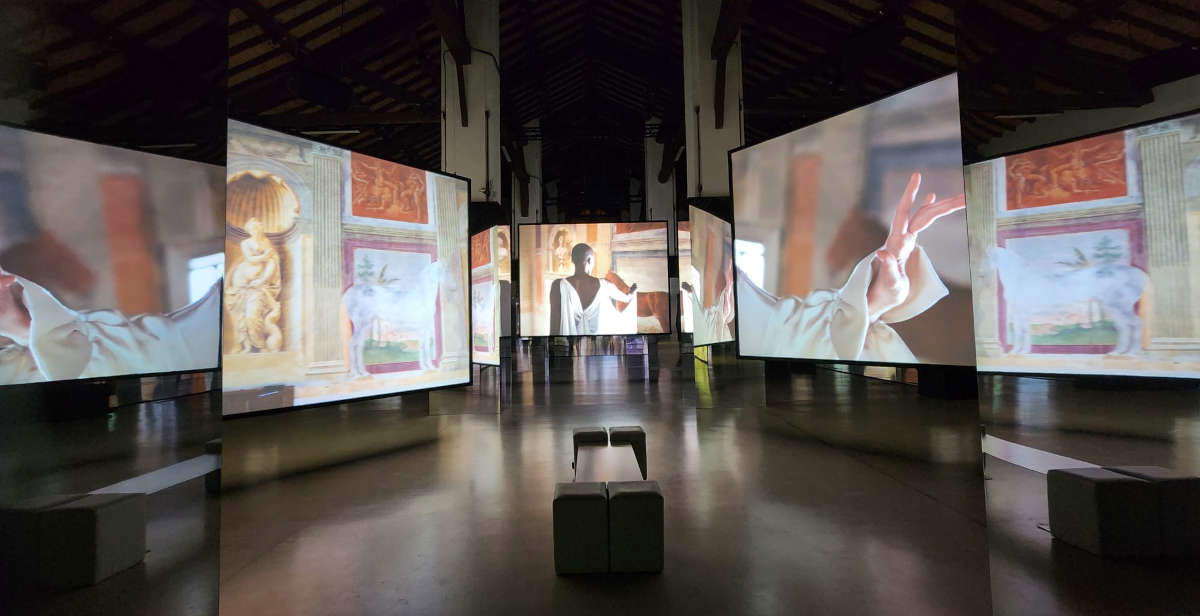
We will spare the reader the individual details, the pedantic inventory of this film by Isaac Julien that has been screened en boucle for months inside the Fruttiere of Palazzo Te in Mantua: every description passed off as a self-respecting review has the singular characteristic of never being stingy with minute-by-minute chronicles, accurate sketches of individual sequences, erudite dissertations on the references that fill the twenty-five minutes or so of projection. A highly polished cadeau, a kind of birthday cake that the administration of Palazzo Te commissioned from Julien to celebrate the five hundredth anniversary of the Gonzaga residence. Spared no expense, one would think, because according to public statements by Stefano Baia Curioni, president of Palazzo Te, the operation required an outlay of two million euros, three-quarters of which was raised through special fundraising. However, it will be convenient to offer a brief summary of this work, All That Changes You. Metamorphosis, which cost the same as two ministerial grants for the Italian capital of culture: Two women, one white and one black, played by Gwendoline Christie and Sheila Atim (actresses who, as befits film products eager to beguile an audience that when it is not at Palazzo Te is sprawled on the couch watching Netflix, were chosen by resorting to thewide repertoire of television series), travel through time, traverse the architecture of Palazzo Te and London’s Cosmic House, show us images of redwood forests (which, the well-informed tell us, allude to the fragility of Earth’s ecosystems), of elemental and complex life forms, of natural spectacles, and end up taking on, Isaac Julien himself explains, “different identities as they try to move beyond an anthropocentric worldview and discuss how to share the planet with other beings, offering space for the representation of non-human perspectives.” To better succeed in the task of dissolving any narrative linearity (and to make sure that the viewer is engaged), the huge space of the Fruitsanders has been filled with mirrors that project sequences of the film different from the main one, so that the audience gets the right nudge to think of new ways to partition the earthly dwelling with mosses and amoebas while watching on one mirror the ceiling of Psyche’s Chamber, on the one next to it the eruption of a volcano, and on the one next to it HD phytoplankton.
The film opens with a kind of quote in the exergue, namely the sequence of Donna Haraway reading an excerpt from her book Staying with the Trouble: “Our task is to wreak havoc, to provoke a powerful response to devastating events, as well as to calm troubled waters and rebuild spaces of stillness.” One has lost count of the number of artists and curators who, having emptied the closet of post-structuralism and fulminated on the path of post-humanism, start from more or less explicit reflections on Donna Haraway (Anicka Yi, Iván Argote, Agnes Questionmark, half of the 2022 Venice Biennale, assorted exhibitions: a few years ago, Hettie Judah on Artnet had proposed a moratorium on exhibition concepts derived from Donna Haraway). Some giving themselves the boot in the same hat as All that Changes You. Metamorphosis. Last year there was also an exhibition at Milan Design Week that said our job is to wreak havoc (the program included aperitivo every day at 7 p.m., because post-humanism is best talked about when drinking a spritz, and clubbing session at the closing night, the last day of Salone del Mobile). In any case, watching the film it almost seems as if Isaac Julien has made it his mission to bury disarray under obsessive aesthetic control, to dampen any attempt at escapism with a smooth and charming lyricism, to reconstruct a space of quiet so comfortable that it ends up putting the audience at ease.
At one point in the film, you see a space capsule, with a Russian greyhound running around in it, in the middle of a forest: swap the spaceship for a Rav4 and you get an advertisement for the new full hybrid suv. Evidently, the artist has not bothered to deviate too much from his modus operandi (Laura Cumming, reviewing his exhibition at the Tate three years ago, offered an eloquent summary: “a glossy, lavish aesthetic made to carry a theoretical load,” a “political lyricism” that “comes dangerously close to glossy mannerism”): we are, after all, at his first Italian exhibition, and we are, moreover, speaking to an audience that normally visits Palazzo Te for other reasons. Fine then to provoke some form of perceptual instability (especially if we have to fill the Fruttiere of Palazzo Te: the space is enormous), fine the constant mixing of historical times (with consequent potential disorientation), fine the load of reference, but you also need a smooth and well-groomed skin, softened by long sessions of skincare and useful gestures to protect the natural skin barriers, a skin that seduces and is pleasant to the touch (if you then run, as always in Isaac Julien, the danger of neutralization, you will say that it is an occupational hazard). All That Changes You. Metamorphosis is a work that avowedly aspires to be subversive, but ends up being beautiful. It is a work that would like to reimagine the poetics of image-making, but settles for being unmissable. So much so that at Victoria Miro, the gallery representing Isaac Julien, inkjet prints on fine Ilford Gold Fibre Gloss photographic paper are already on sale, an edition of six multiples plus two artist’s proofs, available in various sizes, frame not included, price upon request. We didn’t notice that the bookshop at Palazzo Te also has magnets.
Sitting and looking at this dusting of powdered sugar on Giulio Romano’s frescoes, it comes naturally to wonder about the interchangeability of the location, as Palazzo Te is called in some reviews. Since the explanations given by Isaac Julien seem to be a kind of matter-of-fact commentary (any frescoed room of any Renaissance noble house was an aesthetic, political, and often even mythological dream) Angela Vettese, in Il Sole 24 Ore, has even scouted out three parallels between thework of Isaac Julien and “Romano’s” masterpiece (she calls it that, evidently thinking that “Romano” is the surname of Julius, as if he were a member of the Pd parliament). First, the fact that the Chamber of Giants presents itself as a “multisensory device that enraptures the viewer” (translated: the frescoes have no architectural constraints, and the painting continues illusionistically on all the walls). On par, then, with the English director’s mirrors. Second, the reinterpretation of Ovid’s Metamorphoses . Third, the brilliance of the colors, similar to the bounces of light coming from the beams of projections and seeking, as Giulio Romano did, “the maximum physical involvement of the spectator.” All it took was a few brushstrokes untethered from architectural scores, a sacking of ancient myths and a splash of bright colors, Isaac Julien could have set his work in any late-16th-century context (at the Rocca di Fontanellato, the Palazzo Farnese in Caprarola, the Castello di Torrechiara, the Bosco di Bomarzo): let us grant, however, that the artist has interpreted with some coherence a place that has no single symbolic center, that alternates order and disorder, play and myth, love and death, a space where every fragment of plaster is ambiguous, undisciplined, disorienting, that is spectacular enough to indulge his theatrical taste, a place where there is a tension between classical and anticlassical. A place of instability within an apparent order. But it is still a place that comes before the work, with the result that the work, rather than being site-specific, as the kurators would say, could be called institution-specific, and the most interesting conflict is also the one that is not talked about (except to praise the “splendid way to celebrate and activate our past heritage”, says Vettese, “an example to be repeated elsewhere with the same refinement,” hoping, however, not at the rate of two million euros at a time), namely between a place that becomes an enhanced scenography and a work that ends up functioning as a branding of the place, as a cultural critique that nonetheless responds to a celebratory need. So what really happens whenengagement becomes institutional supporter? What kind of radicality is possible within a cultural system that has already assimilated a certain language, especially if the artist is working on a post-humanism that is careful not tobeing disturbing (even Pierre Huyghe, to say, is an institutionalized artist, but at least he causes some discomfort by attempting a more drastic, more energetic, deeper, much less controlled instability)? For now let’s just jubilate for the reactivated past, that’s something.
The exhibition, which started last October 4, was supposed to close its doors at the end of January, but was extended even four months, until May 31. Evidently, Palazzo Te did not want to miss the opportunity to take advantage of the height of the hunting season and fill the Fructieri with all that unsuspecting public who, as is normal, hearing the name Donna Haraway will think at first of some 1970s disco star (no, this is not a moral judgment: it is a statistic, in which, moreover, the writer was also included until a couple of Venice Biennales ago): it is useful to remember that for the exhibition there is no separate ticketing, one enters with the same admission ticket that visitors buy to see Giulio Romano’s frescoes. And probably, before they enter the Fruttiere they encounter at the end of the tour, those same visitors may perhaps think that the Camera dei Giganti is active enough on its own.

The author of this article: Federico Giannini
Nato a Massa nel 1986, si è laureato nel 2010 in Informatica Umanistica all’Università di Pisa. Nel 2009 ha iniziato a lavorare nel settore della comunicazione su web, con particolare riferimento alla comunicazione per i beni culturali. Nel 2017 ha fondato con Ilaria Baratta la rivista Finestre sull’Arte. Dalla fondazione è direttore responsabile della rivista. Nel 2025 ha scritto il libro Vero, Falso, Fake. Credenze, errori e falsità nel mondo dell'arte (Giunti editore). Collabora e ha collaborato con diverse riviste, tra cui Art e Dossier e Left, e per la televisione è stato autore del documentario Le mani dell’arte (Rai 5) ed è stato tra i presentatori del programma Dorian – L’arte non invecchia (Rai 5). Al suo attivo anche docenze in materia di giornalismo culturale all'Università di Genova e all'Ordine dei Giornalisti, inoltre partecipa regolarmente come relatore e moderatore su temi di arte e cultura a numerosi convegni (tra gli altri: Lu.Bec. Lucca Beni Culturali, Ro.Me Exhibition, Con-Vivere Festival, TTG Travel Experience).
Warning: the translation into English of the original Italian article was created using automatic tools. We undertake to review all articles, but we do not guarantee the total absence of inaccuracies in the translation due to the program. You can find the original by clicking on the ITA button. If you find any mistake,please contact us.



















 IT
IT FR
FR DE
DE ES
ES CN
CN


