




by Redazione 11/02/2026



Categories: Exhibitions / Disclaimer
The Minerva of Arezzo returns to its city of origin, starring in the exhibition "The Minerva of Arezzo. A Community History Rediscovered," thanks to a loan from the National Archaeological Museum in Florence.


The Minerva, one of the great bronzes of antiquity and an identifying symbol of the city, returns to Arezzo and is the protagonist of the exhibition The Minerva of Arezzo. A story of rediscovered community, which will be inaugurated on Saturday, Feb. 14, 2026 at 12 noon at the city’s “Gaius Cilnius Maecenas” National Archaeological Museum. The event will be attended by Minister of Culture Alessandro Giuli, Mayor of Arezzo Alessandro Ghinelli, Department Head for the Enhancement of Cultural Heritage Alfonsina Russo, Director General of the Olivetti Plan for Culture Stefano Lanna, Regional Director National Museums of Tuscany Carlotta Paola Brovadan, and Director of the National Archaeological Museum of Florence Daniele Federico Maras.

The return of the statue to its city of origin, thanks to the loan from the National Archaeological Museum of Florence, represents a moment of great symbolic and cultural value for the Arezzo community. The opening also marks the start of a broader path of enhancement promoted by the Ministry of Culture, of which the exhibition is the first event as part of the national project Seeds of Community - Olivetti Plan for Culture.
The opening will be accompanied by the traveling theater performance Minerva is Here. When a goddess returns home, designed to guide the public through an evocative tale of the statue’s return to the place from which it came.


The exhibition will be on view from Feb. 15 to Sept. 6, 2026, and is part of a national program aimed at encouraging the active involvement of communities in cultural heritage enhancement processes. The project Seeds of Community - Olivetti Plan for Culture, strongly supported by the Ministry of Culture - Department for the Enhancement of Cultural Heritage and Central Institute for the Economic Enhancement and Promotion of Cultural Heritage - is being carried out in collaboration with the National Archaeological Museum in Florence and the National Archaeological Museum in Arezzo. In fact, the project is part of the collaboration between Arezzo and Florence, which has already been experimented with on the occasion of the exhibition in Arezzo of the Chimera, which can now be seen again at the National Archaeological Museum in Florence in an entirely renovated room.
An articulated calendar of activities will flank the Arezzo exhibition, with meetings, workshops, seminars and participatory events aimed at schools, citizens, associations and professionals, with the goal of strengthening the link between heritage, territory and community and restoring the Minerva’s role as an identity catalyst, both locally and nationally. And to structural and museographic renovations of some rooms of the National Archaeological Museum “Gaius Cilnius Maecenas,” with the aim of improving the quality of space, accessibility and visitor experience.
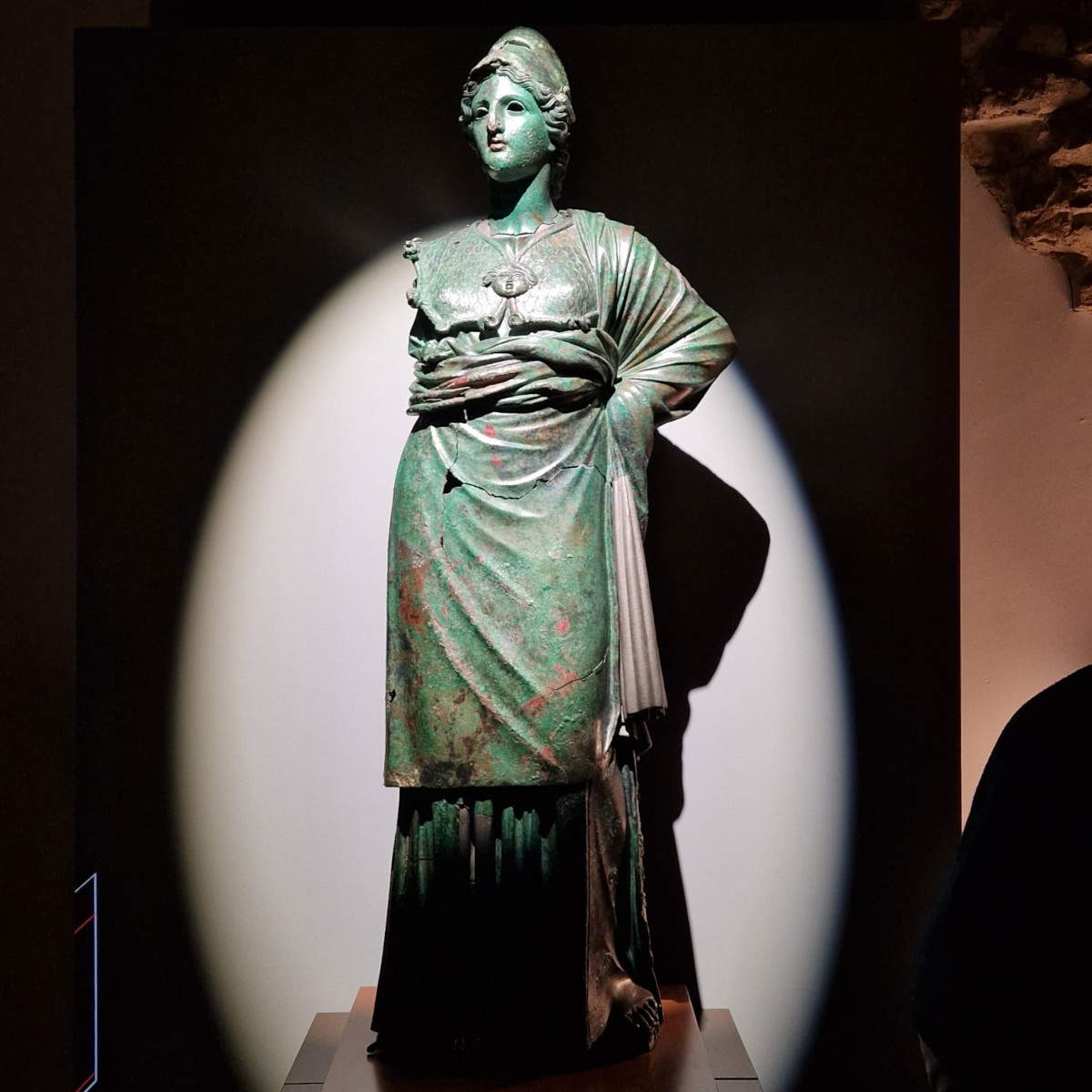
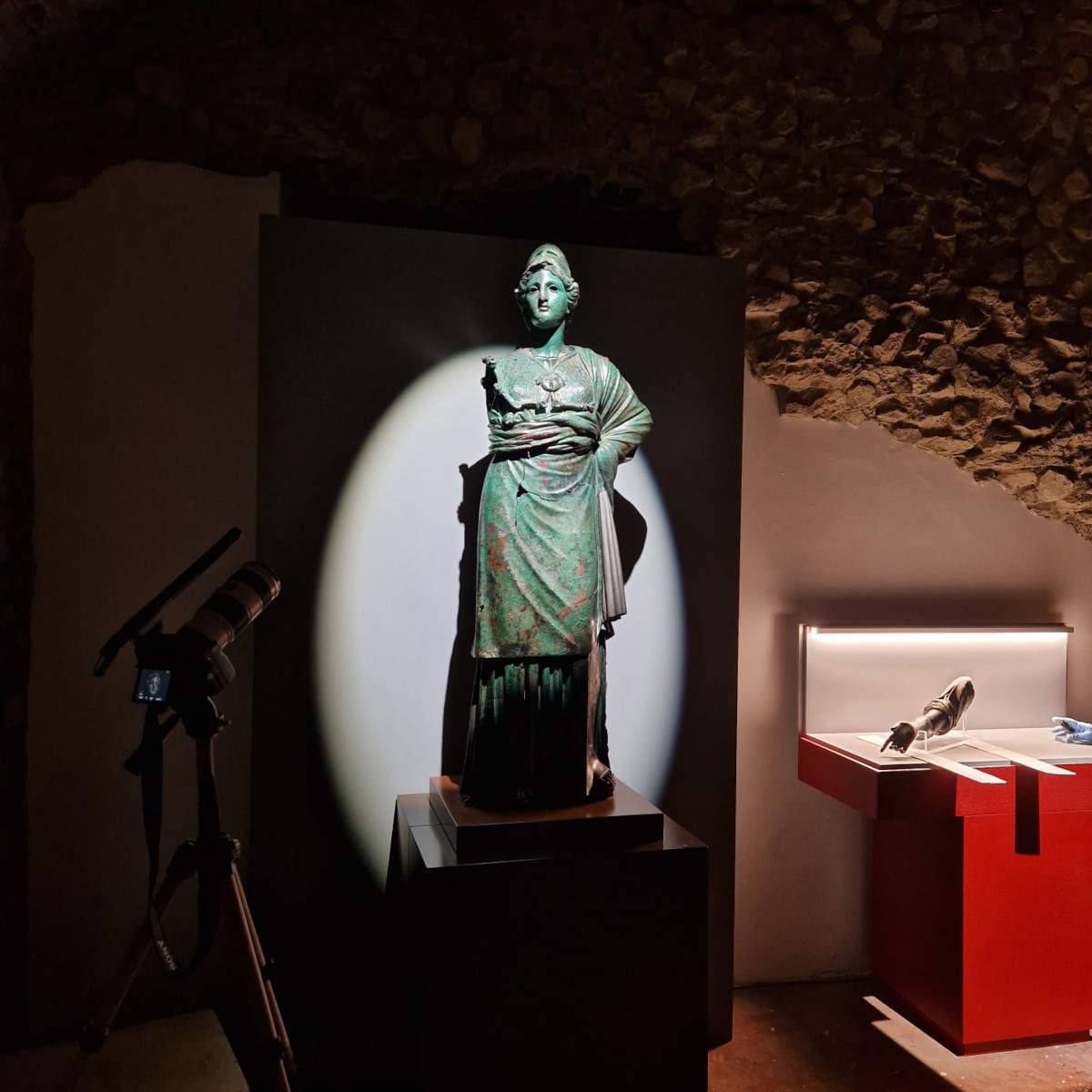
The heart of the exhibition is the Minerva of Arezzo, found in 1541 during the excavation of a well near San Lorenzo. Donated to Duke Cosimo I de’ Medici, it was transferred to Florence, becoming part of the grand ducal collections and, since 1871, of the National Archaeological Museum in Florence. In the new exhibition in Arezzo, the statue is placed in one of the most evocative rooms of the museum’s Roman section, where it is told through an updated and immersive narrative that traces its discovery, collecting fortunes and complex conservation history.
The sculpture, 150.5 centimeters high and made with an average bronze thickness of 4.5 millimeters, depicts Athena/Minerva with chiton and himation, aegis with Medusa’s head and Corinthian helmet. The most recent studies trace it to a Hellenistic original dated to the first decades of the 3rd century BCE, probably produced in the Italic or Magna Graecia area. Restoration conducted between 2000 and 2008 restored the figure to its original elegance and revealed refined technical solutions, such as the use of copper for the lips and eyelash details. Next to the ancient work, a bronze copy made by the Marinelli Artistic Foundry is on display, documenting the appearance taken on by the statue after the 18th-century restorations by Francesco Carradori; the right arm and the helmet snake made by Carradori himself and removed during the last conservation work are also presented.
The exhibition itinerary also aims to delve into the archaeological context of the find, identified in the remains of the domus of San Lorenzo, a vast and luxurious Roman residence built between the end of the first century B.C. and the beginning of the first century A.D., which probably belonged to an aristocratic Aretine. A new layout enhances mosaics, opus sectile floors, wall decorations, bronze statues, furnishings and reliefs, allowing us to understand the significance of the statue’s presence as an element of prestige and a manifestation of private luxuries. Finally, the exhibition aims to broaden the view of Roman Arezzo, Arretium, by placing the domus within an articulated urban fabric, characterized by important infrastructure and public buildings, including the north-south road axis, the theater-terme complex and a forensic area hypothesized on the basis of the discovery of the Arretina elogia.
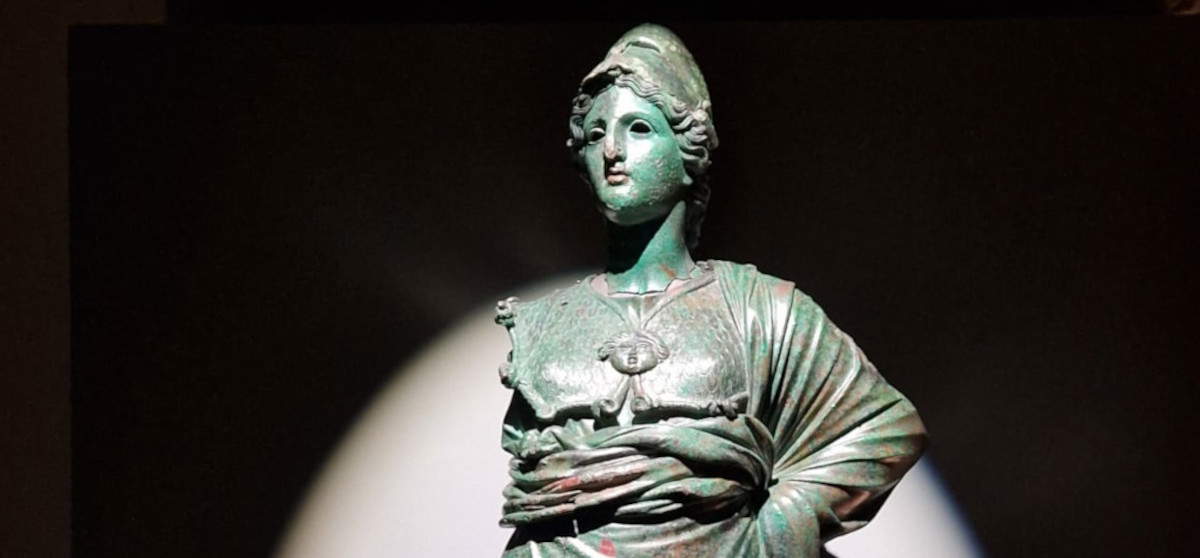 |
| Arezzo's Minerva returns to exhibition in its city of origin |
Warning: the translation into English of the original Italian article was created using automatic tools. We undertake to review all articles, but we do not guarantee the total absence of inaccuracies in the translation due to the program. You can find the original by clicking on the ITA button. If you find any mistake,please contact us.