





On Sunday, March 8, the Collezione Maramotti in Reggio Emilia will open Cannon Fodder, a solo exhibition by Giuditta Branconi, which can be visited until July 26. For the artist, this is her first exhibition in an institutional space, an opportunity to present a new body of pictorial work flanked by a large installation composed of painted canvases that the public will be able to physically walk through, entering the space of the work itself.
The title, which can be translated as “cannon fodder,” refers to expendable bodies, a material destined to be consumed by a larger system. The expression, borrowed from the military lexicon, is translated into the visual and symbolic realm. In this semantic shift, Branconi’s images take on the role of ammunition directed against a present described as violent and oppressive. The pictorial surfaces are configured as compressed and saturated fields, ready to detonate in a deflagration that is not only formal, but also emotional and political. Excess becomes a linguistic choice that rejects composure and questions the idea of balance as a normative value.
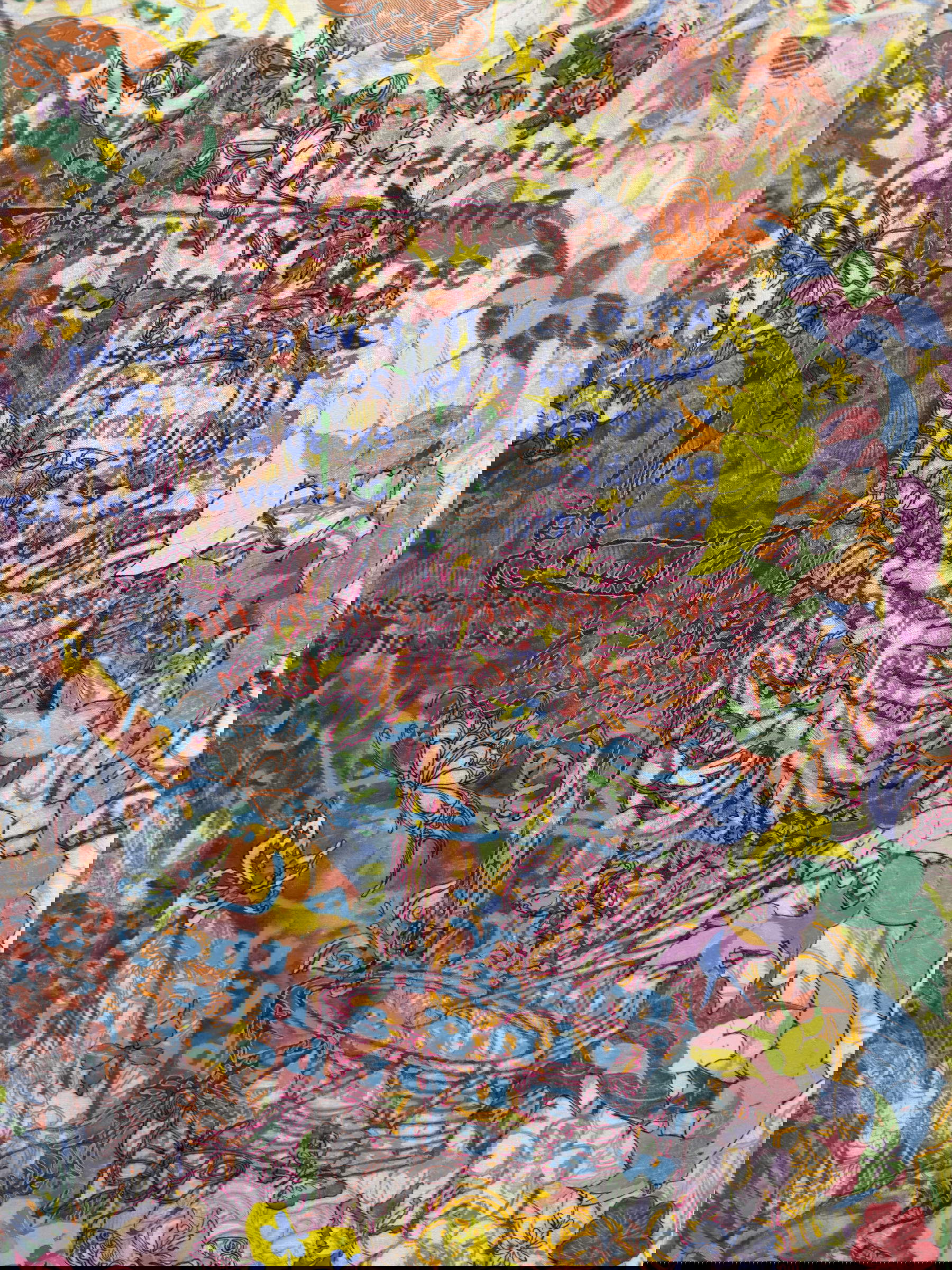
The artist’s painting is characterized by a heightened visual density. The works are developed both on the front and on the back of the thin fabrics used as support, a solution that multiplies the expressive possibilities and expands the levels of reading. The image extends into a further space, accessible through the displacement of the body and the gaze. The traditional two-dimensionality of the canvas is thus brought into tension, until it touches on an environmental dimension. Heterogeneous iconographic references coexist within the paintings. Branconi combines elements from high and popular culture, juxtaposing excerpts from literature, comic books, newspapers, songs and instant messaging. The picture is transformed into a crowded and oxymoronic place, a semiotic labyrinth in which seemingly incongruent images, words and symbols coexist according to an associative logic close to the stream of consciousness. The coexistence of different registers produces a field in which signs overlap and contaminate each other.
Compositional exuberance is matched by a stylistic investigation conducted with technical precision. Each grapheme derives from the appropriation and subsequent recontextualization of codes drawn from disparate sources. The artist draws on Asian art, Victorian-era engravings, children’s books, arabesques, comic books, tattoos, and illustrated manuals. The heterogeneity of visual matrices is reworked into a coherent system, in which citation is presented not as a mere borrowing but as a reorganization of meaning. The free iconographic accumulation saturates the gaze and cancels all distinctions between genres, styles and subjects. Hearts, chains, hunting scenes, clouds, faces, stars, numbers, letters, flowers, birds, skeletons, butterflies coexist in a layered and hybrid imagery. The compositions take on the features of contemporary grotesques, where the ornamental and narrative elements merge. The whole recalls a fantastical Middle Ages that dialogues with art historian Jurgis Baltrušaitis’ reflections on the vitality of medieval Gothic art, understood as a force field capable of regenerating forms and symbols through continuous metamorphoses.
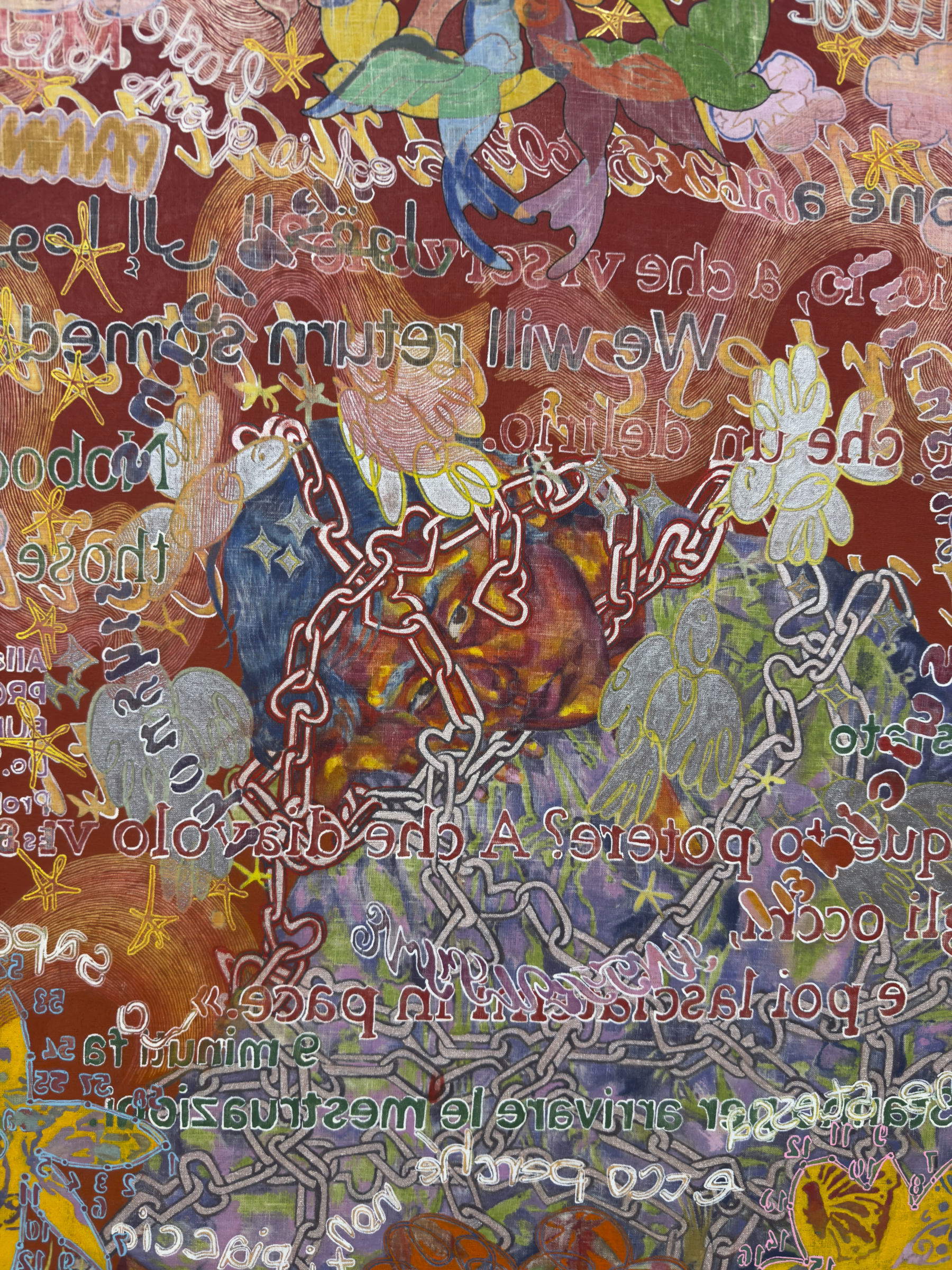
For Cannon Fodder, the artist accentuates the centrality of text. The word becomes a pervasive presence, declined in a multiplicity of languages, alphabets and fonts. The writings are interwoven with the images until they constitute a fragmented inner diary, open to non-linear reading paths. The visitor can get lost in the web of signs or attempt to make connections between scattered fragments, in an interpretive process that does not provide a single point of arrival. The centerpiece of the exhibition is the central installation, configured as an atypical, three-dimensional triptych. Both sides of the canvases are exposed to the gaze, making visible what usually remains hidden. The work presents itself as a traversable device, an access point to a vision that does not contemplate secrets or backsides. The canvas absorbs tensions and returns them in the form of visual impetuosity, converting them into pictorial energy. The bodily experience of the audience, called to physically enter the installation, becomes an integral part of the fruition.
The new works take the form of a battlefield in which signs and figures are pushed to a limit of saturation and collapse. The deflagration evoked by the title does not lead to a final ruin, but opens up the possibility of a reorganization of meaning. A new arrangement emerges from the fragmentation, generated by the collision between contrasting elements. In this perspective, painting becomes a space of conflict and at the same time a place of symbolic redefinition. A volume with a text by Flavia Frigeri, art historian and curator at the National Portrait Gallery in London, is scheduled to be published on the occasion of the exhibition to accompany and explore the exhibition project.
Giuditta Branconi (Sant’Omero, Teramo, 1998) lives and works between Milan and Teramo. She has presented solo exhibitions at Victoria Miro Project in London in 2025 and at L.U.P.O. in Milan in 2025 and 2022. His work has also been included in group exhibitions and fairs in Italy and abroad, including Untitled Art Houston, Houston (2025); Made in Cloister, Naples; Tang Contemporary Art, Hong Kong (2024); Laboratorio Arti Contemporanee, Teramo; Galleria Giampaolo Abbondio, Todi; MIART, Milan (2023); Galleria Giovanni Bonelli, Milan; MAC, Lissone (2021).
Visit the exhibition with free admission at the following times: Thursday and Friday 2:30 p.m. - 6:30 p.m.; Saturday and Sunday 10:30 a.m. - 6:30 p.m.
Closed: April 25, May 1
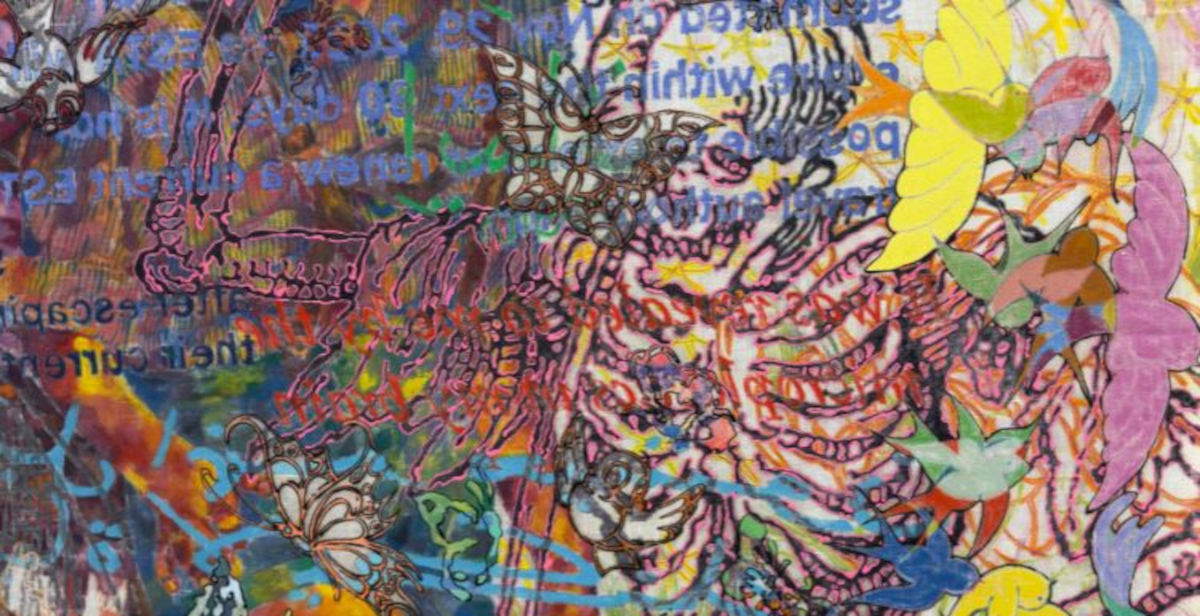 |
| At the Maramotti Collection in Reggio Emilia, the solo exhibition "Cannon Fodder" by Giuditta Branconi |

Warning: the translation into English of the original Italian article was created using automatic tools. We undertake to review all articles, but we do not guarantee the total absence of inaccuracies in the translation due to the program. You can find the original by clicking on the ITA button. If you find any mistake,please contact us.



















 IT
IT FR
FR DE
DE ES
ES CN
CN


