




by Redazione 22/04/2026



Categories: Exhibitions / Disclaimer
At the Italian Art Warehouse in Cold Spring, New York, from April 26, 2026 to April 26, 2028, an extensive retrospective devoted to Alighiero Boetti as part of the program on Arte Povera. About 30 works including historical works, loans and the permanent collection will be on display.


The exhibition program dedicated to the protagonists ofArte Povera continues at the Magazzino Italian Art in Cold Spring, New York state, with a new stage focusing on the work of Alighiero Boetti (Turin, 1940 - Rome, 1994). The exhibition, entitled Tutto Boetti 1966-1993, will be open to the public from April 26, 2026 until April 26, 2028 in the spaces of the museum’s Main Building, which also house the permanent collection dedicated to the movement. The initiative is part of a path already started by the institution, which in previous years presented in-depth monographs on Piero Gilardi, with Carpet nature in 2022, and on Michelangelo Pistoletto, with Welcome to New York between 2023 and 2024. The new chapter confirms the curatorial line oriented toward the systematic analysis of the main interpreters of Arte Povera through dedicated exhibition focuses.
“This exhibition stems from Magazzino’s commitment to deepening the study of our collection in an increasingly punctual way,” explains Nicola Lucchi, director of Magazzino Italian Art. “We are preparing guided tours and educational workshops for schools that will accompany this project, expanding its scope on the educational level. We also await with particular interest the publication of the catalog, which will allow us to further consolidate and disseminate this course of study.”


“The historical nucleus of works by Alighiero Boetti presented here, brought together thanks to the important relationship we have developed over the years with Gianfranco Benedetti of the Christian Stein Gallery, now allows a full critical evaluation of a founding moment in the artist’s career and in the history of the Arte Povera movement,” say Nancy Olnick and Giorgio Spanu, co-founders of Magazzino Italian Art. “We are also very pleased with the collaboration with the Alighiero and Boetti Foundation for the symposium and with all those who have made possible major loans, contributing significantly to the completeness of the exhibition project.”
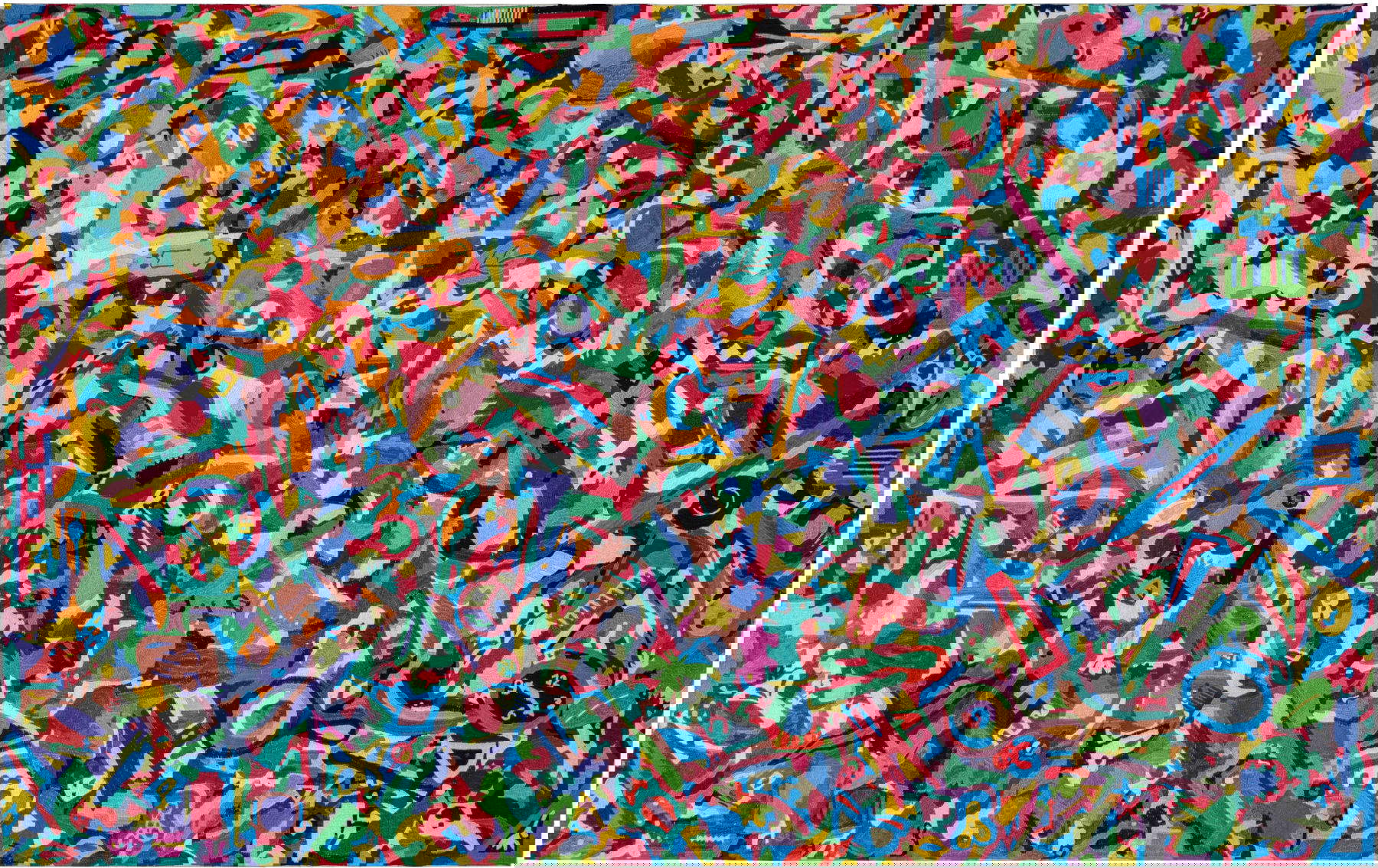
The exhibition dedicated to Boetti brings together about thirty works, selected from a nucleus belonging to the museum’s permanent collection and supplemented by loans from the artist’s heirs and a relevant private collection. The chronological span covered by the exhibition extends from 1966 to 1993, offering a broad reading of the artist’s production over nearly three decades. Works on display include large-scale works such as Mazzo di tubi (1966), Da mille a mille (1975), Insicuro Noncurante (1975-76) and the large kilimAlternando da uno a cento e viceversa (1993).
The title of the exhibition refers to the desire to offer an extended view of the entire span of the artist’s research. The reference to the Tutto series, started in the 1980s, also highlights one of the central cores of his work: large textile compositions in which signs, writings and images are woven into dense and systematic structures. The exhibition opens with a group of key works from his early Turin period, dated 1966, many of which were presented in Boetti’s first solo exhibition at the Christian Stein Gallery in Turin in 1967. Among them appear Triple Meter, Measuring Rod, Squared Mancorrente, Luminous Panel, and Clino. These works introduce the artist’s main lines of research in his early days, focusing on measurement, function and redefinition of the object.
Through industrial materials and objects derived from everyday life, Boetti intervenes on established categories such as authorship, representation and use, highlighting the conceptual dimension of technical tools and seemingly neutral structures. The focus is on the transformation of meaning through minimal operations of displacement and recontextualization. Within the first room are two works of particular note that highlight the spatial and sculptural dimensions of the artist’s early research.Luminous Floor (1966) consists of a painted wooden structure equipped with an internal lighting system and placed on the ground as a platform. The work relates object, architecture and sculpture, integrating light as a constituent element of the form. The reference to the Turin context of the 1960s also emerges in the dialogue with the environments of the Piper Club, a central place of artistic and cultural experimentation of the period.
Next to this work is Mazzo di tubi (1966), composed of sixteen PVC elements assembled vertically to configure a structure similar to a column. The intervention on the industrial object produces a functional reconfiguration, which shifts the focus from the manual gesture to the selection and assembly of pre-existing elements. The result is an autonomous structure that reflects the artist’s interest in systems, classifications, and relationships between order and variation.
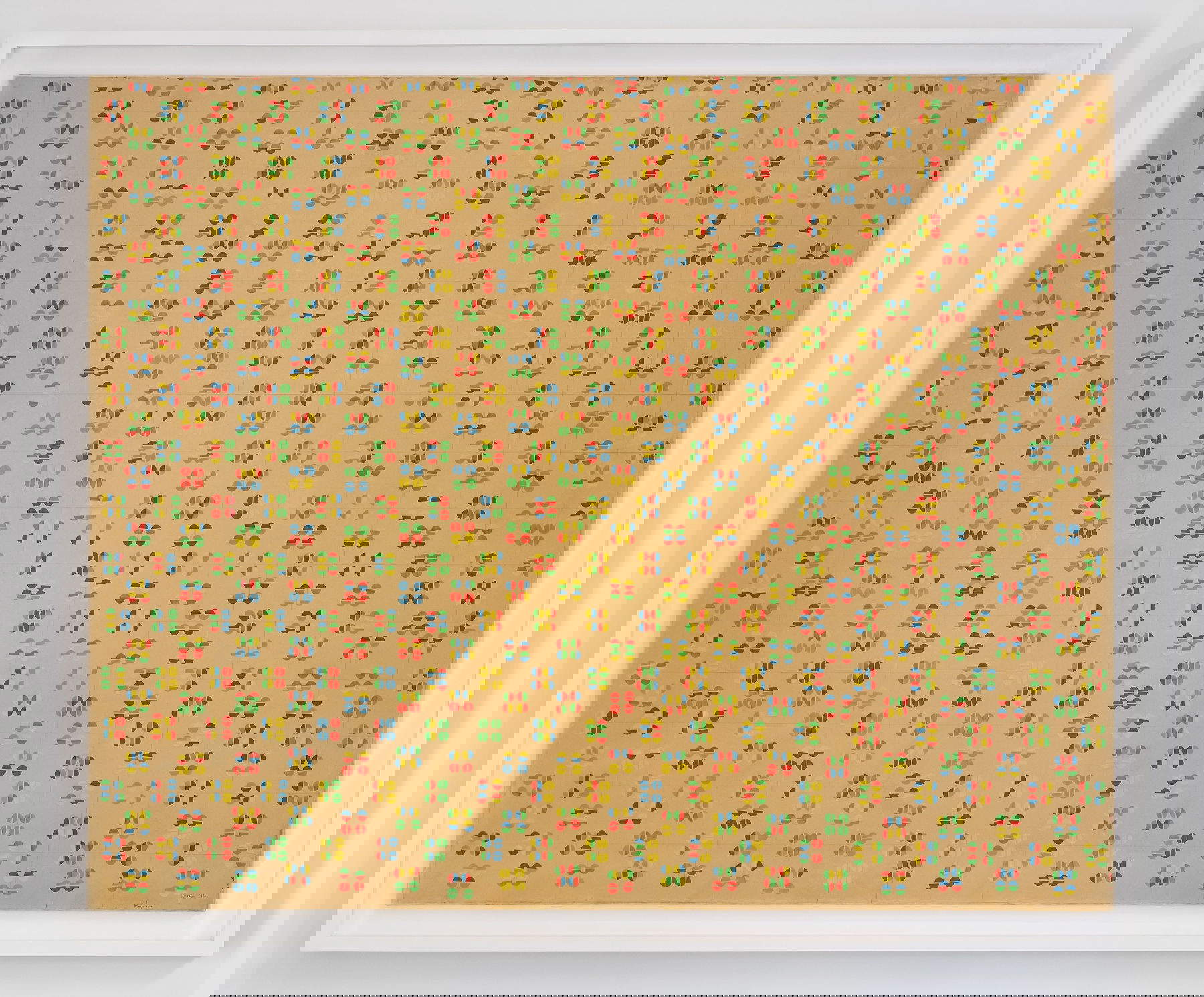
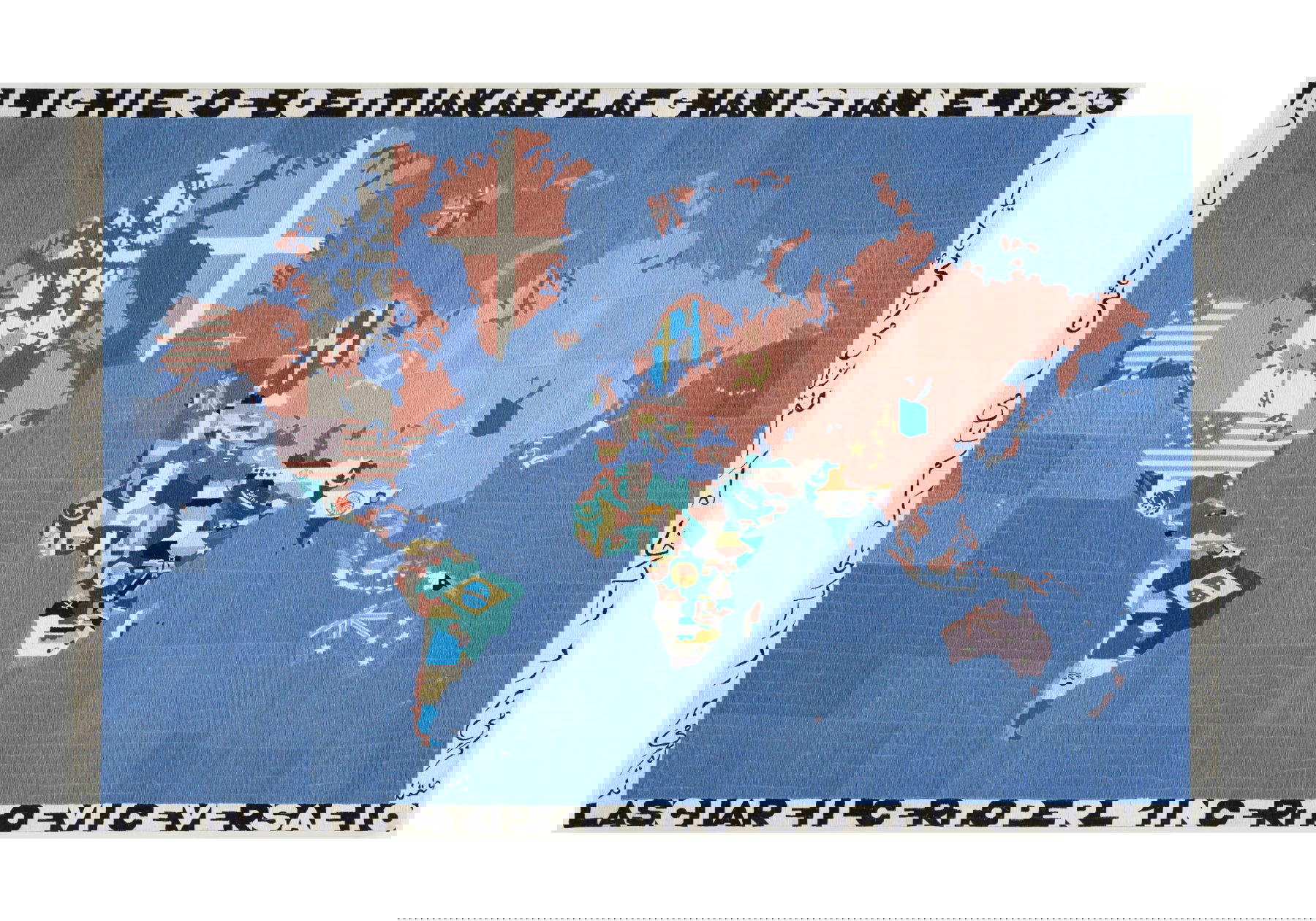
The tour continues with works made during the Roman years, a phase in which Boetti’s research was articulated around the themes of duality, delegation and the redefinition of authorship. In Da mille a mille (1975), composed of eleven sheets of graph paper, the artist’s assistants freely intervene in the coloring of the squares, according to open rules that provide a wide margin of choice. The work thus becomes a field of interaction between structure and operational freedom, in which the final result emerges from processes that are not completely determined. A 1983 Map, part of the series initiated after the artist’s trip to Afghanistan in 1971, also belongs to this phase. Following that experience, Boetti began an ongoing collaboration with Afghan artisans, entrusting them with the making of the embroidered works. The Maps combine pre-existing geographical and symbolic systems, such as political boundaries and national flags, translated into fabric through traditional techniques. The result highlights the co-presence of conceptual structure and executional craftsmanship.
The entire exhibition project highlights the centrality of collaboration in Boetti’s practice, along with the idea of system as the generative principle of the work. The relationship between rule and variation, as well as the tension between control and delegation, constitutes one of the main axes of his research. The exhibition will be accompanied by a catalog edited by Professor Francesco Guzzetti, with fact sheets dedicated to each work. The volume is designed as a study tool and reference for future research, as well as a documentary support for the analysis of the corpus on display. A symposium organized in collaboration with the Alighiero and Boetti Foundation in Rome is also planned for April 25, 2026. The meeting will see the participation of curators, critics and artists called to discuss the impact of Boetti’s research in the development of contemporary art, with particular attention to the conceptual and operational dynamics introduced in his work.
 |
| Magazzino Italian Art: a major exhibition on Alighiero Boetti in New York. |
Warning: the translation into English of the original Italian article was created using automatic tools. We undertake to review all articles, but we do not guarantee the total absence of inaccuracies in the translation due to the program. You can find the original by clicking on the ITA button. If you find any mistake,please contact us.