




From Jan. 19 to March 1, 2026, the National Gallery of Modern and Contemporary Art (GNAMC) in Rome is hosting Promenade, a solo exhibition by Neapolitan artist Maurizio Cannavacciuolo, born in 1954. The exhibition, curated by Marco Tonelli with Angelo Bucarelli and organized with the support of the Giampaolo Abbondio Gallery of Milan and Todi and Open Capital, is located at the beginning of the permanent collection’s itinerary, in the room dedicated to new works. The exhibition presents an installation that combines black and white oils on canvas and ceramic vases. Specifically, the artist is exhibiting four large paintings made between 2018 and 2022, juxtaposed with four intensely colored glazed vases, just over a meter tall, produced by Davide Servadei at Ceramica Gatti in Faenza.
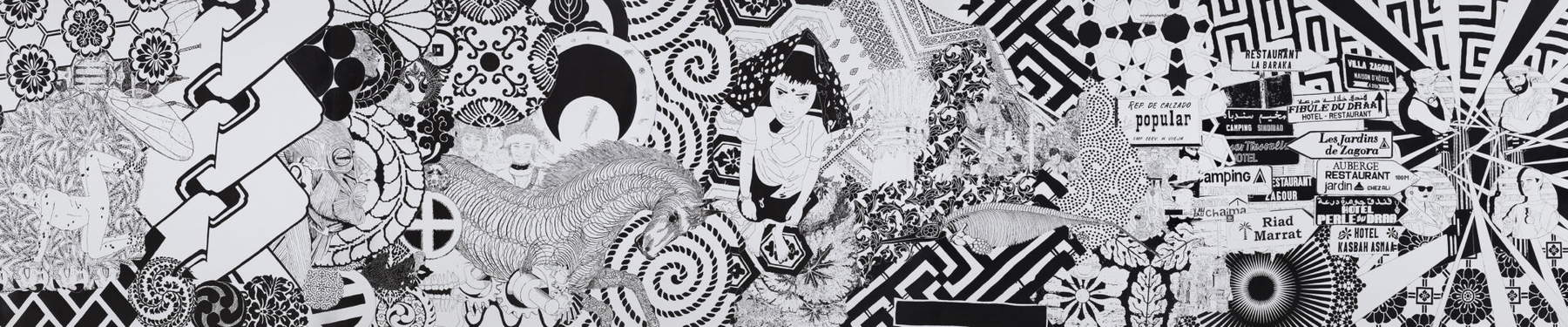
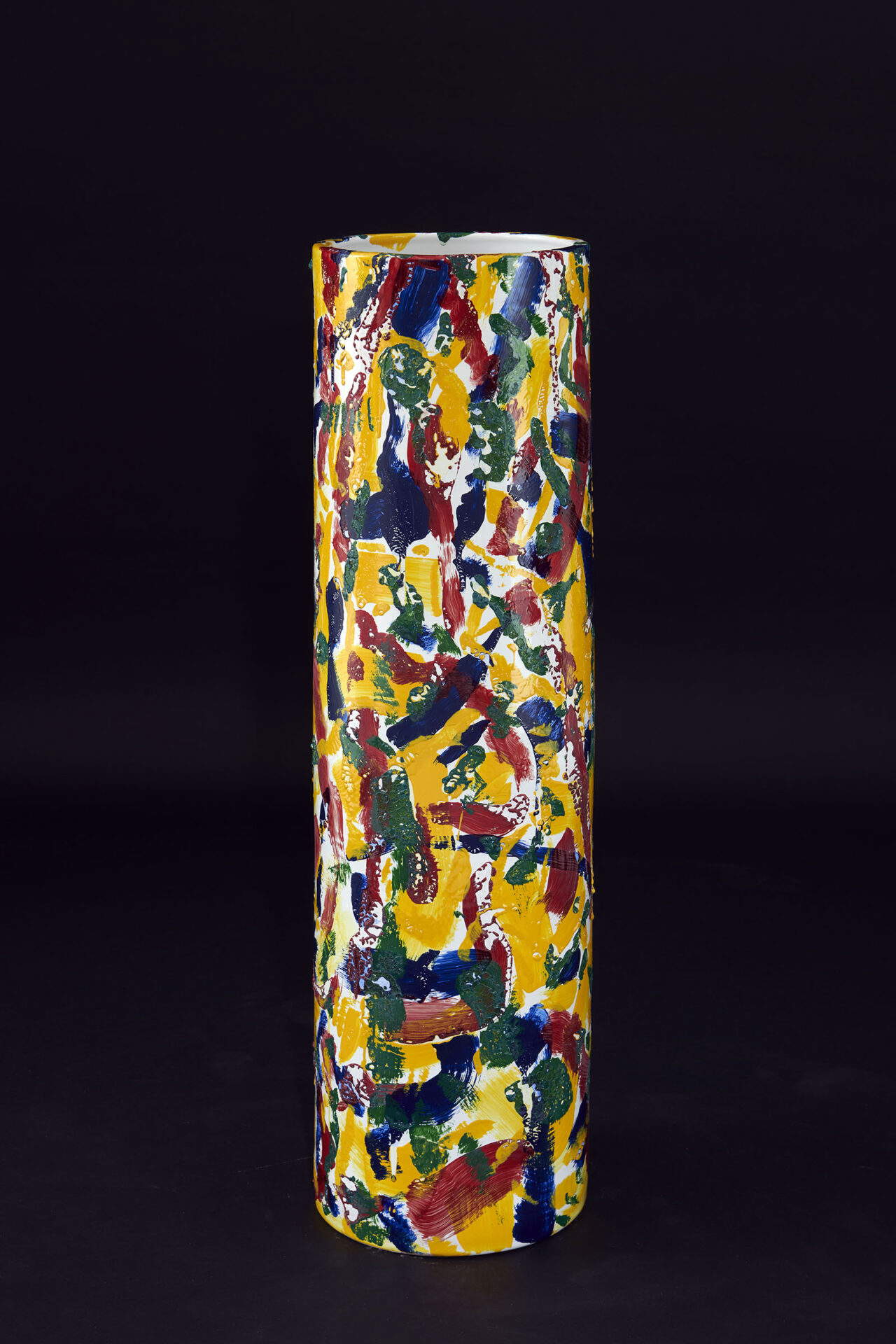
The works on display include Excelsior (2018) and Hungry Angry Bird (2019), both two meters high by three meters wide, flanked by the monumental Ophtalmosaurus fugax (2018), which reaches almost ten meters wide by two meters high. The latter depicts a kind of Byzantine-inspired royal parade, a walk within a fantastical garden of interrupted paths. The painting creates a complex semantic environment, populated by visual signals and rebuses of different natures, including optical, illusionistic and ornamental motifs, as well as human faces and self-portraits of the artist himself, which combine to form a fragmented mosaic with no apparent direction. Completing the exhibition are ceramic vases entitled Be very happy! ( 2022), made as a chromatic counterpoint to the monochromatic paintings. Their bright color and restrained size offer a contrast to the monumentality of the black-and-white paintings, contributing to a complex and articulated visual effect typical of Cannavacciuolo’s production.
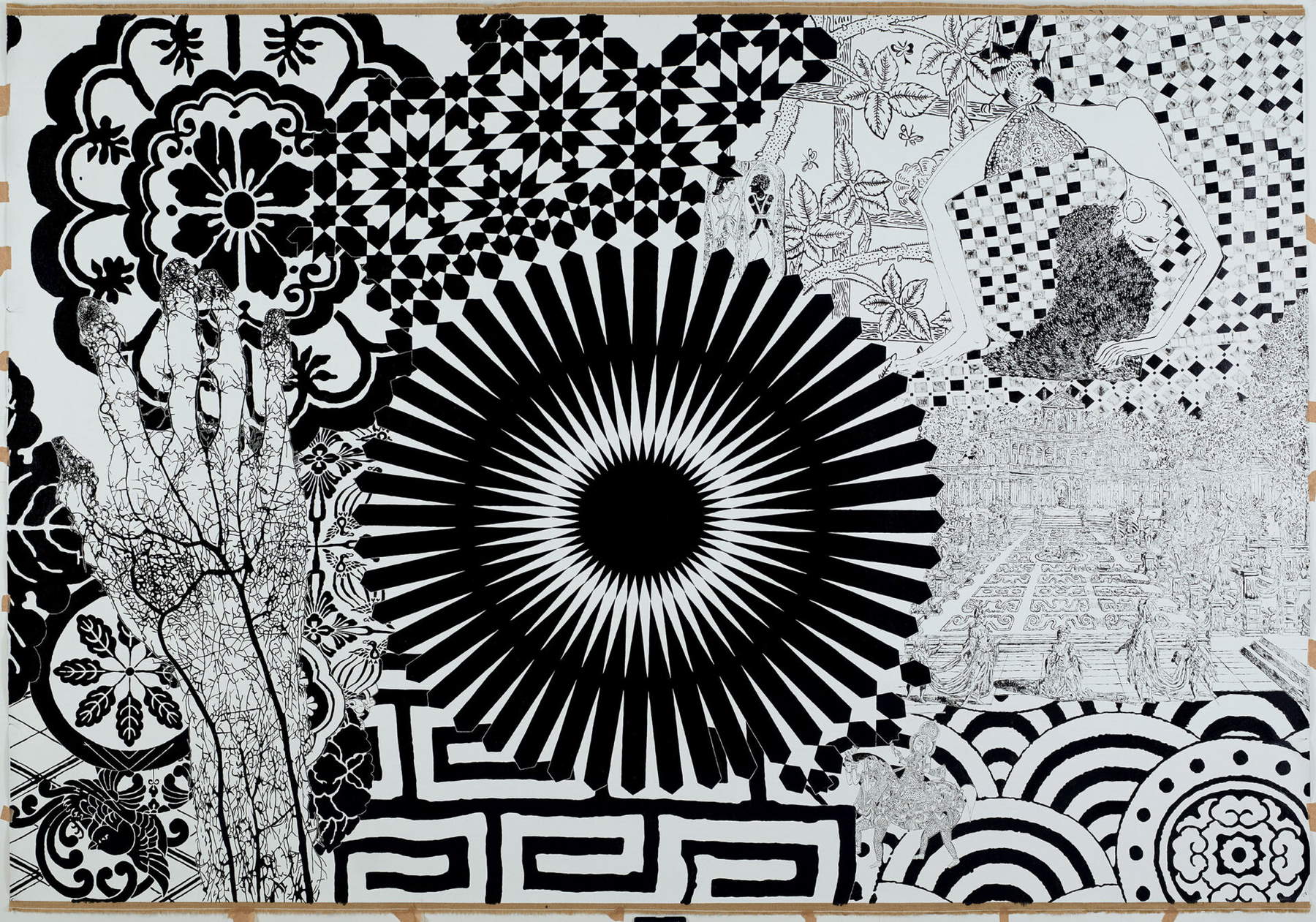
The installation closes with Metempsychosis, Circle Song Seven (2023), a two-by-two-meter work that, at the end of the exhibition, will be donated to the state and become part of GNAMC’s permanent collection. The work synthesizes the main features of the artist’s visual language, combining compositional precision and overlapping iconographic patterns. Metempsychosis, Circle Song Seven represents Cannavacciuolo’s ironic and surreal microcosm, transforming the graphic sign into a global sign system that reflects the consumerist intrusiveness of contemporary iconography, condensed into a monochromatic two-dimensionality. The exhibition, as a whole, aims to hyperstimulate the visitor’s optical and conceptual space, putting painting and ceramics, monumental and minute, white and color, in dialogue. The juxtaposition of different materials and languages reflects the artist’s desire to construct a visual metaphor for the present world, where the layering of signs, motifs and iconographic references creates non-linear paths of perception.
Promenade fits into the line of exhibitions related to GNAMC’s artist donations, with the final work enriching the permanent collection. The exhibition highlights how Cannavacciuolo develops a systematic and meticulous visual approach, in which the complexity of details and the coexistence of multiple levels of reading stimulate prolonged and attentive observation. The work, even in its figurative language, is situated among contemporary conceptual experiments, suggesting a dialogue between pictorial tradition, iconographic reflection and interaction with the exhibition space. The combination of the monumentality of the paintings, the liveliness of the ceramic vessels and the presence of a work destined for the permanent collection underscores GNAMC’s interest in consolidating contemporary Italian artistic memory, highlighting the contribution of figures such as Cannavacciuolo in the construction of a visual language that integrates historical, symbolic and contemporary references.
Maurizio Cannavacciuolo, born in Naples in 1954 and living in Rome, abandoned his architectural studies in the mid-1970s to devote himself to artistic activity, making his debut with the Lucio Amelio Gallery in Naples. His solo exhibitions include Museum Puri Lukisan in Ubud (Bali) in 1989; Gian Enzo Sperone Gallery in Rome in 1993 and 1997; Studio Guenzani in Milan in 1993 and 1998; Sperone Westwater in New York and Fundacion Ludwig de Cuba in Havana in 1997; Asprey-Jacques in London in 1999; the Galleria Cardi in Milan in 2000; Franco Noero in Turin and Francesca Kaufmann in Milan in the same year; the Museu da Republica in Rio de Janeiro in 2022; the Museo de Arte Contemporaneo in Santiago, Chile in 2003; the Sprovieri Gallery in London in 2003, 2006 and 2009; the Baltic Center for Contemporary Art in Gateshead in 2005; A Lecture on Martial History at the Isabella Stewart Gardner Museum in Boston in 2006 and 2016; Galleria Pack and Galleria Giovanni Bonelli in Milan in 2019; But I Have No Glasses Like Yours with Claudio Massini at Palazzo Collicola in Spoleto in 2021; Don’t Worry Be Happy at Visionarea Art Space in Rome in 2023; Meditations at MuMa in Milazzo and Introducing Suzie AIQ at Cardo AI in Milan in 2024.
Cannavacciuolo participated in the XIV Quadriennale in Rome in 2005 and the V SIART Art Biennial in La Paz in 2007. In 2013 his works appear in Art Rio at the Progetti Gallery in Rio de Janeiro; in 2016 he participated in the group show Avanscena at the Giorgio Cini Foundation in Venice; and in 2019 he was invited to the XIII Havana Biennial in Matanzas. Public works include Via dei bambini, a large walkable mosaic pavement inaugurated in the City of Legnano in 2013. In 2025 he took part in the group show EXTRA. Ancient Signs/Contemporary Visions at Palazzo Baldeschi in Perugia. He has also exhibited in numerous international contexts, including Osaka, London, Brussels, Budapest, Sarajevo and Frankfurt. Some of his works are kept in the permanent collection of the Farnesina and the Chamber of Deputies in Rome, as well as in the Cilea-Quattro Giornate station of the Naples Metro.
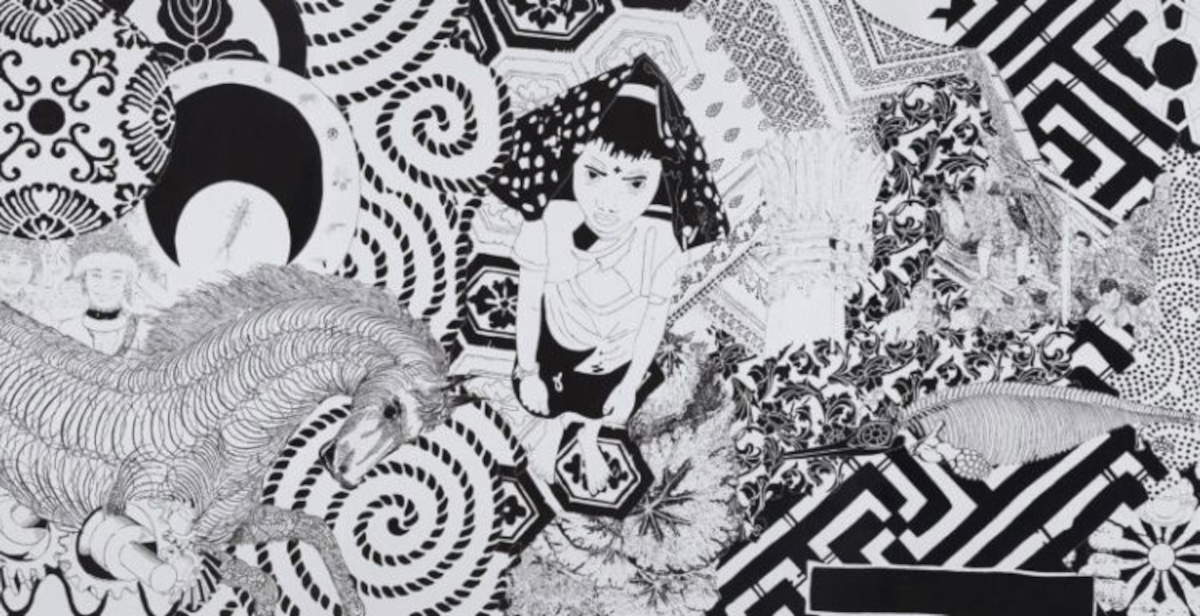 |
| Maurizio Cannavacciuolo on display at GNAMC in Rome with Promenade |

Warning: the translation into English of the original Italian article was created using automatic tools. We undertake to review all articles, but we do not guarantee the total absence of inaccuracies in the translation due to the program. You can find the original by clicking on the ITA button. If you find any mistake,please contact us.






















 IT
IT FR
FR DE
DE ES
ES CN
CN


