





From Dec. 13, 2025 to March 15, 2026, the Osvaldo Licini Gallery of Contemporary Art in Ascoli Piceno will host The Year of the Snake, a solo exhibition by Paola Angelini, the winning artist of the fifth edition of the Osvaldo Licini by Fainplast Prize. The exhibition project is presented by the Associazione Arte Contemporanea Picena, Fainplast and the Municipality of Ascoli Piceno, curated by Alessandro Zechini. The inauguration is scheduled for December 13, 2025 at 6 p.m. The Osvaldo Licini by Fainplast Prize is an award dedicated to contemporary Italian painting and was created with the aim of identifying and supporting the most current research, rewarding practices capable of renewing the pictorial language. Paola Angelini’s work fits into this context, selected for research that addresses the medium of painting as a space of transformation and existential verification.
The exhibition takes shape from a biographical event central to the artist’s path: the loss of her father, a reference figure in her private life and in her constant confrontation on painting. The exhibition is entirely dedicated to him and develops as a crossing of a rupture, understood as a point of passage between a before and an after. The time span evoked is that of a year marked by profound changes, in which painting becomes the instrument through which to measure absence and redefine one’s orientation. The title The Year of the Snake echoes Year of the Snake, a song by Arcade Fire inspired by the Chinese calendar, listened to by the artist in the studio as a kind of daily ritual. The musical reference accompanies the idea of threshold and change, a moment when the new redraws the perimeter of existence and painting changes its direction, opening a reflection on how to be reborn within lack.
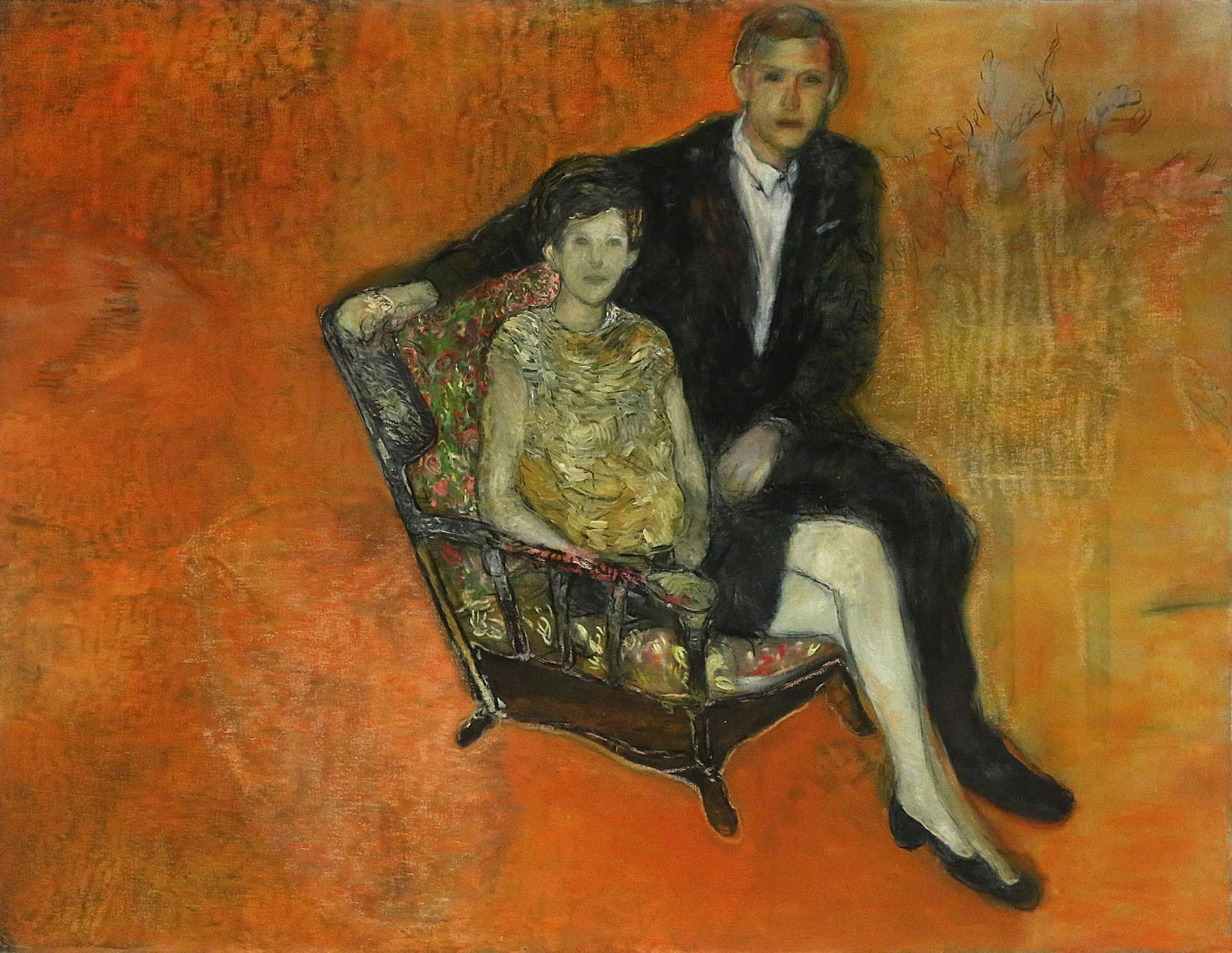
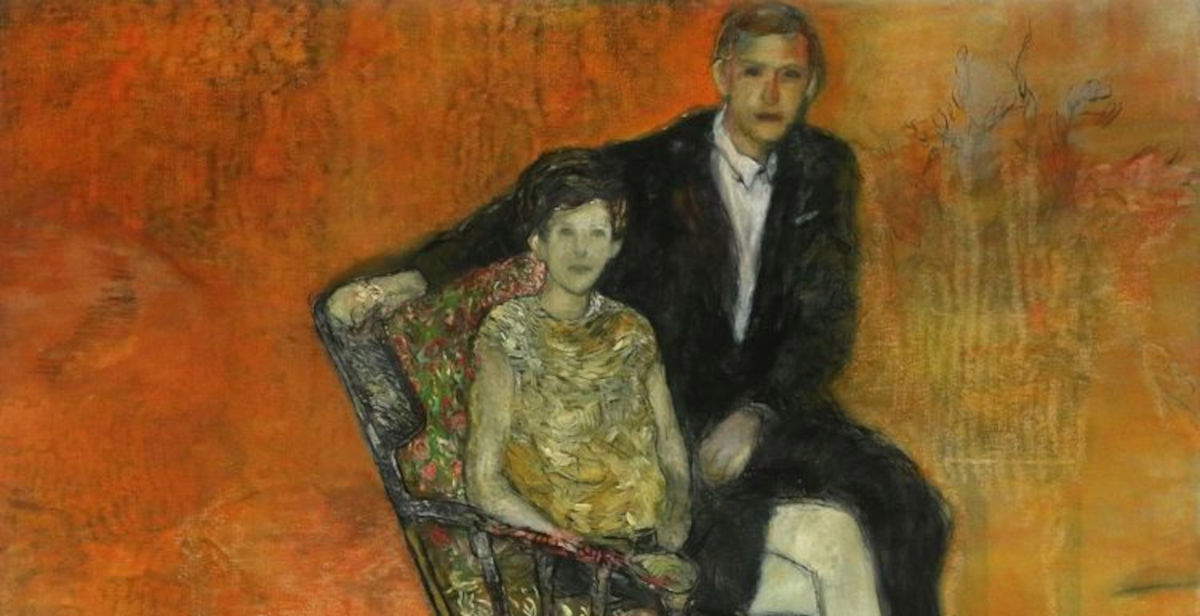
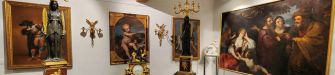
Angelini conceives the exhibition as a layered pictorial body, closer to a succession of lifeboats than to a definitive landing. The practice proceeds by accumulation of signs, elements and images that return in a recursive pattern: heads, angels, moons, figures and landscapes build a personal lexicon in which dream, memory and presence coexist. The exhibition itinerary is divided into three layers, comparable to the construction phases of a painting: priming, sketching and finishing. In the first layer, affective and artistic ties emerge, where the portrait and the symbol tend to overlap. Works such as What is Orange? Why, an Orange, just an Orange! function as temporal devices that draw on a familiar archive, presenting two figures facing the viewer, suspended between intense orange light and uniform lighting perceived as external to the scene. Within the same section, some of the artist’s portraits establish a dialogue with two historical portraits of Nanny, a central figure in Osvaldo Licini’s imagination, constructing a network of cross-references in which the distinction between the viewer and the viewed appears unstable.
The second layer, identified as a sketch, represents the most experimental part of the project. At this stage Angelini accepts only partial control over the outcome of the images and allows the painting to expand into physical space. The work Where are we going?, which spans an entire wall, makes explicit the question about the path to be taken. Abstraction and figuration alternate and exchange roles, returning a feeling of open-ended research, without a definitive path. On the back wall, drawings made in situ combine gesture with the idea of elevation: the charcoal mark, fragile and direct, makes its own journey visible, as if the movement of the body were still present. On display in the same room is a small work by Giovanna Garzoni, a seventeenth-century Ascolan miniaturist, a skull that dialogues as a memento mori with Dove andiamo?, inserting a reflection on the end within a process of transformation.
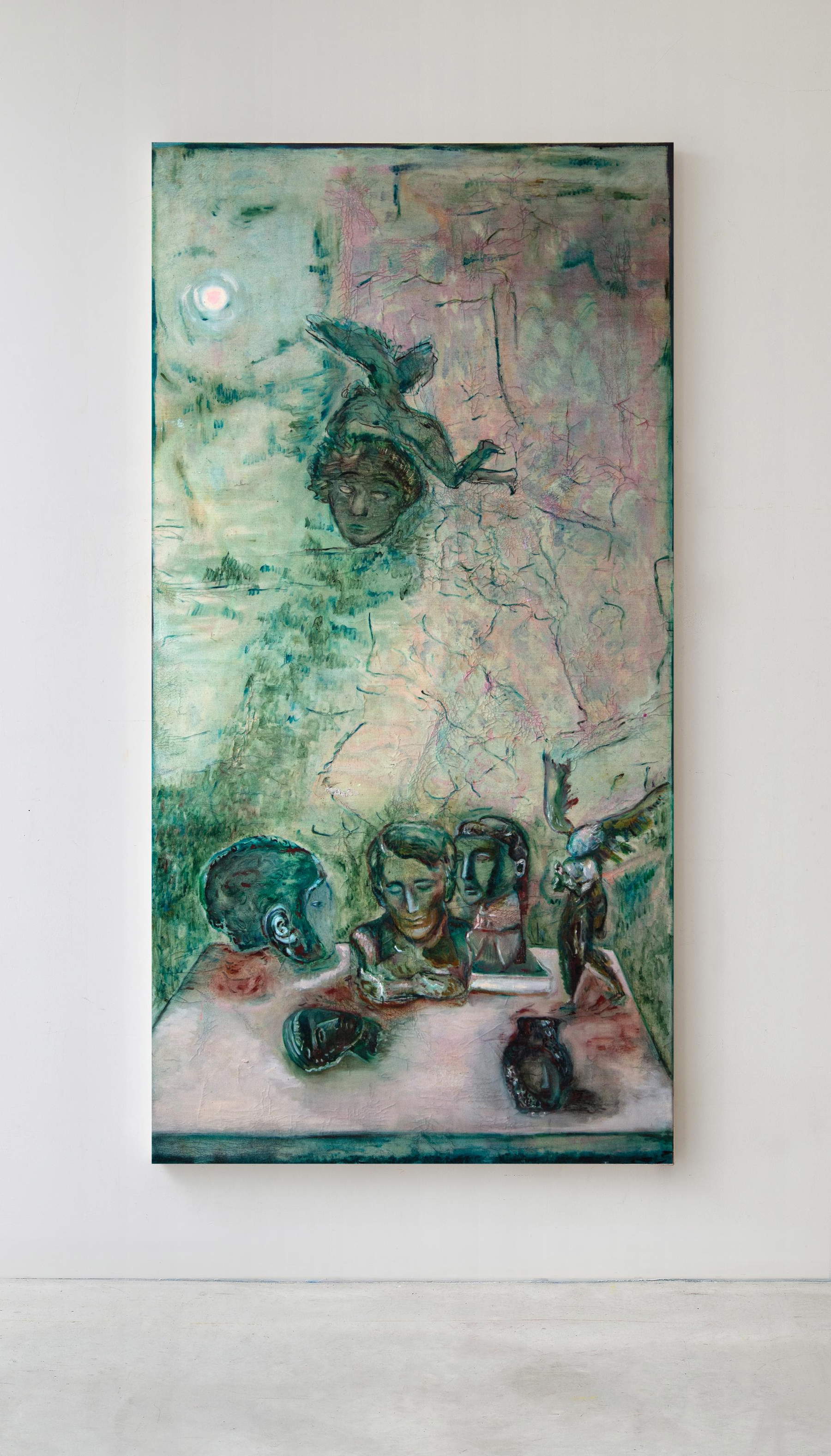
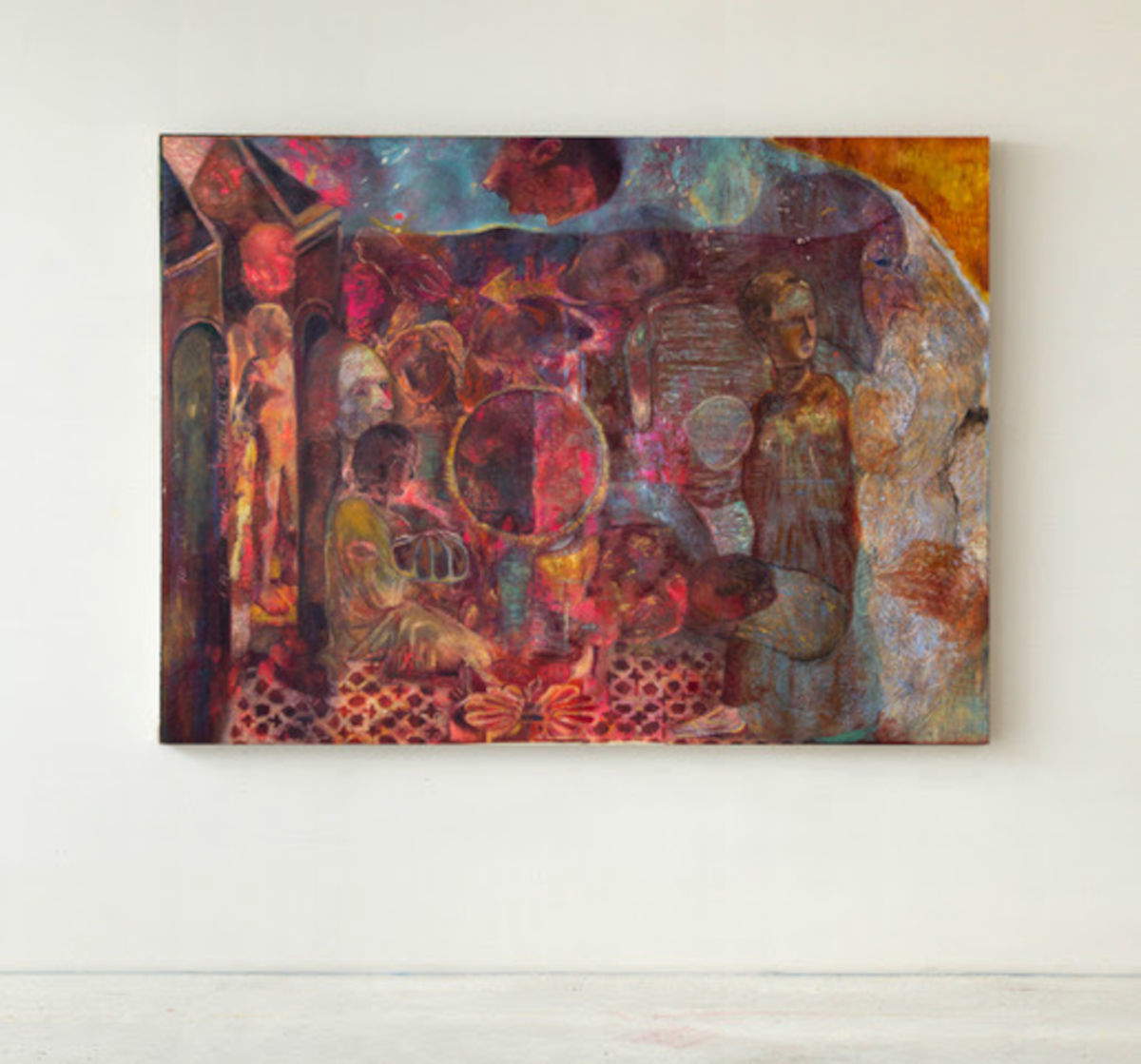
The last layer, the finish, houses five large freestanding paintings, characterized by a strong verticality. These are pictorial bodies that restore layers of memory and change. Each work presents an autonomous construction, with different atmospheres and density of sign. The irregular surfaces, crossed by chromatic overlays and graphisms, alternate bright areas and lunar presences in a continuous dialogue between subjects and landscapes. The moon, along with angels and fractures in the pictorial material, returns as a guiding element, recalling a constant tension between aspiration to elevation and weight of matter, resonating with Licini’s lesson. In one of the paintings, marked by deep greens and bright pinks, a watchful gaze emerges among faces with closed eyes, while an angel in flight attempts to hold back a head followed like a trail by the green of nature; on the ground, a sort of raft collects the face of Leopardi, a poet dear to both Licini and Angelini. Overall, the layering of signs and forms defines the conceptual architecture of the exhibition. From the imprimitura of the figures that interpellate the viewer, to the sketch as a space of research and attempt at flight, to the finish entrusted to the five self-supporting paintings, the path returns a crossing of absence and memory. Painting thus becomes the site of a nonlinear walk, in which the gaze moves among fragments of an interrupted future, accepting loss and uncertainty. In this space, moonlight highlights the coincidence between fragility and strength as a structural datum of Paola Angelini’s experience and painting practice.
Paola Angelini, born in San Benedetto del Tronto in 1983, trained at the Academy of Fine Arts in Florence, where she received a diploma in Painting in 2010. In 2011 she took part in the workshop in Visual Arts at IUAV in Venice led by Bjarne Melgaard, and in the same year she exhibited at the Norwegian Pavilion of the 54th Venice Biennale in the exhibition Baton Sinister. In 2017 he completed his studies by obtaining a Master’s degree in Fine Arts at KASK Conservatorium in Ghent, Belgium.
Parallel to her training, Angelini develops her research through residency programs: in 2014 and 2016 she was artist-in-residence at the Nordic Artists’ Centre Dale in Norway and in 2016 she also participated in the Bevilacqua La Masa program in Venice. His work has been presented in numerous solo and group exhibitions in Italy and abroad, includingForms of Time at the Palazzo Pretorio Museum in Prato and The Conquest of Space at Spazio K of the Galleria Nazionale delle Marche in Urbino (2017), Iconoclash at Museo di Castelvecchio in Verona (2017),Rethinking Media at Brandstrup Galleri in Oslo (2018), Babel of Bric à Brac at BGE Gallery, Stavanger (2019), SplendorSolisal Museo Ca’ Pesaro, Venice (2021), Black Morning at Lyles & King Gallery, New York (2022), The Diver at Fondazione Coppola in Vicenza (2023), Became a sun on the left side of the moon at BGE Contemporary Art Projects in Stavanger (2024) and Image outside of time at Kwai Fung Hin Art Gallery in Hong Kong.
 |
| Paola Angelini in Ascoli Piceno: "The Year of the Serpent" at the Licini Gallery |

Warning: the translation into English of the original Italian article was created using automatic tools. We undertake to review all articles, but we do not guarantee the total absence of inaccuracies in the translation due to the program. You can find the original by clicking on the ITA button. If you find any mistake,please contact us.




















 IT
IT FR
FR DE
DE ES
ES CN
CN


