





The Diocesan Museum of Brescia offers a symbolic reflection through the dialogue between great Renaissance painting and textile art. It happens with Adoremus, one of the most anticipated events in the museum’s exhibition calendar, which, for its fifth edition, brings to Brescia for the first time, from December 3, 2025 to March 8, 2026, a masterpiece by Bernardino di Betto, known as Pinturicchio: The Madonna of Peace (c. 1490). One of the painter’s most representative works, it already embodies from its title the spirit of Adoremus, which aims to offer a message of recollection and hope as opposed to a present crossed by crisis and bewilderment.
The installation, which spreads over four rooms and is conceived as a synaesthetic journey combining vision and tactile experience, finds its climax in the Umbrian master’s painting. Thanks to a collaboration with the Fondazione Arte della Seta Lisio of Florence, the silk example of the robe that envelops the Child in the painting and about 20 samples, including silks, velvets, damasks, and brocades, of the fabrics worn by the characters depicted are presented alongside the work.
Dated between 1488 and 1489 and from the MARec, Museum of Recovered Art of the Archdiocese of Camerino and San Severino Marche, the work manifests the luminous grace and balance typical of the Umbrian Renaissance. The scene is complex, full of presences that differentiate it from the usual Madonnas with Child. The Virgin, seated and barely turned, with her head slightly recumbent, wears sumptuous robes characterized by fine gold embroidery and a band of multicolored silk brocade, adorned with an acorn at the end. The Child, seated on his Mother’s lap on a damask-covered cushion, is looking down as he blesses and holds a crystal globe. Behind them, two angels close the intervening space and guide the eye to the landscape in the background: a partly mountainous countryside lit by the rising sun, with a fortified city perched on a slope.
The commissioner, Libero Bartelli, a wealthy and influential canon who donated the work to his hometown between 1488 and 1489, also appears in the scene. Portrayed in profile in the right foreground, the prelate manifests a casual and confident attitude, with an open eye and arched eyebrow. Physiognomic features, such as the aquiline nose, tight lips, raised leeks and bulging veins in the neck and forehead, reveal the painter’s skill in capturing the human finesse of the individual.
Pinturicchio’s training as a miniaturist shines through in his choice of bright, artificial colors, from green vegetable hues to cerulean to gold, employed generously. His passion for goldsmithing also emerges in the gilded plate on the Child’s robe, where a winged mermaid-sphinx appears, an element that accentuates the fairy-tale and almost magical character of the whole.
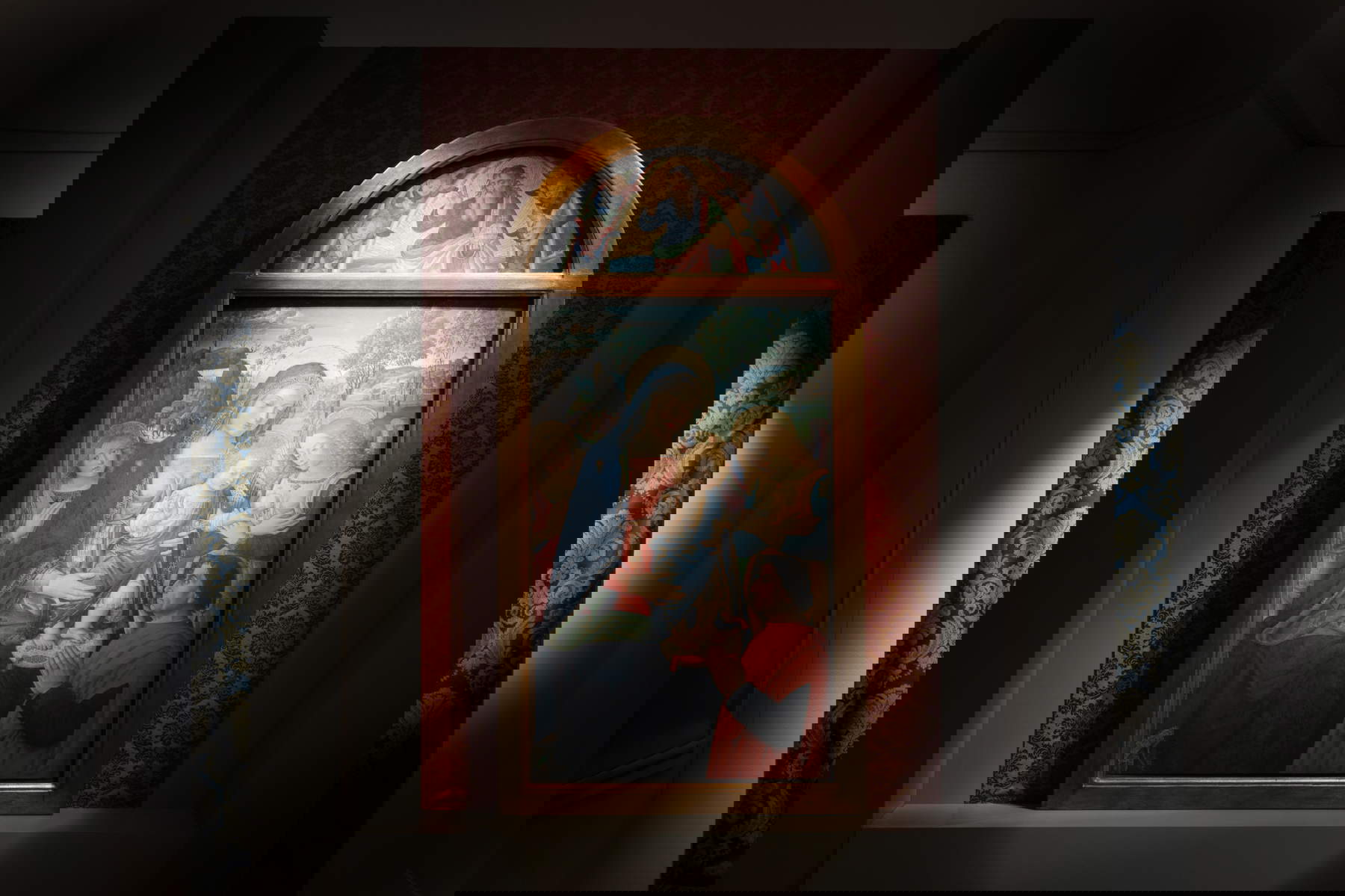
For the exhibition, the historic tailoring shop of the Fondazione Lisio Arte della Seta made faithful reproductions of the textiles (silks, embroideries, fine fabrics) worn by the characters in the painting. In Pinturicchio’s language, in fact, clothing becomes a theological vehicle: materials and ornaments become visual doctrine. The variety of artifacts presented restores the material world of the Renaissance and the symbolic significance of clothing as a sign of the divine.
God the Father wears an old-fashioned robe, a symbol of eternity: the green wool cloak (a pallium or himation) lined with incarnadine and decorated with golden motifs recalls new life, joy and heavenly royalty; the blue tunic represents transcendence. The Virgin, on the other hand, wears a tunic of red woolen cloth and the traditional maphorion of the same material; the blouse and linen veil, white and very thin, refer to purity and humility, while the silky lining of the cloak evokes divine light. The girdle, decorated according to Perugian taste, alludes to virginal birth.
The angels dress embroidered silks with palmette motifs and pseudo-cuftic inscriptions, combining elements of religious iconography and liturgical robes. The donor, Liberato Bartelli, wears a red wool cloth lucco over a dark jacket and white shirt: clothing regulated by suntuary laws that communicates rank, devotion, and ecclesiastical identity.
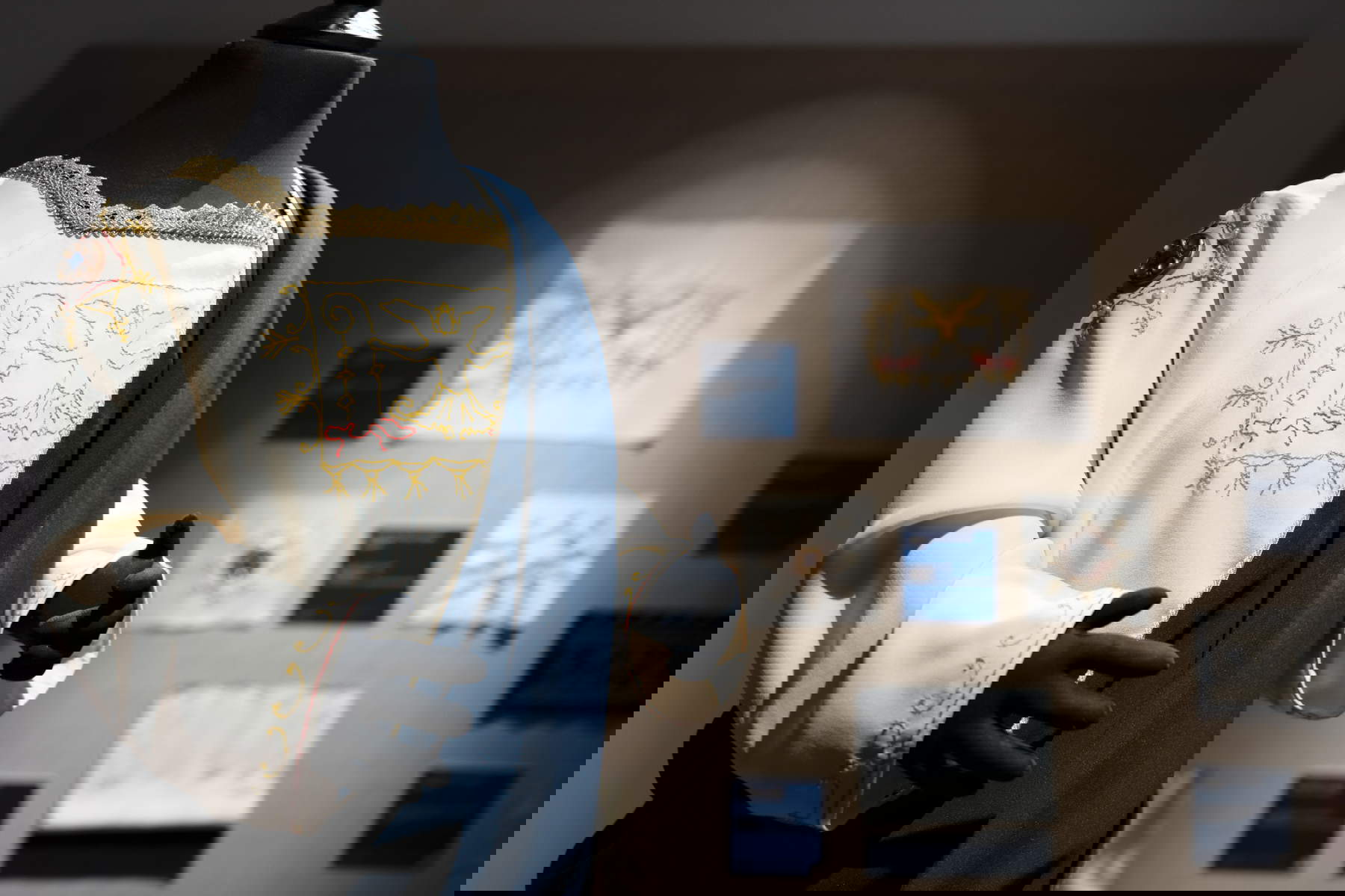
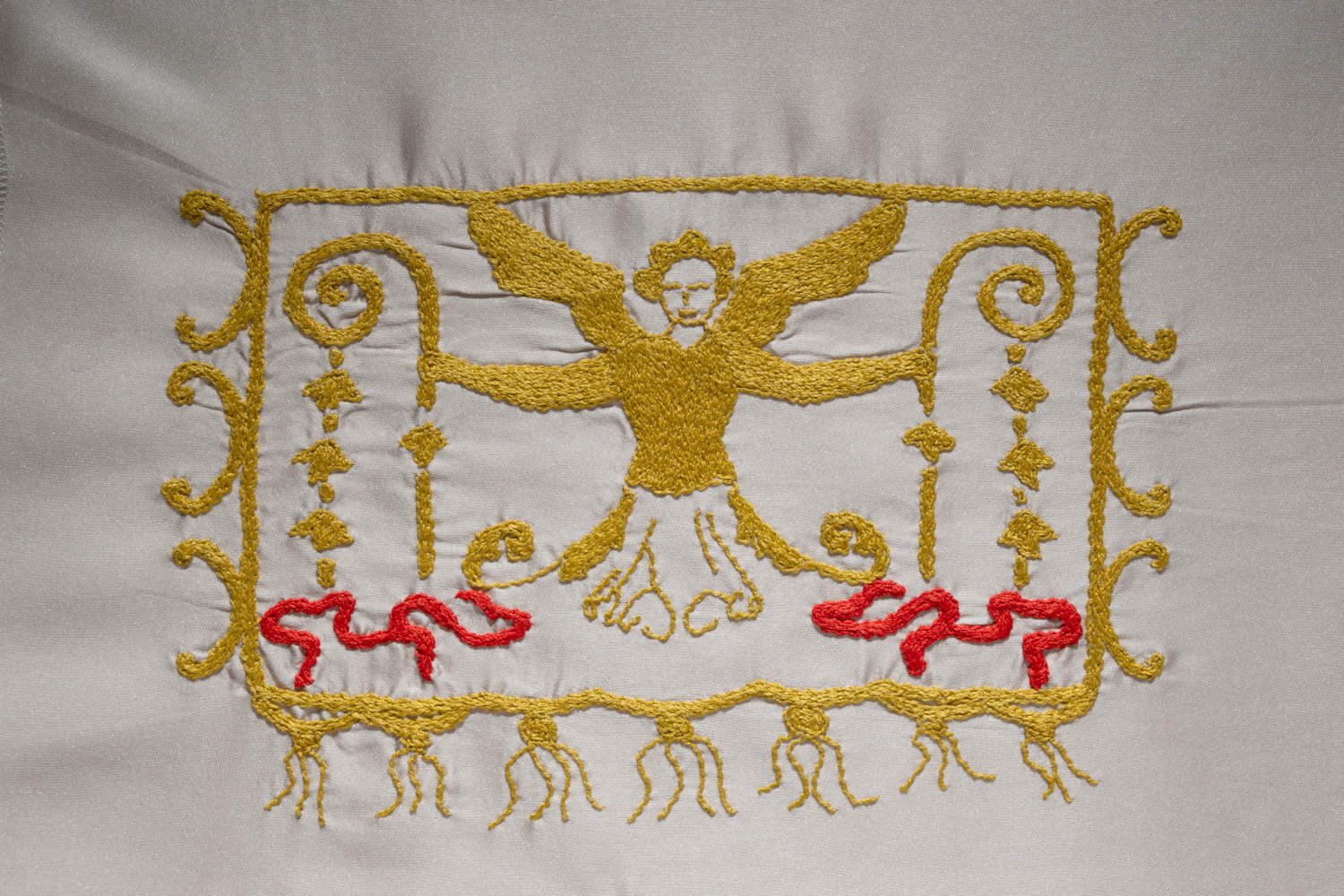
The Child is wrapped in a white silk dalmatic embroidered in gold and a blue silk pallium: the silk and gold, symbols of purity and glory, emphasize his dual human and divine nature. The ensemble explicitly recalls the Byzantine tradition, evident in the pallium, a mantle that recalls spiritual rebirth and detachment from earthly possessions, and in the blue, the color of transcendence and divine light, associated with the icons of Christ Pantocrator. Under the pallium, the white dalmatic alludes to purity, joy, resurrection and imperial dignity. Palmette embroidery evokes imperial ceremonial motifs; pearls and precious appliqués refer to the riches of the Kingdom of Heaven. Embroidered orbicles with pins adorned with sapphires appear on the shoulders, evoking Christus Sapientia.
Of particular note is the embroidery at the neckline: a winged mermaid-like figure holding racemes with the outline of vine shoots, a symbol of Christ’s descent to the underworld and victory over death, of Christ emerging from the “sea” transfigured on Holy Saturday.
|
| Pinturicchio's Madonna of Peace and textile art in dialogue at Brescia Diocesan Museum |

Warning: the translation into English of the original Italian article was created using automatic tools. We undertake to review all articles, but we do not guarantee the total absence of inaccuracies in the translation due to the program. You can find the original by clicking on the ITA button. If you find any mistake,please contact us.






















 IT
IT FR
FR DE
DE ES
ES CN
CN


