





The Prisons of the Martyrs of Belfiore, in the Castle of San Giorgio in Mantua, will reopen to the public starting March 29, 2026. In fact, on the occasion of the 160th anniversary of the annexation of Mantua and the Veneto region to the Kingdom of Italy in 1866, a significant restoration project involving the Castle of San Giorgio has been completed, allowing the damage caused by the 2012 earthquake to be repaired. After the first interventions carried out immediately after the earthquake and the reopening of the castle in March 2015, the new recovery project was financed in 2014 with ALES (former ARCUS) funds. The work focused on two main objectives: the structural consolidation of the building and the restoration of some cells related to the history of the Martyrs of Belfiore.
The first batch of works, worth 1,034,557 euros, involved securing the second floor of the castle through seismic improvement works and the re-roofing. On the other hand, the second lot, with an investment of 285,000 euros, involved the restoration of the cells in which Carlo Montanari, Giovanni Grioli, Felice Orsini, Tito Speri and Ciro Menotti were detained. The total funding of 1,500,000 euros was managed for a long time by the Regional Secretariat of Lombardy, initially under the direction of Marco Edoardo Minoja and later, in the final stages, by Francesca Furst.
Andrea Alberti, formerly Superintendent of Archaeology, Fine Arts and Landscape for the provinces of Brescia, Cremona and Mantua between 2009 and 2015, was the single person in charge of the procedure in the first intervention carried out after the earthquake, which affected the northeast tower of the castle (where the Bridal Chamber is located) and defined the guidelines for the subsequent works. Since 2016, this role has been assumed by architect Anna Maria Basso Bert. The design and direction of works for the first lot were entrusted to architect Antonio Giovanni Mazzeri of Palazzo Ducale, with the collaboration of Paolo Faccio of IUAV Venice for aspects related to structural consolidation. For the second lot, dedicated to the restoration of the cells, design and supervision of works were handled by restorer Daniela Marzia Mazzaglia. The companies that carried out the interventions were Leoni Costruzioni and Panizza 1914 s.r.l. for the first lot, while the restoration of the cells was carried out by the company Aurifolia.
The work began in 2021 under the direction of Stefano L’Occaso, who said, “The Prisons of St. George’s Castle, one of the emblematic places of the history of the Risorgimento, finally reopens after a long and complex intervention that involved many colleagues and many professionals and that also committed, in addition to ALES funding, important resources from the Institute budget.”
Inside the cells of the Martyrs of Belfiore, a place that represents the desire for freedom and national unity, evidence of the building’s different historical phases has been preserved and enhanced. The preserved stratifications range from the 16th century, the period of Francesco Gonzaga and Isabella d’Este, to the 19th century, when the rooms were used as prisons by the Austrians and later became a pilgrimage destination for supporters of Italian unification, who saw in the Martyrs of Belfiore an example of great patriotic value.
On the second floor of the castle, especially from the 1830s onward, numerous political conspirators mainly from the Veneto and Lombardy were imprisoned. Among them were the nine patriots who were hanged between December 1852 and March 1853 in the little valley of Belfiore, near Mantua: don Enrico Tazzoli, Carlo Poma, Angelo Scarsellini, Bernardo de Canal, Giovanni Zambelli, Tito Speri, don Bartolomeo Grazioli, Carlo Montanari and Pietro Frattini, later remembered as the Martyrs of Belfiore. They were joined by Don Giovanni Grioli, who was shot in November 1851, and Venetian patriot Pier Fortunato Calvi, a native of Cadore, who was hanged in July 1855 in the Lunetta area, not far from the Sparafucile fortress.
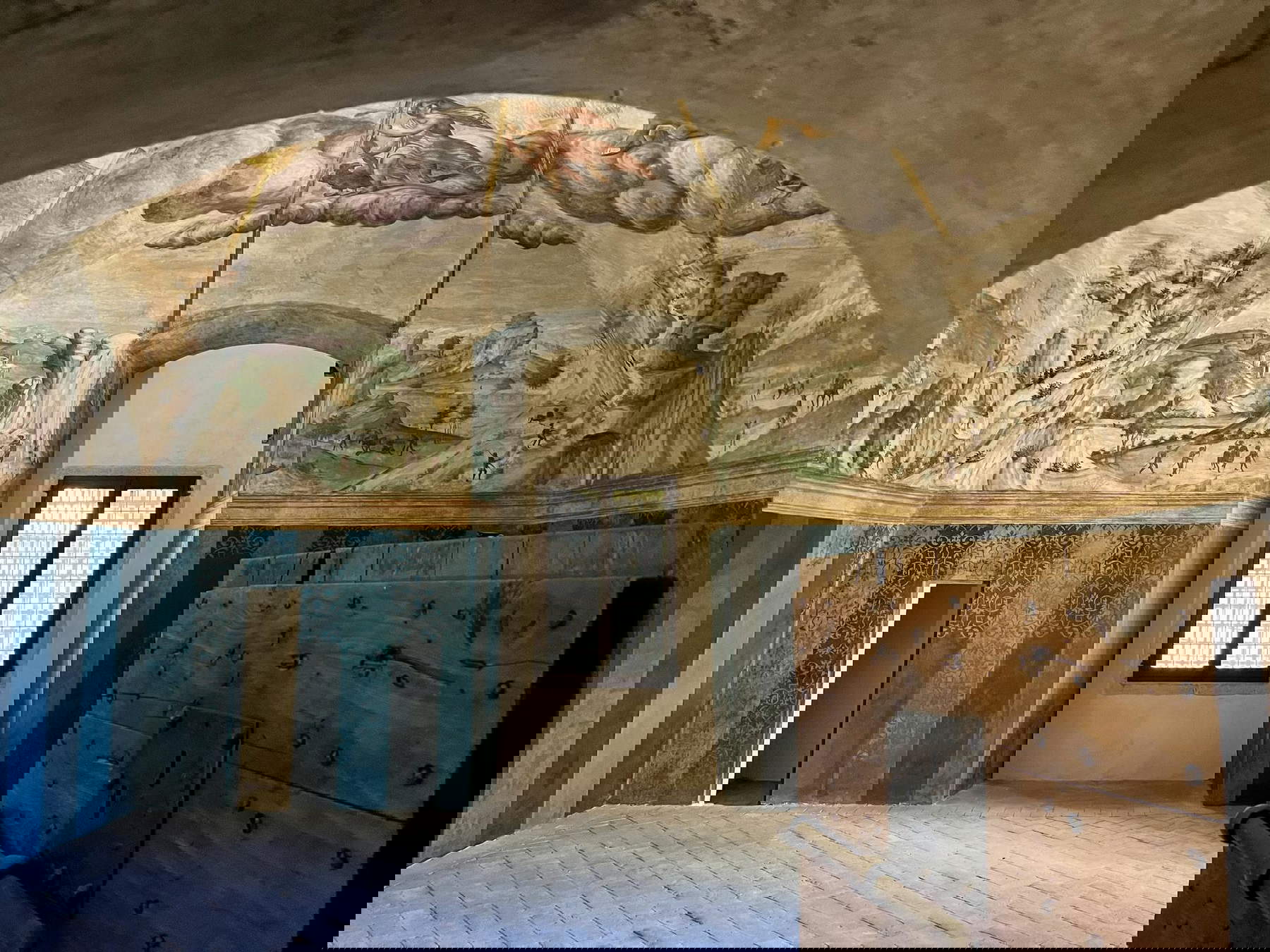
The restoration mainly involved the plasters of the cells, which were consolidated and cleaned. During the work each room returned elements of particular interest. In the cell of Tito Speri, for example, a complex operation of removing successive layers of plaster allowed to bring to light 16th-century decorations, including a rare depiction related to Isabella d’Este. The Grioli-Orsini cell, on the other hand, confirmed, through material traces, the attempt to erase Felice Orsini’s escape from collective memory by modifying the structure of the window used for the escape. In the Montanari cell, a graffitied representation of a fortified city seen from above, made on a black background, emerged with greater clarity. In the corridor, engravings depicting grenadier soldiers were identified, while Menotti’s cell, also known as the Zodiac Room, recovered the legibility of early 16th-century decorations while retaining 19th-century traces. These artistic and historical elements now coexist in the layering of evidence accumulated over the centuries, restoring a complete narrative of the history of these rooms.
The major recovery project was also joined by an intervention designed by the PDA studio of Mantua, which made the castle’s southwest tower accessible to the public. For the first time, visitors will be able to reach the patrol walkways, between the tower’s battlements, and admire from above the landscape of the Mantua lakes and the city from an unprecedented vantage point.
To celebrate the reopening of this part of the museum route, a press conference reserved for journalists and authorities will be held on Saturday, March 28, 2026 at 10 a.m. On Sunday, March 29 at 4 p.m., however, there will be a free aerial dance performance open to the public. The performance will be by French artist and choreographer Antoine Le Menestrel, of the Lézards Bleus company, who will perform on the facade of the castle overlooking the lake. The performance will be inspired by the escape of patriot Felice Orsini, which took place on the night of March 29-30, 1856, from the castle’s prisons then under Austrian rule. At the end of the event, three guided tours of the prisons of St. George’s Castle will be organized, scheduled at 5:15 p.m., 5:45 p.m. and 6:15 p.m., for groups of 30 people accompanied by the assistance and supervision staff. Entrance will be from Castle Square and reservations must be made through the infopoint (tel. 0376 352100). The cost of the ticket is 5 euros per person.
From April 7, 2026, escorted tours of the prisons and patrol walkways will also start, organized by AFAV staff. Visits will take place Tuesday through Saturday with two shifts in the morning (9:30 a.m. for schools and groups, 11 a.m. for individual visitors) and two in the afternoon (3:30 p.m. for schools and groups, 5 p.m. for individuals), always by reservation through the infopoint. Tickets cost 5 euros, while admission is free for schools. It is important to remember that the trail is not accessible to people with mobility difficulties and is not recommended for those with heart or respiratory problems.
|
| Mantua, the Prisons of the Martyrs of Belfiore in the Castle of San Giorgio reopen to the public |

Warning: the translation into English of the original Italian article was created using automatic tools. We undertake to review all articles, but we do not guarantee the total absence of inaccuracies in the translation due to the program. You can find the original by clicking on the ITA button. If you find any mistake,please contact us.





















 IT
IT FR
FR DE
DE ES
ES CN
CN


