




A museum dedicated to democracy will be created in Pamplona, Spain. An international architectural competition was launched in recent days by the Pamplona City Council to transform the city’s War Memorial into a memorial museum dedicated to recovering democratic memory and denouncing fascism. The initiative represents a pivotal step in the path initiated by the city administration to radically redefine the symbolic meaning of one of the city’s most controversial buildings, historically linked to the glorification of the 1936 coup d’état and the Franco regime.
The Monument to the Fallen, dating from 1942, is in fact a large building that commemorates the 4,500 soldiers from Navarre, the region in which Pamplona is located, who died fighting for Francisco Franco’s Nationalists during the Spanish Civil War , who would go on to win the war by establishing the dictatorship that lasted from 1939 until 1975. It is a Greek-cross building marked by a severe classicism. In recent years it has been partially resemantized: the square in front of it was in fact renamed, in 2015, “Plaza de la Libertad,” or Freedom Square, and the building itself today is used as an exhibition venue, but its controversial symbolism as a monument dedicated to the fallen of the faction that was allied with the Fascists and would later establish the dictatorship has never waned, not least because the Monument still retains its Franco-era symbols (despite the fact that removal in Navarre is mandatory by law: they have been covered, however). Even, in 2024, demolition of the monument has been proposed by 31 associations. The transformation into a museum of democracy could thus write the final chapter of a long and painful history.
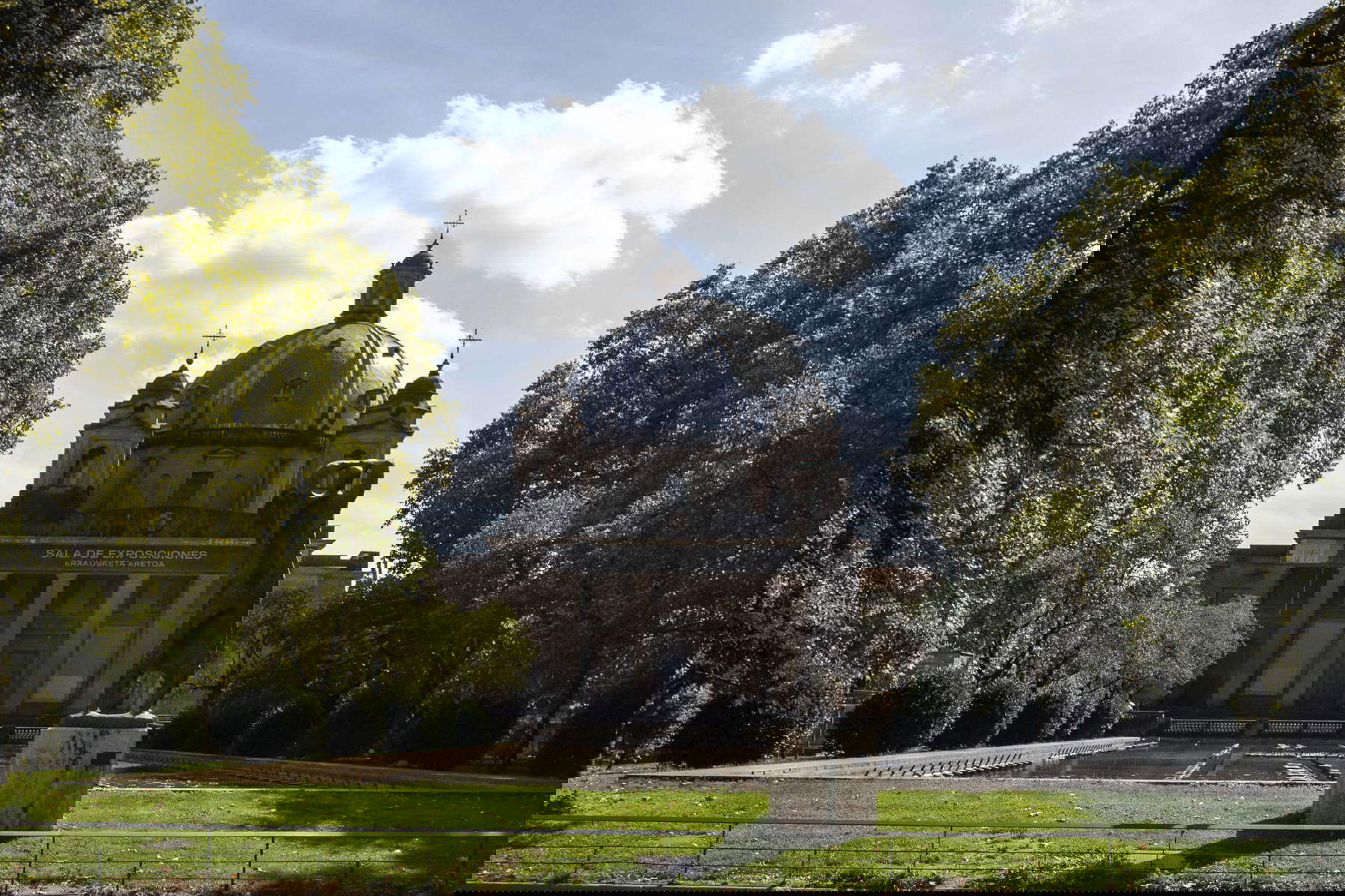
The official presentation of the competition that is to transform the Monument was entrusted to Joxe Abaurrea San Juan, deputy alderman for Strategic Government, Urban Planning, Housing and Agenda 2030 of the Pamplona City Council. The transformation of the monument will have to adhere strictly to the provisions of the “Political Agreement for the Transformation of the so-called War Memorial and the Creation of the Maravillas Lamberto Interpretation Center,” approved by the City Council on Feb. 6, 2025, as well as the indications contained in the report of the Expert Committee on the Transformation of the Monument and the revised sheet of the Municipal Plan Catalog. These three normative and programmatic references precisely define the framework within which planners will have to move. The deadline for submitting applications is two months from the publication of the notice in the Official Journal of the European Union.
The competition launched by the City of Pamplona will allow for the selection of up to five design proposals, which will then be presented to the citizenry in an informative and participatory phase. The contributions collected through this process will be integrated into the final technical project that, through a negotiated procedure, will lead to the development of the transformation works of the building and its urban context.
The proposed intervention aims at a radical transformation of the symbolic charge of the monumental complex. The building is to cease to be a place of celebration of the 1936 military coup and Francoism to become a space dedicated to democratic memory. The future Memorial Museum will be called upon to explain the role and responsibilities of the “Bando Nacional” (also called “Bando Sublevado” by the Republicans), or the Nationalists, clarifying who they were, when they acted and in what ways, but also to warn society about the emergence of new forms of fascism and to promote the values of civil coexistence and human rights.
The objectives of the competition are on three main levels. The first concerns the symbolic deactivation of the monument through a new interpretation of the space consistent with democratic and contemporary values. The second concerns the design of the Memorial Museum, which is to intervene in an integrated manner on both the building and its urban surroundings. The third objective is the transformation of the symbolic structure of the urban landscape, changing the existing hierarchies and making the connection between the Ensanche and Lezkairu neighborhoods more permeable.
The approach taken is that of democratic memory, which implies interdisciplinary work capable of combining the physical and symbolic transformation of architecture with a critical, theoretical and historical analysis of the past. In this perspective, the Memorial Museum will be part of a wider network of spaces dedicated to memory, standing alongside, for example, the Navarro Institute of Memory, contributing to the construction of a unified memorial project for the city and reinforcing Pamplona’s identity as a “City of Memory” and as an international node in the memorial museum scene.
Criteria for the competition include the application of the principles of the International Charter of Memorial Museums of the International Committee on Memorial Museums and Human Rights, the definition of the main thematic axes of the museum, and the adaptation of the project to the intended uses and functional needs. The indications contained in the technical report of the committee of experts are considered mandatory, with the exception of the formal aspects of the intervention and the museum management model, which retain a guiding character.
The scope of the competition is not limited to the monument, but also includes the Plaza de la Libertad, the rear part of Serapio Esparza Park, and neighboring streets. Thus, the projects will have to address in an integrated way the issue of access and services to the existing buildings, the tree stock of the plaza and park, the underground parking and its entrances, as well as the presence of Jorge Oteiza’s “Korean” sculpture. The call for proposals also includes the possibility that the process of implementing the intervention itself will become part of the re-signification of the monument and its context.
From an economic point of view, each selected proposal will receive a prize of 20,000 euros, VAT included, for a total value of the competition that may reach a maximum of 100,000 euros. The competition procedure will consist of several stages. The first will involve an anonymous, open design competition, with proposals being evaluated by a jury that will select up to five projects and may make recommendations and suggestions. The jury’s findings will be forwarded to the selected designers and form the basis for the subsequent negotiation phase. This will be followed by an information phase, during which the selected proposals will be presented publicly by the authors, allowing the public to make comments and contributions. Public participation will play a central role in the identification of the winning project, and the indications that emerge will feed into a technical report that will become part of the contract for the drafting of the final design and, if envisaged, for the direction of the work. The third phase will consist of a negotiated procedure without new competition, reserved for the winning projects. Technical specifications and contract terms will be defined at the end of the participatory phase, and the intervention budget will be adjusted to the available investment capacity.
The evaluation of proposals will be based on the overall and conceptual quality of the projects. Criteria include appropriateness with respect to the objective of symbolically deactivating the monument and transforming it into a musealization object, architectural and functional suitability as a Memorial Museum, the quality of the urban design proposal for reconfiguring the public space, and the technical and economic feasibility of the intervention.
|
| Pamplona, the Francoist war memorial will be turned into a Museum of Democracy |

Warning: the translation into English of the original Italian article was created using automatic tools. We undertake to review all articles, but we do not guarantee the total absence of inaccuracies in the translation due to the program. You can find the original by clicking on the ITA button. If you find any mistake,please contact us.

















 IT
IT FR
FR DE
DE ES
ES CN
CN