




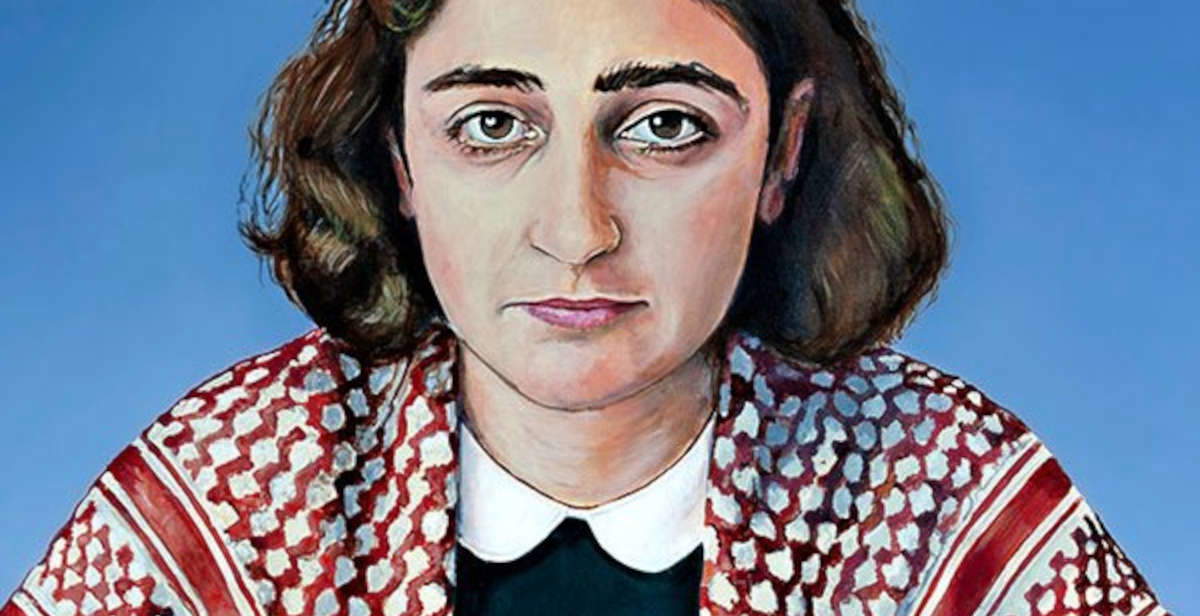
There is controversy in Germany over a work by Italian artist Costantino Ciervo (Naples, 1961) displayed at the Fluxus+ Museum in Potsdam: the painting depicts Anne Frank with a keffiyeh on her shoulders and has been accused of anti-Semitism. The privately owned museum is currently hosting an exhibition entitled COMUNE - Das Paradox der Ähnlichkeit im Nahostkonflikt (“Common - The Paradox of Similarity in the Middle East Conflict”), curated by Italian artist Costantino Ciervo. The work that sparked the controversy depicts the young German woman, born Annelies Marie Frank, who has become a universal symbol of the Shoah tragedy, wearing a traditional Palestinian shawl, intent on writing on a modern tablet. The image drew an immediate and extremely harsh reaction from various Jewish organizations and diplomatic authorities. The Israeli Embassy in Germany described the work as an example of delegitimization of the Jewish state and a dangerous relativization of the Nazi extermination.
The figure of Anne Frank, who died in 1945 in Bergen-Belsen concentration camp after going into hiding in Amsterdam to escape racial persecution, is a pillar of European historical memory. For critics, the use of her image associated with current political symbols constitutes an unacceptable instrumentalization of her biography. Kai Diekmann, president of the circle of friends of Yad Vashem and former editor of the Bild newspaper, called the work a “cynical falsification of history,” stressing that Holocaust victims should not be used as models for contemporary political disputes. Diekmann also warned that implicitly equating the fate of Anne Frank with that of the Palestinian people, or suggesting a parallel between Israeli policy and that of Nazi Germany, crosses the line into anti-Semitism.
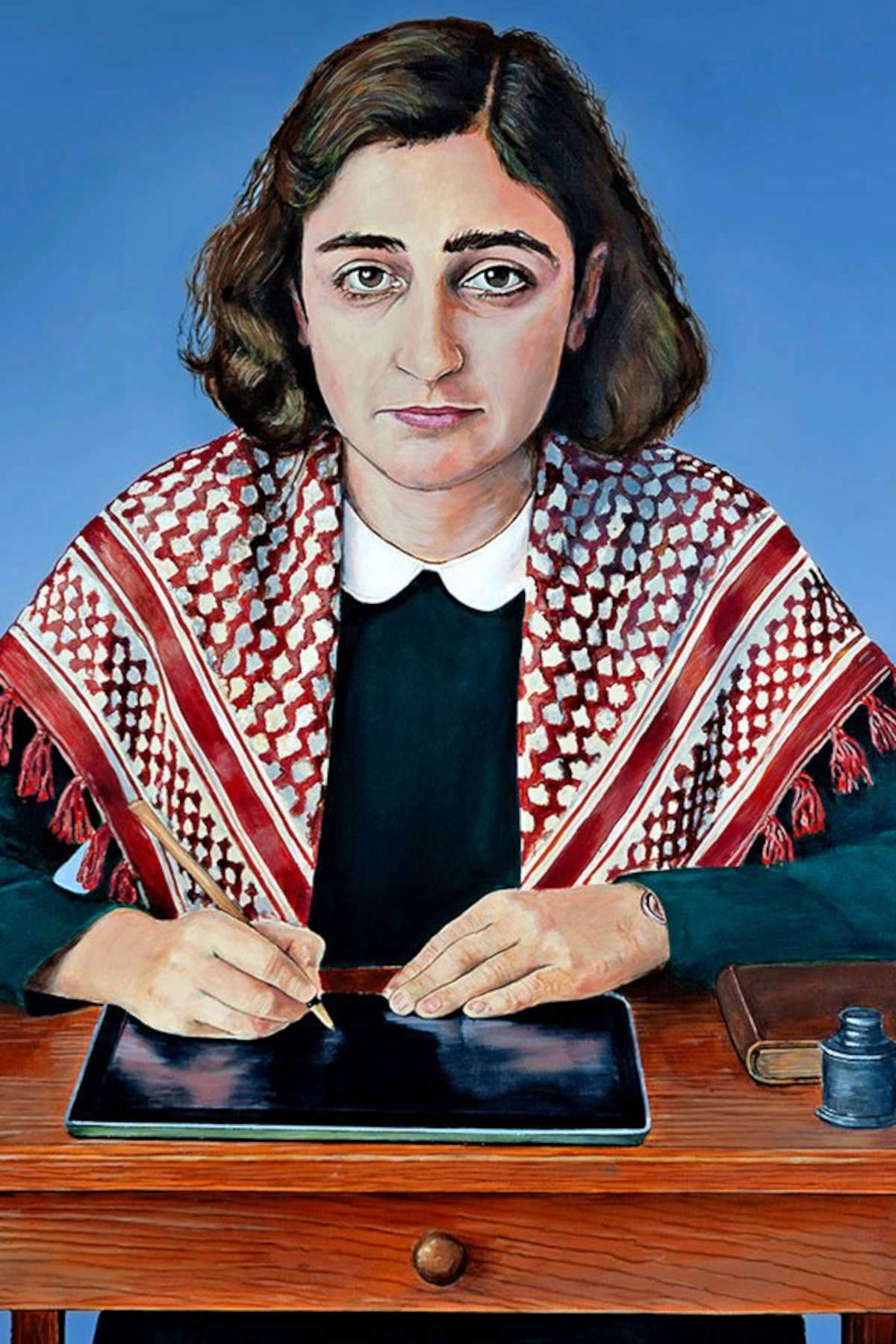
Volker Beck, president of the German-Israeli Society, has filed a criminal complaint against those responsible for the exhibition, accusing them of flouting the memory of the dead and trivializing the Shoah. Beck claims that the painting denies the actual conditions of persecution suffered during the Holocaust, turning a victim of Nazism into a political activist or a symbol of Palestinian national resistance. Doing so, according to the politician, would offend the dignity of the victims, suggesting an improper comparison between the Nazi genocide and the conflict in Gaza.
Costantino Ciervo, a Neapolitan but longtime Berlin resident known for his often provocative works, defended his creative vision. Through his project, Ciervo wanted to promote critical reflection on the conflicts and similarities that can unite seemingly distant cultures. In her illustrative notes, the artist explained that the image of Anne Frank was not intended to be offensive, but on the contrary was meant to be a universal call against all forms of violence and a call for justice and humanity. For the artist, the combination of historical memory and current reality serves to thematize the very issue of genocide as a phenomenon that questions the collective consciousness. Ciervo also posted a video on his Facebook page to reiterate his position.
The Fluxus+ museum, through the mouth of its executive director Tamás Blénessy, confirmed its willingness not to remove the work, despite outside pressure. Blénessy categorically rejected accusations of anti-Semitism, saying that censorious intervention in the exhibition’s content is out of the question. The museum management considers the work a symbol of condemnation of violence and responded to the criticism by installing a statement next to the painting reiterating that remembrance of the Holocaust should serve as a universal warning. However, the management described the legal action taken as a clear attempt to intimidate the institution and the artist.
However, a proposal was made to allow the community itself to write a commentary text, to be displayed next to the portrait of Anne Frank, to present its views and criticisms to visitors. Previously, more drastic hypotheses had also been considered, such as covering the image with a curtain accompanied by a warning of potential sensitive content, but the final choice fell on textual dialogue.
The “COMMON” exhibition, scheduled to close on Feb. 1, is not limited to the case of Anne Frank alone. The exhibition uses artificial intelligence technologies to transform portraits of Palestinian people, placed in front of geographic maps, into “visual twins” who are then displayed with the Star of David, seeking to investigate the concept of mirror identity in conflict.
Local politicians have also sought to intervene in the affair. Andreas Büttner, commissioner against anti-Semitism for the state of Brandenburg, initially suggested that removing the image would be the easiest solution to respect the feelings of the affected community. More recently, Potsdam Mayor Noosha Aubel has taken on a mediating role, stating that the complexity of the situation can only be resolved through direct and respectful confrontation between the parties. Aubel acknowledged that although the exhibition was curated following scientific and artistic criteria, one cannot ignore the sense of unease and deep concern it generates in Jewish organizations, especially in light of the global climate of insecurity.
The debate remains open and is part of a broader reflection on the function of contemporary art in reframing historical trauma. On the one hand there is the need to preserve the specificity and uniqueness of the Shoah from any form of improper juxtaposition, and on the other the need of some artists to make that symbol “alive” and universal in order to denounce the suffering of the present. The Potsdam Public Prosecutor’s Office continues to examine the complaints received, but at the moment has not issued detailed statements on the nature of the charges. Meanwhile, the exhibition continues.
 |
| Anne Frank with a keffiyeh: storm in Germany over Italian artist's work |

Warning: the translation into English of the original Italian article was created using automatic tools. We undertake to review all articles, but we do not guarantee the total absence of inaccuracies in the translation due to the program. You can find the original by clicking on the ITA button. If you find any mistake,please contact us.





















 IT
IT FR
FR DE
DE ES
ES CN
CN


