




by Redazione 17/12/2025


Categories: News / Disclaimer
The history of glass in Venice is rooted in a far more remote, articulate and technologically advanced past than we imagine: the earliest, early medieval phase has long remained on the margins of the narrative.


The history of glass in Venice has its roots in a far more remote, articulate and technologically advanced past than one imagines. When one thinks of Venetian glass in fact, the collective imagination leads to the Renaissance, but this deeply ingrained and universally shared view returns only part of the story. For a long time the earliest phase of the history of glass in Venice, the early Middle Ages, remained on the margins of the narrative, considered a mere antecedent of future Murano excellence. An almost forgotten chapter is now resurfacing thanks to the study of tiny fragments.

An archaeometrical research just published in the journal Archaeological and Anthropological Sciences by researcher Margherita Ferri of Ca’ Foscari University Venice, Department of Humanistic Studies, examines early medieval glass artifacts from San Pietro di Castello, on the ancient island of Olivolo, one of the city’s earliest settlement nuclei, strategically located near access to the lagoon and control of the port routes. The research was conducted in collaboration with Elisabetta Gliozzo of the Department of History, Archaeology, Geography, Art and Entertainment (SAGAS) of the University of Florence and Eleonora Braschi of theInstitute of Geosciences and Georisources of the CNR, and is based on materials found during archaeological excavations carried out in the early 1990s by the Soprintendenza Archeologia, Belle Arti e Paesaggio for the metropolitan city of Venice, with which the Venetian Department of Humanities actively collaborates. The analysis concerns forty-five glass samples datable between the 6th and 9th centuries, which include pottery, working scraps, and a soapstone crucible.


The results return a picture of a surprisingly dynamic early medieval Venice, embedded in wide-ranging trade networks and equipped with advanced technological skills. As early as the eighth century, the city appears as a nerve center of the Mediterranean, capable not only of participating in large-scale trade, but also of incorporating and using the most sophisticated innovations of its time.


One of the most relevant aspects that emerged concerns the shift from traditional natron-based glass production, inherited from the Roman Empire, to that based on vegetable ash. This change, brought about by the difficulty of sourcing Egyptian natron, marked a momentous turning point for European glassmaking. “The answer that emerged from the excavations at San Pietro di Castello,” explains Margherita Ferri, “is surprising. Some fragments of glass produced from plant ashes dating back as early as the 8th century were found here. But the real twist is another: chemical analysis attributes these ancient fragments to a Syro-Levantine production. This means that the Venice of 1300 years ago was not only familiar with this new technology, but its trade was so efficient that it imported state-of-the-art materials produced hundreds of miles away. This places Venice among the very first centers in Italy to embrace and master this new technology, showing it to us as an incredibly receptive and connected center.”
A further discovery concerns a blue natron mosaic tile, within which two different systems of opacification were identified: calcium antimoniate, typical of the ancient tradition and in disuse since the 4th century, and lead stannate, a more modern technique. This seemingly anachronistic coexistence is explained by the practice of recycling. Early medieval craftsmen recast older materials to recover glass, mixing different techniques and traditions. Even the blue coloring reveals sophisticated choices: instead of using pure cobalt, slag from metalworking was used, a cobalt-rich byproduct, a sign of a deep understanding of materials and an economy based on reuse.
Analyses of the provenance of raw glass also delineate a Venice embedded in a highly articulated international trading system. The finds show an almost equal distribution between materials from Egypt and those originating in the Levant, the two main production areas of the time. Venetian trade routes appear flexible and adaptable, capable of responding to political and economic changes in the Mediterranean.
New technologies and exotic objects arrived in Venice either in the form of raw materials destined for local workshops or as finished artifacts. The plant ash-based goblets, for example, show a chemical composition of the raw material that can be traced back to theSyrian-Levantine area, but they have identical shapes to local products made with the natron-based technique. This indicates that raw glass was imported and later processed according to Venetian models. In contrast, the finding of a glass with a conical base, typical of Syrian production and not attested in the Adriatic at that time, suggests the direct import of the finished product, a valuable object.
Early medieval Venice thus appears as a mixed supply chain, based on the import of both raw materials and luxury finished goods for direct consumption, confirming a surprisingly advanced level of economic and cultural organization for the time.
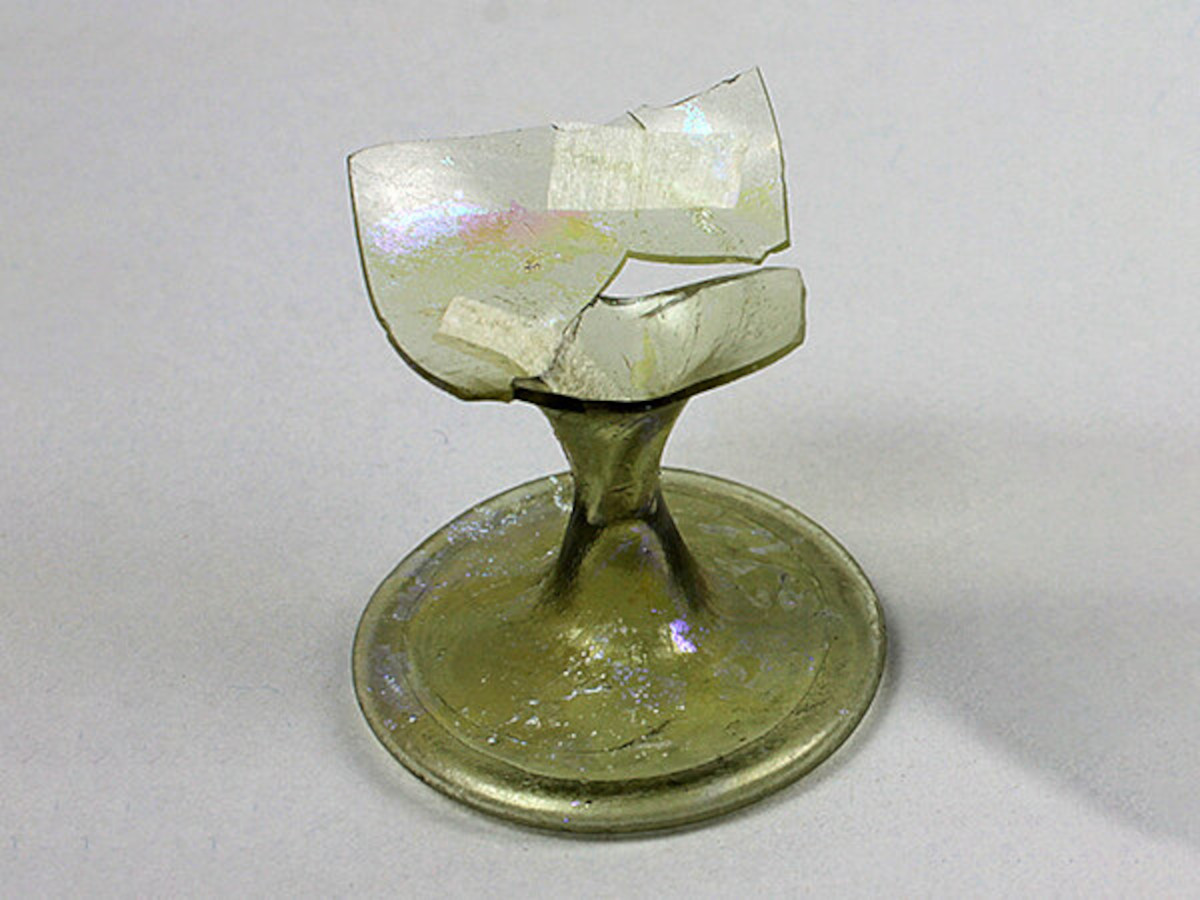
Pictured: early medieval chalice from San Pietro di Castello, similar to those analyzed, undergoing restoration.
 |
| The history of glass in Venice does not start from the Renaissance, but has older origins: new research reveals |
Warning: the translation into English of the original Italian article was created using automatic tools. We undertake to review all articles, but we do not guarantee the total absence of inaccuracies in the translation due to the program. You can find the original by clicking on the ITA button. If you find any mistake,please contact us.