





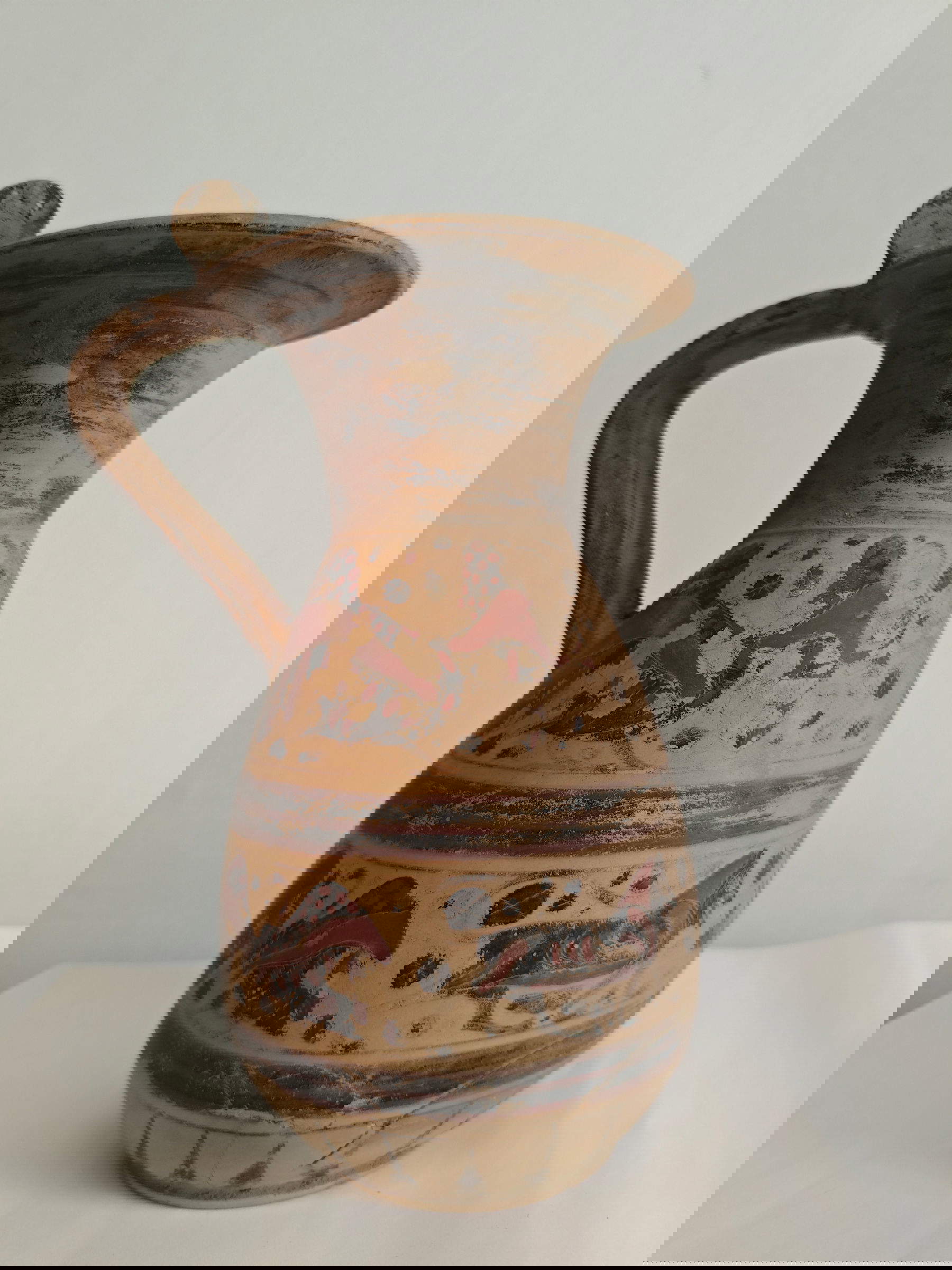
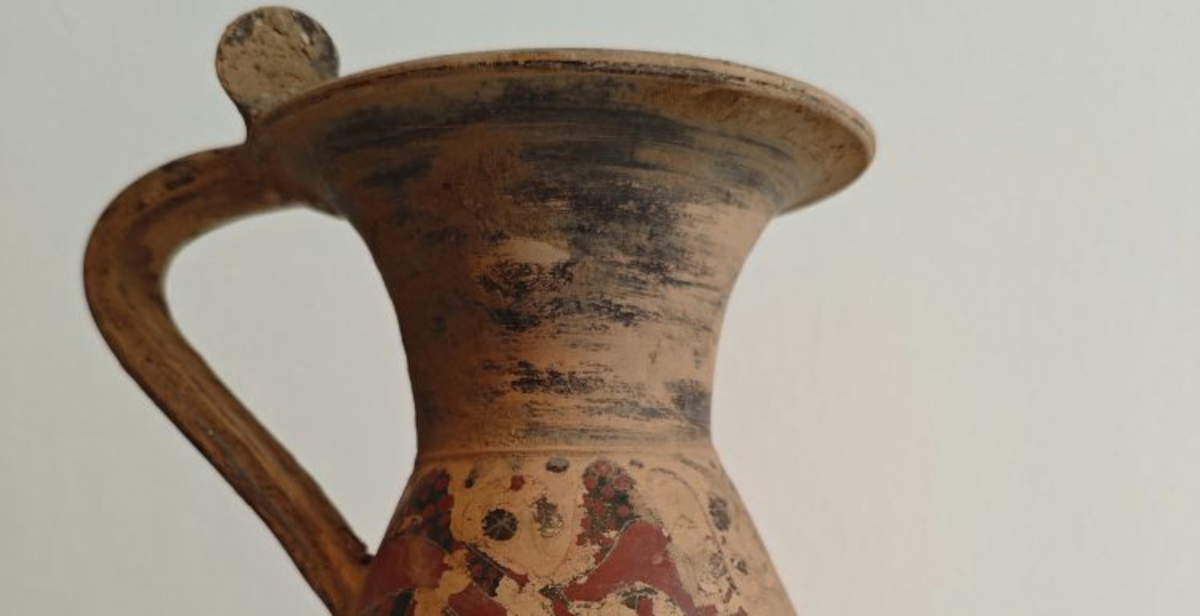
In the first week of December 2025, the Carabinieri’s Cultural Heritage Protection Unit (TPC) in Venice handed over to the Soprintendenza Archeologia, Belle Arti e Paesaggio for the metropolitan city of Venice a collection of ten archaeological artif acts of significant historical and artistic value. Prominent among the artifacts is an Etruscan-Corinthian wheeled olpe (a pitcher) dating to the first decades of the sixth century B.C., which can be compared with a specimen preserved at the National Etruscan Museum of Villa Giulia. The vase has parallel brown, red and white bands on the neck; on the body are two overlapping registers with real and fantastic animals, interspersed with circular rosettes graffitied in the shape of a cross and a lower “wolf’s tooth chain” decoration.
The artifacts returned include mainly impasto and fine tableware ceramics, produced and circulated mainly in the Middle Etruscan-Latium Tyrrhenian area. Among the artifacts, a limited presence of imported items is also reported, related to Mediterranean mobility dynamics and prestigious social contexts. The dating of the finds lies between the Orientalizing and Late Archaic Ages, that is, between the 8th and 6th centuries BCE. The investigation, coordinated by the Venice Public Prosecutor’s Office, began in October 2024 following an inspection carried out at a private home as part of an inheritance. The operation was conducted by the ABAP Superintendency, in structural collaboration with the Carabinieri TPC. The inspection revealed the absence of valid property titles from the owner of the finds, who nonetheless cooperated in the investigation by reporting the find in accordance with the Cultural Heritage and Landscape Code.
The investigations reconstructed the path of the finds, which came from clandestine excavations in the central-Italic area, then were fenced in Ceretan and Etruscan-Latium areas, until they reached the hands of the most recent bona fide holders, who lacked the necessary possession titles. Italian law gives archaeological goods from the national territory the presumption of belonging to the cultural domain. A private individual can claim ownership only by proving that the artifacts were assigned to him by the state as a fortuitous discovery award, for compensation, or that they were in his possession, or that of others, prior to the enactment of Law No. 364 of June 20, 1909. Any alienation or legal act performed in violation of the regulations of the Cultural Heritage Code is considered null and void. During the investigation, the Carabinieri TPC carried out technical-historical-artistic examinations together with the Venice ABAP Superintendency, receiving operational support from the Venice-Mestre Carabinieri Company. After the necessary investigations, in May 2025 the Public Prosecutor’s Office ordered the release of the property and its return to the state, represented by the Venice ABAP Superintendency. On the order of the General Directorate of Archaeology, Fine Arts and Landscape of the Ministry of Culture, the artifacts were assigned for enhancement to the National Archaeological Museum in Fratta Polesine, under the jurisdiction of the Veneto National Museums Regional Directorate.
The recovery of archaeological finds is one of the main investigative directions of the Venice Carabinieri TPC Unit, which operates with constant checks at commercial establishments in the sector and with the collection of reports from scholars and enthusiasts. The activity relies on the cooperation of the Ministry of Culture offices and the Superintendencies of Bolzano and Trento. Restitution to the public heritage enables the collective enjoyment of assets that represent historical and cultural evidence of the territories concerned, bringing to light objects of civilization that tell the story of ancient communities and social contexts. The principle of the presumption of innocence remains valid: the responsibility of the people involved in the events under investigation will be ascertained only following irrevocable criminal judgments or decrees.
 |
| Veneto, Carabinieri hand over ten stolen archaeological artifacts to the Superintendency |

Warning: the translation into English of the original Italian article was created using automatic tools. We undertake to review all articles, but we do not guarantee the total absence of inaccuracies in the translation due to the program. You can find the original by clicking on the ITA button. If you find any mistake,please contact us.




























 IT
IT FR
FR DE
DE ES
ES CN
CN


