





Since the issue of the Russian presence at the Venice Biennale has become common knowledge, the social pages of newspapers and art magazines, including the one I direct, have become a receptacle for amiable quips about the freedom of art (to which, for some reason that escapes me, sport is always added), constantly invoked without thinking that never in history has art been a neutral activity. Most praise, therefore, Pietrangelo Buttafuoco’s choice not to exclude Russia from the next edition of the Venice Biennale, in the name of a sort of franchise, a safe-conduct, a privilege of the total freedom that art should enjoy without derogation. “Art should not be censored, art should always be free,” says most commentators. This is an interesting phenomenon, which gives an idea of how tenaciously widespread is still the romantic myth of the artist as a genius divorced from reality and operating under exclusive dictation of a natural impulse, without having to answer to anyone other than his genius, his inspiration. Hence, therefore, also the profoundly naive idea that the Venice Biennale is a kind of Arcadia of virgins, a free coterie of chosen spirits, a Woodstock of the visual arts where creative people from all over the globe gather to express themselves in complete freedom. This probably also gives rise to the idea that the pavilion of Russia, as well as that of Italy, France, Congo, whoever, should be regarded as a kind of aseptic, free conciliabule of artists from the relevant countries. But that is not how the Venice Biennale works. If ever there were to be neutral art, then that art certainly does not dwell within the national pavilions of the Biennale.
If anything, the Venice Biennale should be viewed as a world art championship where the national participations are expressions of their respective countries and governments. The national pavilion is, in essence, the image with which a country intends to present itself in the eyes of the world. The Venice Biennale is soft power even before it is art. Let’s call it “art diplomacy,” if you will. Often even democratic countries do not shy away from this logic, although the room for artists and curators to maneuver, in these cases, is decidedly wider, and although national pavilion spaces often give rise to tension, friction and controversy, as is only natural. Curators are typically ministerial appointees, or at least are chosen by agencies that report to the government of the country that intends to take part in the Venice Biennale. See, by way of example, the recent trajectory of the U.S.: first Trump administration, two artists (Mark Bradford in 2017 and Martin Puryear in 2019) who I would not feel would be exactly close to Trump’s sentiment, and who respectively addressed the theme of the U.S. social crisis and the implications of the concept of freedom. Biden administration, two artists (Simone Leigh in 2021 and Jeffrey Gibson in 2024) called upon to re-discuss their country’s history and reflect the image of plurality, openness, and attention to minorities that the administration intended to propose to its citizens and the world. Second Trump administration: an abstract sculptor, Alma Allen, was chosen by virtue of a supposed “American excellence” that her work would embody, and we know she will bring to Venice her works that, as I understand it, are supposed to represent the American landscape. Bottom line: since Trump, in his second administration, also wanted to put himself at the head of a domestic culture war (his attitude toward museums is also evidence of this), the administration opted for an artist far removed from the sensibilities of the two who preceded him. However, there is also a necessary clarification to be added: in democratic countries pavilions are usually also lavishly funded by private donors and supporters, a circumstance that allows for a space of independence that, in the pavilions of countries where there are no democratic systems, usually financed totally by the state apparatus, does not exist.
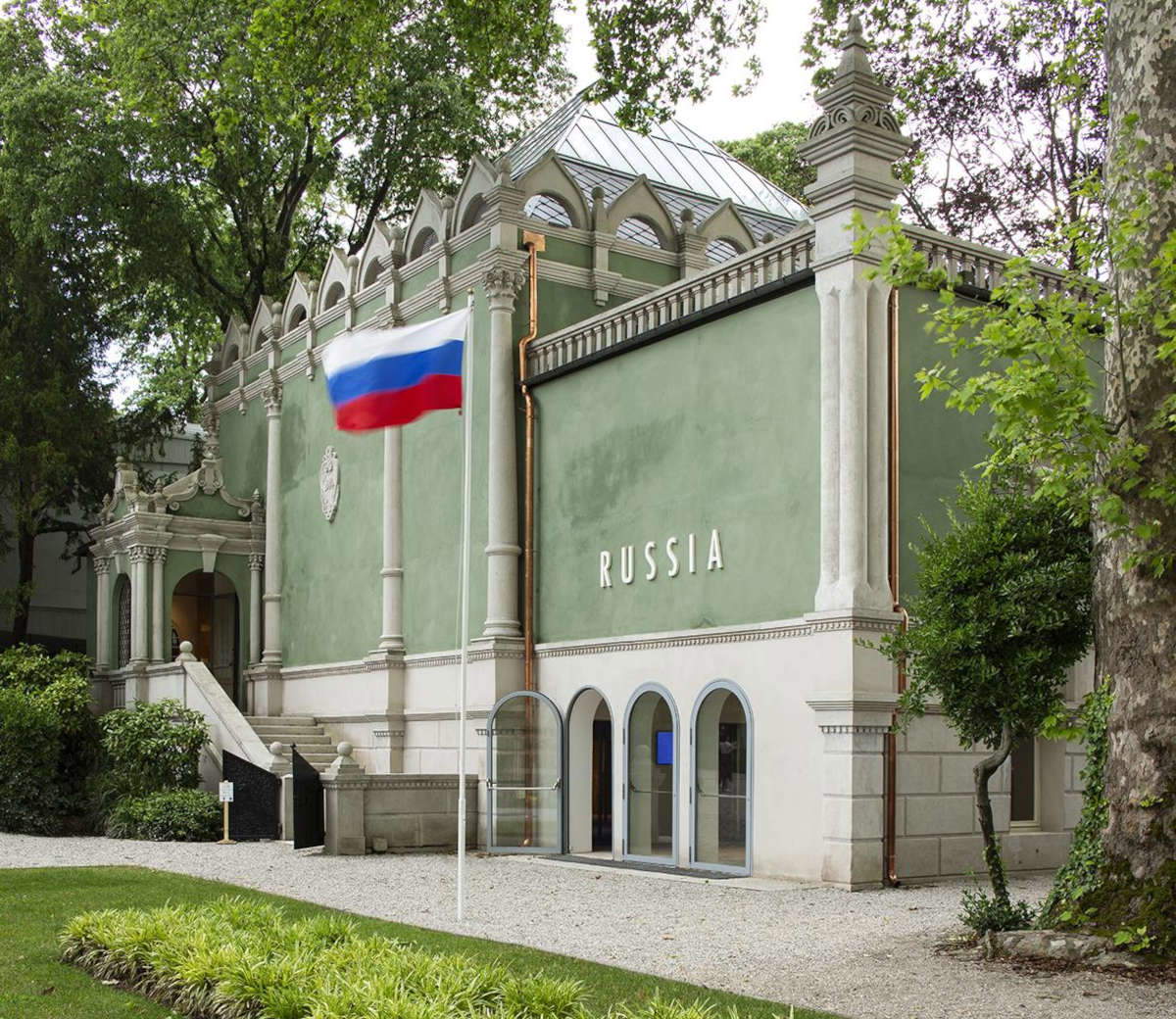
So if even in democratic countries national pavilions are often a reflection of their countries’ administrations, I do not see why it should be any different for Russia. Especially since the management of the Russian presence at the Biennale is entrusted to an advisor to Putin who a few months ago wrote an editorial advocating the restoration of official censorship, and is overseen by the daughter of the deputy director of the state-owned company that manufactures the weapons with which the Russians fight the Ukrainians. In Russia, as is well known, there is no room for dissent. Dissident artists are not allowed to work in their homeland. There are of course those who say that even in the past some artists have contested their pavilion. And it is true that even in national pavilions art can produce ambiguity and dissent (although, in history, it has happened much more often in the pavilions of democratic countries). It should also be added that cases of open dissent have been sporadic, and objections have been consummated when a given event that the artist intended to contest in controversy with his or her own country occurred after the artist had been chosen. This is the case, for example, with the 2022 Russia Pavilion itself: the two artists who were supposed to represent the country, Kirill Savchenkov and Alexandra Sukhareva, withdrew because they did not feel up to exhibiting their works when their government was raining missiles on Ukraine (and from looking at their current resumes, it appears that they have not exhibited in Russia since, despite the fact that they could count on a rather hectic exhibition schedule until 2021). I therefore find it hard to believe that the artists chosen by the curator of the current Russian pavilion will come to Venice to contest their country. I highly doubt it, not least because some of the artists chosen have recently supported the actions of the Russian government, so I fear the possibility of a contestation is unlikely (I hope so, but if they asked me to bet chips on it, I would cordially decline).
All this is to say that the dogma of freedom of art, unfortunately, should not be used to legitimize a national presence at the Venice Biennale. I can accept that the chatter about “art always having to be free” and the “Biennale always having to be a space for confrontation” comes from the public who have never been to the Venice Biennale and think, because of that romantic myth mentioned above, that the Biennale is a kind of big hippy commune that gathers near St. Mark’s Square every two years: it will be necessary, however, to remember that those who reason in this way, either through lack of knowledge of the subject or through naiveté, unwittingly lend themselves to Russian propaganda (we have seen it: the characters behind the current Russian pavilion try to win the sympathies of our public opinions by presenting themselves as the bearers of a message of dialogue). I also understand those who would like to exclude, like Russia, Israel or the United States: it is a position I do not share, for reasons I have already explained, but at least one imagines that those who support it know what the Venice Biennale is about and know its political nature. Much less acceptable, on the other hand, is for those who are ranting about absolute freedom to be the insiders, those who should know how the Venice Biennale works, but who probably, at this point, go to Venice between April and May just to gorge themselves on spritzes and sardines in saor and while they are there take a stroll through the pavilions. If an intellectual cannot distinguish between the presence of an artist and a national presence, then it is better for him to limit himself to the role of buffet intellectual, of minstrel, and avoid intervening on topics that could turn him into the unwitting shoeshine of the propaganda of a country hostile to us. Russia’s presence at the Venice Biennale is not the presence of Russian artists, but the presence of the Russian state. Excluding a Russian artist would be censorship, excluding Russia is a kind of, let’s see it this way, political sanction. So, to proclaim unconditional openness is to ignore the fact that at the pavilions of the Venice Biennale, art is also a reflection of the image of various countries and their governments.

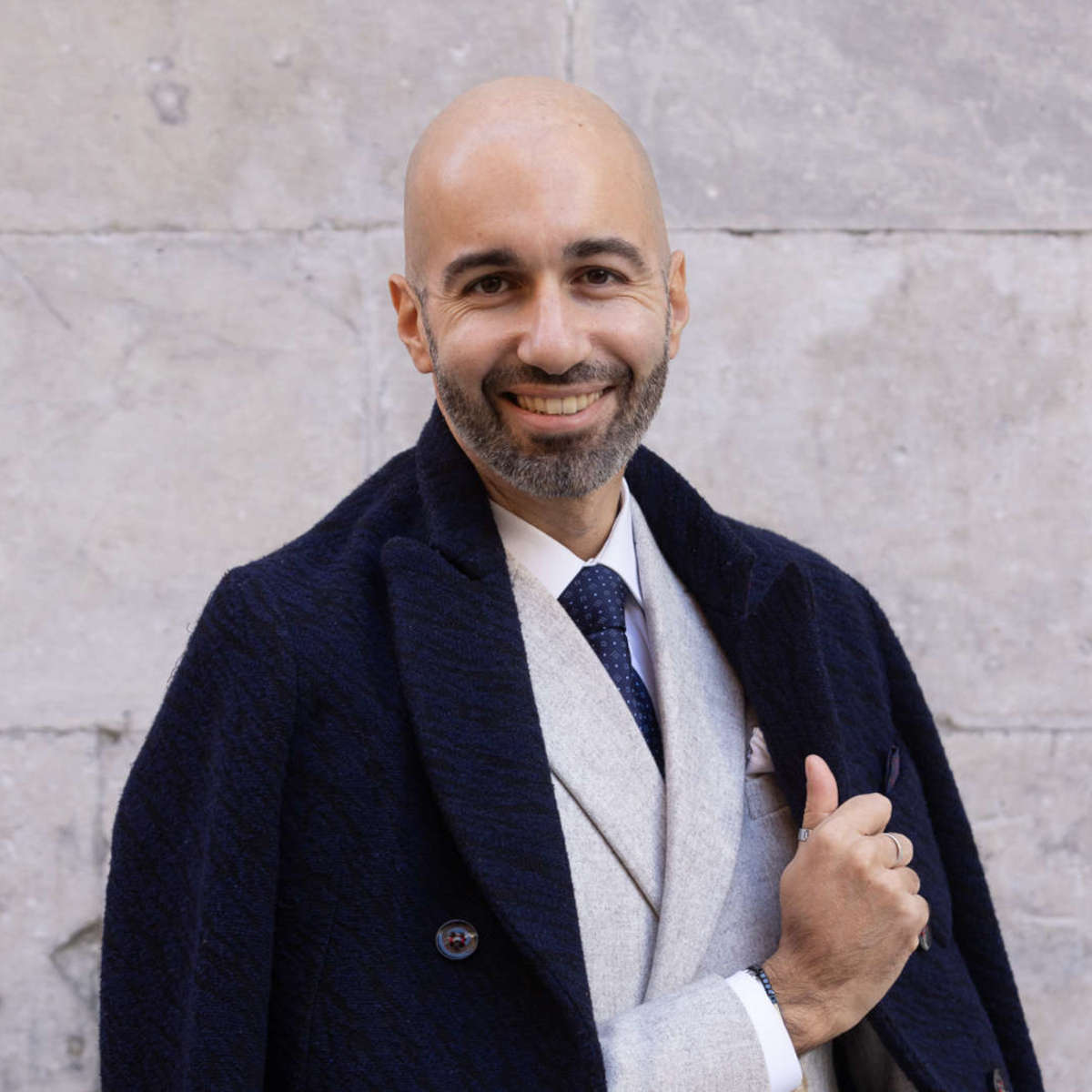
The author of this article: Federico Giannini
Nato a Massa nel 1986, si è laureato nel 2010 in Informatica Umanistica all’Università di Pisa. Nel 2009 ha iniziato a lavorare nel settore della comunicazione su web, con particolare riferimento alla comunicazione per i beni culturali. Nel 2017 ha fondato con Ilaria Baratta la rivista Finestre sull’Arte. Dalla fondazione è direttore responsabile della rivista. Nel 2025 ha scritto il libro Vero, Falso, Fake. Credenze, errori e falsità nel mondo dell'arte (Giunti editore). Collabora e ha collaborato con diverse riviste, tra cui Art e Dossier e Left, e per la televisione è stato autore del documentario Le mani dell’arte (Rai 5) ed è stato tra i presentatori del programma Dorian – L’arte non invecchia (Rai 5). Al suo attivo anche docenze in materia di giornalismo culturale all'Università di Genova e all'Ordine dei Giornalisti, inoltre partecipa regolarmente come relatore e moderatore su temi di arte e cultura a numerosi convegni (tra gli altri: Lu.Bec. Lucca Beni Culturali, Ro.Me Exhibition, Con-Vivere Festival, TTG Travel Experience).
Warning: the translation into English of the original Italian article was created using automatic tools. We undertake to review all articles, but we do not guarantee the total absence of inaccuracies in the translation due to the program. You can find the original by clicking on the ITA button. If you find any mistake,please contact us.



























 IT
IT FR
FR DE
DE ES
ES CN
CN


