





In Spain , an important acquisition for the María Cristina Masaveu Peterson Foundation (FMCMP) in Madrid, which recently enriched its collection by securing on the international market a work by Artemisia Gentileschi (Rome, 1593- Naples, after August 12, 1654): an oil-on-canvas Madonna del Latte auctioned by Dorotheum in Vienna on October 22, 2024, when the painting sold for 565,000 euros, from an initial estimate of between 400,000 and 600,000 euros. This painting is dated around 1609-1610, a crucial period when Artemisia was still a teenager, trained in the workshop of her father, Orazio Gentileschi. Having been made when the painter was about sixteen or seventeen years old, the work stands as one of her earliest known creations and is a rare and important testimony to her early talent.
Artemisia’s training came under the guidance of Orazio, whose influence is evident in her early works, especially in this Madonna and Child. The young artist’s skill enabled her to faithfully replicate her father’s style. Horace’s influence can be seen in his color palette, in the physiognomy of the characters, in the delicate rendering of shading and modeling of the flesh tones, and in some of the details, particularly in the way draperies are depicted. It is likely that Artemisia, like her father, who in the years between 1590 and the early 1600s worked in direct contact with models as did Caravaggio, learned to paint by the same method. Despite this strong paternal imprint, the work already manifests a distinctive quality: Artemisia demonstrated from the beginning an ability to infuse meaning and emotion into her representations. The evident affection between mother and son, clearly expressed in this work, is the element that places her work on a separate plane from that of her father.
The attribution to Artemisia was confirmed by one of the painter’s leading experts, Riccardo Lattuada, who pointed out the relationship of this work with Scipione Pulzone’s Holy Family with St. Elizabeth and St. John the Baptist, dating from 1588-1590 and preserved in the Galleria Borghese in Rome, as well as with an engraving by Marcantonio Raimondi. Similar to Pulzone’s painting are both the position of the Madonna’s legs and the way Mary’s and the Child’s hair are rendered, characterized by the same golden highlights.
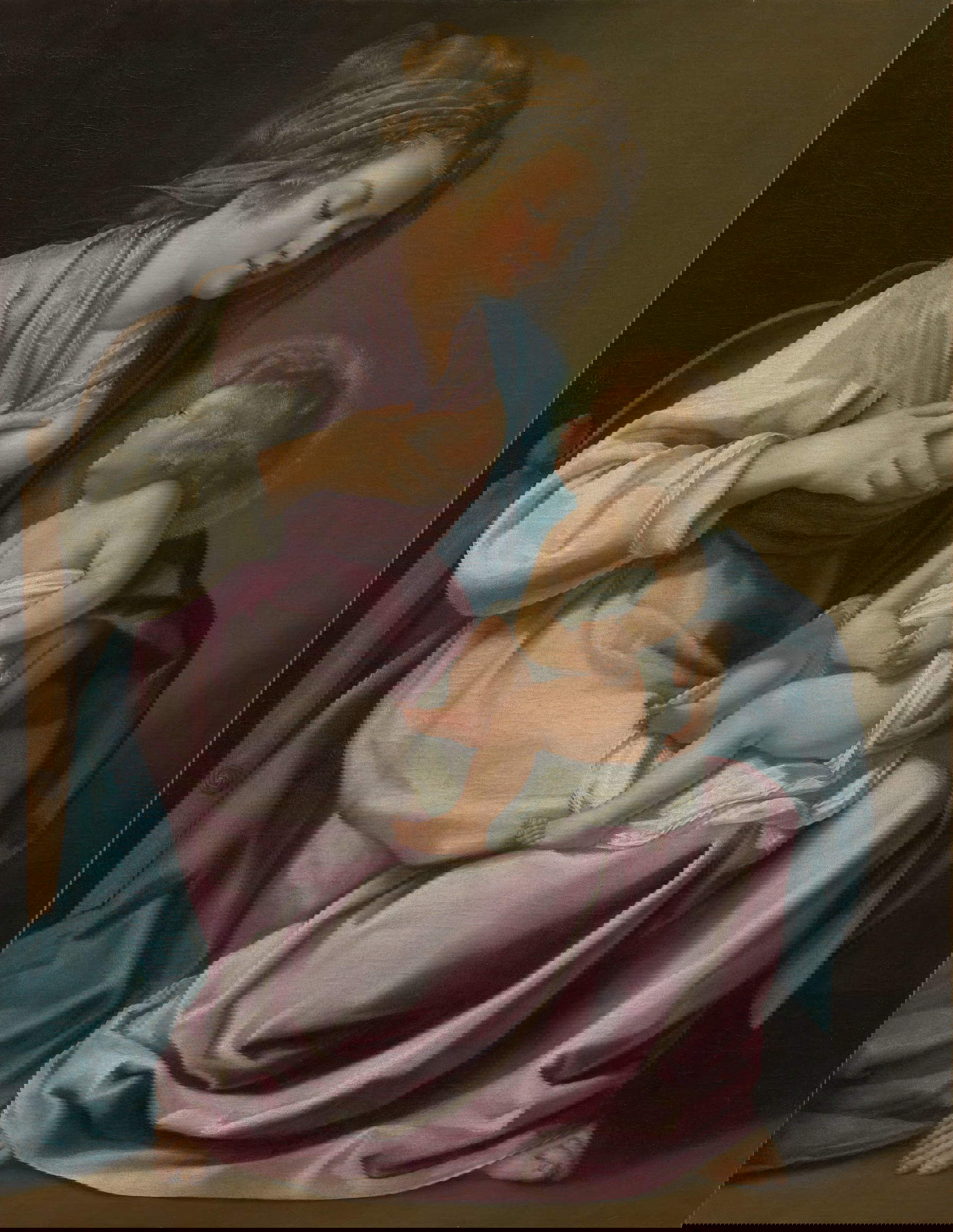
The work depicts the iconography of the Virgo lactans or Madonna of Milk, an extremely popular subject in Catholic spirituality from the late Middle Ages onward. Although the Council of Trent (1545-1563) later discouraged its depiction for reasons of modesty, since the act of breastfeeding, although a symbol of comfort and protection offered by Mary to believers, required the exposure of the Virgin’s breasts, Artemisia resolves the issue in a chaste manner. Indeed, in this composition, the Virgin demurely covers her right breast, wrapping her hand around the one offered to the Child. The figure of Mary is placed on a nurse’s chair, a low seat that forces her to keep her legs bent to accommodate the Child on her lap. This arrangement, combined with the pronounced design of the folds of the robes and the use of contrasting light, gives the figure a monumental appearance, designed for a subdued view.
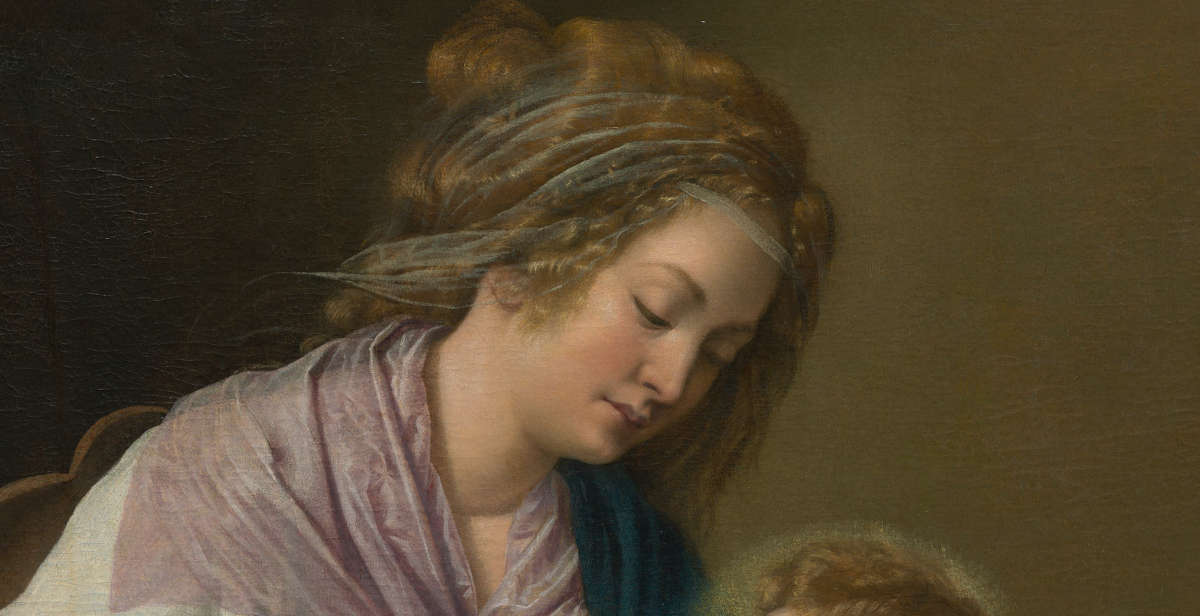
Some details make this version particularly unique. The Madonna has a more youthful appearance than later versions, with a serene, slightly chubby face and lighter, disheveled hair. It has been suggested that Artemisia used herself as a model, as the features of the female protagonist’s face appear similar to hers. The Child also shows a refinement of execution that differs from later replicas. Another distinctive element of this composition is the transparent scarf wrapped around the Madonna’s neck and the overall harmonious and diffuse coloring of the painting.
Because of its size and theme, this canvas had to serve as an excellent calling card of Artemisia’s artistic abilities. The success of the model is confirmed by the fact that there were made, at least, three subsequent examples, painted after her move to Florence following her marriage in 1612. The example acquired by the Masaveu Peterson Foundation is recognized as the initial model, and it is speculated that it may have accompanied the artist on her trip to Tuscany.
Other known versions of the Madonna del Latte executed by Artemisia include one preserved in the Galleria Spada in Rome (dated 1610-1611) and another from the Medici collections, now in the Galleria Palatina of Palazzo Pitti in Florence (dated 1616-1618). Although the iconography is identical and the compositions similar, variations exist, particularly in the pose of the Christ Child. The three works were compared at a monographic exhibition at the Musée Maillol in Paris in 2012, where it was noted that the figures maintain comparable dimensions in all compositions.
Artemisia, following a common practice for the time, especially prevalent in Tuscany in the 16th century and also in Rome, replicated her compositions, with more or less variations, by employing preparatory drawings and cartoons. Artemisia’s use of such tools is also documented in her correspondence with clients, particularly when she was in Naples. Francesco Solinas has suggested that all versions of the Madonna del Latte may have been derived from similar preparatory drawings or cartoons.
A technical analysis conducted by Gianluca Poldi offered insights into the execution methodology. The artist used a canvas prepared with a dark background (brown), but applied a white primer in specific areas to ensure the brightness of the final color, such as under the Madonna’s robe and in the highlights of the cloak.
Spectroscopic analysis revealed the use of fine pigments, including natural ultramarine (derived from lapis lazuli) mixed with lead white for the blue cloak, as well as a red carmine-type lacquer pigment for Mary’s pink dress, and several yellow and brown ochres and earths. Of particular interest is the technique used for the flesh tones, to which the artist added significant amounts of coarsely ground lead-based yellow, in addition to the traditional mix of lead white, cinnabar and ochre.
Infrared reflectography revealed some compositional changes made directly on the canvas, especially regarding the figure of the Child: his facial profile was initially painted slightly closer to his mother’s breast, and the position of his legs and right arm were also corrected. These regrets indicate that the artist worked from a preliminary study (probably on paper), but modified the work in the course of execution, a method that would also characterize his later works. The painting was made before the well-known and documented public trial against Agostino Tassi, which took place between the spring and winter of 1612. Tassi, a colleague of Orazio’s on several projects, abused Artemisia in 1611. After Tassi’s conviction (which was never served), Artemisia married the Florentine Pierantonio Stiattesi on November 29, 1612, moving to Florence the following January, where she remained for seven years, later becoming a celebrated artist, active in Naples, Rome, Venice and even London.
The attributional history of the painting has seen several phases. Initially sold in Paris in 2010 with attribution to Artemisia’s workshop, it was later acquired by a private collection in Switzerland. The work was exhibited as a work by Artemisia Gentileschi in the monographic exhibition Artemisia Gentileschi - History of a Passion in Milan (Palazzo Reale, 2011-2012) and Paris (Fondation Dina Vierny - Musée Maillol, 2012). Despite a 2011 critical review by Gianni Papi questioning its authenticity, the attribution has been supported by curators such as Roberto Contini and Francesco Solinas, and has also been independently endorsed by Riccardo Lattuada.
The María Cristina Masaveu Peterson Foundation announced that the work, exhibited for the first time in Spain at the FMCMP Center in Madrid, will remain on public view on this occasion until January 25, 2026, and will be accompanied by complementary activities, including a conference on the theme of Virgo Lactans.
 |
| An early work by Artemisia Gentileschi has been acquired by a Spanish foundation: exhibition in Madrid |

Warning: the translation into English of the original Italian article was created using automatic tools. We undertake to review all articles, but we do not guarantee the total absence of inaccuracies in the translation due to the program. You can find the original by clicking on the ITA button. If you find any mistake,please contact us.
























 IT
IT FR
FR DE
DE ES
ES CN
CN


