





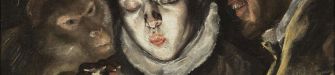
The Vatican Museums let it be known that they have found a work by El Greco (Domínikos Theotokópoulos; Candia, 1541 - Toledo, 1614) hitherto unknown because it was misunderstood: it is a Redeemer , which is now on display at thePapal Palace in Castel Gandolfo until June 30, in an exhibition organized to mark the 800th anniversary of the death of St. Francis of Assisi: on one side, therefore, the newly discovered face of the Redeemer, on the other a St. Francis receiving the stigmata. Two small-format paintings, both intended for private devotion, which become an opportunity to delve into El Greco’s artistic genesis.
The Redeemer, painted between 1590 and 1595, comes from the Ambassadors’ Room of the Vatican Apostolic Palace. The work, a small oil on panel, 45 by 29 centimeters, belonged to Spanish Catholic intellectual and politician José Sánchez de Muniáin, who donated it in 1967 to Paul VI. The presence of four small holes along the edges suggests that the panel may have been used in the past as a portable altarpiece. For a long time the painting remained misunderstood, partly due to a lack of thorough studies and compromised conservation conditions. As early as the 1960s, in fact, the work looked degraded and was probably repainted. At a time when the rediscovery of El Greco fueled the market and the circulation of forgeries, an unknown forger intervened on the panel, covering the original drafts and summarily tracing the image of Christ.
The recent restoration campaign, conducted in the Vatican Museums’ Laboratory of Restoration of Paintings and Wooden Materials under the direction of Master Restorer Paolo Violini, has completely overturned knowledge of the work. The intervention, entrusted to restorer Alessandra Zarelli and accompanied by the scientific analyses of the Scientific Research Cabinet directed by Fabio Morresi, has brought to light an unexpected discovery: beneath the visible surface lies what the Vatican has called “a pictorial palimpsest.”
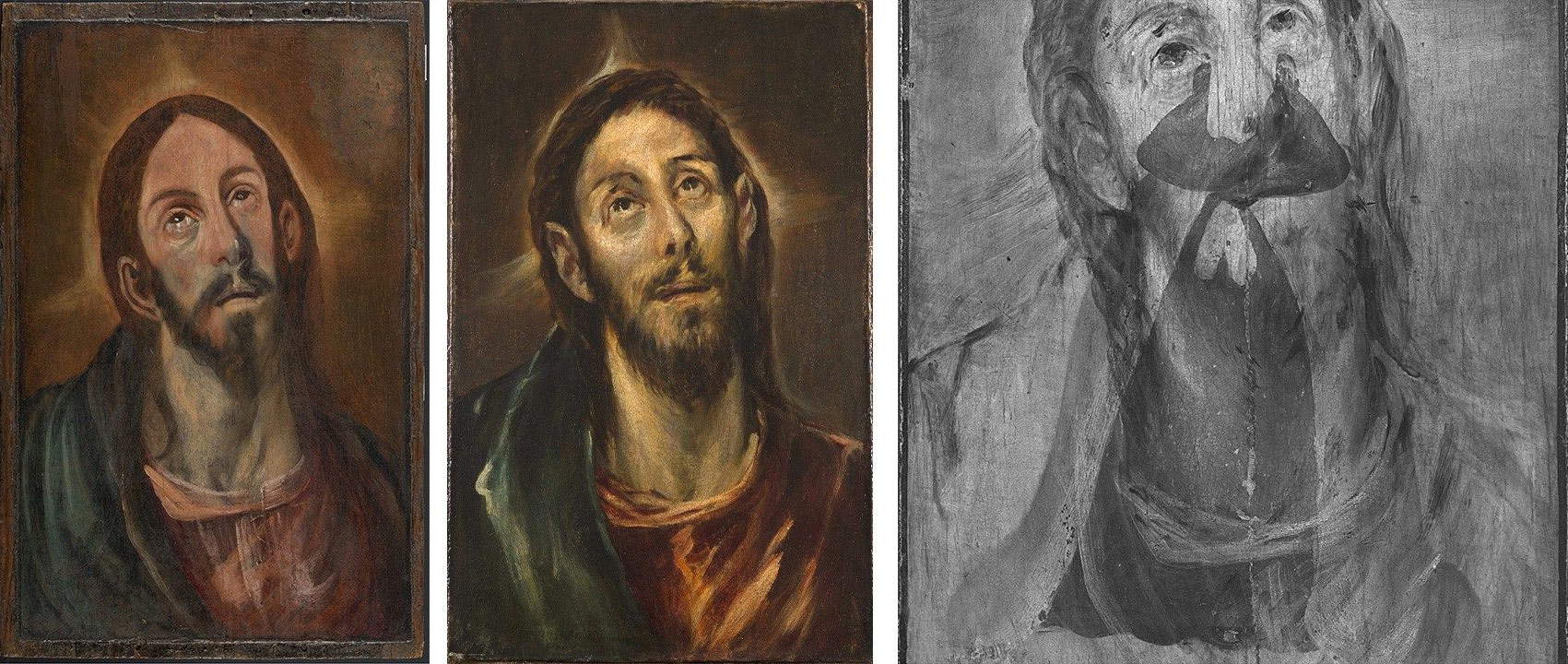
The cleaning made it possible to recover the original layers and, progressively, to identify elements whose presence was not even suspected. In fact, the investigations revealed two additional underlying drafts, which can be traced to as many sketches of works by El Greco. Comparison of the data with other paintings by the artist confirmed the full authorship of the panel, restoring to it a historical and artistic value of extraordinary importance.
Below the surface of the Redeemer, reflectography identified in the upper left corner the figure of a Madonna and Child, part of a study for an Apparition of the Virgin to Saint Lawrence. Below Christ’s face, on the other hand, the figure of St. Dominic in adoration of the Crucifix, a subject El Greco tackled around 1590, emerged barely hinted at. The painting thus appears as a kind of pictorial “notebook” on panel, with three overlapping images documenting different phases of the artist’s work.
What had long been considered almost a copy or a historical forgery turned out, thanks to restoration, to be a complex and authentic work, capable of testifying to the workings of El Greco’s workshop and creative method. An artist who, trained as a painter of icons in the Byzantine tradition, was able to evolve in an original and visionary direction, profoundly influencing later movements such as Impressionism and Surrealism.
The exhibition tour allows a close look at the results of scientific investigations and restoration, which have transformed the perception of the Redeemer’s work. The intervention has restored legibility to the original drafts and made it possible to clearly distinguish between the authentic parts and those added at a later time. As pointed out by the scholars involved, before the restoration the painting was perceived in the form in which it had come to the Vatican Museums, marked by the alterations of time and subsequent interventions. Instead, the operations conducted have brought to light a set of elements that tell the complexity of the artistic work and open new perspectives for study.
The discovery of the underlying images, some of which are visible even to the naked eye, gives the painting a layered dimension, making it a valuable document not only from an aesthetic point of view, but also from a historical and technical one. It is a direct record of the creative process, which rarely emerges so clearly in ancient works.
|
| Vatican Museums resurface a work by El Greco |

Warning: the translation into English of the original Italian article was created using automatic tools. We undertake to review all articles, but we do not guarantee the total absence of inaccuracies in the translation due to the program. You can find the original by clicking on the ITA button. If you find any mistake,please contact us.
























 IT
IT FR
FR DE
DE ES
ES CN
CN


