





An excavation and restoration site of the Villa of Poppea is currently underway at Oplontis-Torre Annunziata, which is particularly involving the famous Hall of the Mask and the Peacock, one of the residence’s most refined rooms, decorated in II style. From the recently begun archaeological investigations, new and striking fragments of highly refined frescoes are emerging, including vivid figures of peacocks and masks.
The operation, which was initiated with the aim of clarifying some aspects related to the development of the western sector of the villa, along the urban section of Via dei Sepolcri, and solving problems of a conservative nature, also represents an important opportunity to enhance the archaeological and urban context. In fact, the excavation will make it possible to establish a direct connection with the nearby Spolettificio Borbonico, where new museum exhibition spaces, storage facilities and additional services will be built in the coming years.
The first results of the research, including the completion of the excavation of the hall, are presented in a contribution published in thee-journal of Pompeii excavations.
“Despite the traces present and the interpretative efforts made at the time of the first excavations, the real course of this room and those nearby until today retained many uncertainties that the current excavation work will be able to clarify,” explains Pompeii Archaeological Park Director Gabriel Zuchtriegel, “as well as uncovering new decorated portions with extraordinary details and colors, of which we can already admire some previews.”
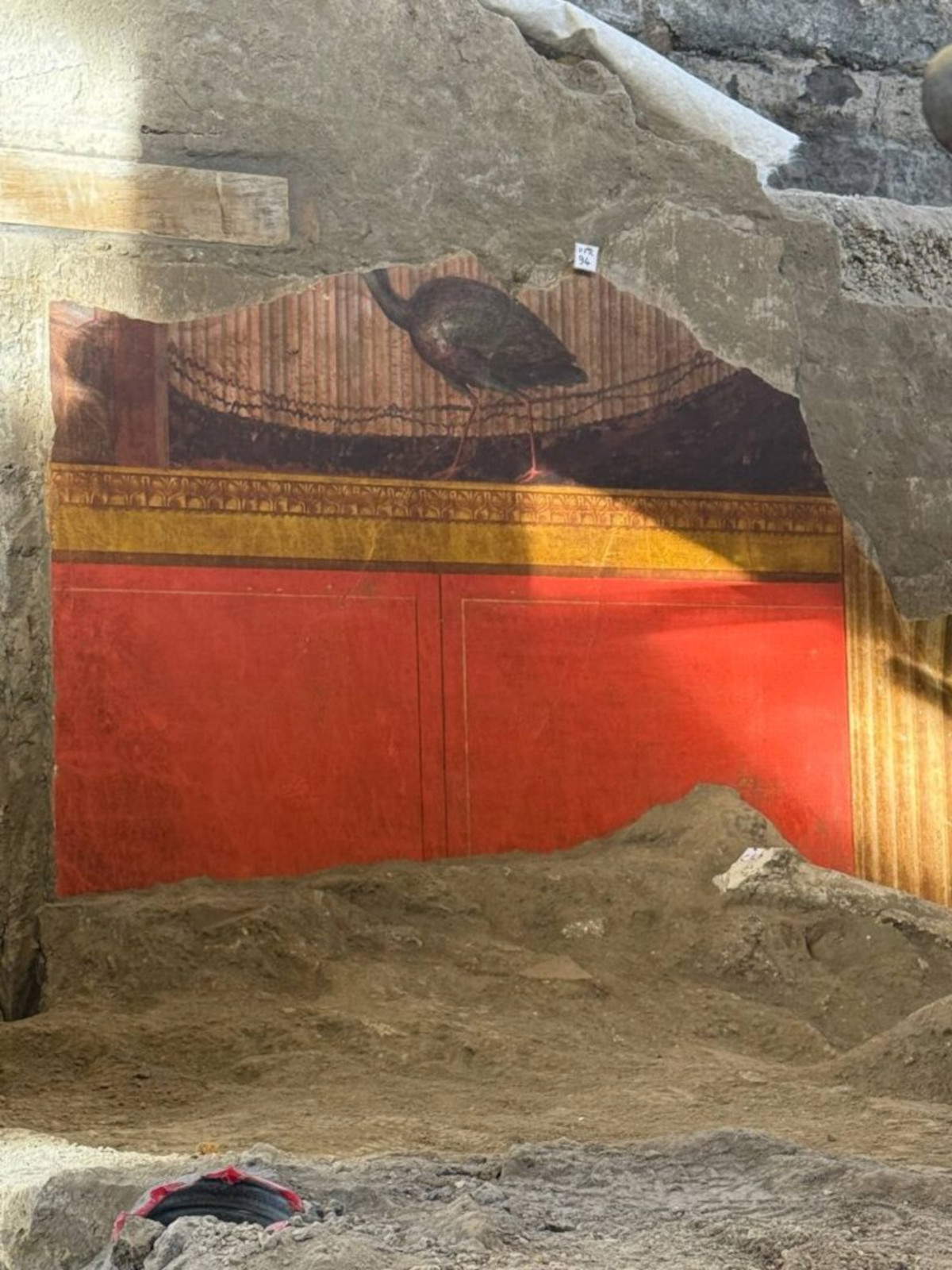
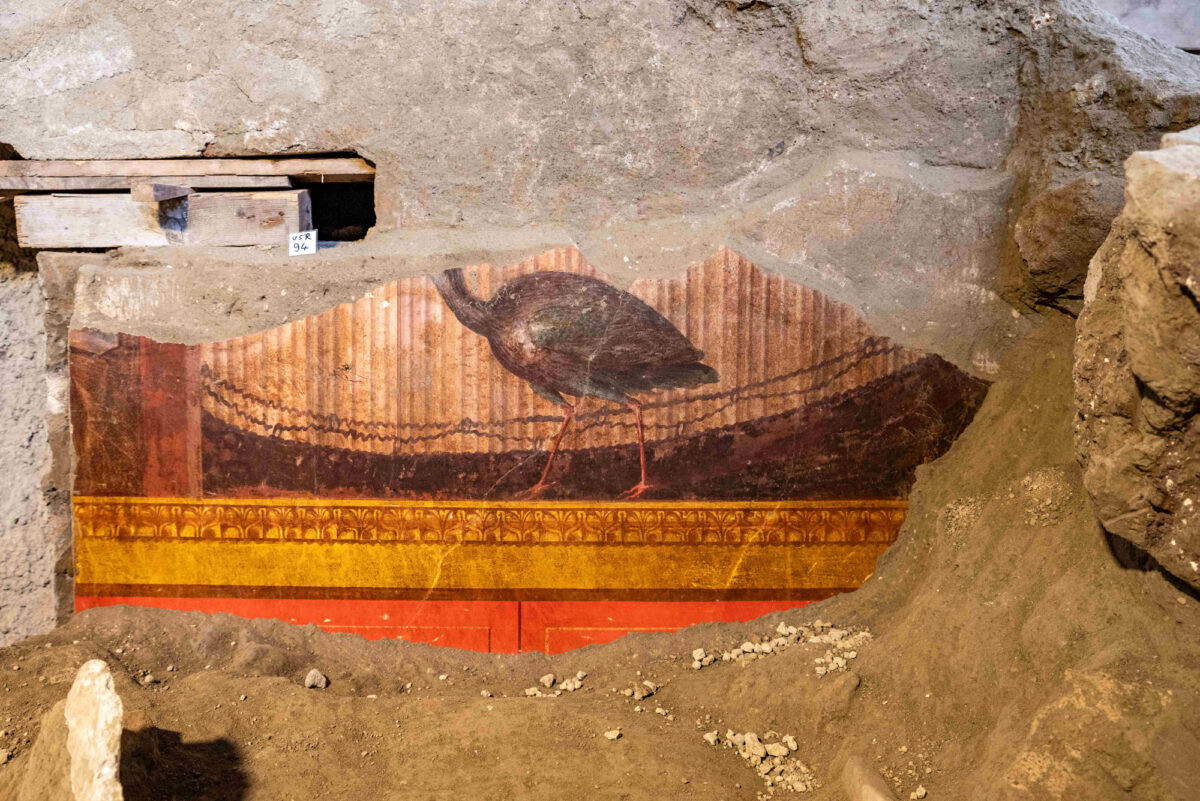
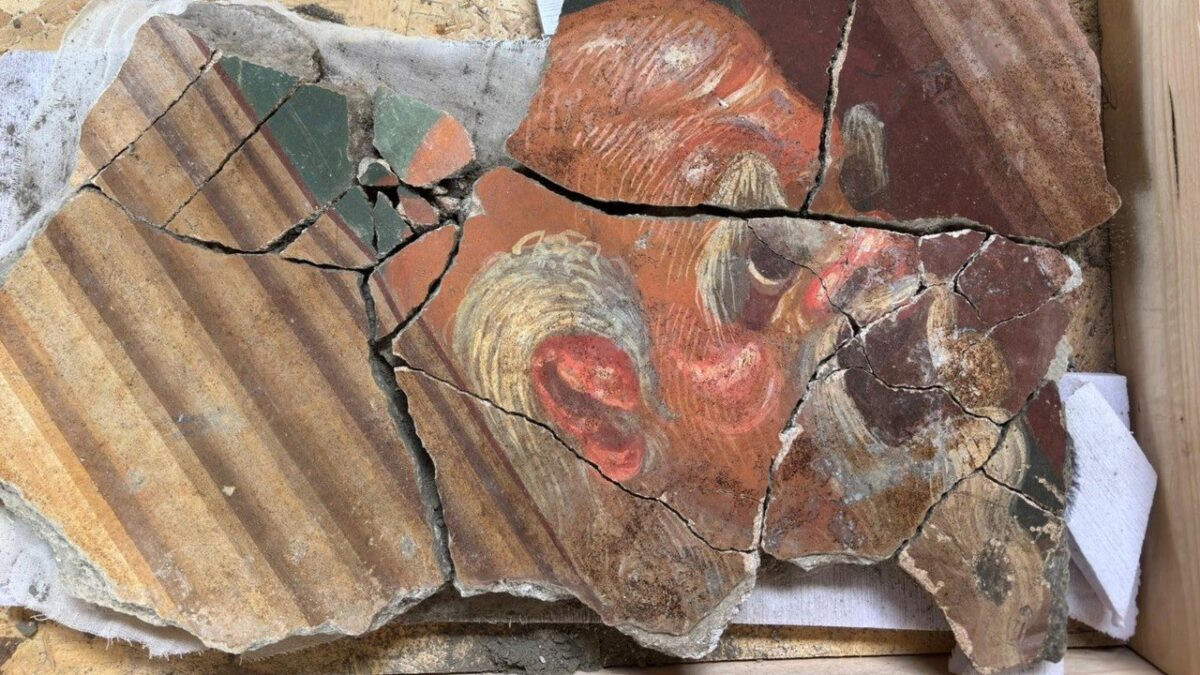
Among the most notable discoveries is a peacockess depicted in its entirety, symmetrical to the male peacock identified on the southern portion of the same wall, along with fragments frescoed with the image of a stage mask traceable to a character from the Atellan Comedy. Unlike other masks in the room, referable to Tragedy, this one can be identified with Pappus, the old fool who tries in vain to pose as a young man and is regularly mocked. Also of particular interest is the discovery of fresco fragments depicting a golden tripod set in a circle, similar in setting to that depicted on another wall, where a bronze tripod appears instead.
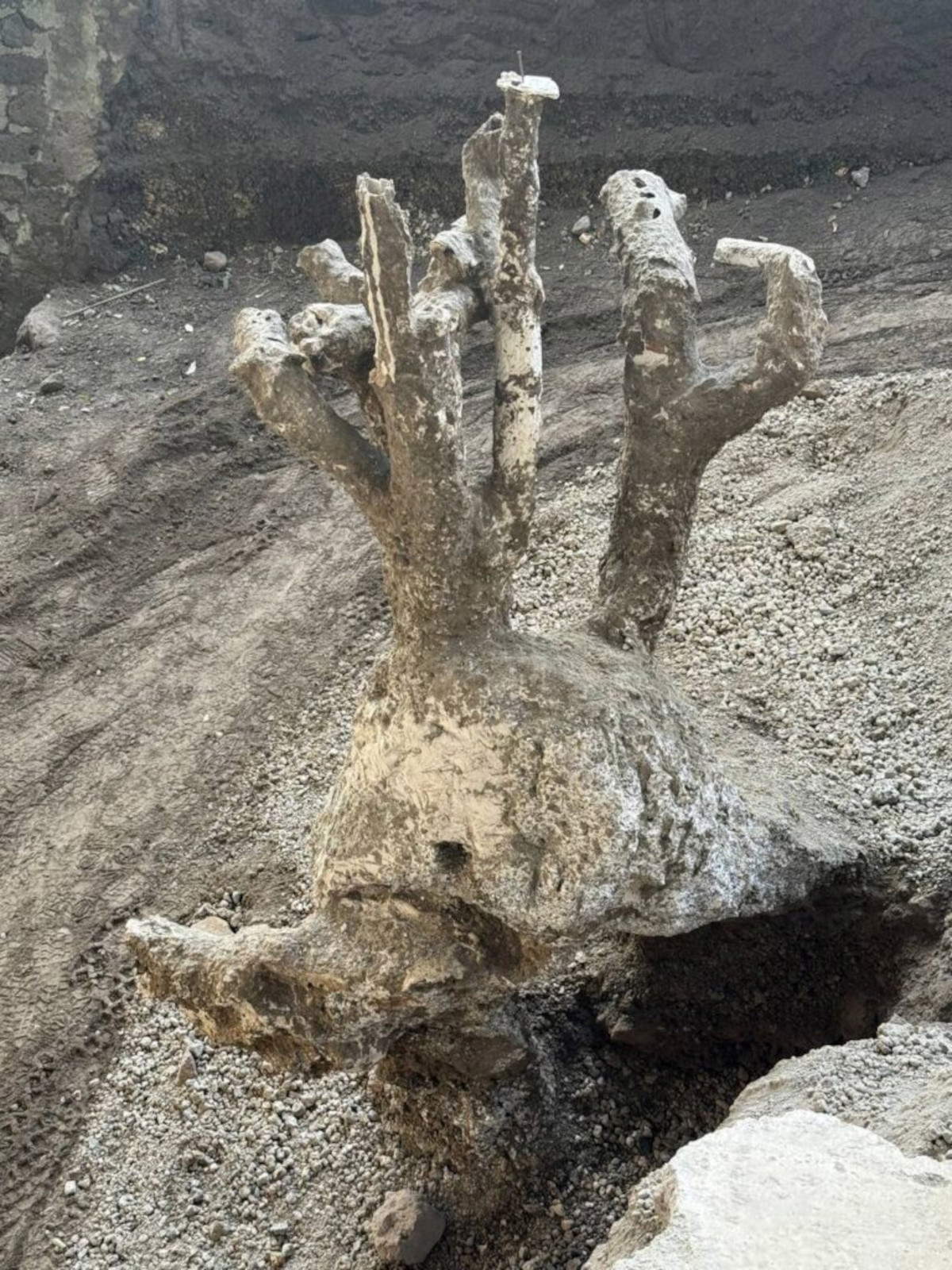
Through the use of the cast technique, the excavation also returned the footprints of the trees that decorated the garden, preserved in their original position and arranged in a precise ornamental pattern. This arrangement ideally doubled the colonnade of the southern portico, recalling solutions known both in the domus of Pompeii and at the Oplontis site itself. It is plausible that the tree species present were similar to those identified in previous archaeobotanical analyses conducted in adjacent environments, as in the case of the olive tree.
The investigations also led to the identification of four new rooms in addition to the 99 already known, including an apsidal room likely belonging to the thermal sector. Of particular interest is the detection of a paleoalveum, that is, an ancient section of a seasonal stream bed that flowed at the present-day Via dei Sepolcri. This riverbed would probably have formed after the 1631 eruption, which eroded part of the deposits left by the 79 A.D. eruption, offering new elements for understanding the evolution of the surrounding landscape. “These first results offer new and promising research perspectives for understanding the layout of the villa,” added Director Zuchtriegel, “and for studying the interactions between human settlement and the natural environment over the long term.”
In parallel with the excavation, work is underway to restore the decorative apparatus of two small but valuable rooms, originally intended for rest, known as cubicula, facing the southwestern area of the villa, near the other construction site. Striking is the extraordinary richness of the decorations, consisting of stucco, wall frescoes, painted vaults and mosaic floors of great quality, testifying to the high technical level of the ancient artisans and the use of a wide range of colors, including the precious Egyptian blue.
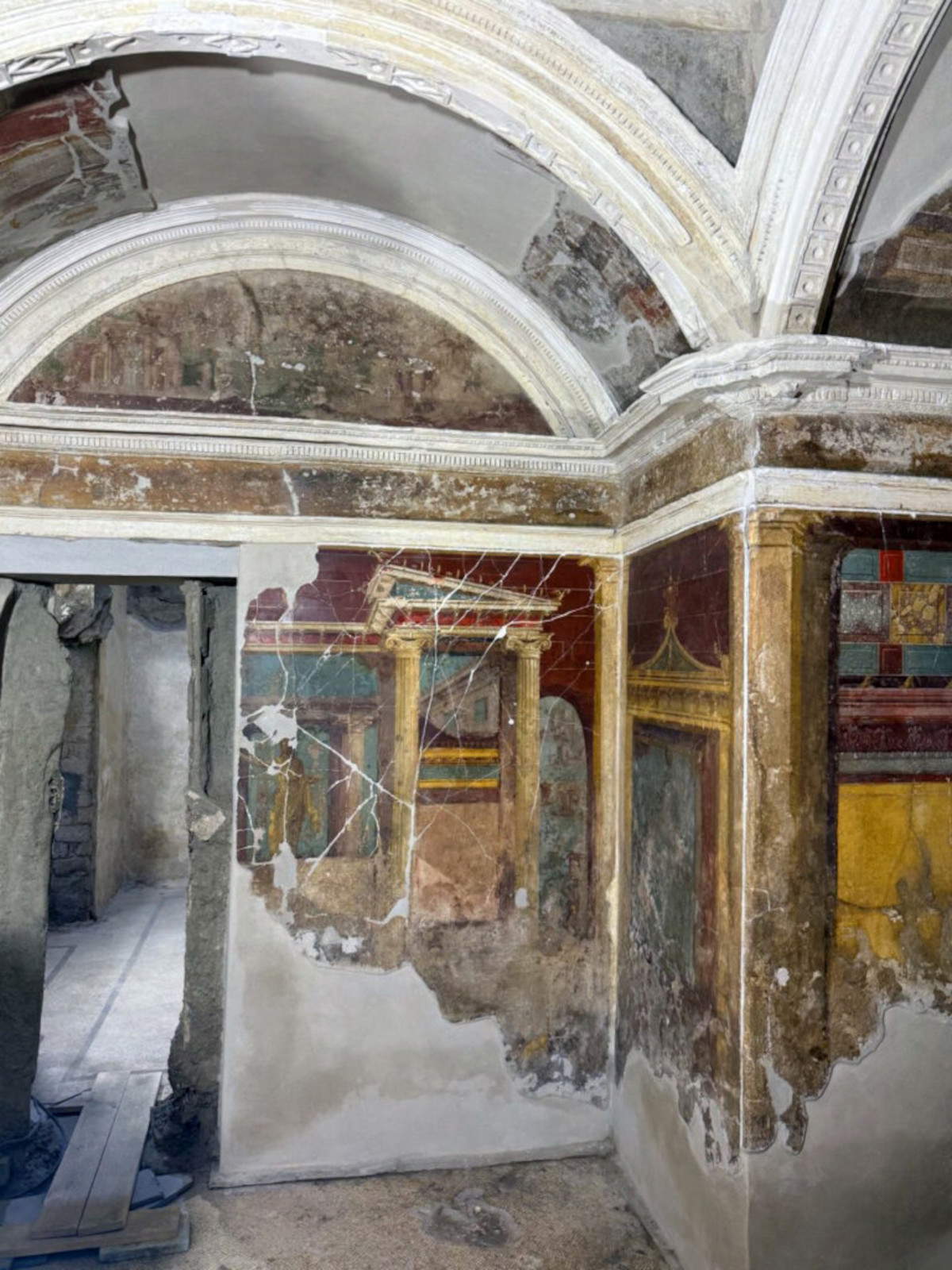
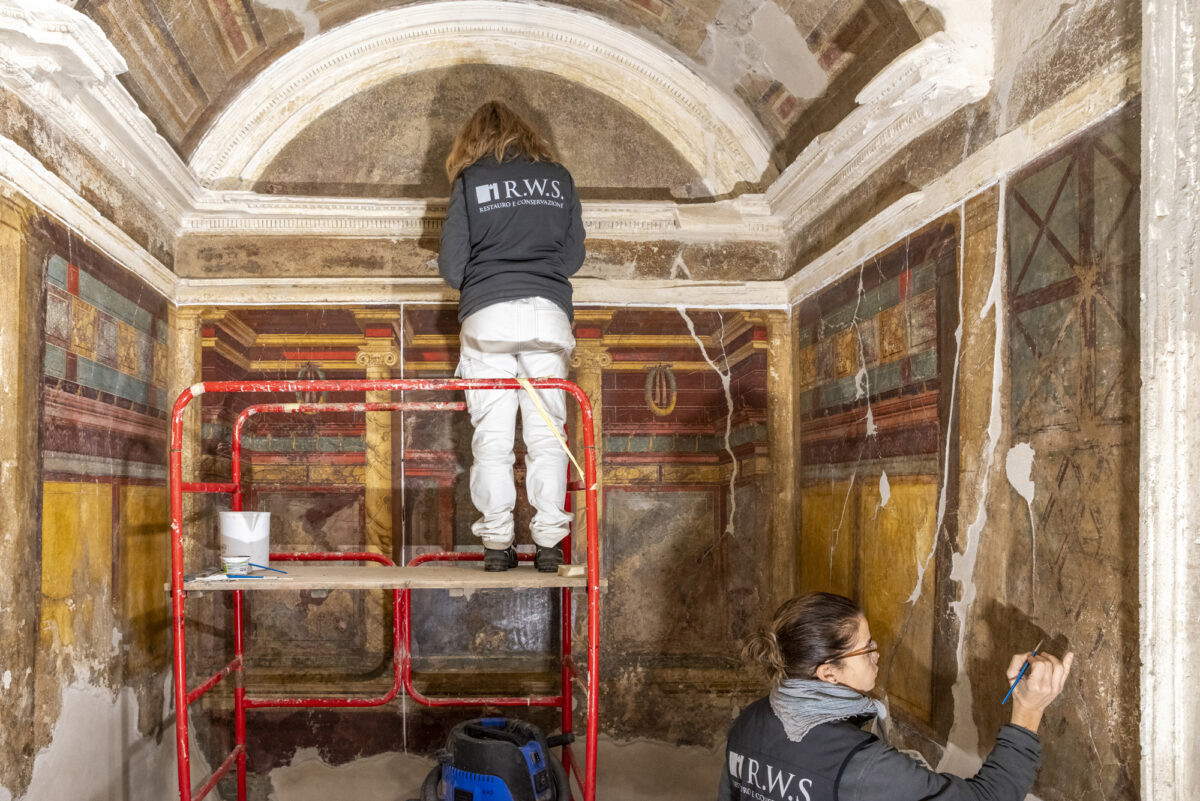
The main objective of the intervention is to recover the full legibility of the paintings and mosaics, compromised over time by the degradation processes of the original materials and the alteration of products used in previous restorations.
The first room has frescoes in II style, with faux marble and fantastic architecture that visually expand the space. The vaults are decorated with a coffered motif, while the lunettes house landscape depictions. The mosaic flooring is only partially preserved and features black and white tiles arranged in geometric patterns. A narrow passageway leads to a second, apparently more sober room, decorated in III style with monochrome backgrounds and floral motifs; originally it must have been covered by a vault, of which few traces remain. Several phases of work are recognizable in this space, some of them unfinished, suggesting that the room was undergoing renovation at the time of the eruption.
Also preserved are casts of door and window shutters, made in plaster at the time of discovery according to a technique derived from that developed by Fiorelli, which still preserve original traces of wood.
The restoration work site, now in its final stages after about a year of work, has already returned results of great quality, restoring frescoes and flooring to a condition of strong legibility and bringing out colors and details previously not perceptible. The completion of the cleaning and removal of altered materials includes a final pictorial retouching operation, aimed at ensuring full enhancement and proper legibility of these extraordinary decorations.
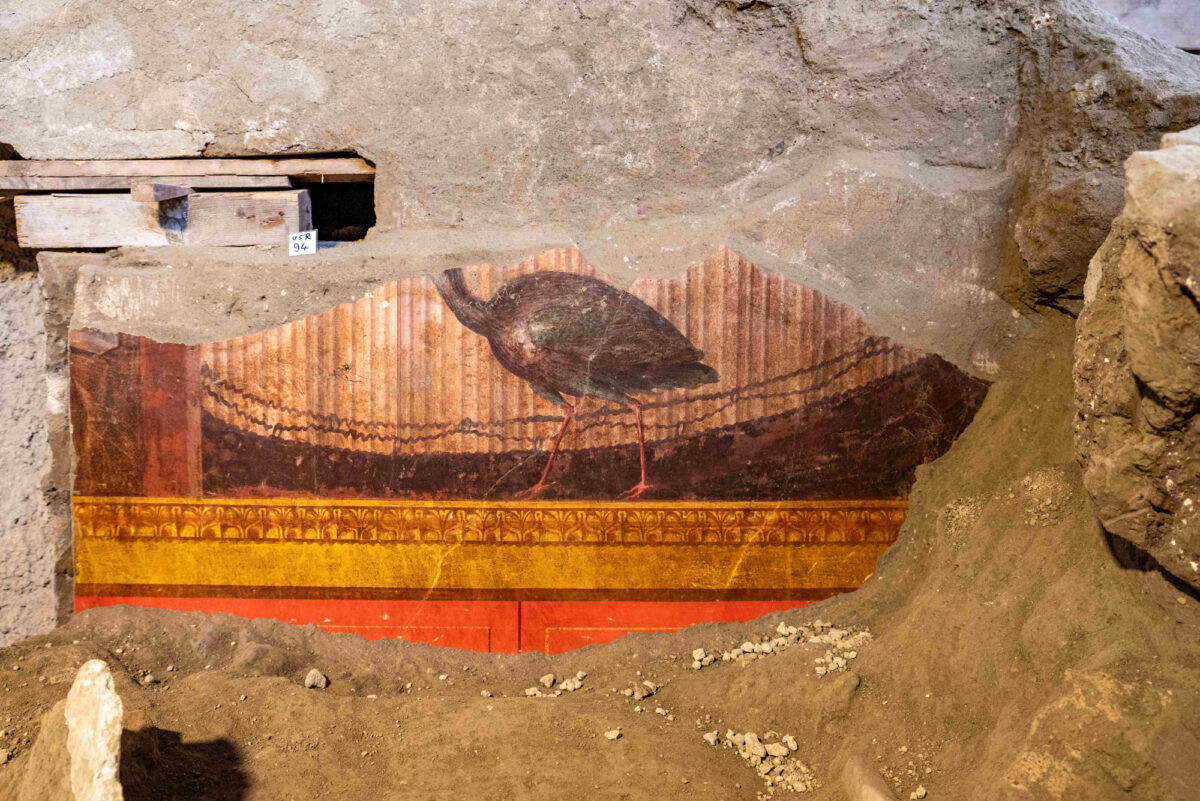 |
| Pompeii, frescoes with peacocks and masks surface in the Villa of Poppaea at Oplontis |

Warning: the translation into English of the original Italian article was created using automatic tools. We undertake to review all articles, but we do not guarantee the total absence of inaccuracies in the translation due to the program. You can find the original by clicking on the ITA button. If you find any mistake,please contact us.





























 IT
IT FR
FR DE
DE ES
ES CN
CN


