





The appointments of the Aurelia→SUD project, conceived and curated by Gabriele Landi, resume in his studio in Ressora di Arcola (La Spezia), Via Aurelia sud 19. From Aug. 24 to Dec. 31, 2025, a new artistic intervention enriches the project’s path: it is “La notte sperde le lontananze” made by Daniel Bacci (Lucca, 1975), who has been carrying out an original research on the relationship between sign, language and perception for years.
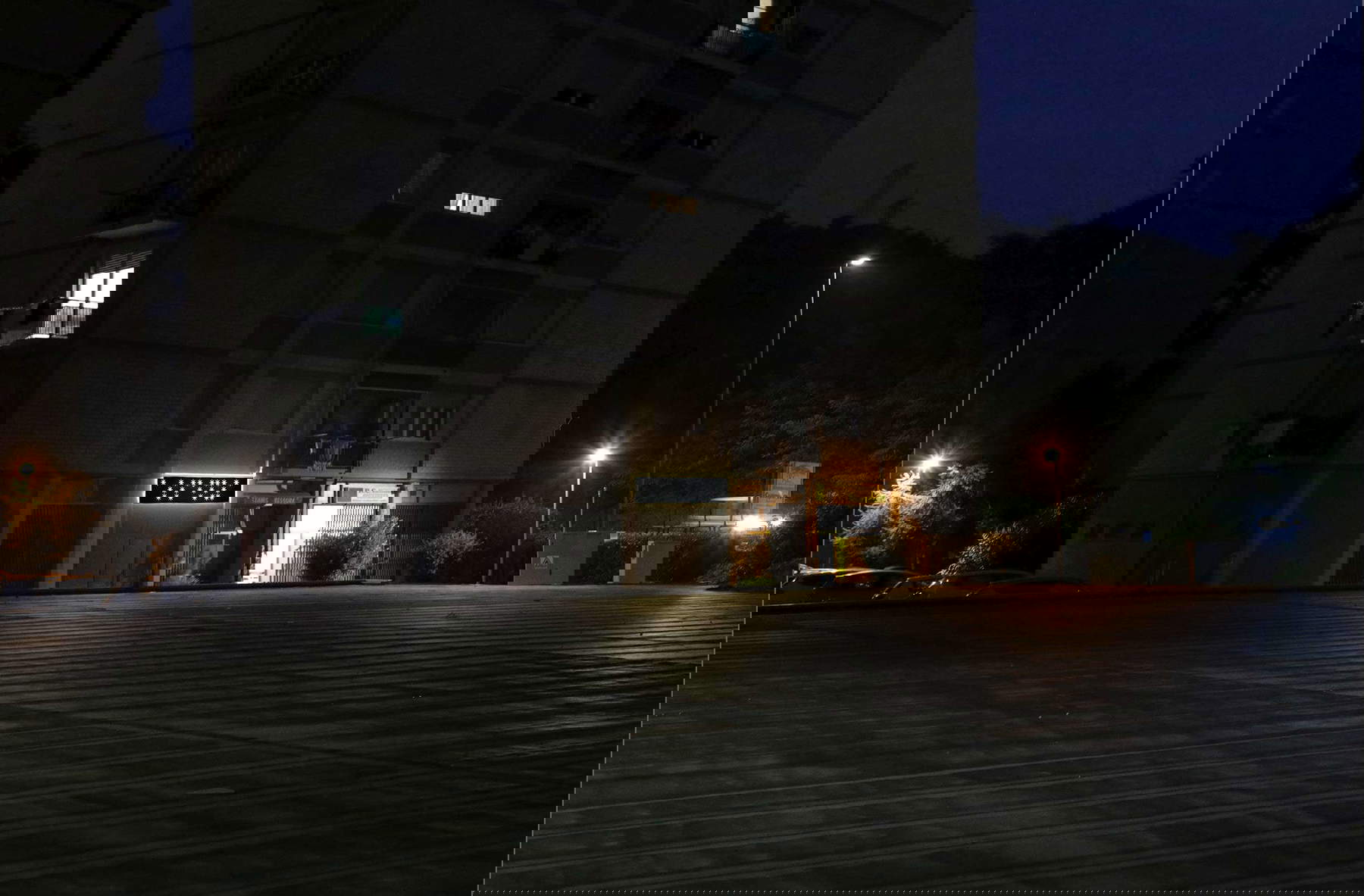
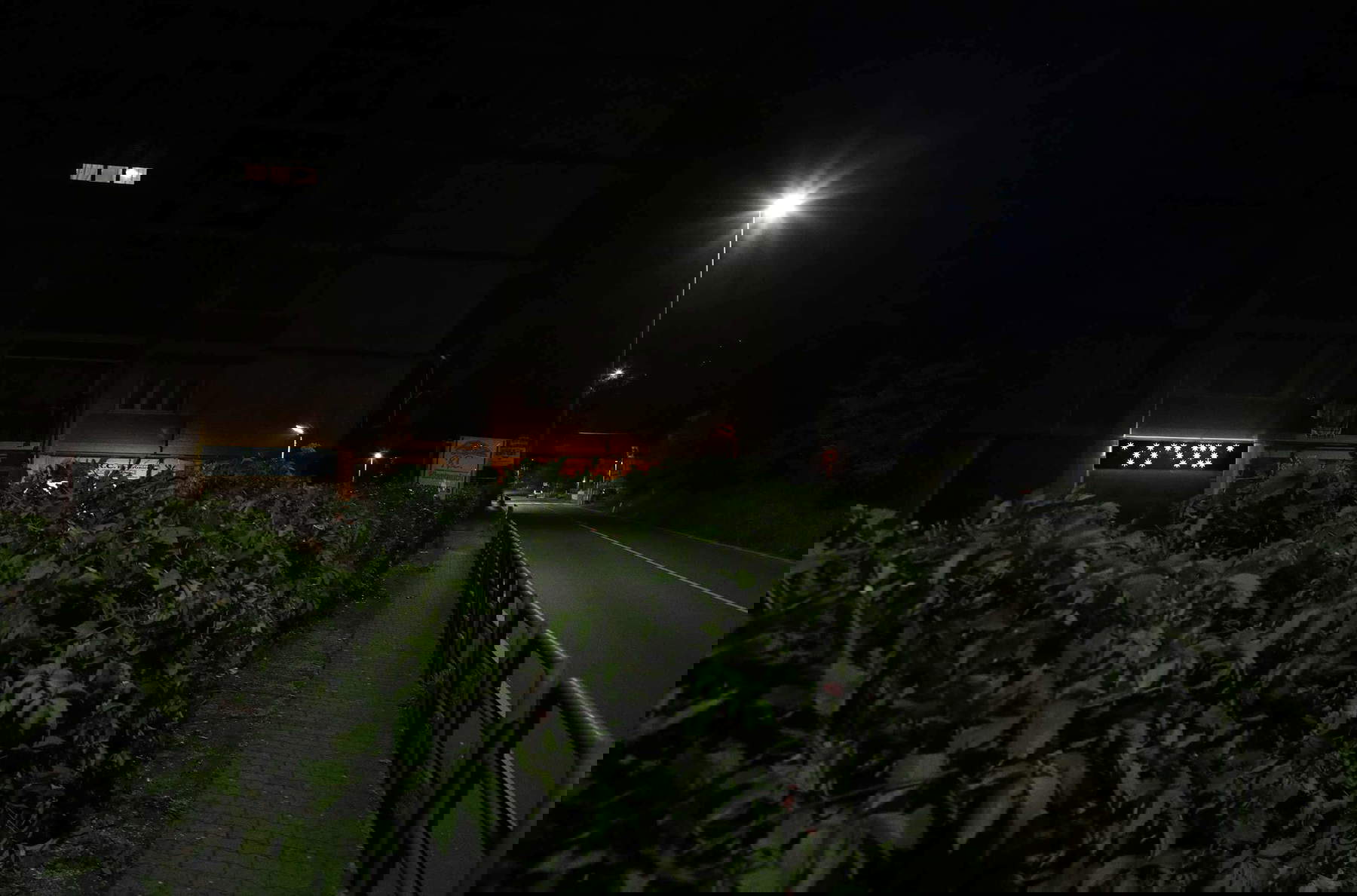
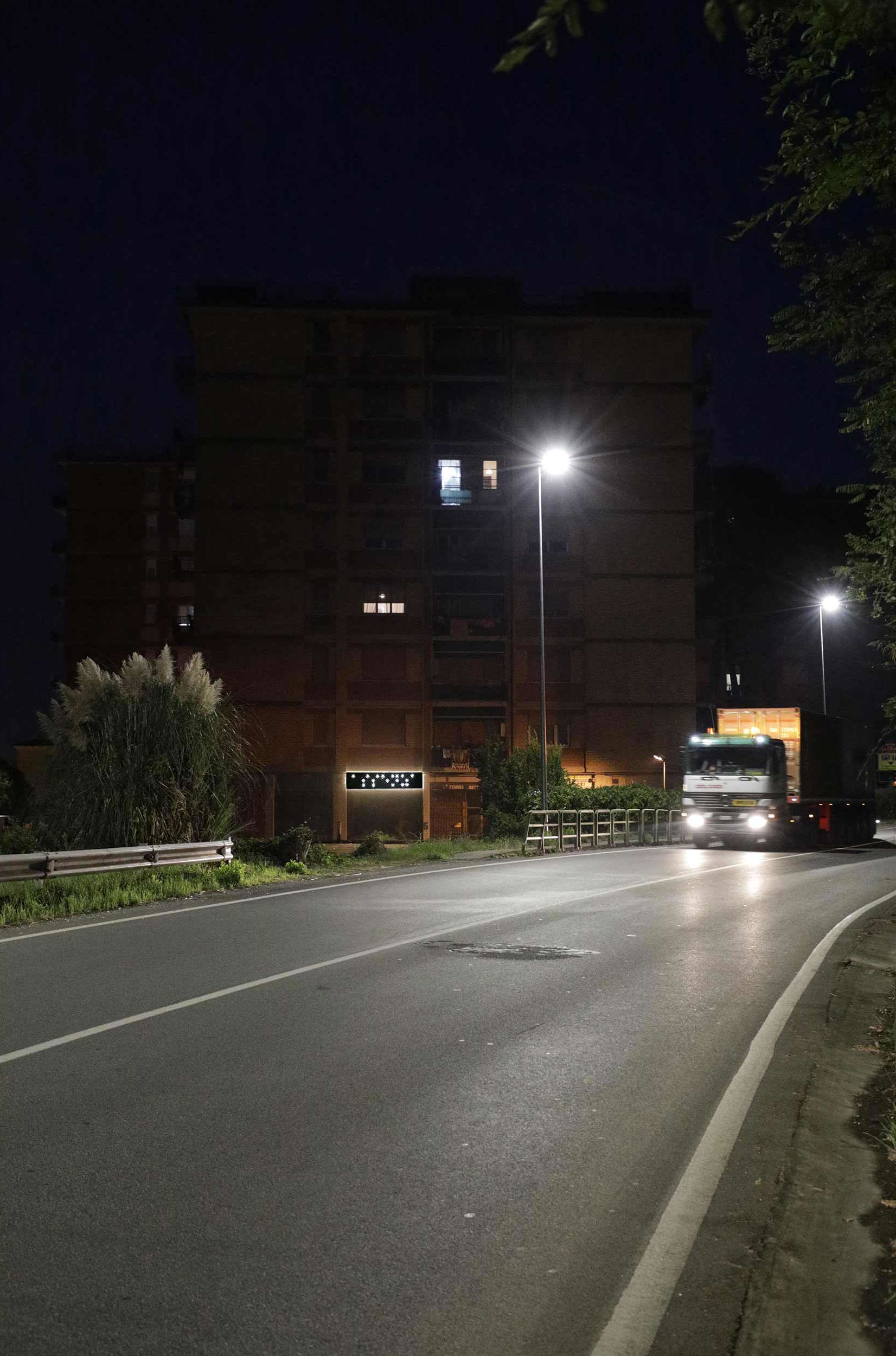
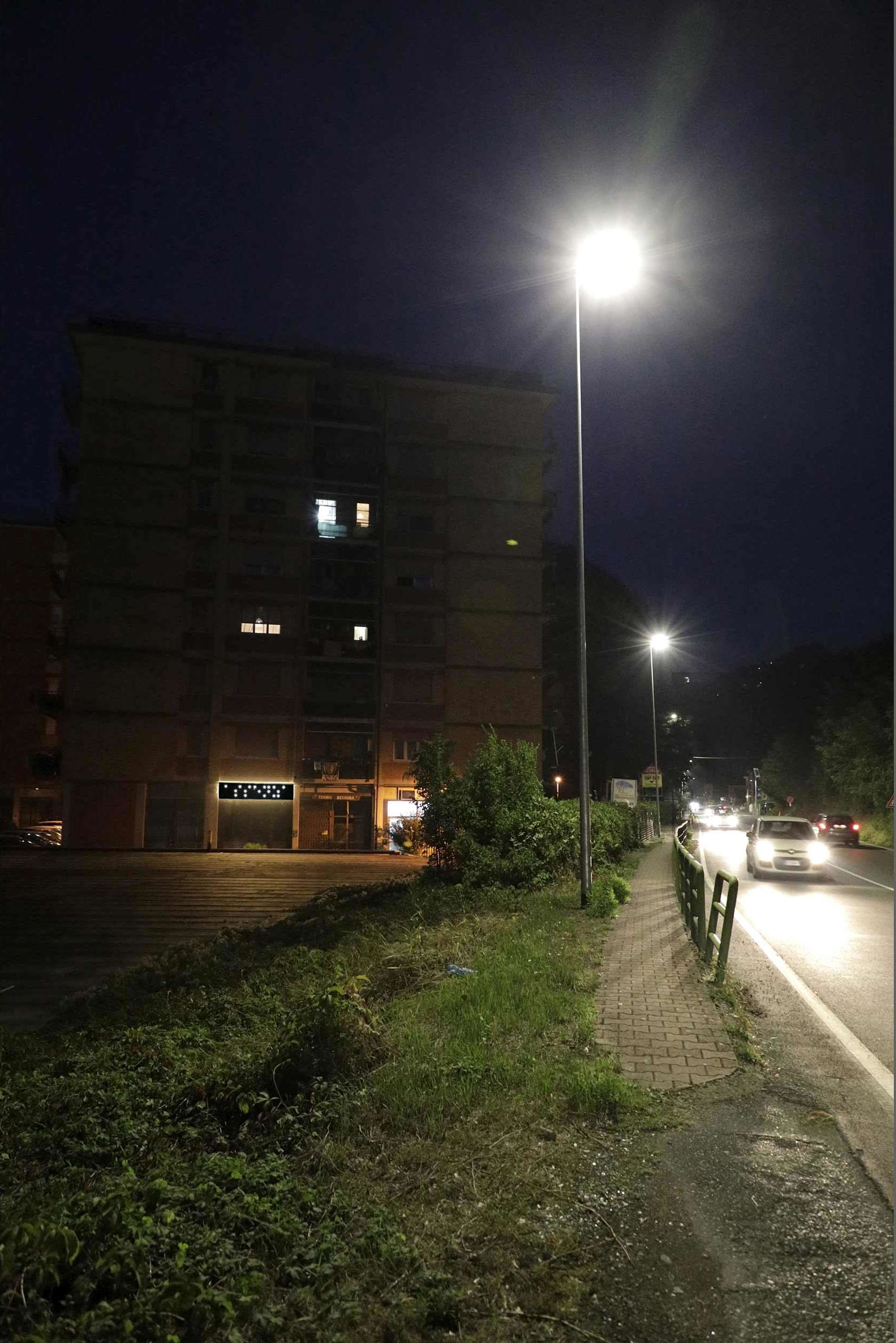
Aurelia→SUD is a project conceived as a contemporary art experience outside traditional exhibition venues. The structure that houses it is a large light box, three and a half meters wide by seventy centimeters high, placed along the road and accessible to the gaze of anyone passing by car or on foot. It is therefore neither a gallery nor a museum space, but an immediate meeting point between art and passersby. Gabriele Landi imagined this instrument as a sort of luminous window capable of welcoming from time to time the interventions of different artists, offering itself day and night to anyone who travels along that stretch of the Aurelia.
In this context is the work of Daniel Bacci, who for Aurelia→SUD has conceived a project with a strong conceptual and personal value, entitled La notte sperde le lontananze. The work, says the artist, originates from a reflection started 20 years ago, when in one of his solo shows he had used Morse language translated into luminous and colored sequences. In that case, a precise word was projected obsessively: “consume.” The exhibition environment was thus transformed into a space invaded by intermittent signals, capable of communicating a direct and disturbing message about the relationship between the individual and consumer society.
For the work intended for Aurelia→SUD, Bacci chose to take up that idea and at the same time radically modify it. The sign designed for the Arcola space does not use Morse, but Braille writing. However, the peculiarity of the project lies in the fact that the writing is not really readable by touch. It is a Braille that offers itself to sight but not to the function for which it was designed. The written word is “absence.” A word that becomes the central theme of the work and is connected to an intimate and personal reflection of the artist.
Bacci explained that the project also stems from a thought related to time and space experienced since the loss of his father. In this sense, “absence” is not just an abstract concept but an emotional condition that is transformed into a visual language. The Prussian blue sky that forms the background of the work, dotted with bright stars, refers to a quote from Confucius: the stars as holes in the sky from which the light of infinity filters. Starting from this thought and the idea of writing that was not really legible, Bacci conceived the image of a sky dotted with star signs that become both ornament and writing.
A distinctive element of the work is the choice of the eight-pointed star, inspired by the Giottesque model from the Scrovegni Chapel in Padua. The artist recounted how in early sketches he had used the more common five-pointed star, only to realize that the iconographic associations and references were too immediate and did not correspond to his research. His encounter with the eight-pointed figure, also confirmed by a dialogue with his friend and artist Silvia Papucci, provided the key to building a language more consistent with Bacci’s vision. The stars thus became symbols capable of combining tradition and modernity, spirituality and conceptualism.
Bacci pointed out that he had never worked before in a context such as Aurelia→SUD, where the work is exposed to the casual view of passersby and motorists who may observe it for only a few moments. “I’ve never worked in such a situation before, and that’s also why when I immediately agreed,” he said. “However, I think that whenever a conceived work comes out of the studio and is exposed, it is always put at the mercy of people. There are always risks involved. However, I think art is art always. It has to trigger questions. It has to capture attention, not with a sense of gimmickry but by activating reflections. So I think any context is appropriate.”

Daniel Bacci’s career has developed between solo and group exhibitions in Italy and abroad. Recent solo exhibitions include È domenica e non ho niente da fare. I don’t even feel like dreaming, presented at Piano Nobile in Pistoia in 2024, Permutations - One After Another at Artcore in Bari in 2016, The Sound of the Shell at Gedok in Munich in 2011, and the solo show at T293 Gallery in Naples in 2003. His works have also been included in numerous group exhibitions, including La pittura geometrica contemporanea italiana at Spazio Bedeschi in Verona in 2024, Sparta (On Painting in Italy) at Villa Gori di Stiava in Lucca in 2023, La peinture, une bonne resolution at the Vis-à-vis gallery in Metz in 2022, Intérieur/Extérieur in Thionville in 2020, Non ho fatto io la sedia il tavolo il foglio la penna con la quale io scrivo... at the Winter Museum in Siena in 2019, Heavenly Creatures at Kunsthalle Merano also in 2019, Ixion at MAC in Lissone in 2018, Awakening Room at The Others in Turin in 2018, Schwarz-weiss-grau at Kunstraum Munich in 2016, What theappearing lets transpire at MAC in Lissone in 2014, Niente da vedere tutto da vivere at the Marble Institute for the Carrara Sculpture Biennial in 2010, Z4 marginal zone at Villa Ockenburgh in The Hague in 2008, and Luogo/nonluogo=nuovo luogo at Fondazione Antonio Ratti in Como in 2003.
The common thread of his research, as noted on several occasions, is the investigation of the paradox between despotism and freedom, declined through works that stage an illusory, geometric and immobile reality, capable of imprisoning the gaze and at the same time opening glimpses of reflection on the human condition. The intervention for Aurelia→SUD, with the theme of absence and personal memory, thus fits naturally into this trajectory, adding a chapter related to language, time and the sky as a metaphor for the infinite.
|
| Aurelia→SUD project restarts in Liguria, with a talk by Daniele Bacci |

Warning: the translation into English of the original Italian article was created using automatic tools. We undertake to review all articles, but we do not guarantee the total absence of inaccuracies in the translation due to the program. You can find the original by clicking on the ITA button. If you find any mistake,please contact us.















 IT
IT FR
FR DE
DE ES
ES CN
CN


