





It is by no means easy to organize thematic multimedia group exhibitions by enhancing the breath and specificities of multiple works without the end result being dissonant, and it is even more difficult to orchestrate curatorial reasoning on topical issues without the works presented being enslaved to homologating theses. It is in this perilous terrain that PUSH THE LIMITS moves. Culture Undresses and Makes War Appear, the second exhibition event in an interesting project of the Merz Foundation in Turin. The format PUSH THE LIMITS was conceived in 2020 by Beatrice Merz and Claudia Gioia as a choral song of seventeen women artists of different ages, biographies and origins, represented by more or less recent works from their creative journey. The title of the review is a clear vindication of art’s ability to force the limits of thought, perception and discourse, introducing new elements into the system to open it to the infinity of possibilities. Five years later, the approach to the reflection maintains this thread, but focuses the investigation on the relationship between culture and current events, in elective affinity with a specific text by Mario Merz, who together with Marisa hovers (never in a forced way) as a tutelary deity in all the exhibitions hosted by the Foundation. Culture undresses and makes war appear, the subtitle of this second edition, is in fact derived from a poetic-conceptual piece composed by the doyen of Arte Povera during the artistic sit-ins he organized at the height of the 1968 protest: “[...] this is our long Sunday, we are undressing culture to see how it is made” (hopefulmonster 2005).
Again, only women artists were selected, again from different backgrounds and ages, invited to build with the interweaving of their powerful soliloquies a new counterpoint, this time of nineteen voices, centered on a relationship with current events that, one understands from the first glance, presses to return the conflictuality of a historical period in which the whole world seems to be sitting on a powder keg ready to explode. In order to reflect the urgency of each expressive instance, the works and the layout have been chosen by the artists in collaboration with the curators with the intention of offering a significant and varied overview of the emergencies of our present (from a female perspective, it would seem obligatory to say, but we choose not to do so because it would be reductive with respect to the universal scope of the works in the exhibition to make them pertain to a gender strand). Some are of recent production, some are older, and some have been reworked in relation to the new context. The rootedness in topicality that unites them is made to converge in the flow of Mario Merz’s legacy, in consonance with iconic works such as Giap’s igloo (1968) or Gaddafi’s tent (1968-1981) or with his systematic insertion of paper newspapers in installations. While the Turin-based master tended to trigger a conceptual reflection on the possibility of art being a transformative space and dialogue capable of shifting the axis of thought, the women artists in the exhibition seem to prioritize the search for forms of conceptualization effective in denuding the exposed nerves of the present and short-circuiting its terminations. Art always remains at the center, but the emphasis here is on the challenge of formulating thoughts and words where the conflicts of the present seem instead to push toward repetition and immobility. The result is a polyphonic landscape of crisis, in which the works of Heba Y. Amin (Cairo, 1980), Maja Bajević (Sarajevo, 1967), Mirna Bamieh (Jerusalem, 1983), Fiona Banner (Merseyside, 1966), Rossella Biscotti (Molfetta, 1978), Monica Bonvicini (Venice, 1965), Latifa Echakhch (El Khnansa, 1974), Yasmine Eid-Sabbagh, Cécile B. Evans (Cleveland, 1983), Dominique Gonzalez-Foerster (Strasbourg, 1965), Mona Hatoum (Beirut, 1952), Emily Jacir (Bethlehem, 1970), Jasleen Kaur (Pollokshields, Glasgow, 1986), Katerina Kovaleva (Moscow, 1966), Teresa Margolles (Culiacán, Sinaloa, 1963), Helina Metaferia (Washington, 1983), Janis Rafa (Athens, 1984), Zineb Sedira (Gennevilliers, 1963) and Nora Turato (Zagreb, 1991) prepare a path made seductive by the formal quality of each, although it is fraught with pitfalls and leaps into the void. The charisma of the individual works forces one to proceed in stages, dwelling on each suggestion to follow the thread of a surgical reasoning that is careful not to self-destruct into a sterile cathartic dystopia.
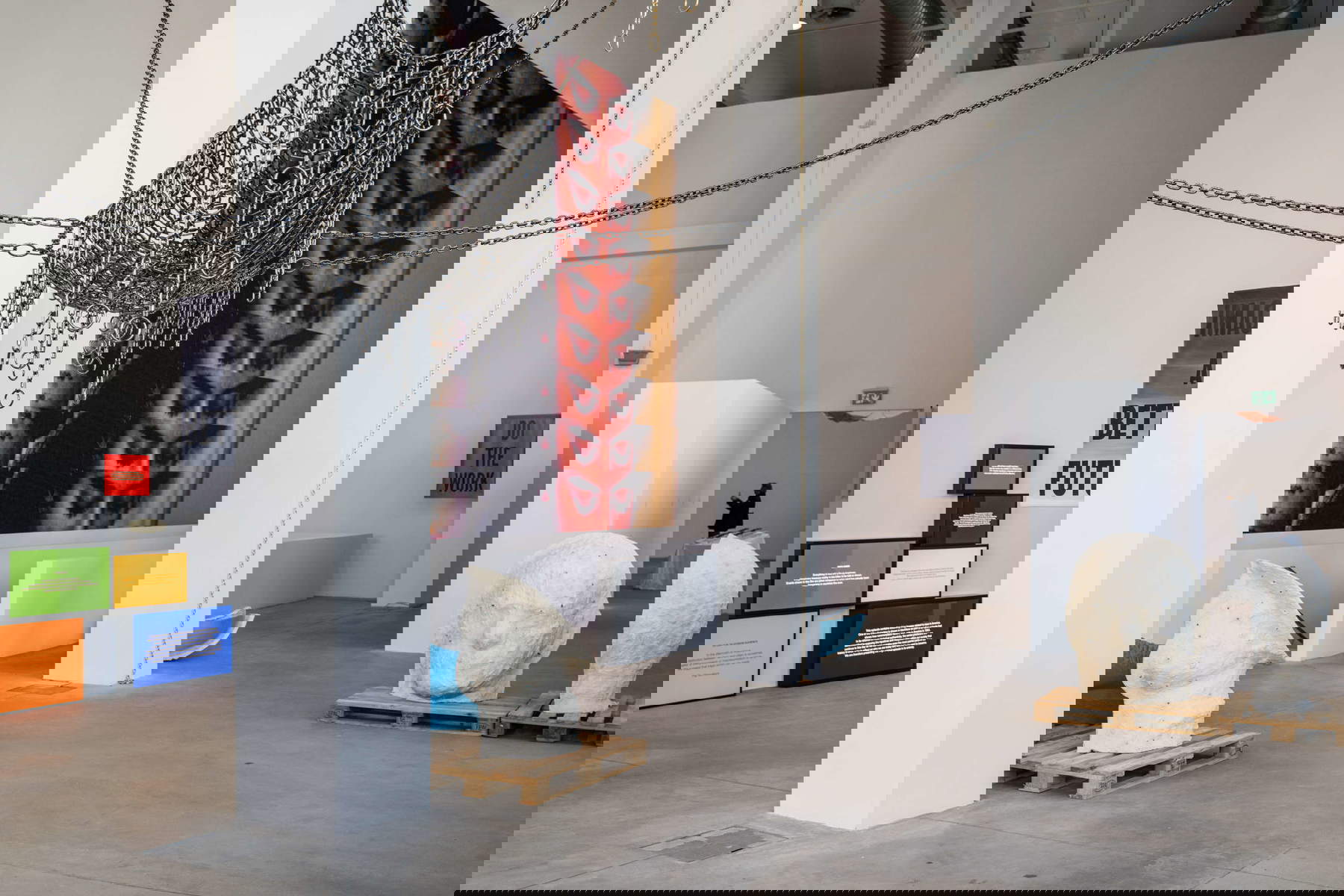
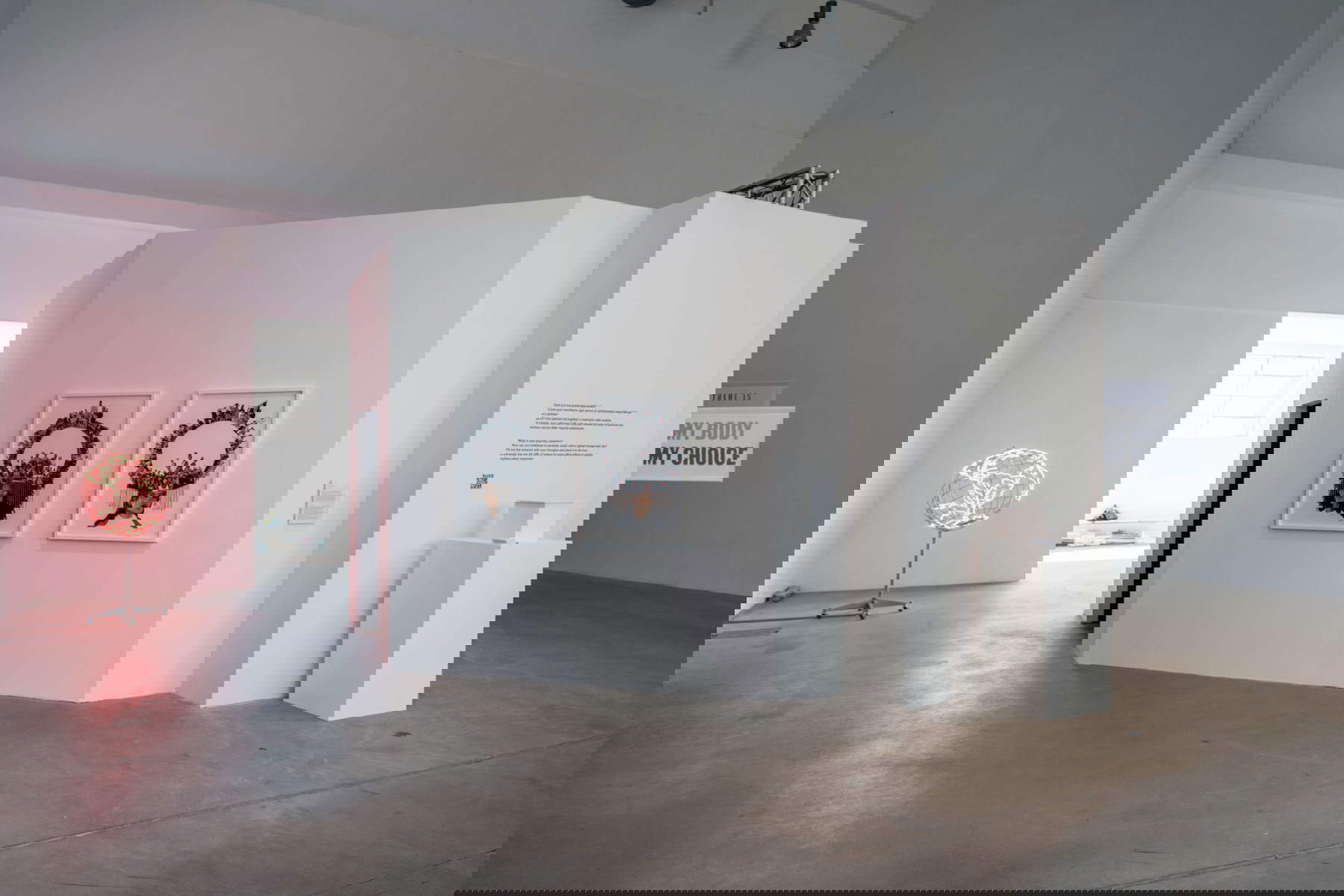
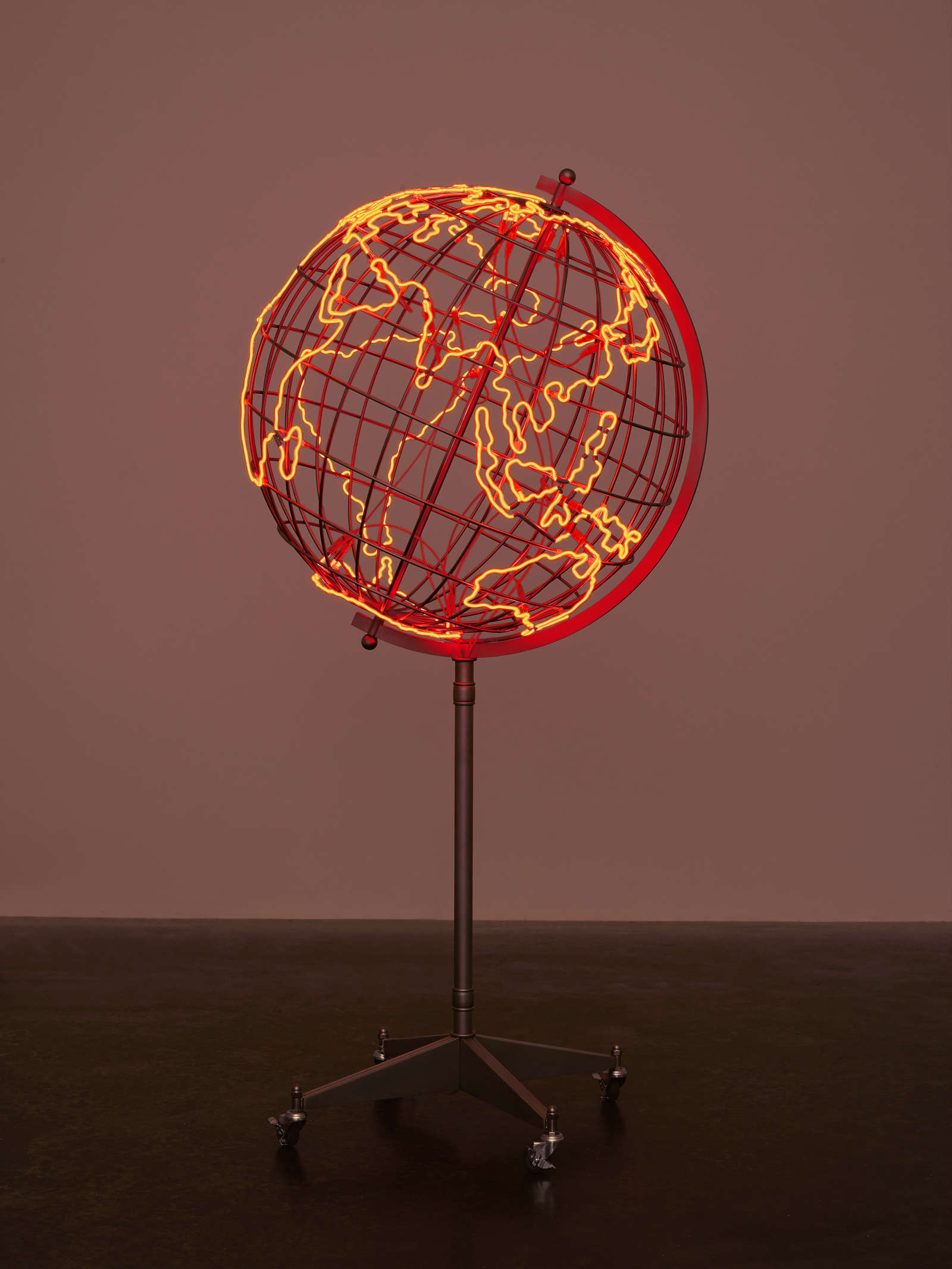
Against the superficiality of language and the resulting trivialization of reflection is hurled from the very entrance, on the foundation’s exterior wall, the inscription Speaking my TRUTH!!! (2024/2025) by Nora Turato. The phrase echoes an expression that has gone viral on social media, which, by extolling individual authenticity, smuggles in the overbearing right to sovereign subjectivity. The artist, using the text as material to construct the body of his work as a fragmentary anthology of colloquial language, dissects the vernacular of contemporary culture by collecting quotations and translating them into captivating incantations that highlight the relationship between language and the ideological component with which it is innervated. The work appears here in dialogue with Mario Merz’s neon Fibonacci sequence permanently placed on the side tower of the building’s façade, sharing its approach to space and additive vocation, but at the same time differing from it in the absence of any desire to lead the code (in its case linguistic and not numerical) back to the perfection of the formula. It does not give rise to doubts about the exhibition’s context of reference the first work encountered inside: Hot spot (stand), 2018, by Mona Hatoum, a luminous globe in which territories are identified by glowing borders. The sculpture, rather than referring to specific ongoing conflicts, seems a suggestion to consider our planet as an interrelated unicum, impossible to save by fragments. It seems significant in this regard to note how, although most of the artists draw inspiration from the burning issues of their respective places of origin, many of them have moved away from it by choosing to live elsewhere, and all approach the object of their investigation from a cosmopolitan rather than a particularistic perspective. In the sign of Merz, therefore, the exhibition itinerary proceeds by stages exemplary of a reflection on identity acted as an “oblique” encounter with the other (human, but also animal or extraterrestrial) capable of deconstructing the crisis by shattering its polarizations. This concept appears glaringly in Janis Rafa’s video The fear of leaving tha animal forever forgotten under the ground (2021), which shows from an ambiguous point of view the life of a group of stray dogs locked up in a claustrophobic and dark place, a (for now) disused antinuclear shelter built during World War II. The camera, alternately held by an invisible human being and one of the dogs, always in subjective view, alternates between human and animal perspectives, generating contradictory perceptions in which opposites such as bestial and human, perpetrator and victim, hunter and prey, submission and power, cruelty and compassion, intersect until they become inextricable.
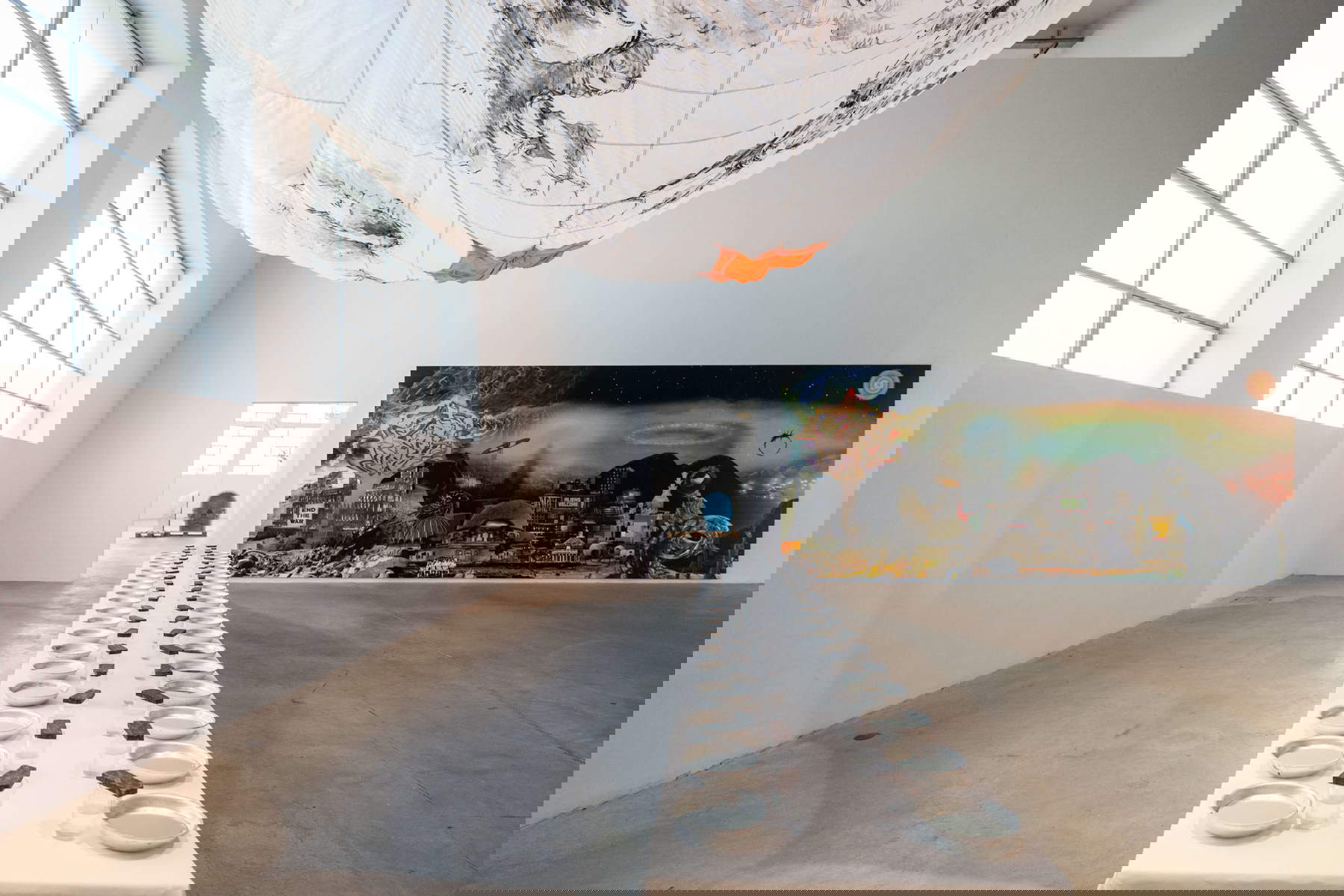
It then takes center stage in Katerina Kovaleva’s environmental installation Memory table (2025), a mournful banquet without diners topped by a parachute painted with angelic figures, fragile Paradise identified by the inscription “Lux Aeterna.” To the starting reference, the traditional Russian prescription of leaving the deceased a glass of vodka and a slice of black bread (here replaced by a fragment of granite arranged for each guest) to sustain him or her during the journey to the afterlife, is superimposed the inevitable iconographic reference to a Last Supper rendered militaristic by the gamelle that replace the plates, in whose shiny surfaces the visitor, as he or she approaches, can see his or her own face reflected. The presence of this layered conceptualization on the memory of war victims by a Russian artist confirms the non-sanctioning intention of the exhibition, openly placing itself in derogation of a dominant thought that presses to convey similar expressions only if they come from their Ukrainian counterparts.
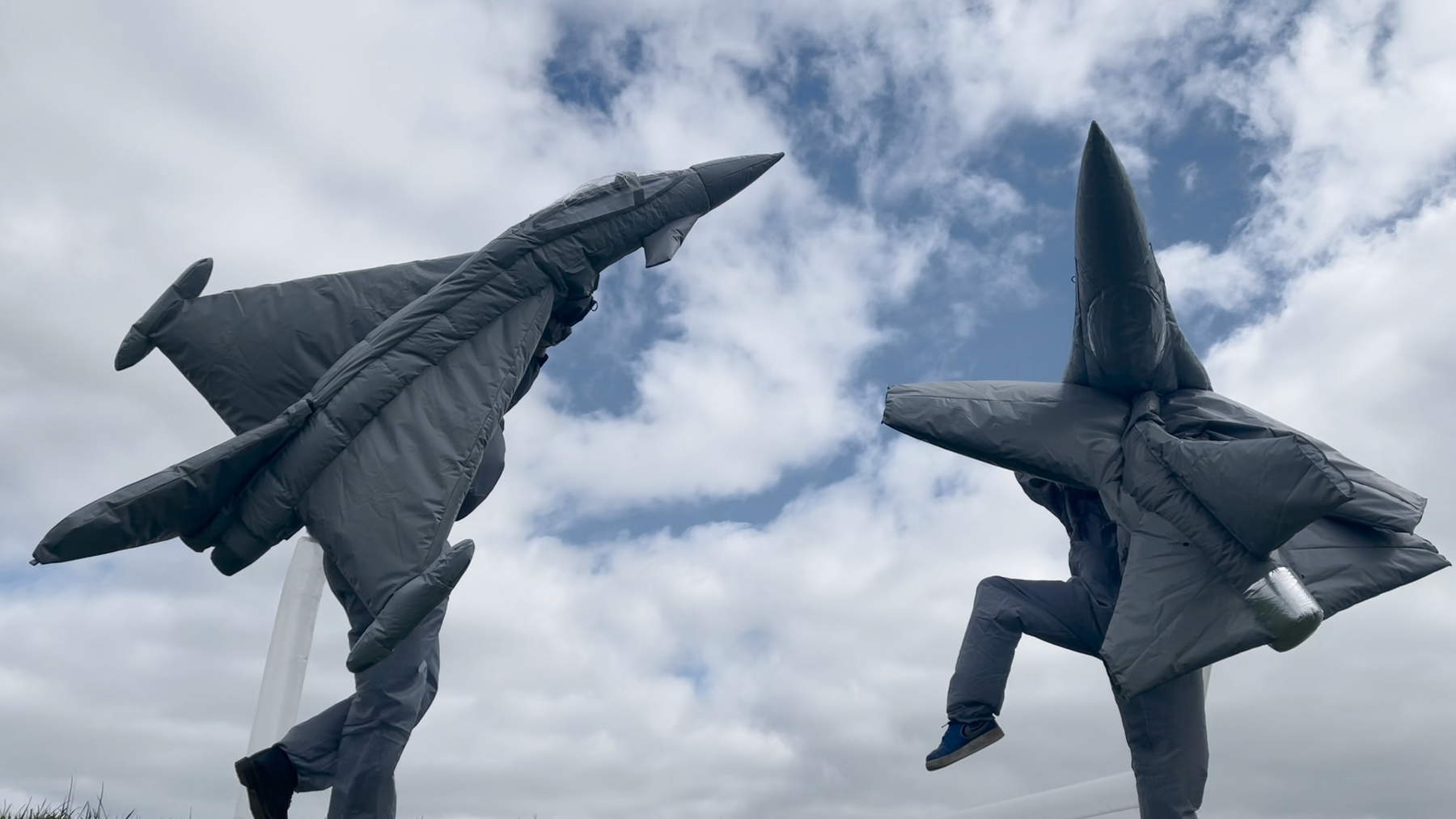
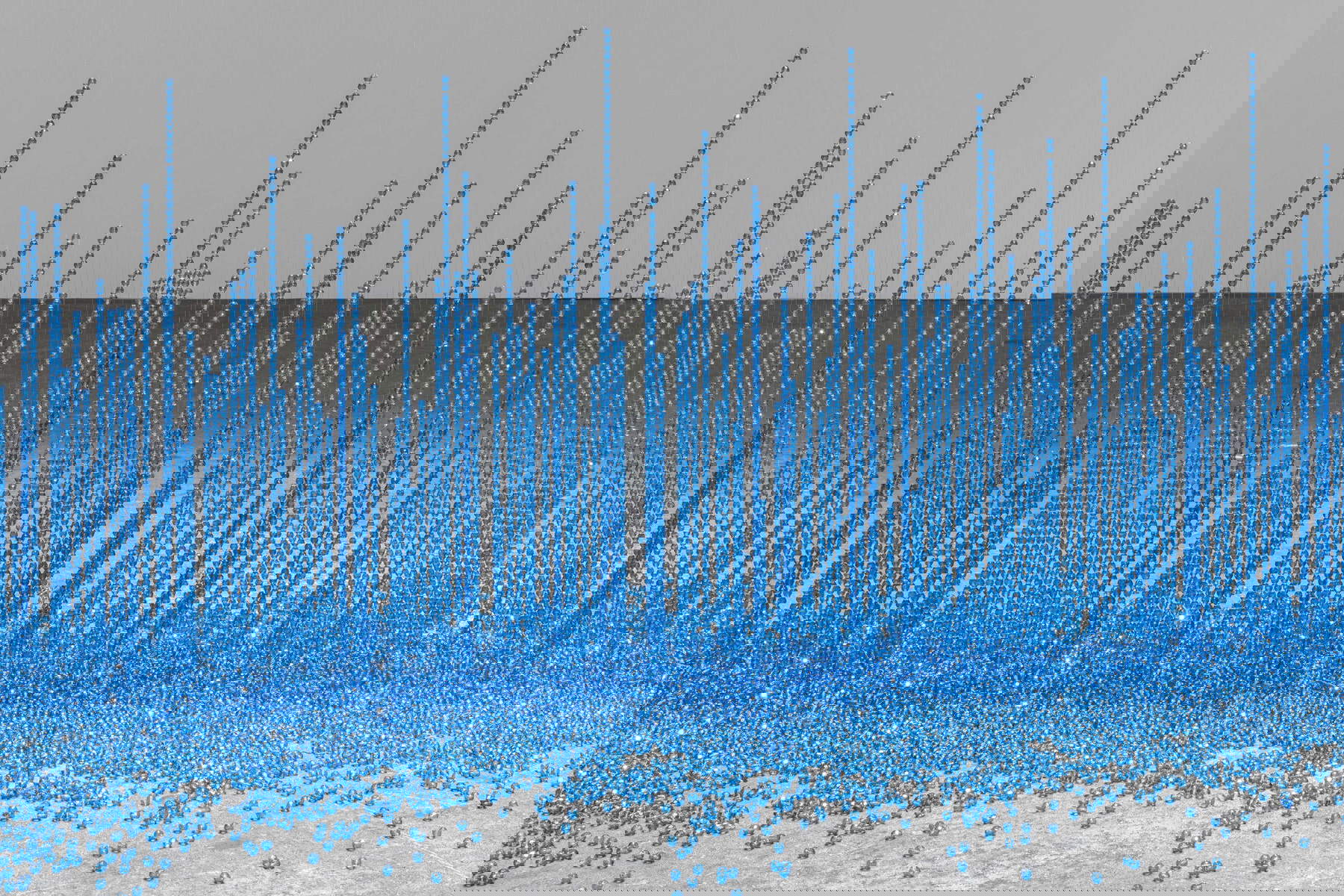
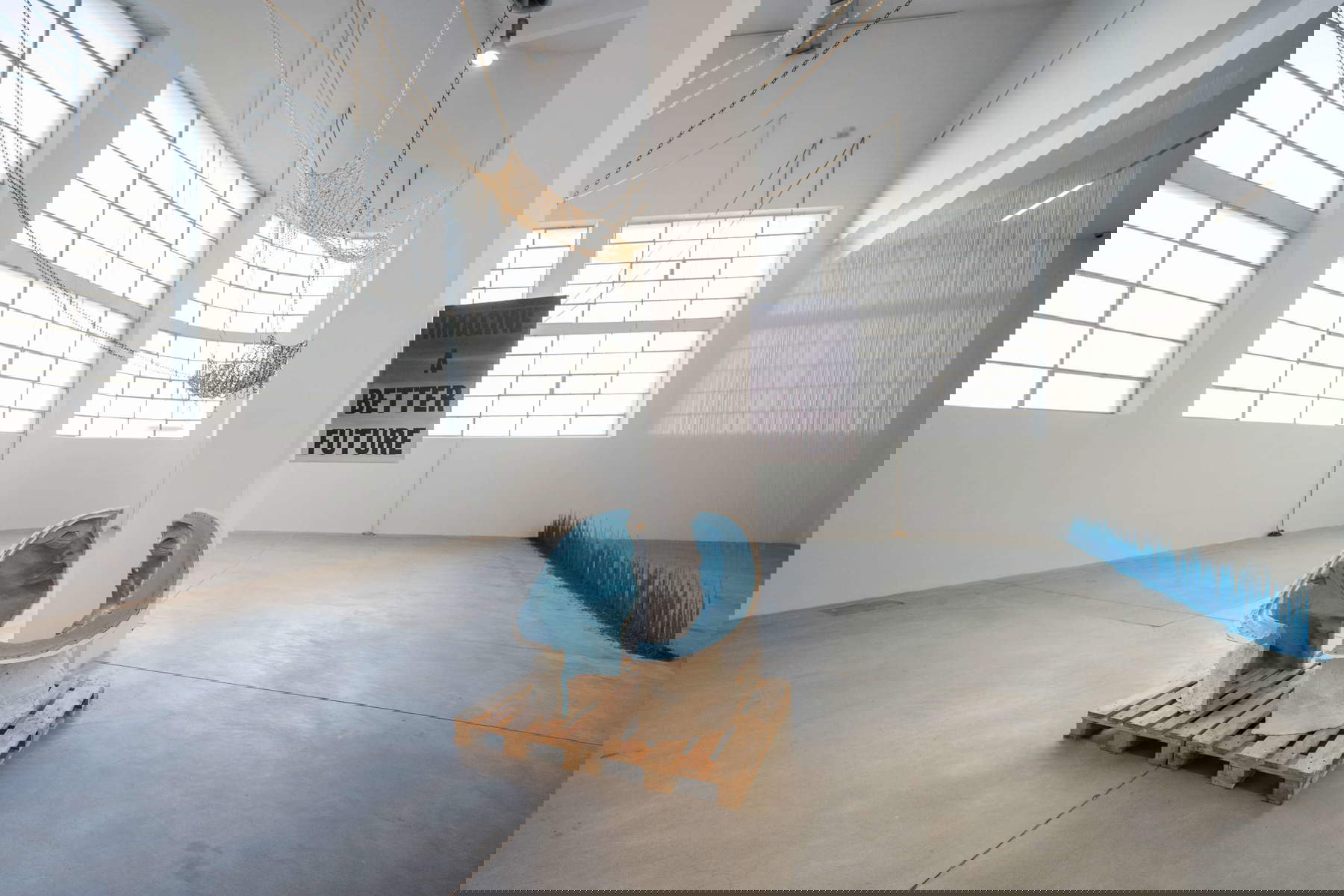
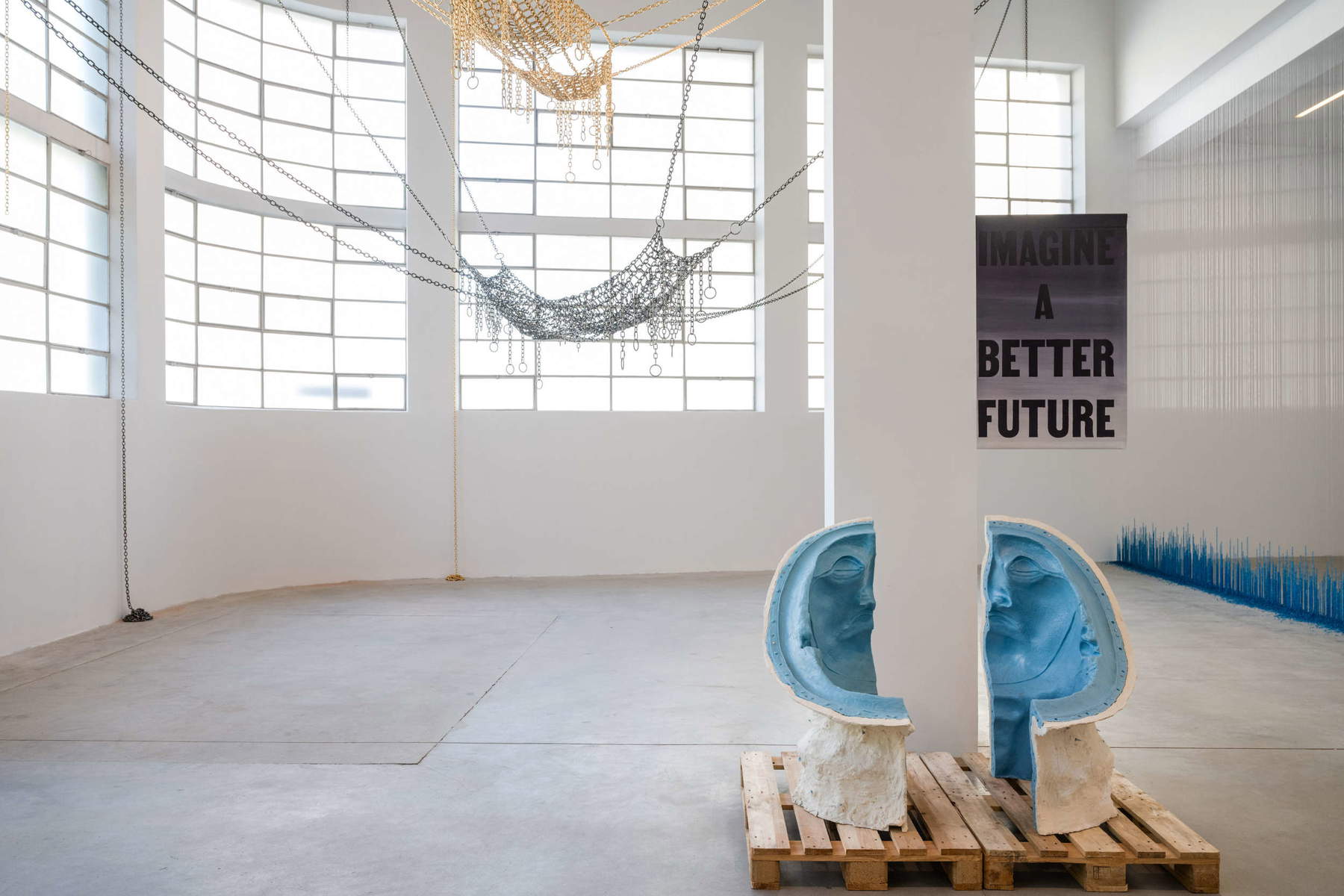
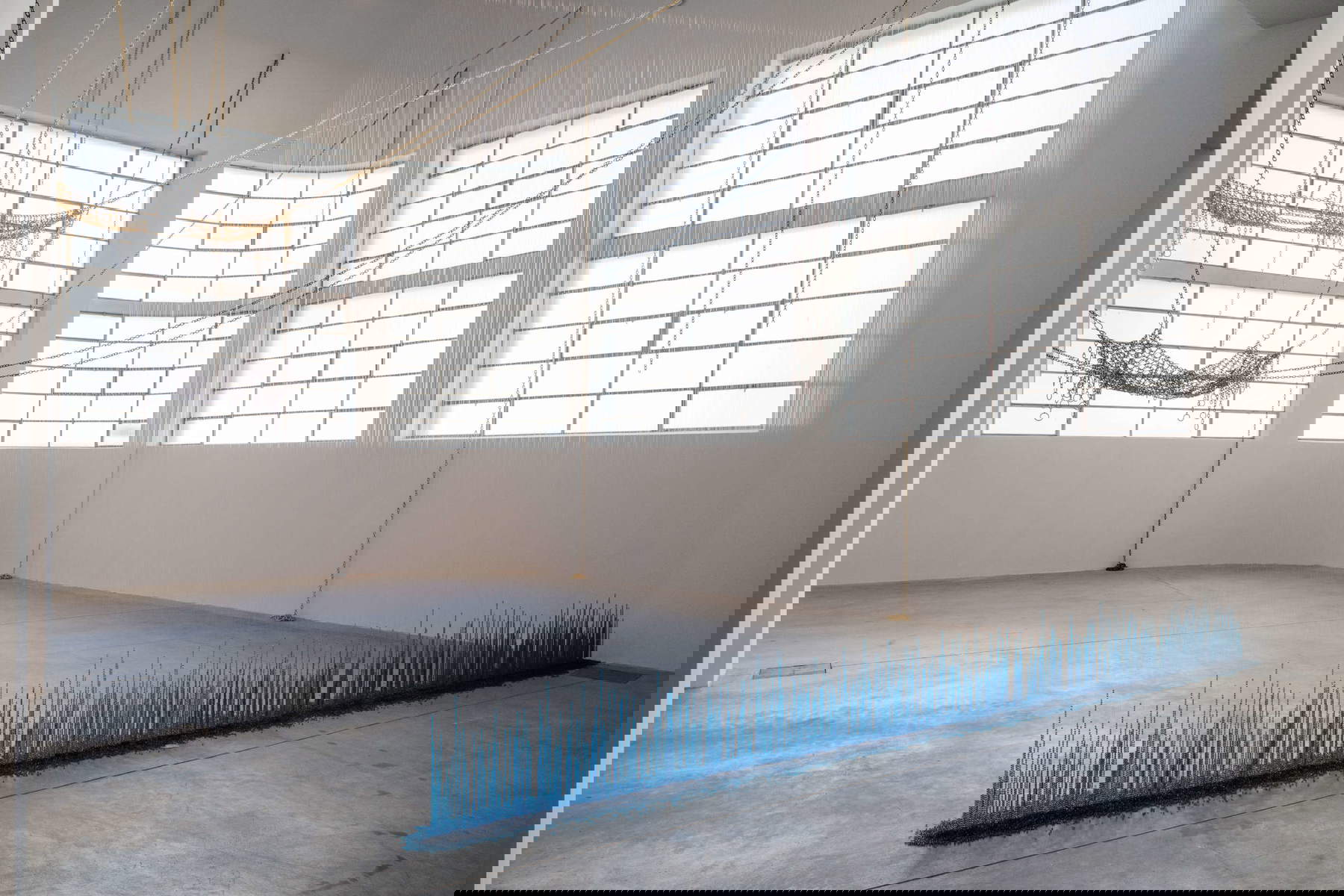
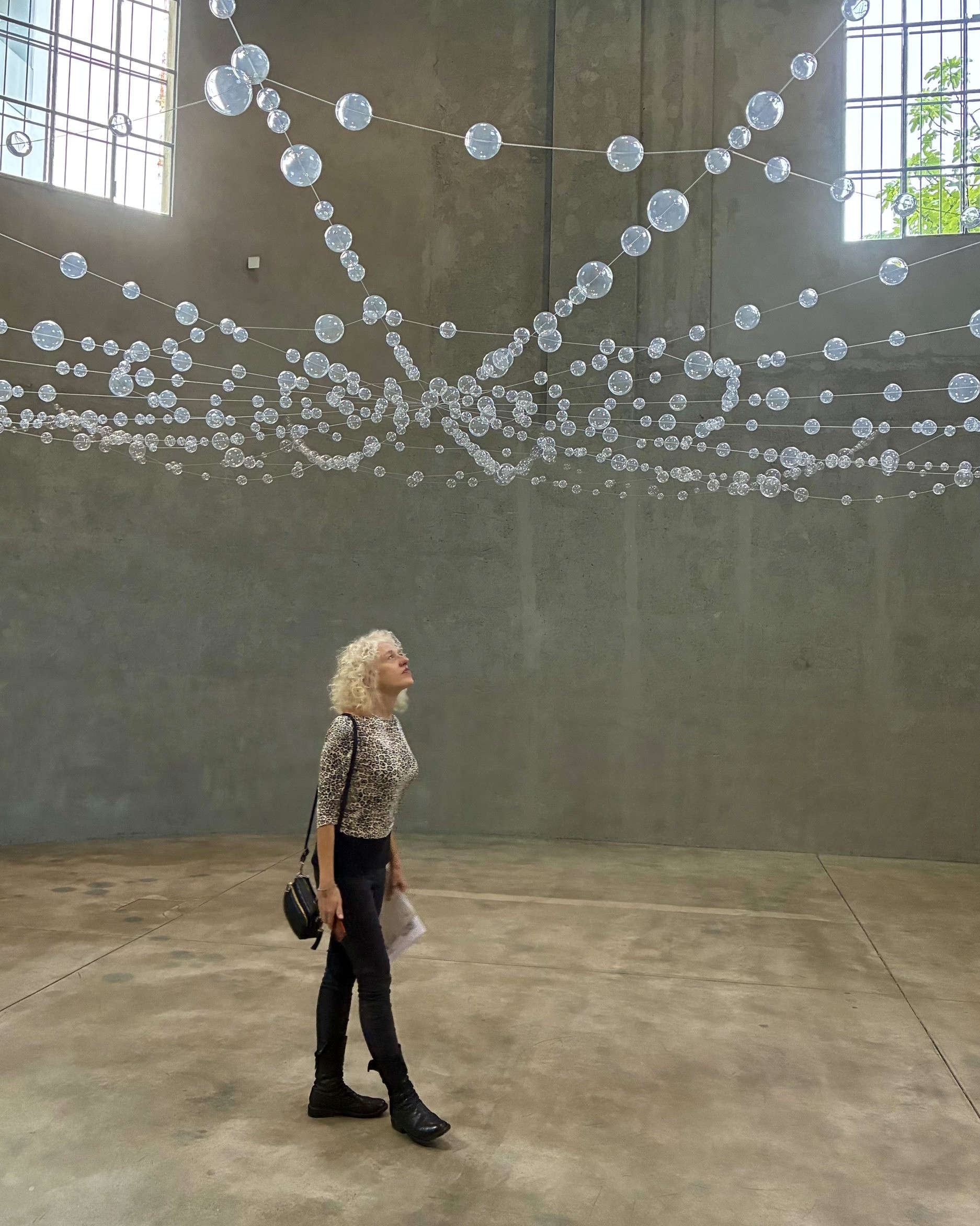
The path continues as a traversal of a constellation of milestones, including, to name some of the more immediate works: Rossella Biscotti’s Heads in Object (2015), inverted casts of two sculptural heads of Mussolini that remained forgotten for years in the warehouses of the Eur spa in Rome, presented as ruins; Teresa Margolles’ Sonidos de la muerte (2008), recordings broadcast from speakers embedded in the wall made at the discovery sites of murdered women in Ciudad Juárez, a Mexican city holding a tragic record of feminicides, or Latifa Echakhch’s Untitled (Tears Fall), 2025, a fragile shower of blue beads gushing from above like tears, first presented to the public at the last edition of Art Basel Unlimited. The visit ends in the basement with Pranayama Typhoon (2021) by Fiona Banner, also known as “The Vanity Press,” a thrilling environmental-scale video in which two performers don inflatable fighter planes to stage an ambiguous ritual dance between duel and courtship against a backdrop of pristine nature. The title combines the word “pranayama,” an ancient Indian breathing technique, with the term “typhoon,” by which we designate both the destructive weather phenomenon frequent in areas of the Pacific Ocean and Southeast Asia and a futuristic model of a military aircraft. The depotentiation of violence suggested by the rubbery inoffensiveness of the war machines staged opens to a poetic exploration, unencumbered by precise partisan orientations, of vulnerability and power relations.
The exhibition, therefore, takes the shape of a multifaceted and intelligent attempt to give form to the transformative drive that Mario Merz sensed in the inseparable relationship between art and life. If the Turin-based artist conceived the igloo as an archetype of a habitable space in which thought and action could merge, inscribing in its domes as much the Fibonacci series, emblem of organic growth and the energy inherent in matter, as the slogans of protest, the works gathered here seem to translate that same urgency into a variegated discourse capable of traversing the contradictions of our present without resolving them in pacifying syntheses and without wallowing in easy defeatism. The cyclical logic that animated Merz’s research, that spiral that connected the archaic forms of nature to the processes of contemporaneity, finds here an actualizing declination that takes up its symbolic method as a tool to show the supporting structures of culture and to imagine new possible configurations. The result is an ecosystem of aesthetics, moreover among the most influential in the current international art scene, which claim art’s mission to react to the proliferation of crises by becoming an active agent of critical resistance rather than imaginative evasion.

The author of this article: Emanuela Zanon
Laureata in Discipline dell’Arte, della Musica e dello Spettacolo all’Università di Bologna, città dove ha continuato a vivere, si è specializzata in Beni Storico Artistici all’Università di Siena. Curiosa e attenta al divenire della contemporaneità, crede nel potere dell’arte di rendere più interessante la vita. È direttrice editoriale di Juliet Art Magazine online.Warning: the translation into English of the original Italian article was created using automatic tools. We undertake to review all articles, but we do not guarantee the total absence of inaccuracies in the translation due to the program. You can find the original by clicking on the ITA button. If you find any mistake,please contact us.

























 IT
IT FR
FR DE
DE ES
ES CN
CN


