




by Redazione 29/12/2025



Categories: Exhibitions / Disclaimer
Until March 1, 2026, the Falcone Theater of Genoa's Royal Palace is hosting the first major exhibition entirely dedicated to St. George, one of the four patron saints of Genoa, a symbolic figure of protection and civic identity deeply rooted in the city's history.

Until March 1, 2026, the Falcone Theater of the Royal Palace in Genoa is hosting the exhibition San Giorgio. The Journey of a Knightly Saint from the East to Genoa, curated by Alessandra Guerrini and Luca Leoncini, Anna Manzitti, Gianluca Zanelli with Michele Bacci, Clario Di Fabio, Michel Huynh, Anna Melograni, produced by Ministry of Culture - National Museums of Genoa with the support of Fondazione Compagnia di San Paolo, Fondazione Carige. Technical sponsor Floridia - Allestimenti museali, under the patronage of the Liguria Region and the City of Genoa.
This is the first major exhibition entirely dedicated to St. George, one of the four patron saints of Genoa, a symbolic figure of protection and civic identity deeply rooted in the city’s history. Since the Middle Ages, his image has spread extensively in urban space and in Genoa’s visual culture: from religious depictions to the portals of palaces, from official documents to the city’s banner, whose flag continues to fly over public buildings to this day. Patron saint of knights and invoked as a defender against the plague, St. George intertwines his cult with the very history of the Republic of Genoa, in a bond that is strengthened and renewed over the centuries.


A rich selection of precious artifacts, from the Middle Ages to the mid-sixteenth century, accompanies the visitor in an articulated itinerary of paintings on wood and canvas, bas-reliefs, sculptures, goldsmithing, prints, miniatures and decorated objects, in which the figure of the saint is reproposed and reinterpreted by artists and artisans according to different languages and sensibilities. The story of Saint George is also the protagonist of important masterpieces from numerous Italian and European museums and institutions, with works by masters such as Cosmè Tura, Ercole de’ Roberti, Carpaccio and Mantegna, alongside loans from Paris, Brussels, Cologne and Hamburg.
The exhibition itinerary, enriched by video insights, recounts the creation of the “myth” of St. George, from his origins as a martyr in the Byzantine era to the medieval narrative that consecrates him as a knight saint engaged in the fight against evil. The narrative concludes with an invitation to rediscover the city’s heritage through a map that guides visitors in search of depictions of St. George spread throughout the city, from the 15th-century portals of the historic center to more recent interpretations in contemporary murals.

The exhibition is the result of a long research effort involving numerous international scholars and cultural institutions. The aim is to explore the figure of the saint and the extent to which his cult spread throughout Europe and the Mediterranean. Despite the universal fame of the knight saint, this is in fact the first exhibition specifically dedicated to him, and it is no coincidence that it takes place in Genoa, a city that has deeply linked its name to Saint George since the Middle Ages.
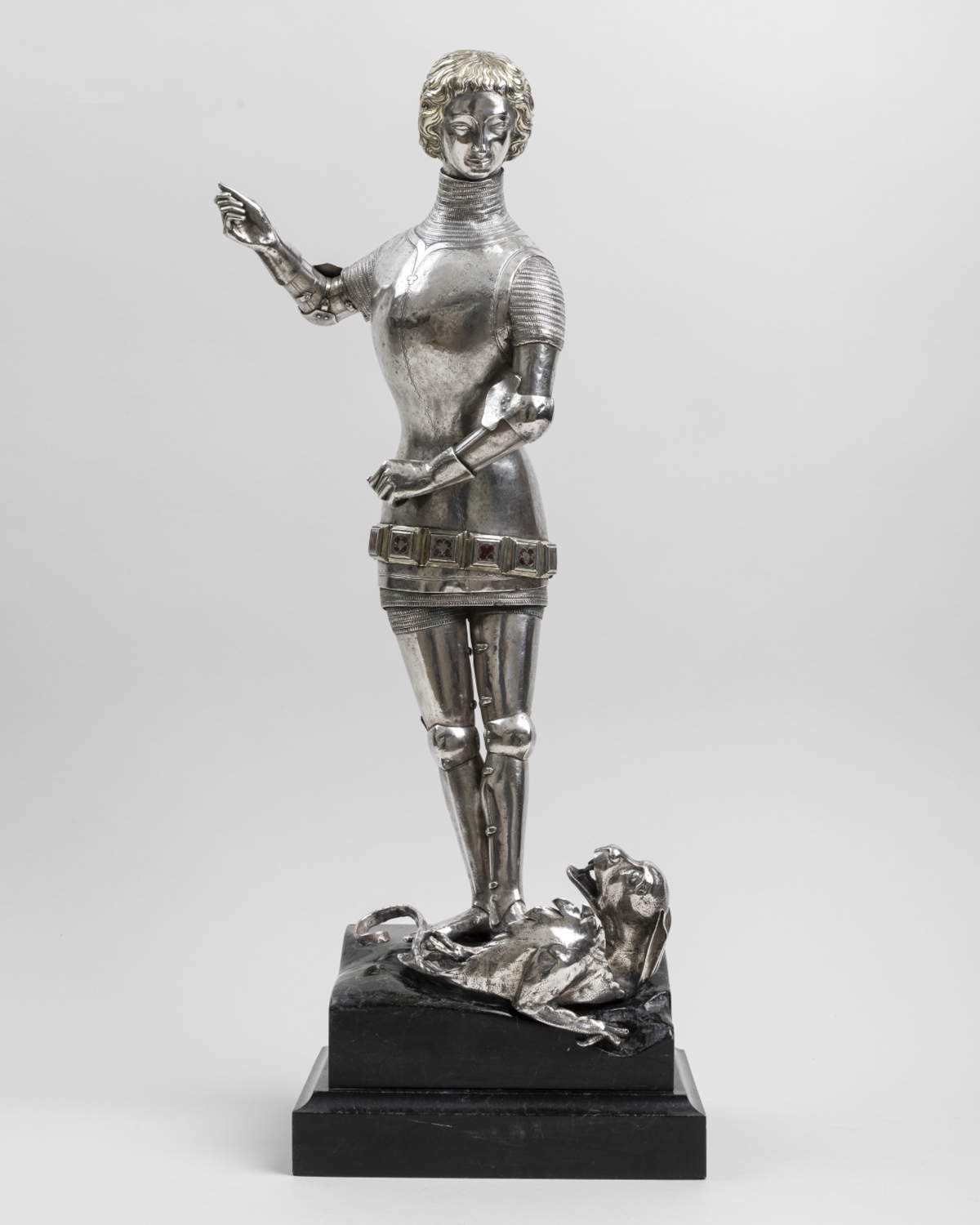
The bond between the city and the saint is also strengthened through literary tradition: indeed, the narrator who delivered the most famous version of his legend, Iacopo da Varagine, archbishop of Genoa in the 13th century, is Ligurian. Starting from this privileged relationship, the exhibition unfolds in the exhibition spaces of the Teatro del Falcone, giving rise to an itinerary that puts works of art and objects of international provenance in dialogue, bearing witness to how St. George became a true visual icon in the Middle Ages shared by very different cultural contexts. The variety of materials and artistic techniques documents this iconographic richness, with a thematic rather than chronological path that juxtaposes painting, sculpture, goldsmithing, miniature, ceramics and engraving. The entrance to the exhibition is marked by an imposing cast of Donatello’s famous St. George, one of the absolute masterpieces of the Renaissance, which ideally introduces the theme of the classical hero. This work is followed by an ancient 15th-century portal, which immediately recalls the Genoese context and the unbreakable bond between the city and its patron saint.
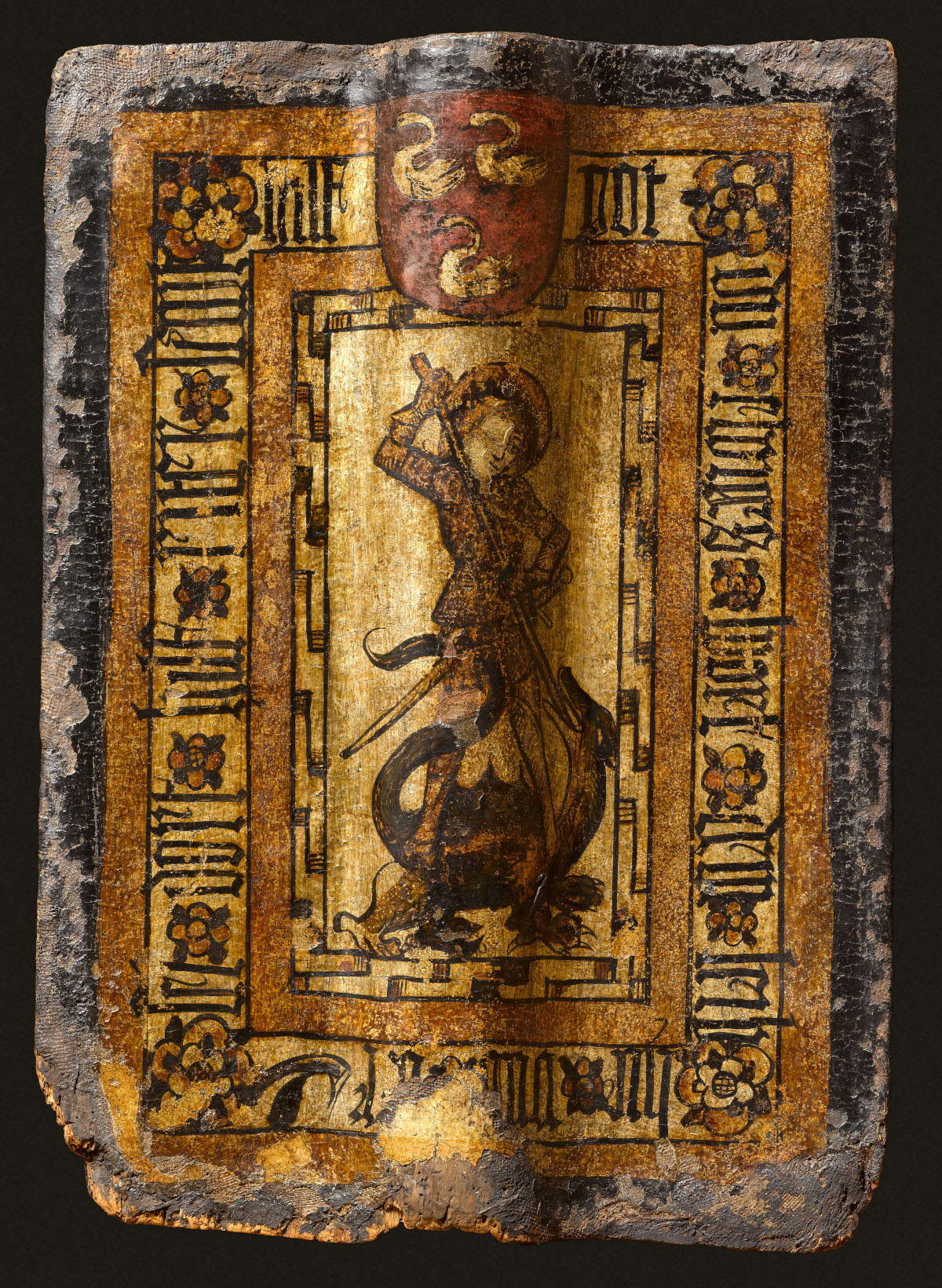
The theme of the warrior saint dominates the first room, where a suit of armor, a sword from the early 14th century, venerated in Cologne as a relic of the saint, and a shield painted on leather from the Musée de Cluny in Paris are displayed. In this context finds one of its most accomplished representations Carpaccio’s 15th-century painting from the Abbey of San Giorgio in Venice, which depicts the knight in the act of piercing the dragon.
In the next corridor, the narrative continues through two illuminated manuscripts from the 15th century, which testify to the presence of the figure of St. George both in civic texts, as in Giorgio Stella’s Annales genuenses, and in manuscripts with a liturgical function, such as the Kyriale from theAbbey of San Giorgio in Venice. The figure of the saint thus emerges in a double dimension, religious and civic, closely intertwined.
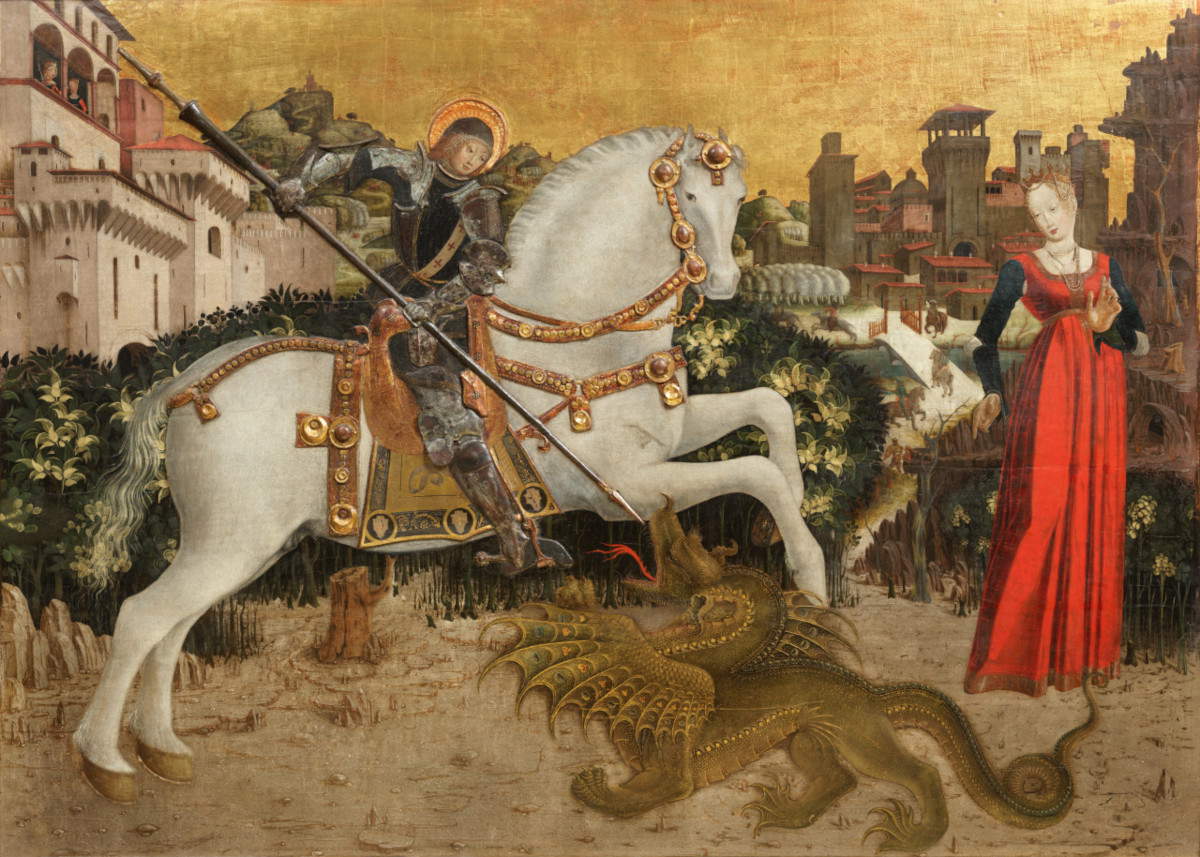
The next room is dedicated to the dragon, a symbol of evil to be defeated, represented on different materials and supports, from ceramics to metals to marble. Alongside works of great value, there are also objects of special curiosity, such as richly decorated ancient aquamaniles or the medallion of the Guild of St. George of Brussels, commissioned by the archers’ guild. Prominent among the masterpieces is the panel with St. George and the Princess by an anonymous Brescian painter from the Pinacoteca Tosio Martinengo in Brescia, chosen for its technical excellence and rich iconographic details, which summarize the entire legend against the backdrop of the liberated city.
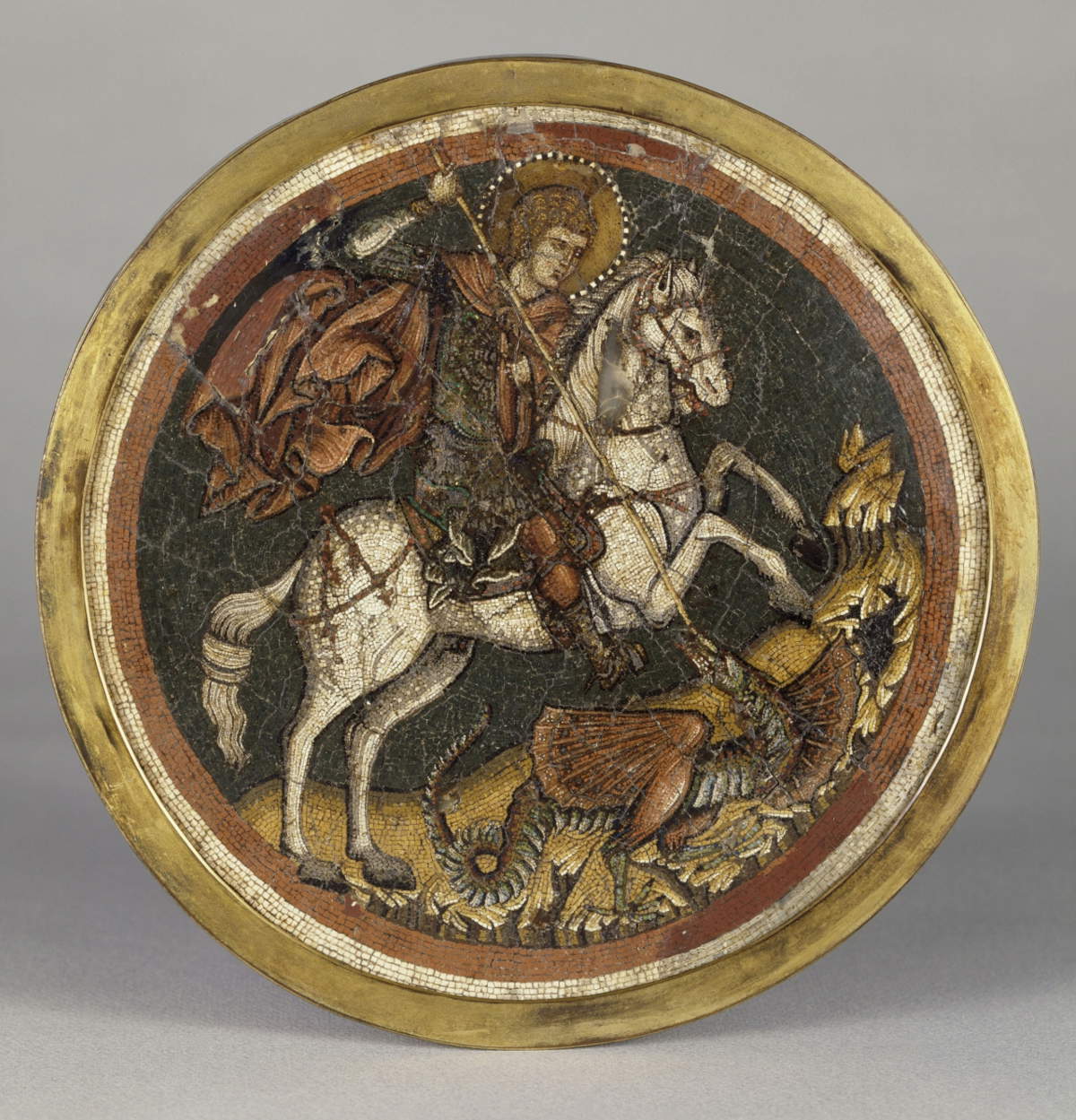
Among the loans from the Musée du Louvre is a very rare 14th-century micro-mosaic with wood tesserae, probably intended for private devotion, which further documents the variety of techniques employed in the depiction of the saint. Also of particular significance is the Reliquary of the Arm of St. George from the Treasure of St. Mark’s in Venice, an extraordinary example of goldsmithing and the object of a long devotional tradition.
The tour continues with a selection of works from Genoa or of Ligurian provenance, starting with Luchino da Milano ’s Saint George from the Palazzo San Giorgio, believed to be the probable first city gonfalon. This is followed by, among others, a panel painting by Niccolò da Voltri, commissioned by the Genoese community in Palermo, and Pietro Francesco Sacchi ’s painting made for the church of Levanto in 1520, a work that experienced a complex historical vicissitude between Napoleonic requisitions and Parisian exhibitions before returning to Italy in 1817.
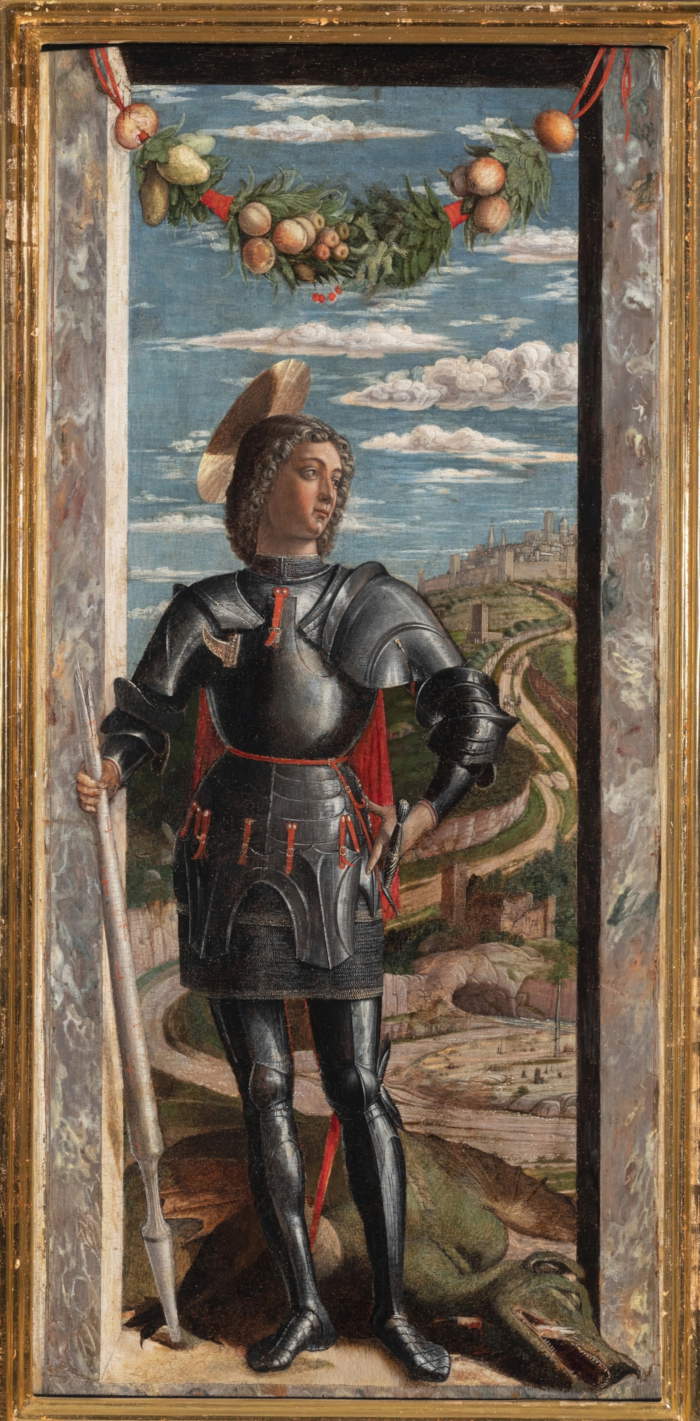
The last room houses an absolute masterpiece, exhibited in Genoa for the first time: Andrea Mantegna’s Saint George, dated between 1459 and 1461. In this concluding image the saint, victorious and pacifying, appears as a “Christian Perseus,” rendered with extraordinary pictorial mastery. Comparison with two small works of the Ferrarese school, by Cosmè Tura and Ercole de’ Roberti, underscores remarkable artistic affinities and dialogues.

At the end of the visit, a map of the city invites the public to ideally continue the journey outside, discovering the many depictions of St. George scattered throughout the city. The exhibition is also accompanied by a series of in-depth videos, with talks by scholars who provide historical and iconographic keys to the figure of the saint. Special attention is also given to the youngest visitors, with dedicated tools such as a playbook and audio guides designed for family visits, to make the discovery of one of the deepest symbols of Genoa’s history and identity accessible and engaging.
The rich catalog, accompanied by a detailed iconographic apparatus, is published by Dario Cimorelli Editore.
Hours: the exhibition follows the opening hours of the National Museums of Genoa: Tuesday from 1:30 to 7 p.m.; Wednesday through Saturday from 9 a.m. to 7 p.m. Closed Mondays. Sundays and holidays 2025/open; see the Royal Palace website for hours.
Genoa National Museums single ticket: €12 (Exhibition + Palazzo Reale + Palazzo Spinola); reduced €2 for 18-25 year olds. Free for under 18 and eligible persons
|
| Genoa hosts the first major exhibition entirely dedicated to St. George |
Warning: the translation into English of the original Italian article was created using automatic tools. We undertake to review all articles, but we do not guarantee the total absence of inaccuracies in the translation due to the program. You can find the original by clicking on the ITA button. If you find any mistake,please contact us.