




by Redazione 01/02/2026



Categories: Exhibitions / Disclaimer
From Feb. 19 to May 17, 2026, the Carlo Maria Martini Diocesan Museum hosts Hans Memling's The Crucifixion, on loan from Vicenza, along with contemporary works by Stefano Arienti, Matteo Fato, Julia Krahn and Danilo Sciorilli.

The Carlo Maria Martini Diocesan Museum in Milan will host from Feb. 19 to May 17, 2026 an event that puts Renaissance and contemporary art in dialogue. The focus of the exhibition HANS MEMLING. The Crucifixion. Four contemporary artists around a masterpiece will be the famous panel painting by Hans Memling (Seligenstadt, c. 1435/1440 - Bruges, 1494), datable between 1467 and 1470, from the Museo Civico di Palazzo Chiericati in Vicenza. The exhibition, curated by Valeria Cafà, Giuseppe Frangi and Nadia Righi, offers a comparison between the visual and spiritual power of the Flemish work and the works of Stefano Arienti, Matteo Fato, Julia Krahn and Danilo Sciorilli, created especially for the occasion, in collaboration with Casa Testori.
The exhibition is supported by the patronage of the City of Milan, with PwC Italia as main sponsor, Fiera Milano sponsor, support from Fondazione Grana Padano and Fondazione Maurizio Fragiacomo, and Zeroglass as technical sponsor. The Crucifixion will be placed at the center of the installation, becoming the reference point for the artists called to confront the table through a respectful and discreet approach, reinterpreting compositional, chromatic and iconographic details according to their own contemporary language.


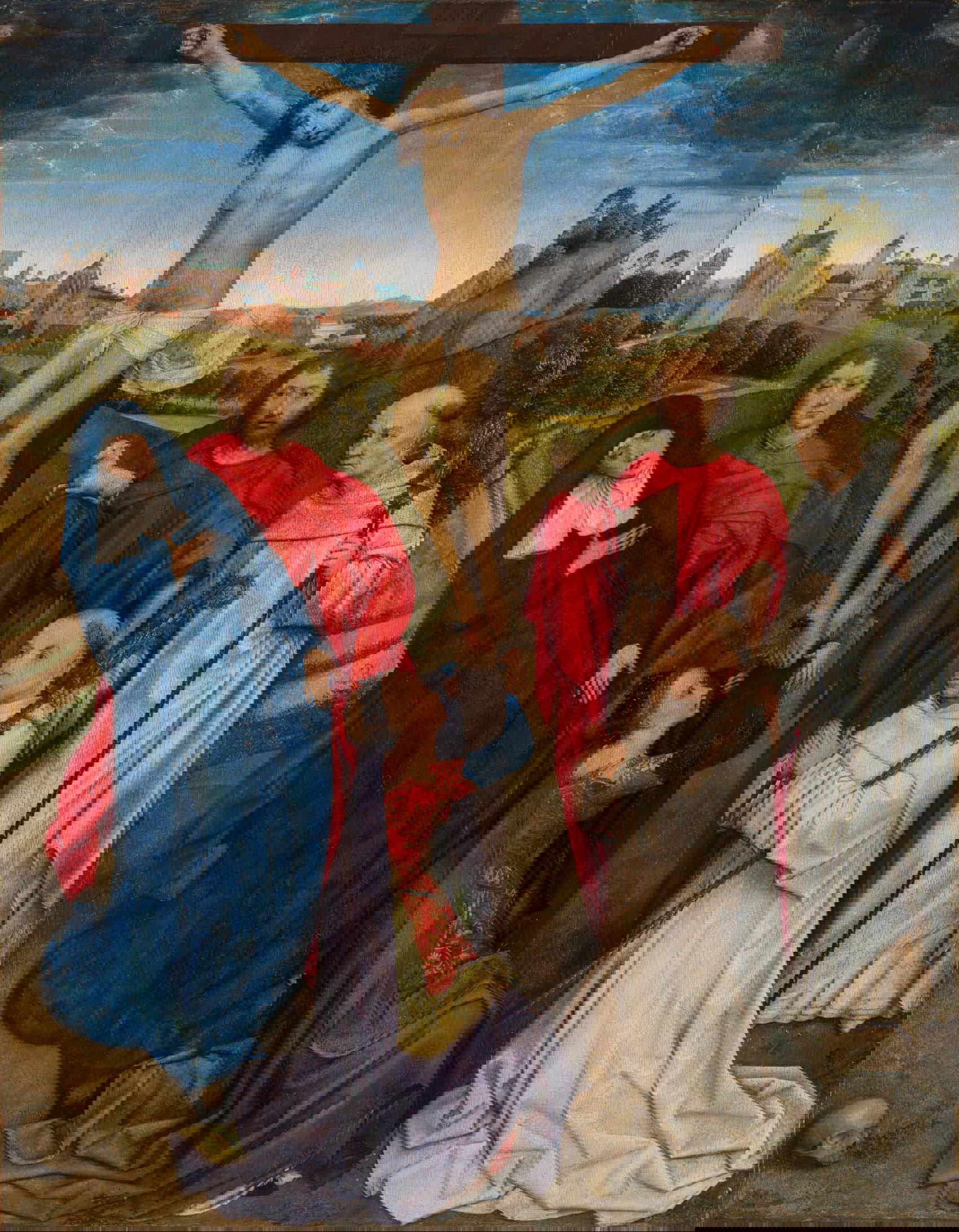
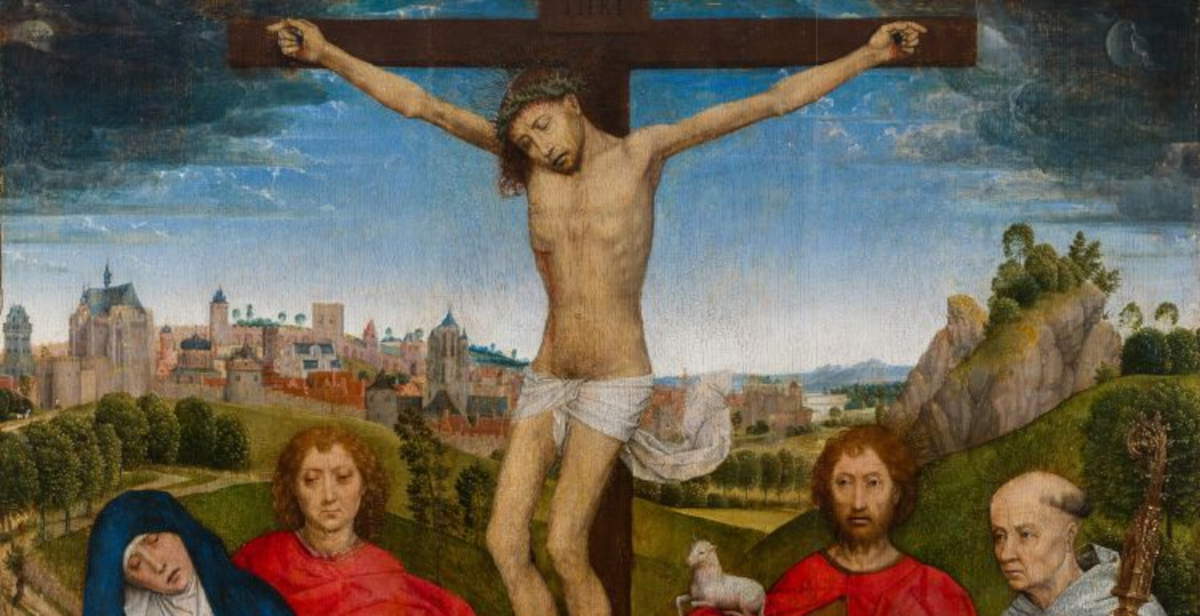
The painting, donated to the Vicenza Civic Museums in 1865 by Counts Matteo and Ludovico Folco, depicts Christ Crucified in the center, with St. John the Evangelist holding the grieving Virgin and Mary Magdalene kneeling at the foot of the cross on the left. On the right side appear St. John the Baptist with a lamb and St. Bernard of Clairvaux, patron saint of the commissioner, shown kneeling in the foreground. The work had been commissioned between 1467 and 1470 by Cistercian abbot Jan Crabbe for the Abbey of the Dunes near Bruges, of which he was titular. Memling, who was probably trained between Cologne and Brussels, had moved to Bruges around 1465, a city that was already a thriving artistic center in Flanders.
The background of the painting shows a bird’s-eye view of a hilly landscape, rendered with typically Flemish care, with a walled city, towers and bell towers, trees, rocks, and a river flowing toward the horizon. The bright glazed colors, the analyticity of the faces and the sharpness of the contours of the drapery recall the influence of Rogier van der Weyden, Memling’s master. The whole shows a gradual evolution toward gentler and less dramatic forms than the language of the master.
The panel was originally the central panel of a triptych, dismembered at an unspecified time. An 18th-century copy ideally reconstructs its composition. The side panels, severed and sold separately, are now preserved between Pierpont Morgan Library in New York and Groeningemuseum in Bruges, depicting members of the Crabbe family and two figures of theAnnunciation, respectively.
Contemporary artists invited to engage with the masterpiece have developed different languages. Stefano Arienti reflects on Memling’s symbolic landscape. Matteo Fato makes a painting on canvas conceived as part of an installation in which the easel takes an active role. Julia Krahn explores the figure of Mary at the foot of the cross through photography and sculpture, while Danilo Sciorilli offers a video triptych based on a performance in his home country. The exhibition will be accompanied by a catalog published by Dario Cimorelli Editore.
 |
| In Milan, four contemporary artists dialogue with Hans Memling's Crucifixion |
Warning: the translation into English of the original Italian article was created using automatic tools. We undertake to review all articles, but we do not guarantee the total absence of inaccuracies in the translation due to the program. You can find the original by clicking on the ITA button. If you find any mistake,please contact us.