




For the first time in history, a selection of original folios from Leonardo da Vinci ’s Codex Atlanticus will be exhibited in Naples, inside the Majolica Cloister of the Complesso Monumentale di Santa Chiara. The initiative, the result of a collaboration between the Neapolitan Province of the Most Sacred Heart of Jesus OFM, the Complex of Santa Chiara, Arthemisia and the Pinacoteca Ambrosiana in Milan, will allow the public to take a closer look at six drawings from the largest Leonardo corpus that has come down to the present day. The sheets, on display in rotation from Dec. 6, 2025, to June 7, 2026, offer a close look at the artist’s working method and his research activities in the fields of science, technology and art.
Leonardo da Vinci, born in Vinci in 1452 and active in major Italian courts, united diverse disciplines in a unified approach to knowledge. His paintings, including the Mona Lisa and theLast Supper, are world-famous, but alongside his pictorial production he pursued a systematic study of nature, the human body, bird flight, water and technical mechanisms. These investigations are collected in thousands of folios that testify to an activity of continuous observation and an interpretation of the world based on the relationship between art and science. The Codex Atlanticus represents the largest collection among Leonardo’s writings and drawings that have come down to the present. Kept at the Veneranda Biblioteca Ambrosiana in Milan, it comprises 1,119 sheets produced between 1478 and 1519. It contains studies of anatomy, plans of machines, geometric analyses, reflections on hydraulics and proportions, architectural drawings and observations on nature. The name derives not from the extent of the contents but from the format of the pages, similar to that of modern geographic atlases. The collection was organized in the 16th century by sculptor Pompeo Leoni, who brought together materials from different notebooks. The operation made it possible to preserve a considerable amount of folios, although it disrupted the original structure of the Leonardo series and made it complex to reconstruct their chronological order.
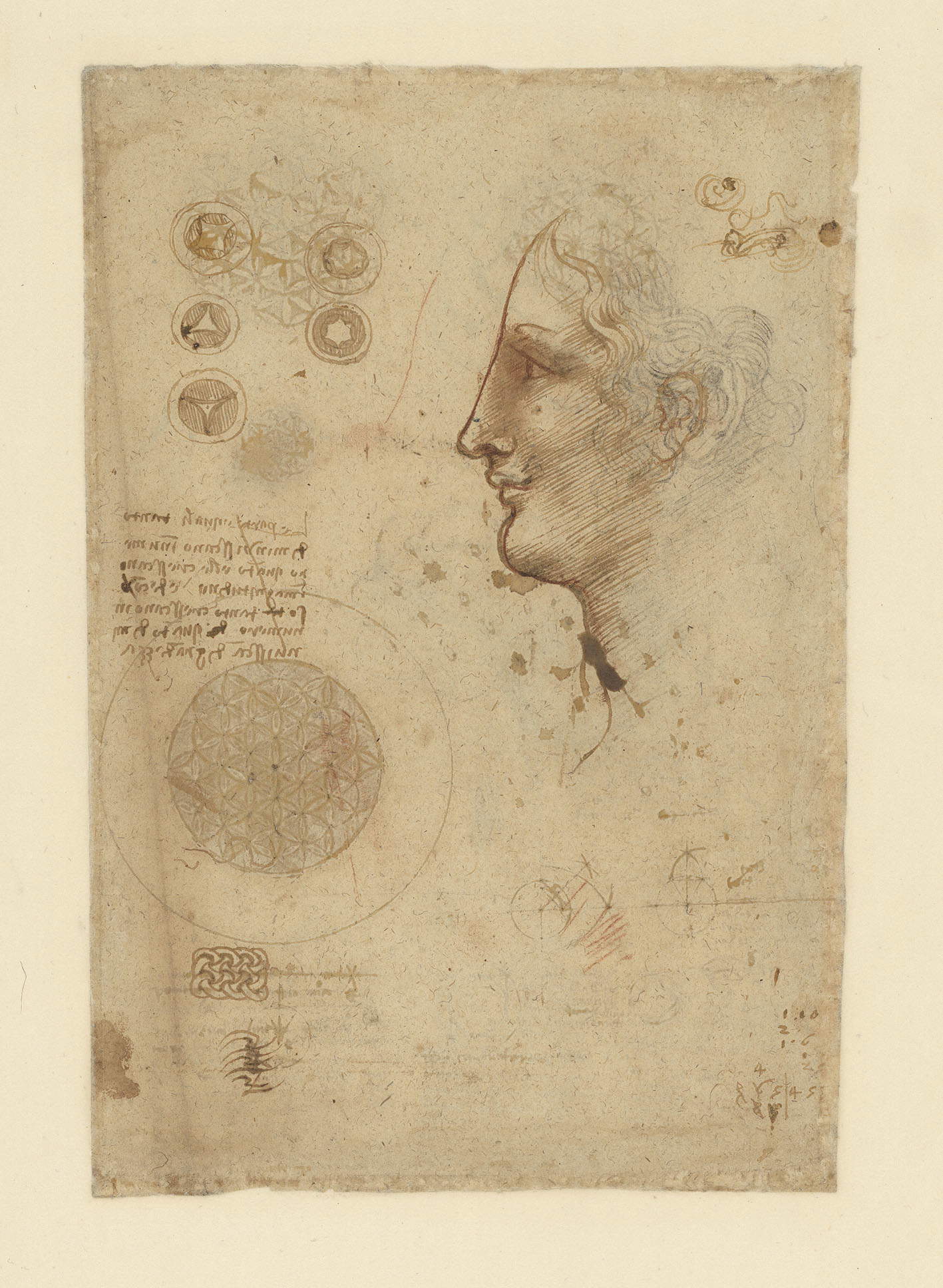
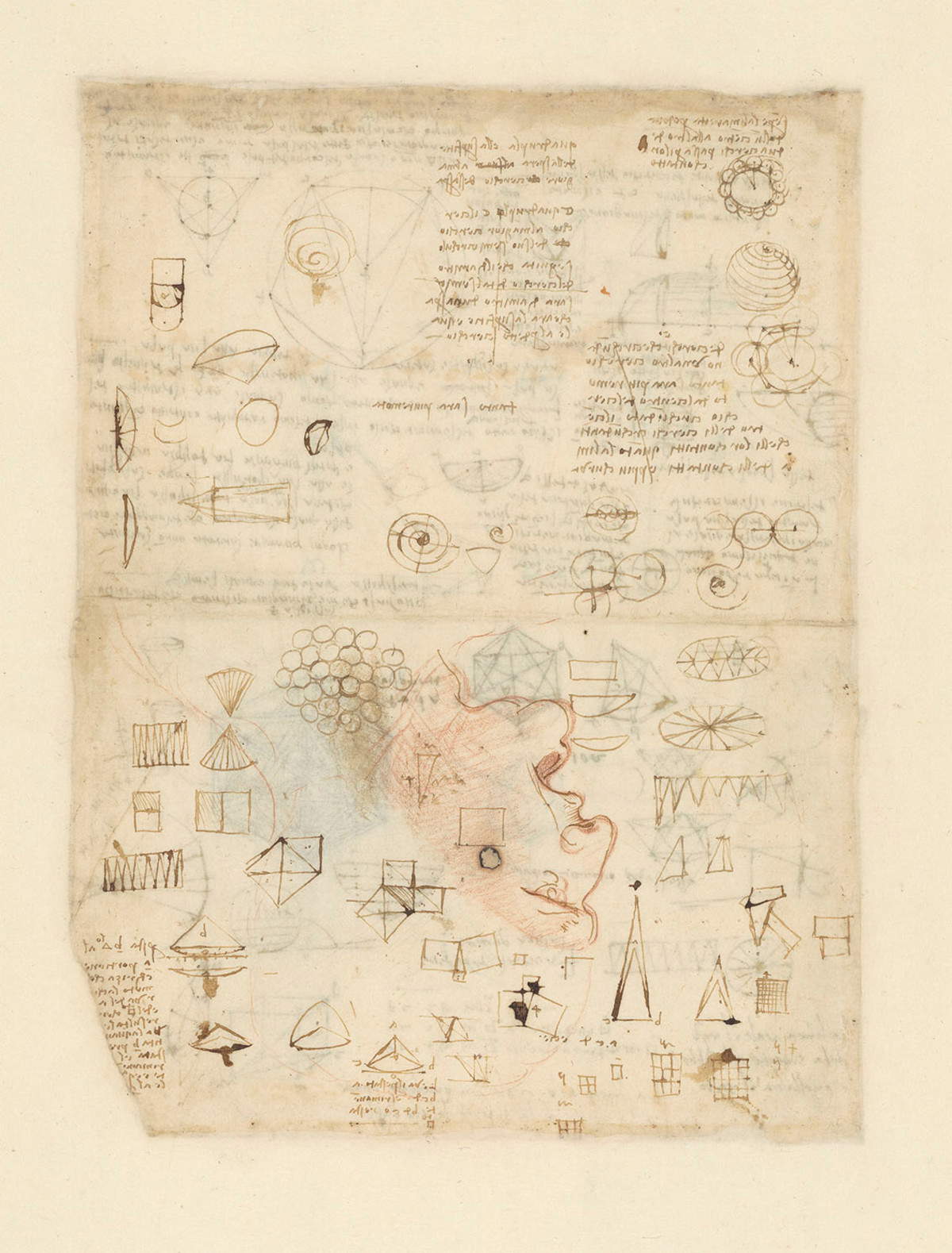
Six sheets, selected by scientific curator Monsignor Alberto Rocca, director of the Pinacoteca Ambrosiana, will be displayed in Naples in turn. From December to March, folios 518v, 239r and 816r will be on view; from March to June, folios 142, 281 and 1775. The exhibition allows direct observation of Leonardo’s mirror writing, the evolution of his handwriting and the role that drawing played within his study process. Topics range from geometric figures to technical annotations, from his relationship with scholars such as Luca Pacioli to his reflections on the workings of machines and natural phenomena. The exhibition includes the use of multimedia supports, enlargements and transcriptions to facilitate the reading of the sheets and make complex content accessible. The choice of the majolica cloister of Santa Chiara as the exhibition venue is linked to the history of the place: built in the 14th century at the behest of Robert of Anjou and Queen Sancia of Majorca, the complex houses an 18th-century cloister decorated with polychrome majolica tiles attributed to Domenico Antonio Vaccaro. Damaged by bombing in 1943, the site was faithfully reconstructed and is now a landmark in Neapolitan artistic history.
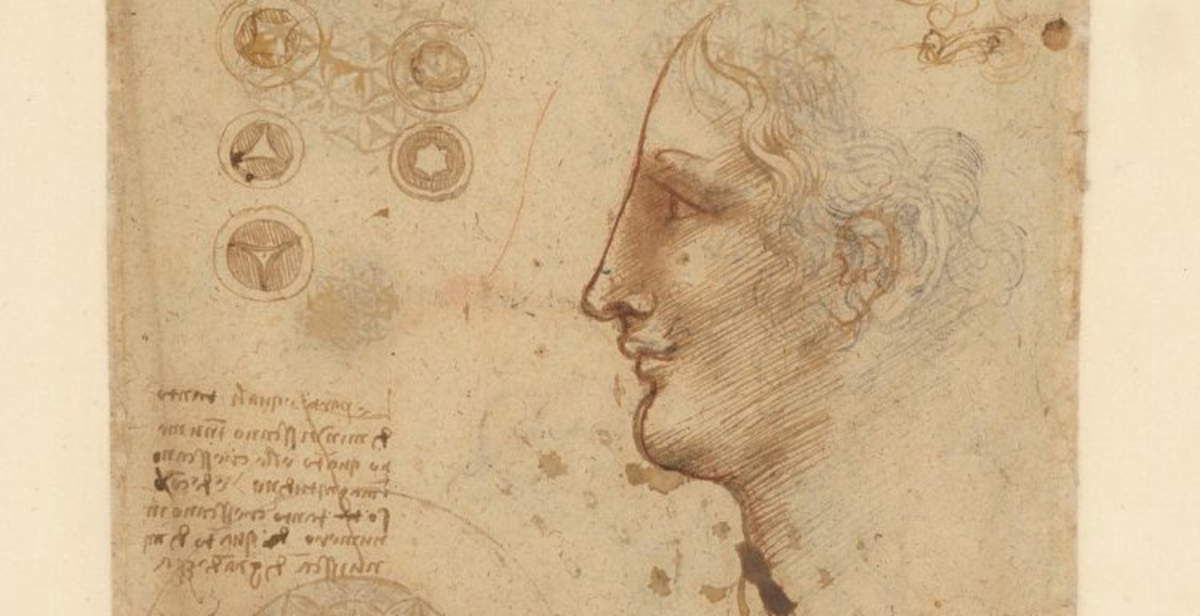
The project invites us to explore Leonardo beyond the dimension of great pictorial masterpieces, focusing on the intellectual processes that preceded and accompanied his inventions. The Codex Atlanticus bears witness to a research activity in which direct observation of reality is translated into drawing and theoretical reflection. In the corpus, the topics addressed transcend disciplinary divisions: military engineering, hydraulics, mechanics, botany, music, urban planning, geometry, and proportions occupy the pages in a free and often associative manner. The presence of uncompleted ideas, exercises, calculations and marginal notes returns the image of a process-oriented mind rather than a finished product. The exhibit includes some of the most important pages of the Codex. Sheet 518v presents a series of geometric studies in which Leonardo analyzes figures such as pyramids, cones, spheres and polyhedra through transformations and proportions. Of particular note is the calculation that relates the lateral surface area of the cone to that of the base: when the hypotenuse coincides with the diameter of the base, the lateral surface area is double that of the base. Alongside this study appears the idea of obtaining a sphere from a cube composed of screwed plates, transformed by turning, a sign of the artist’s interest in craft techniques. There is also a screaming human profile in the sheet, which allows one to speculate on a connection with the preparatory studies for the Battleof Anghiari, which can be dated between 1503 and 1504.
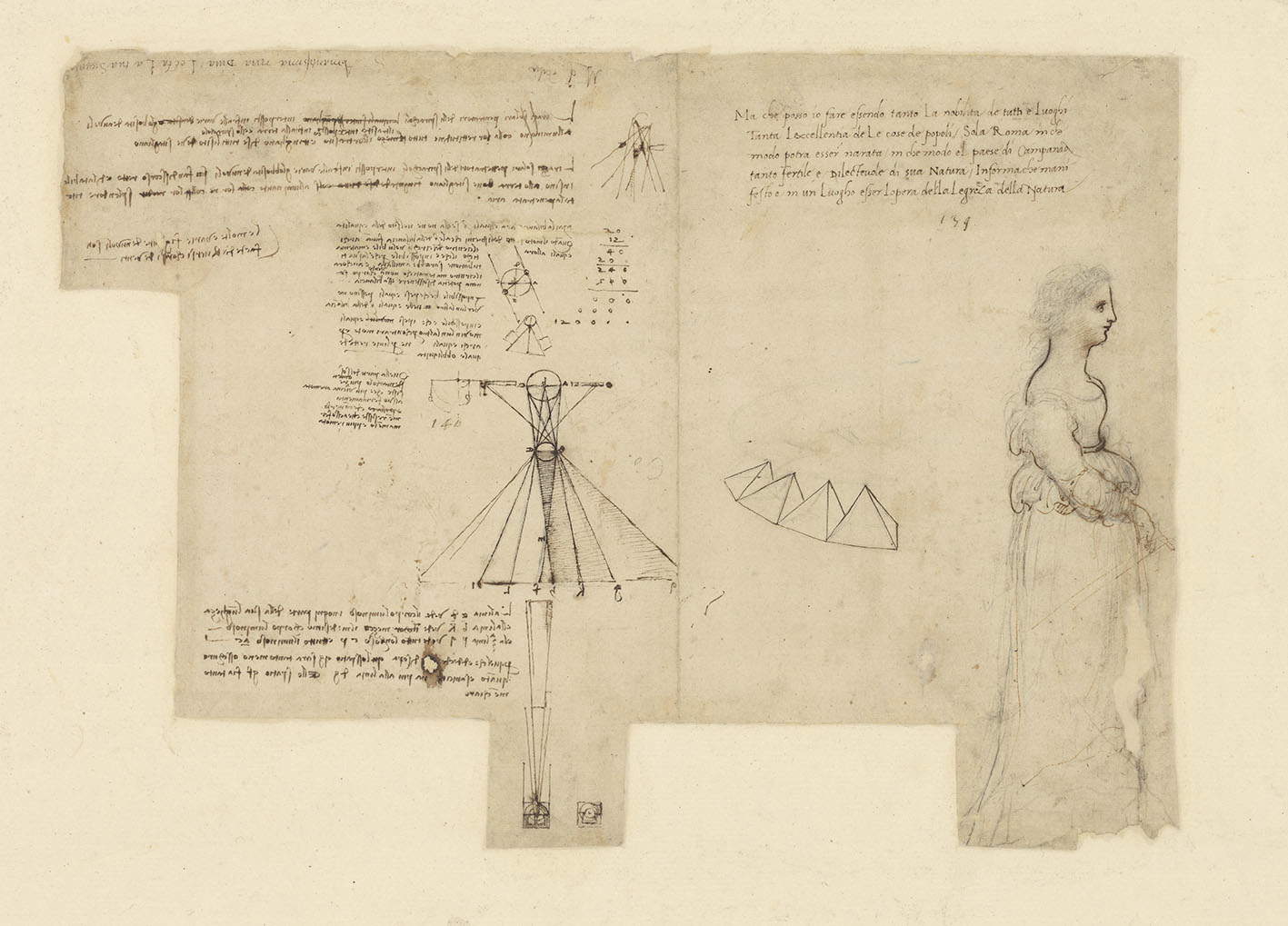
Sheet 239r shows the way the workshop materials were used by several hands. The paper, of rough quality, shows traces of charcoal drawings attributable to pupils, probably studies with licentious themes. Leonardo later added geometric annotations, while a head of a young man, made in sanguine and repainted in pen, is attributed to a collaborator. There are five figures of concentric circles related to the geometric ludo, two entanglements close to its nodal structures, and numerical calculations such as the 365:8 division, referable to the division of the solar year into cycles. The marginal note on the relations between number and magnitude summarizes the proportional principle investigated in the sheet. Sheet 816r is one of the most discussed because of its complex material history. It has clippings, folds and added writings. In the past, some scholars speculated that it contained a letter from Leonardo to Cecilia Gallerani, but subsequent research has shown that the affective phrases and the female figure are the work of Francesco Melzi, the master’s pupil and secretary. Melzi’s notes include praise of Rome and Campania, described as “the work of Nature’s alegreza.” Leonardo’s autograph texts, on the other hand, concern studies on light filtering through clouds, analysis on shadows, and mechanics notes referring to the balance of scales. The numerical operations reported are part of these reflections on proportion. The paper highlights the coexistence, in the same medium, of Leonardo’s and Melzi’s activities, showing the shared use of the material.
The exhibition is produced under the patronage of the City of Naples and is a collaboration between the Neapolitan Province of the Most Sacred Heart of Jesus of the Order of Friars Minor and the Fondo Edifici di Culto (FEC). It is organized by Arthemisia in collaboration with the Pinacoteca Ambrosiana. The scientific curatorship is entrusted to Monsignor Alberto Rocca, with didactic and informative contribution by Costantino d’Orazio. The catalog is published by Moebius and the exhibition has Sole365 as a special partner. The presence of the Codex Atlanticus in Naples represents an opportunity to study Leonardo’s work as a mental process rather than as a succession of results. The folios, preserved today as loose units and subject to rotation for reasons of protection, make clear the dynamic character of his research, based on continuous investigation and contamination between disciplines. To look at a page of the Codex is to observe a thought in motion, in which words and graphic signs coexist to elucidate natural phenomena, mechanical workings and structures of the visible world. The arrival of the folios at St. Clare makes it possible to deepen this dimension, introducing the public to an intellectual laboratory that continues to arouse interest because of its modernity and the breadth of the themes it addresses.
 |
| Leonardo da Vinci's Codex Atlanticus arrives in Naples for the first time |

Warning: the translation into English of the original Italian article was created using automatic tools. We undertake to review all articles, but we do not guarantee the total absence of inaccuracies in the translation due to the program. You can find the original by clicking on the ITA button. If you find any mistake,please contact us.





















 IT
IT FR
FR DE
DE ES
ES CN
CN


