



by Redazione 31/01/2026



Categories: Exhibitions / Disclaimer
In Milan, at the Fondazione Prada, in the space of the Cistern, the site-specific project conceived by artist Mona Hatoum that aims to propose a reflection on the instability that characterizes the present and the fragility of the human condition.
From Jan. 29 to Nov. 9, 2026, Over, under and in between, the site-specific project conceived by artist Mona Hatoum that aims to propose a reflection on the instability that characterizes the present and on the fragility of the human condition, can be visited at Fondazione Prada’s Milan headquarters in the Cistern space.
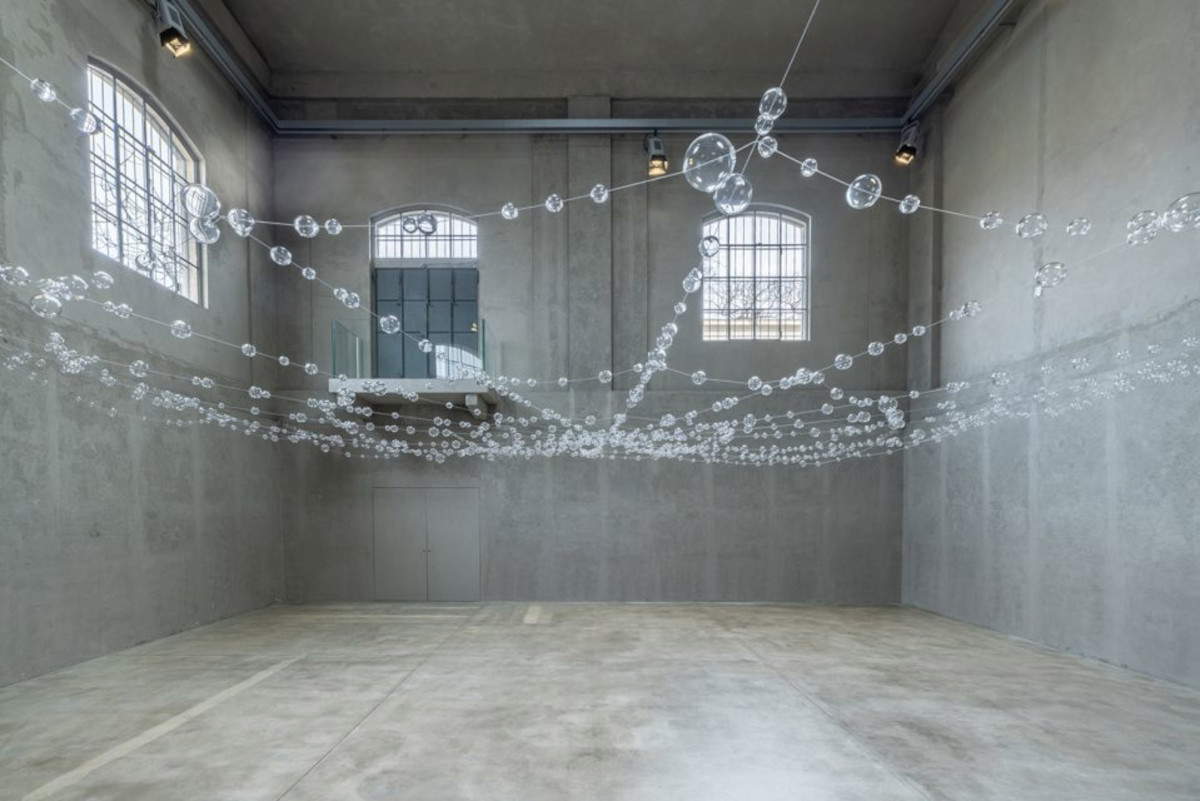
The three installations that make up the project investigate some recurring and identifying elements of Hatoum’s artistic language: the spider web, the map and the grid. Their presence reactivates and redefines the space of the Cisterna building, which once housed the silos and tanks of the former alcohol distillery in the Fondazione Prada complex. The works, independent of each other but conceptually connected, evoke concepts of instability, danger and vulnerability, establishing a direct dialogue with the space and, above all, with the visitor’s physical experience.
In the entrance hall of the Cistern, a vast suspended web of hand-blown clear glass spheres, joined by wires, extends above the space that can be walked through by the public, taking on the form of a spider web. In recent decades, Hatoum has frequently employed this motif to address themes of entrapment, abandonment, neglect, family ties and relationships. As the artist states, “a spider web can be seen as a threatening web that suggests an oppressive sense of entrapment, but at the same time offers a home or safe place. For me, the large spider web suspended above also has a poetic, almost cosmic meaning. The beautiful and delicate glass spheres are a direct reference to dew drops and evoke their fragility and luminosity. They can also resemble a celestial constellation. I like to see it as an allusion to the interconnectedness of all things.”


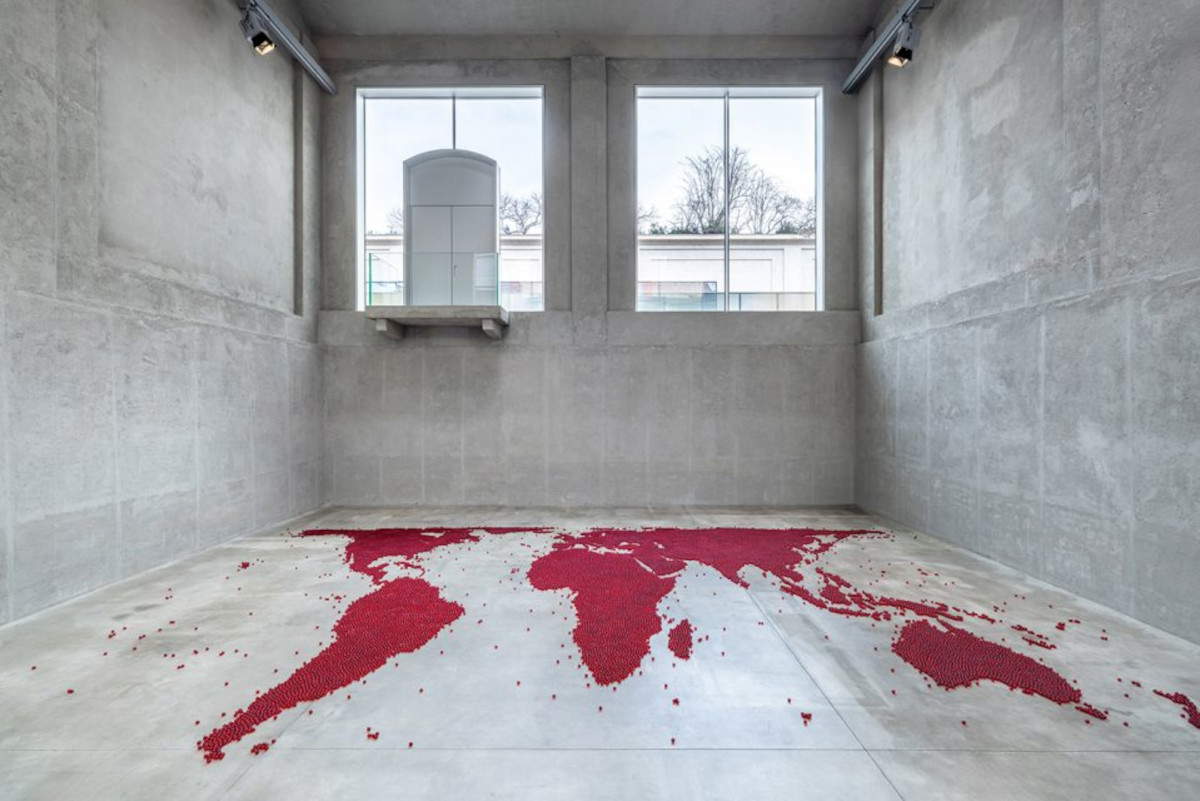
In contrast, the central room of the Cistern features a concrete floor completely covered with translucent red glass spheres, arranged to outline a map of the world in which only the outlines of the continents are drawn, without reference to political or geographic boundaries. The more than thirty thousand spheres, not fixed to the floor, create an unstable configuration that the artist defines as “an open and undefined territory,” exposed to possible external destabilizing forces. As Austrian architect and theorist Theo Deutinger notes, “a globe is not a map. It is not flattened and therefore cannot be folded or rolled up and put in a pocket. And the globe does not allow us to see planet Earth in its entirety. A map is like the skin of the Earth, detached and flattened.” The cartographic representation of the world is never neutral, as it historically reflects power relations and systems of domination. For this reason, Hatoum chose to adopt the Gall-Peters projection as an alternative to the more widely used Mercator projection, correcting for distortions that visually reduce the extent of territories in the global South, such as Africa, South America and Southeast Asia, smaller than their actual extent compared to the global North.
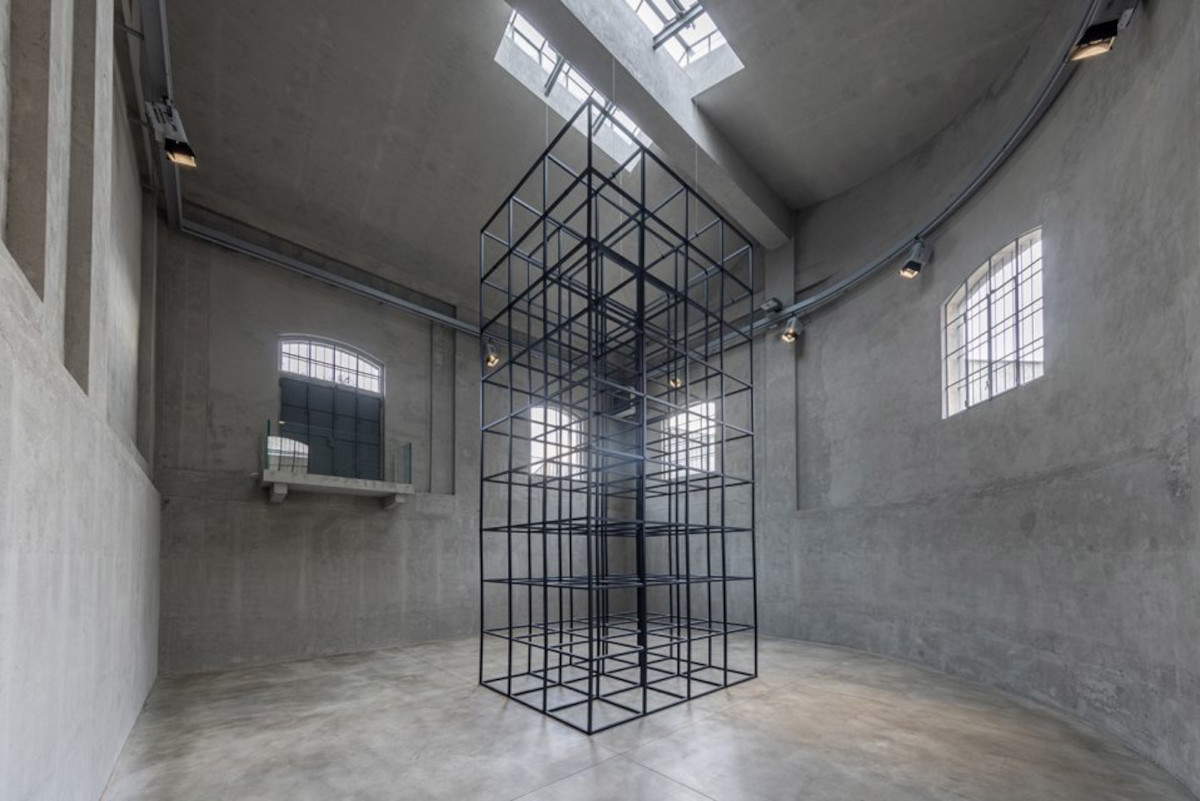
The third room of the Cistern houses all of a quiver, akinetic installation consisting of a metal grid structure made up of nine stacked levels of open cubes. Suspended from the ceiling, the work moves slowly, oscillating between a tension toward collapse and recomposition. Creaks and rattles accompany the movement of each row of cubes, as the structure proceeds with an undulating, zigzagging gait downward, like a body on the verge of succumbing to gravity and destruction. The work testifies to Hatoum’s interest in minimalist aesthetics and his ability to transform essential modular forms such as grids and cubes into living presences, deeply connected to bodily experience and capable of evoking feelings of unease, claustrophobia and helplessness. Through its cyclical motion, all of a quiver embodies a condition of permanent precariousness, a continuous suspension between opposites such as construction and ruin, levitation and collapse, endurance and fragility. As Lebanese architect Lina Ghotmeh writes in the Notebook published on the occasion of the exhibition, “Hatoum’s work teaches us that to remain standing is not to conquer instability, but to inhabit it. Demonstrating an openness to change instead of a need to control it, the oscillation of all of a quiver is a lesson in humility.”
|
| Milan, at Fondazione Prada, Mona Hatoum's site-specific project on the instability and fragility of existence |
Warning: the translation into English of the original Italian article was created using automatic tools. We undertake to review all articles, but we do not guarantee the total absence of inaccuracies in the translation due to the program. You can find the original by clicking on the ITA button. If you find any mistake,please contact us.