





From March 18 to September 26, 2026, theItalian Cultural Institute in Paris is hosting Horse Power (Ram), a sculpture created in 2023 by Nico Vascellari, curated by Pier Paolo Pancotto. The work, exhibited in the Institute’s spaces at 50 Rue de Varenne, comes from the collection of the International Sculpture Park in Mestre, owned by Banca Ifis, and is presented to the French public within an institutional context dedicated to the promotion of contemporary Italian creativity.
The initiative is part of a program with which Banca Ifis supports the enhancement of art and the dissemination of the cultural heritage kept in the park of Villa Fürstenberg, the institute’s historic headquarters. The decision to bring to Paris a work belonging to its collection is part of a strategy that aims to strengthen the international presence of Italian contemporary art through targeted exhibition projects. Horse Power (Ram) focuses on the figure of the ram, an archetype that in symbolic tradition recalls spring, fertility and primordial energy. The first sign of the zodiac and associated with the planet Mars, the ram represents beginning and the capacity for action. Such imagery runs through classical and literary culture: from the Chrysomallo myth to its presence in Dante’s Comedy, where it appears in Paradise as a reference to Creation, and in twentieth-century poetry, as in Salvatore Quasimodo’s 1929 composition Aries.
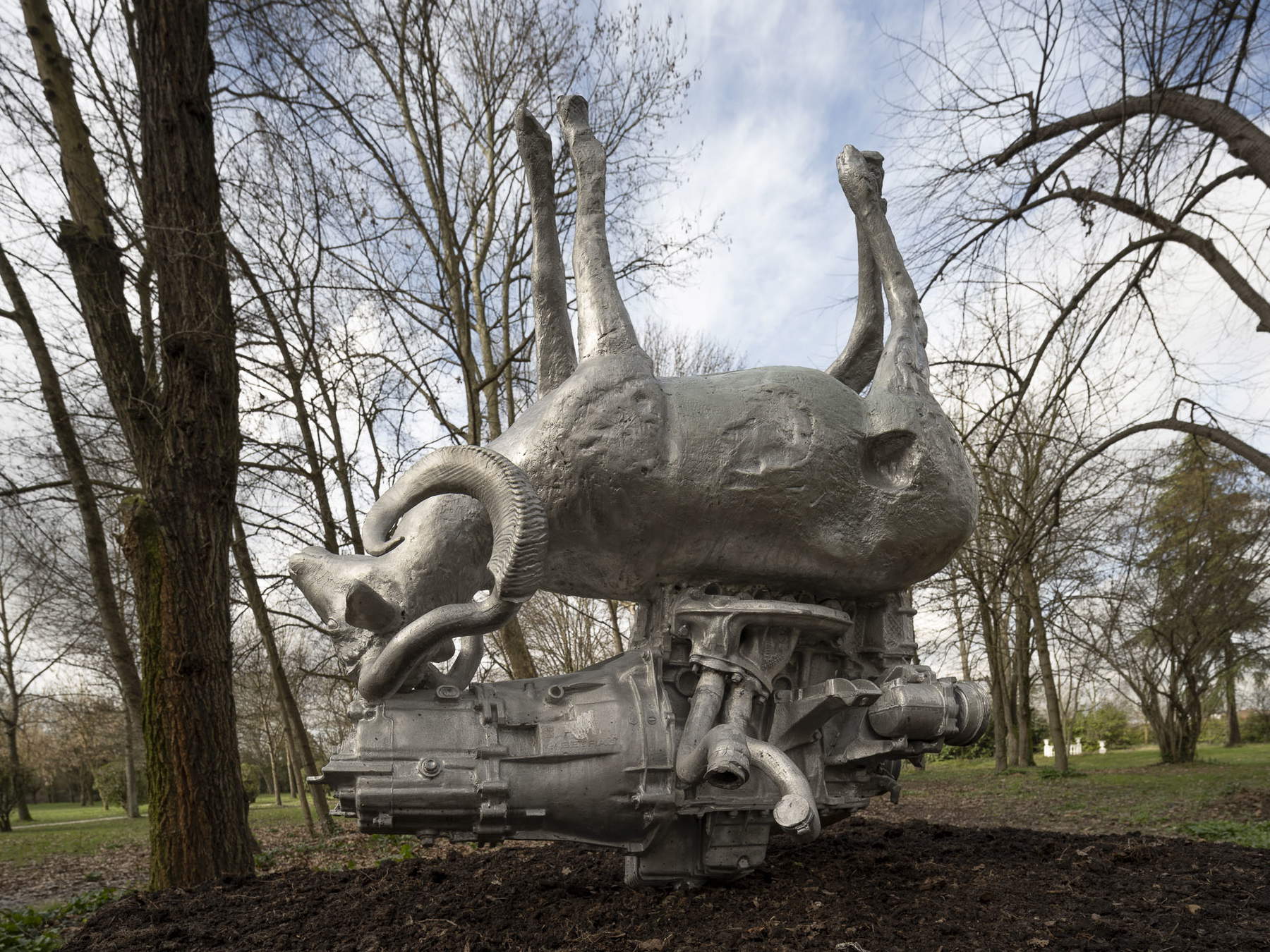
Vascellari reworks this symbolic heritage through a formal solution that avoids all monumentality and rhetoric. The animal appears upside down, with its head pointing downward and its limbs locked in an unnatural position. The belly shows signs of sagging, almost suggesting a dissolution of matter, while the back is crossed by a car engine. The fusion of organism and machine becomes a central element of the composition, accentuated by the base eroded by vegetation, which introduces an additional level of visual and conceptual tension.
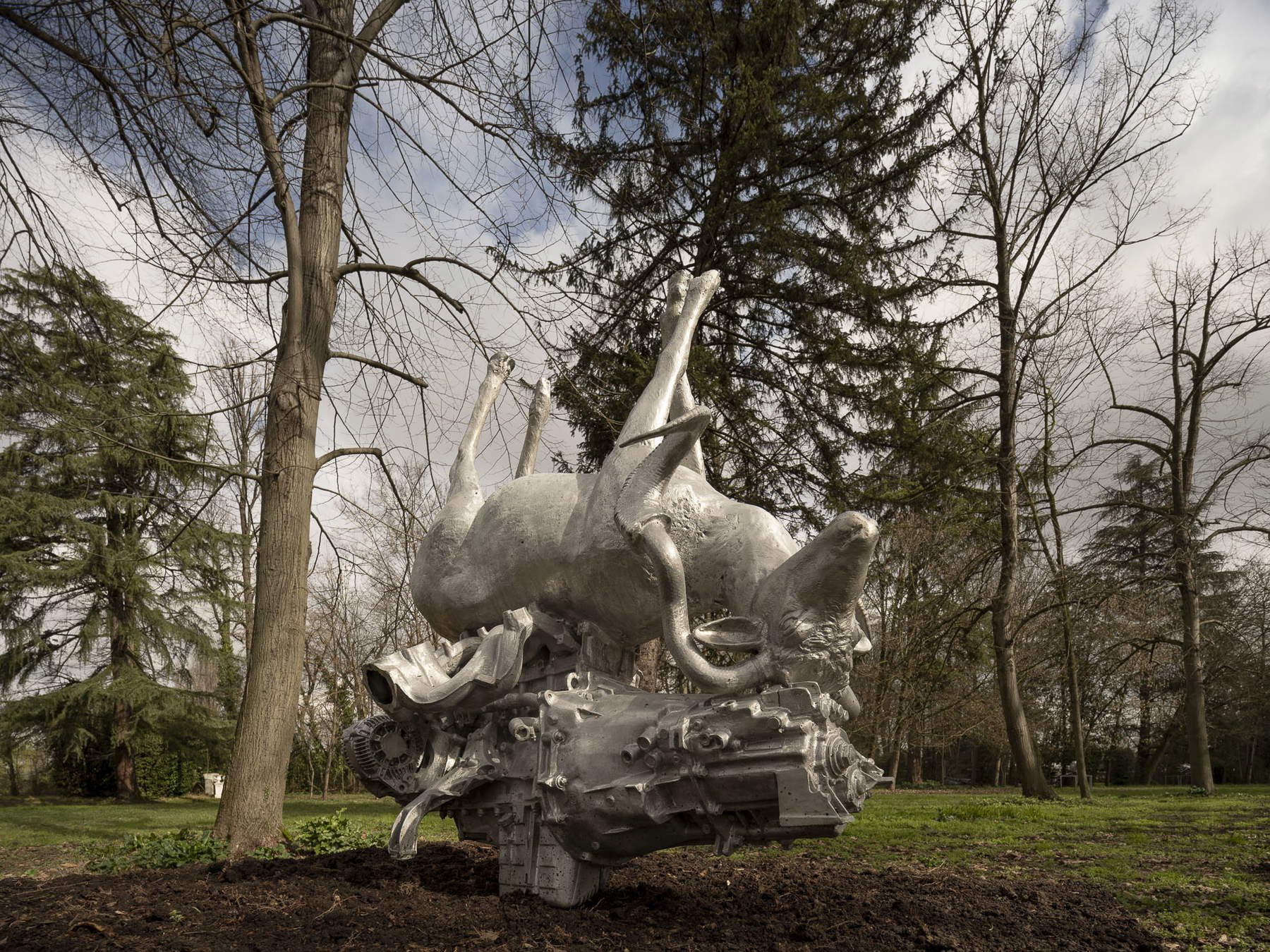
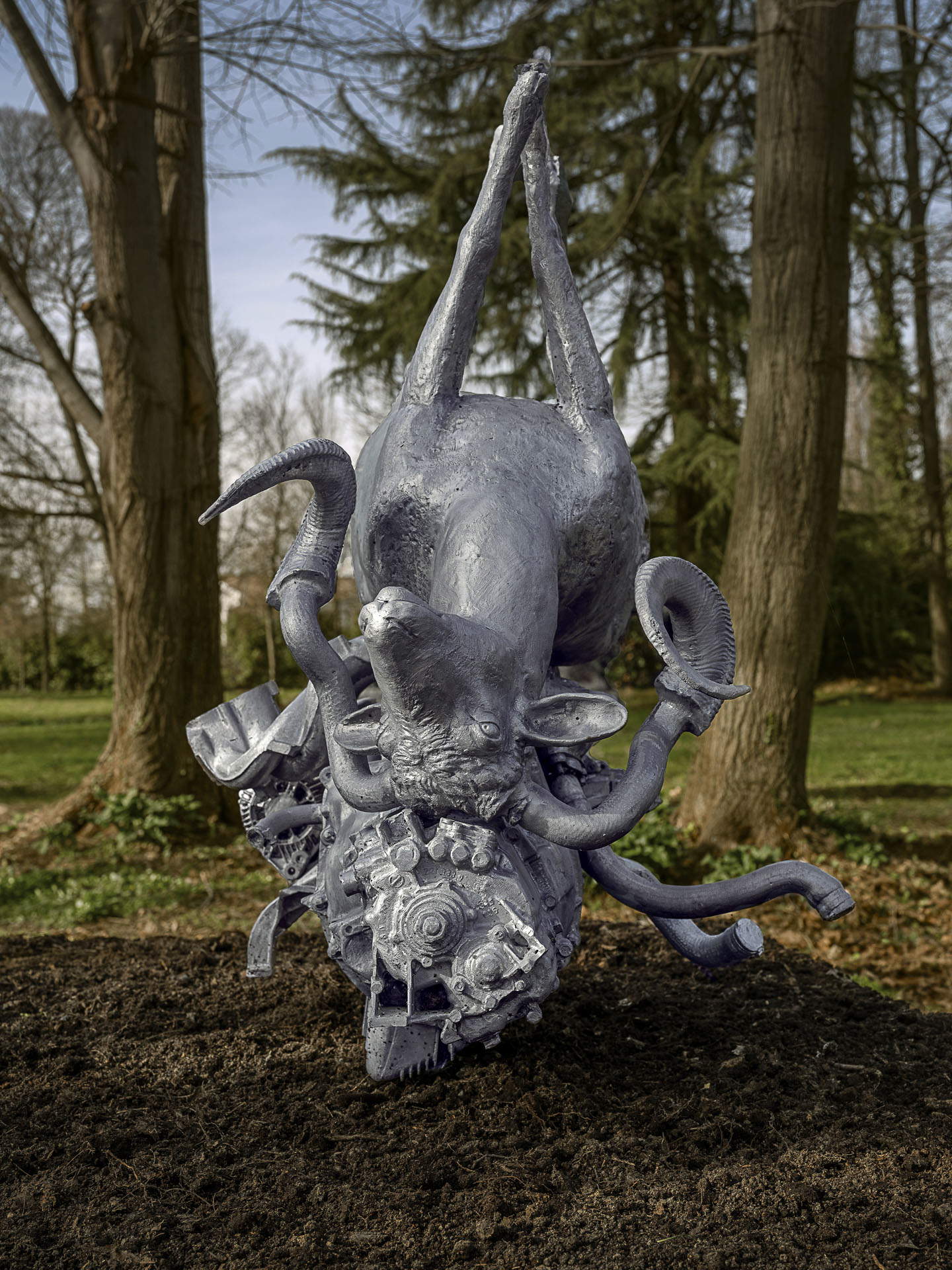
The work belongs to the Horse Power cycle, which was initiated in 2019 on the occasion of the Lyon Biennial and later developed into the sculptural complex presented in the Melma exhibition, staged in 2023 at Forte Belvedere in Florence. The sculptures in the series are now located in the Villa Fürstenberg International Sculpture Park, where they are placed in dialogue with the landscape and other works in the collection. The project originates from a performative action carried out in a post-industrial area near Cinecittà, Rome. For three days and two nights, nine cars, driven by stuntmen, were set in motion after their hoods were replaced with wax sculptures depicting animals. The forms were derived from taxidermied models, selected to achieve a deliberately impersonal, almost serial image. During the action there were chases, collisions and head-on collisions, in a dynamic that evoked a theatrical dimension close to futurist imagery, in which man, machine and animal were closely interconnected.
The heat produced by the engines gradually deformed the wax sculptures until they partially melted, particularly in the belly area. This process generated a visual fusion between the animal forms and the mechanical structure of the vehicles. Subsequent translations into metal fixed the outcome of this transformation, maintaining its symbolic tension. The Horse Power cycle thus addresses the theme of the instrumentalization of nature within social and economic systems, with particular attention to the use of animal imagery as an emblem of strength in industrial language and contemporary communication.
The Paris exhibition ties in with the activities promoted by Ifis art, a brand established in April 2024 with the aim of bringing together the bank’s cultural initiatives. Key projects include the International Sculpture Park, opened in 2023 to celebrate 40 years since the founding of Banca Ifis. The park covers the 22 hectares of the Villa Fürstenberg garden in Mestre and houses 25 works by 15 contemporary Italian and international artists, including Fernando Botero, Annie Morris, Park Eun Sun, Igor Mitoraj, Manolo Valdés, Pablo Atchugarry, Pietro Consagra, Roberto Barni, Julio Larraz, Philip Colbert, Giuseppe Penone, Jaume Plensa, Nico Vascellari, Davide Rivalta, and Tony Cragg.
Access to the park is free of charge, subject to reservation via the Ifis art app, and the project is a case study in the landscape of corporate collections and cultural and social responsibility practices. In parallel, in 2026 Banca Ifis renews its support for the Italian Pavilion of the Venice Biennale for the fourth consecutive year as a sponsor. The exhibition project, curated by Cecilia Canziani and entitled Con te con tutto (With you with everything), is promoted by the Ministry of Culture’s General Directorate for Contemporary Creativity. During the opening months of the Biennale Arte 2026, the bank also participates in the organization of initiatives related to the public program. Among these, the International Sculpture Park will host an appointment dedicated to the theme of the garden and reflection on the living through art, with a seminar day curated by Chiara Camoni. The meeting is proposed as a moment of articulated discussion, aimed at returning an interpretation of the place that hosts the event.
Born in Vittorio Veneto in 1976, Nico Vascellari figures among the most established Italian artists in the international context. His research, articulated between sculpture, performance, installation, video and sound, has long explored the relationships between the individual, the natural environment and socio-economic structures. His work is distinguished by a marked performative dimension and an imagery that interweaves underground culture, rituality and ecological sensitivity. Over the years he has participated in relevant international exhibitions and festivals, developing projects in which natural, animal and symbolic elements are reinterpreted to investigate the processes of transformation and appropriation enacted by contemporaneity.
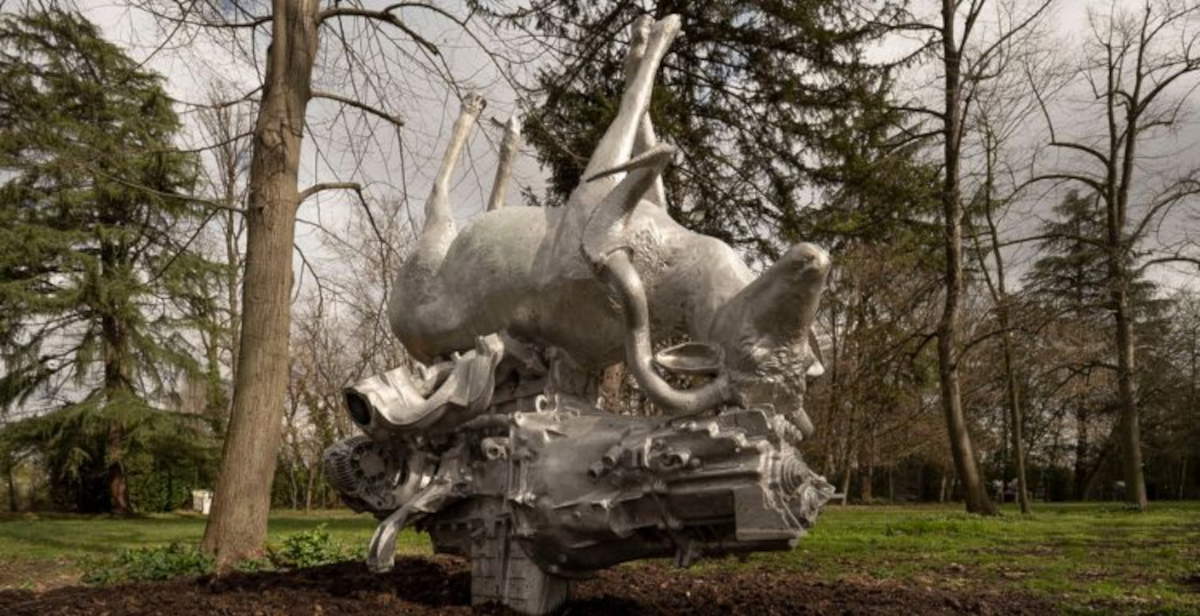 |
| Nico Vascellari in Paris: the sculpture Horse Power investigates the relationship between nature and machine |

Warning: the translation into English of the original Italian article was created using automatic tools. We undertake to review all articles, but we do not guarantee the total absence of inaccuracies in the translation due to the program. You can find the original by clicking on the ITA button. If you find any mistake,please contact us.























 IT
IT FR
FR DE
DE ES
ES CN
CN


