





On the centenary of the relocation of Giovanni Pisano ’s pulpit in Pisa Cathedral in 1926, theOpera della Primaziale Pisana presents a major exhibition that tells this incredible story by restoring one of the most important sculptors of the European Middle Ages to his complexity and history. Giovanni Pisano. Memoir of a Sculptor, set up in the spaces of the Palazzo dell’Opera del Duomo and open to the public from December 13, 2025 to March 8, 2026, offers a journey through two centuries of studies, reinterpretations and discoveries, reconstructing the long process that led to the modern rediscovery of the artist and the enhancement of one of his most famous masterpieces. The exhibition has been curated by Donata Levi of the University of Udine and Emanuele Pellegrini of the IMT School of Lucca, with the support of a scientific committee composed of Michele Amedei, Flavio Fergonzi, Roberto Paolo Novello and Max Seidel. The exhibition is entirely designed for Pisa and will be visible only at today’s venue, with no further stops.
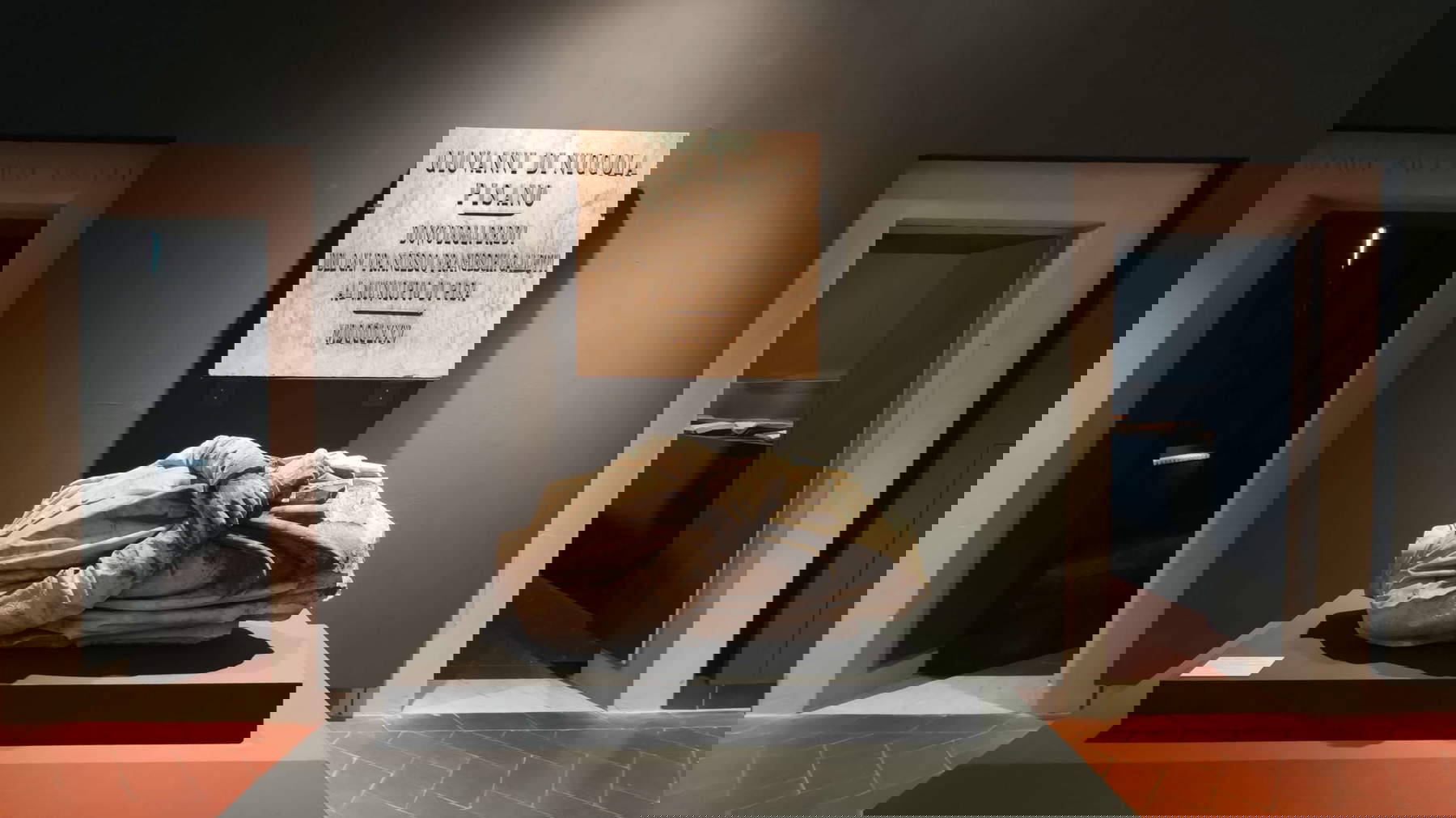
The opening of the exhibition is marked by a striking image. The mutilated trunk of the monument that Salvino Salvini dedicated to Giovanni Pisano in 1875 introduces the visitor to a reflection on the memory of the sculptor and the fragility of the history of monuments. Originally made for the Camposanto, the statue was moved in 1926 to the small square of San Sisto. Between 1944 and 1945, during World War II, it was blown up by American soldiers. Reduced to a headless torso, it now lies horizontally on display. The fragment, in addition to bearing witness to the violence of the conflict, becomes a symbol of how the artist’s memory has long been haunted and painstakingly reconstructed through generations of studies and interventions.
The rediscovery of Giovanni Pisano in the nineteenth century represents a significant chapter in the history of medieval sculpture. Paradoxically, while in Pisa the fragments of the pulpit, dismantled after the great fire that the Cathedral suffered in 1595, lay in the Camposanto, collected by Carlo Lasinio at the beginning of the century and awaiting a decision on their fate, it was foreign scholars, amateurs and travelers who first grasped its modernity. Jean Auguste Dominique Ingres, one of the most influential French painters of the time, and the English art critic John Ruskin recognized in Giovanni’s sculptures an expressive force ahead of its time and an emotional charge that broke with classicist tradition. Thus we understand the centrality of the nineteenth-century cultural context in shaping the artist’s myth.
The exhibition reconstructs this climate through a section devoted to the representations of illustrious artists in the visual culture of the century: from Giotto to Michelangelo, Simone Martini to Benvenuto Cellini. In that period, the masters of the past were reread through a Romantic lens that emphasized their gestures, biographies and anecdotes, transforming them into emblematic figures of individual creativity. Giovanni Pisano entered fully into this narrative and was considered an indispensable point of reference. Not his father Nicola, though better known in art histories, but Giovanni found a place in the famous series of portraits dedicated by Paul Delaroche to the great artists of every age for the École des Beaux-Arts in Paris between 1836 and 1841. His fortunes continued into the twentieth century, when artists such as Lorenzo Viani, Marino Marini, and Henry Moore continued to engage with his sculpture. The dialogue between a work by Marini and a Sienese she-wolf sculpted by a follower of Pisano, featured in the exhibition, underscores the persistence of his influence even in contemporary art.
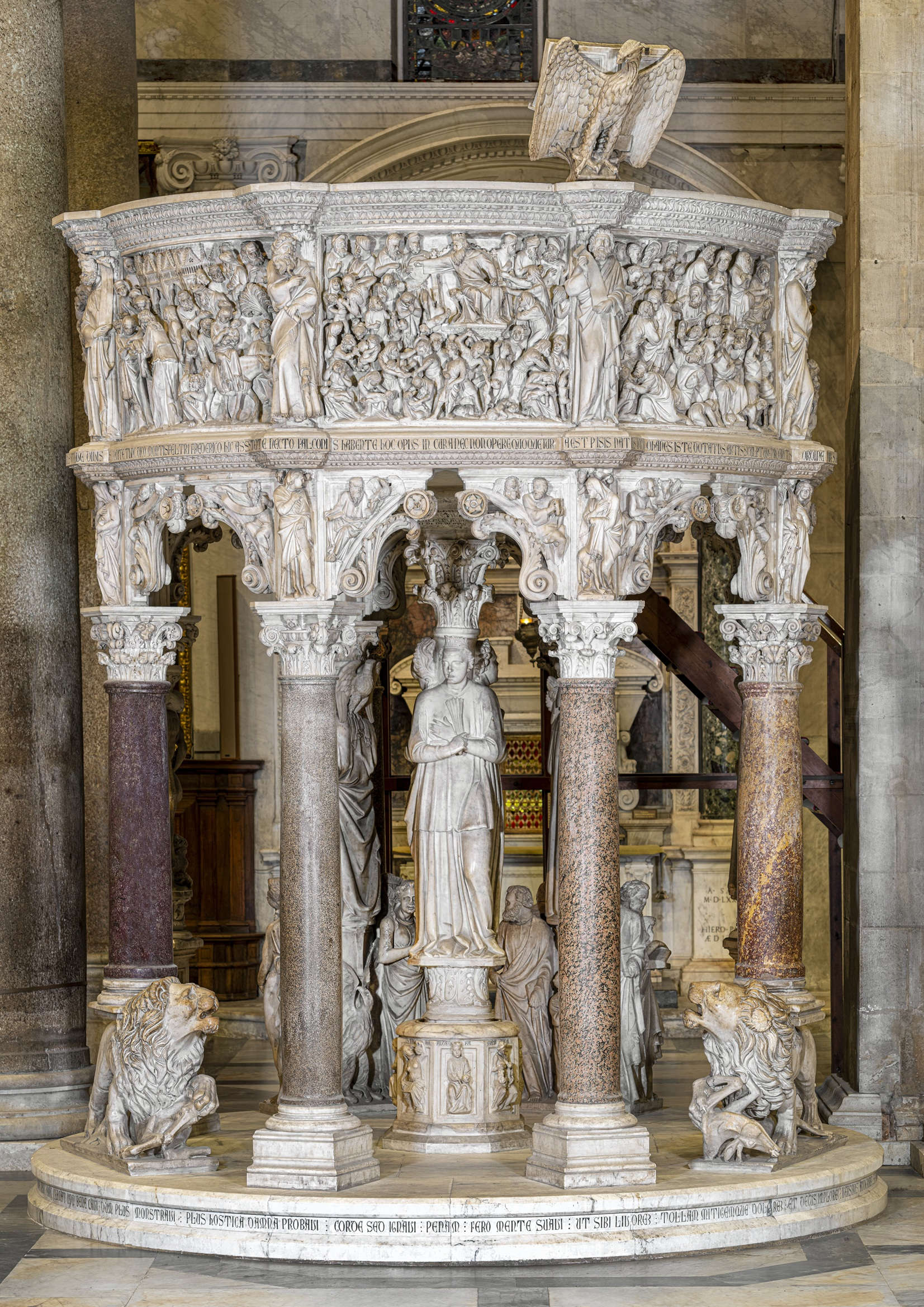
The exhibition then reconstructs the complex history of the pulpit, completed by Giovanni in 1310. After the fire that hit the Cathedral in 1595, the monument was dismembered and its fragments, deprived of their original unity, were gradually reused. Some became holy water stoups, others were used to decorate the counter-façade of the Cathedral, and still others were used as steps or supports in the reorganization of liturgical spaces. For more than two centuries the pergamum thus survived only through scattered and often integrated parts in different functions. In the nineteenth century, Carlo Lasinio, in charge of the Cemetery, collected all available fragments, initiating a study process that would lead to the 1926 reconstruction.
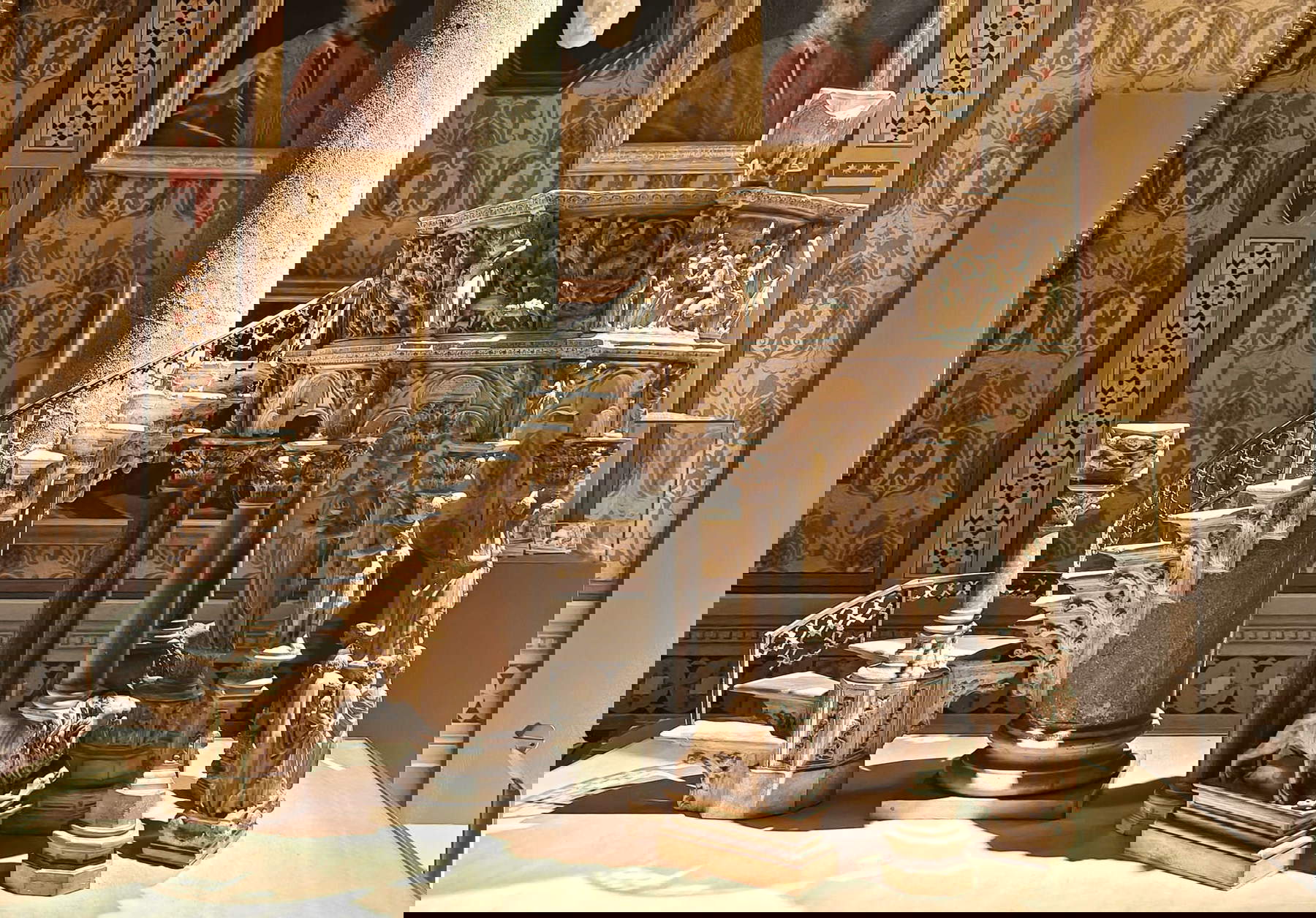
The exhibition devotes ample space to the curious contrast between the immobility of the Pisan situation and the initiative taken elsewhere. In London, the South Kensington Museum-now the Victoria and Albert Museum-commissioned Giovanni Franchi, an artisan from Lucca, to make a series of plaster casts of the fragments preserved in Pisa. Thus, in 1865, a full-scale pulpit was exhibited in plaster in London (where it can still be admired today), while a second model, mounted with some variations, was presented in Paris for the Universal Exhibition of 1867. Giovanni Pisano thus became an international case well before the Pisan reassembly of 1926, when the monument was finally reassembled in the Cathedral as part of the larger presbytery renovation project promoted by Cardinal and Archbishop Pietro Maffi, to which sculptor Lodovico Pogliaghi, a member of the Commission established in 1922, also contributed.
One of the most anticipated elements of the exhibition is the return to Pisa of three fragments of the pulpit from the Metropolitan Museum of Art in New York. These are the Tetramorph group, which originally supported the lectern of the Gospel, and two pillars with tuba-playing Angels belonging to the Last Judgment. The three marbles left the city early through the antiquities market (they are attested in Florence in 1870, but we do not know where they were before that) and passed into the collection of John Ruskin (a photograph in the exhibition shows visitors where they were placed in the home of the great British artist and critic), only to be acquired by the New York museum in 1921. After nearly two centuries, these elements return to dialogue with the parts preserved in Pisa, ideally completing the reading of the pulpit and restoring a more faithful vision of the original work.
The itinerary is divided into eleven rooms and relates the collections of the Palazzo dell’Opera with the Cathedral and with the materials kept in the storerooms. Among the works on display are bronzes, cartoons and preparatory plaster casts by Lodovico Pogliaghi, documenting the creative process related to the bronze candle-bearing Angels destined for the Cathedral’s high altar. These materials, recently restored for the occasion, make it possible to closely follow the work phases of the Lombard sculptor and to understand the direct dialogue he established with Giovanni Pisano’s legacy. The 1926 reconstruction, to which Pogliaghi contributed, emerges as a crucial moment in the history of monument and medieval sculpture in Italy.
The exhibition also presents a nineteenth-century plaster and wood model made by Pisan cabinetmaker Giuseppe Fontana as an early proposed reconstruction of the pulpit. This is complemented by a three-dimensional scale reproduction, specially created for the exhibition, which allows visitors to accurately identify the original parts of the monument and the additions made between the 19th and 20th centuries. A video station accompanies visitors through the history of the pulpit, summarizing its history and illustrating the stages of its long journey through centuries of dispersion, restoration and recomposition.
The quality of international loans confirms Giovanni Pisano’s notoriety beyond Italian borders. In addition to the Metropolitan Museum of Art, the exhibition can count on works from the Louvre Museum and the Musée d’Orsay in Paris, as well as the Victoria and Albert Museum in London. The breadth of collaborations underscores the sculptor’s central role in the history of medieval art and in the European cultural landscape.
Particular attention is paid to the exhibition’s image, entrusted to Gianluigi Toccafondo. The artist created seven tempera paintings inspired by a photograph by Enrico Van Lint depicting the monument of Salvino Salvini before its destruction at the end of World War II. The works, purchased by the Opera della Primaziale Pisana and exhibited along the itinerary, establish a further dialogue between the figure of Giovanni Pisano and contemporary sensibilities, ideally continuing the process of reinterpretation begun in the 19th century and continued in the 20th century.
Giovanni Pisano. Memory of a Sculptor restores to the public a complex figure, which has gone through centuries of oblivion, revaluations and discoveries. Through documents, original works, reconstructions and historical accounts, the exhibition reassembles the fragments of a broad narrative, ranging from the dispersal of the pergamum after the fire of 1595 to its reassembly in 1926, from the first Romantic interpretations to the renewed attention of contemporary sculptors. Pisa thus rediscovers an important piece of its artistic and cultural history, celebrating one of the most original and modern protagonists of the European Middle Ages.
The exhibition opens daily from 9 a.m. to 6 p.m. (during the Christmas period, Dec. 22, 2025 to Jan. 6, 2026, from 9 a.m. to 7 p.m.). Tickets: admission only exhibition 8 euros, exhibition + monuments and museums of Cathedral Square excluding bell tower 11 euros, exhibition + monuments and museums of Cathedral Square + Bell Tower 27 euros. Residents of the municipalities in the province of Pisa and students enrolled at the University of Pisa can enjoy free admission with a guided tour by reservation on January 9, 16, 23, 30, 2026 from 6 p.m. to 8 p.m. (For info and reservations visit the website www.impegnoefuturo.it: from the same site you can get info on guided tours and educational workshops for schools organized by the Cooperative Society Impegno e Futuro).
|
| Pisa, a major exhibition traces the story of Giovanni Pisano's rediscovery |

Warning: the translation into English of the original Italian article was created using automatic tools. We undertake to review all articles, but we do not guarantee the total absence of inaccuracies in the translation due to the program. You can find the original by clicking on the ITA button. If you find any mistake,please contact us.























 IT
IT FR
FR DE
DE ES
ES CN
CN


