





On the occasion of the Venice Biennale 2026, Associazione Genesi, founded in 2020 by Letizia Moratti, and Banca Ifis present the latest work of director and visual artist Shirin Neshat in Venice. From May 9 to September 6, 2026, the halls of Palazzo Marin will host the film trilogy Do U Dare!, a project curated by Ilaria Bernardi and Bartolomeo Pietromarchi, presented by Gladstone Gallery and Galleria Lia Rumma in collaboration with Magonza editore.
The work takes as its starting point the story of Nasim Aghdam, a media figure of Iranian origin whose biography and artistic activity form the project’s inspirational core. Shot in three different socioeconomic contexts in New York City, the trilogy investigates the tension between interiority and exterior representation in the female condition, articulating a comparison between American society and a female perspective marked by the Iranian experience.
The narrative reconstructs the journey of Aghdam, who grew up in the United States after fleeing Iran because of her membership in the Bahá’í faith, which was subject to persecution. Settling in a California suburb, she experienced a condition of isolation, lacking a sense of belonging to American society and progressively distancing herself from her cultural roots. In this context she developed an online presence through a channel on YouTube, posting performance videos in which she sang and danced, constructing an expressive language that mixed provocation and a demand for attention. The content, which went viral, challenged the stereotypical image of women as objects of desire and control. The platform’s termination of her account was perceived as an act of censorship akin to her experiences in Iran; in 2018, at the age of 38, Aghdam armedly broke into YouTube’s headquarters, injuring several people and taking her own life.

The Do U Dare! trilogy is divided into three episodes, each set in a different urban context of the New York metropolitan area, constructing a fragmented portrait of the psychological dimension of the protagonist. The first episode, set in an immigrant neighborhood in Brooklyn, follows the figure of Nasim through a space marked by economic marginality and social exclusion. Everyday life appears dominated by institutional indifference and cultural alienation, while the migrant experience emerges as a condition of uprooting. In this context, a growing tension develops that leads to an extreme gesture, interpreted as a form of protest and a demand for recognition.
The second episode takes place in the financial district of Wall Street, where the protagonist enters an environment characterized by mechanical routines and emotional disconnection. The narrative introduces a breaking element when, during the night, a disembodied musical voice attracts the attention of the crowd. The discovery that the source of the sound coincides with Nasim herself transforms the figure into a performer, capable of catalyzing collective attention. In this passage, the work addresses the theme of visibility as a form of power, analyzing the obsession with fame and public recognition.
The third episode focuses on the protagonist’s home environment, where Nasim produces her own digital content. Through a series of performances in which she plays different characters, she constructs a critical representation of American society. The performance actions highlight structural contradictions, including political hypocrisy, systemic racism and economic inequality, highlighting the distance between national rhetoric and social reality. The work also addresses the objectification of the female body in the media, analyzing the tension between aestheticization and commodification.
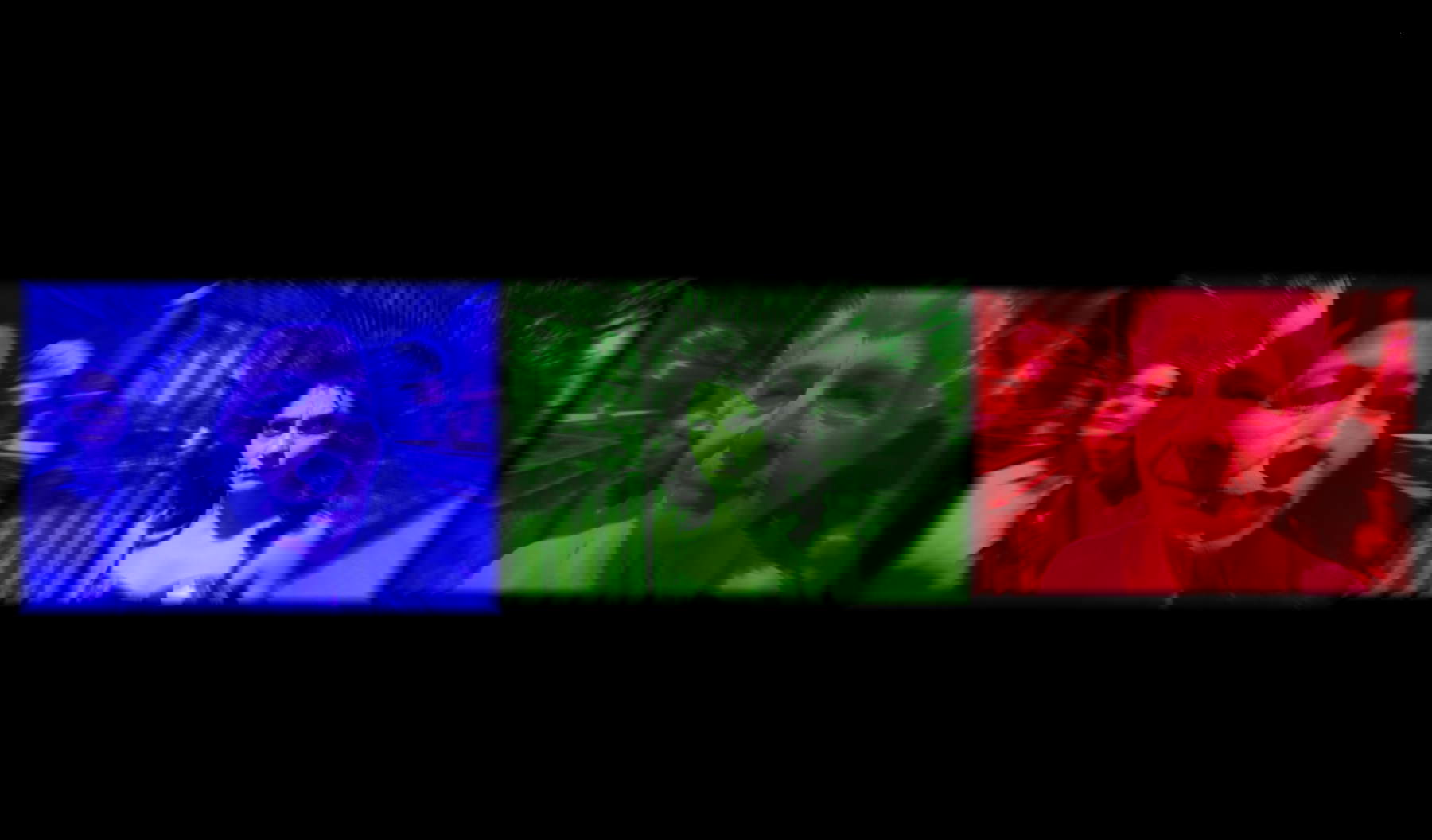
Formally, the trilogy alternates different visual registers, shifting from black-and-white realism to more explicitly surreal dimensions. This oscillation reflects the psychological condition of the protagonist, marked by emotional instability and difficulty in distinguishing between imagination and reality. The migration experience is thus interpreted as a process of identity fragmentation, in which assimilation involves the need to assume multiple roles. Through the interweaving of documentary elements and narrative construction, Do U Dare! is configured as a reflection on the relationship between artistic creation and self-destruction, addressing themes such as exile, loneliness and the search for recognition. The trilogy proposes a reading of the artistic gesture as a means of reappropriating one’s voice, but also as a space in which the human cost of uprooting manifests itself.
On the occasion of the exhibition, Magonza editore will publish a monographic volume collecting texts by curators Ilaria Bernardi and Bartolomeo Pietromarchi, as well as an essay by Giovanni Curatola, a scholar of Islamic art. The volume is intended as an independent in-depth study of Shirin Neshat’s work, going beyond the mere documentation function of the exhibition.
 |
| Shirin Neshat in Venice: her new film trilogy investigates the female condition |

Warning: the translation into English of the original Italian article was created using automatic tools. We undertake to review all articles, but we do not guarantee the total absence of inaccuracies in the translation due to the program. You can find the original by clicking on the ITA button. If you find any mistake,please contact us.



























 IT
IT FR
FR DE
DE ES
ES CN
CN


