





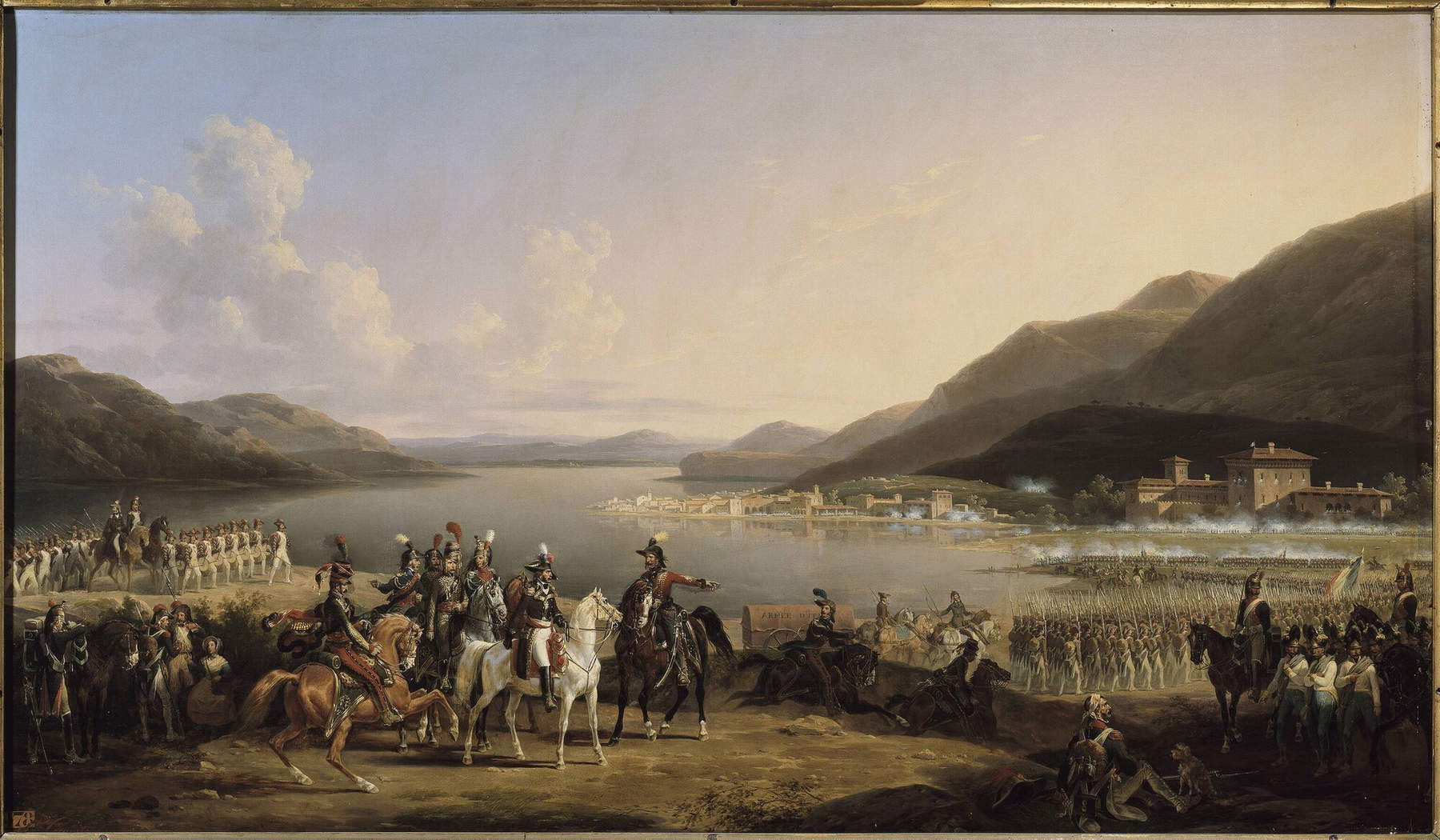
The collection of MuSa, the Museum of the City of Salò, is enriched with a new and significant piece of its artistic and historical memory. The Salodi institution has in fact acquired the drawing The Battle of Salò, a work by French painter Hippolyte Lecomte (Puiseaux, 1781 - Paris, 1857), an ink and pencil sheet measuring 30 by 55 centimeters made around 1834 as a preparatory study for the large canvas that the author executed for the historical gallery of the Castle of Versailles. The work’s arrival coincides with a special moment for the city: in 2026 Salò will celebrate the six-hundredth anniversary of the Magnifica Patria, the federation of municipalities founded in 1426 during the Venetian era and which remained active for centuries, with its headquarters right in the Riviera capital. Lecomte, almost two centuries ago, chose to symbolically represent its end with the battle that took place on July 31, 1796, when the French army prevailed over the Austrian troops, closing a long historical cycle.
The drawing that has just entered the museum collection offers a close-up view of the artist’s creative process. The composition pinpoints the crucial moment of the clash, rereading the dynamics of the battle with greater freedom than the final canvas and introducing some dissimilarities that bring out Lecomte’s own graphic and narrative research. The point of view shows the intention to effectively restore the position of the two sides, while also highlighting the landscape background. In the background can be recognized the urban profile of Salò and the monumental silhouette of Palazzo Martinengo in Barbarano, a place that played a strategic role in the events of 1796. The mansion was in fact hit by an Austrian flotilla that bombarded the coast, while inland French troops, led by General Suaret and awaiting reinforcements, tried to resist the siege.
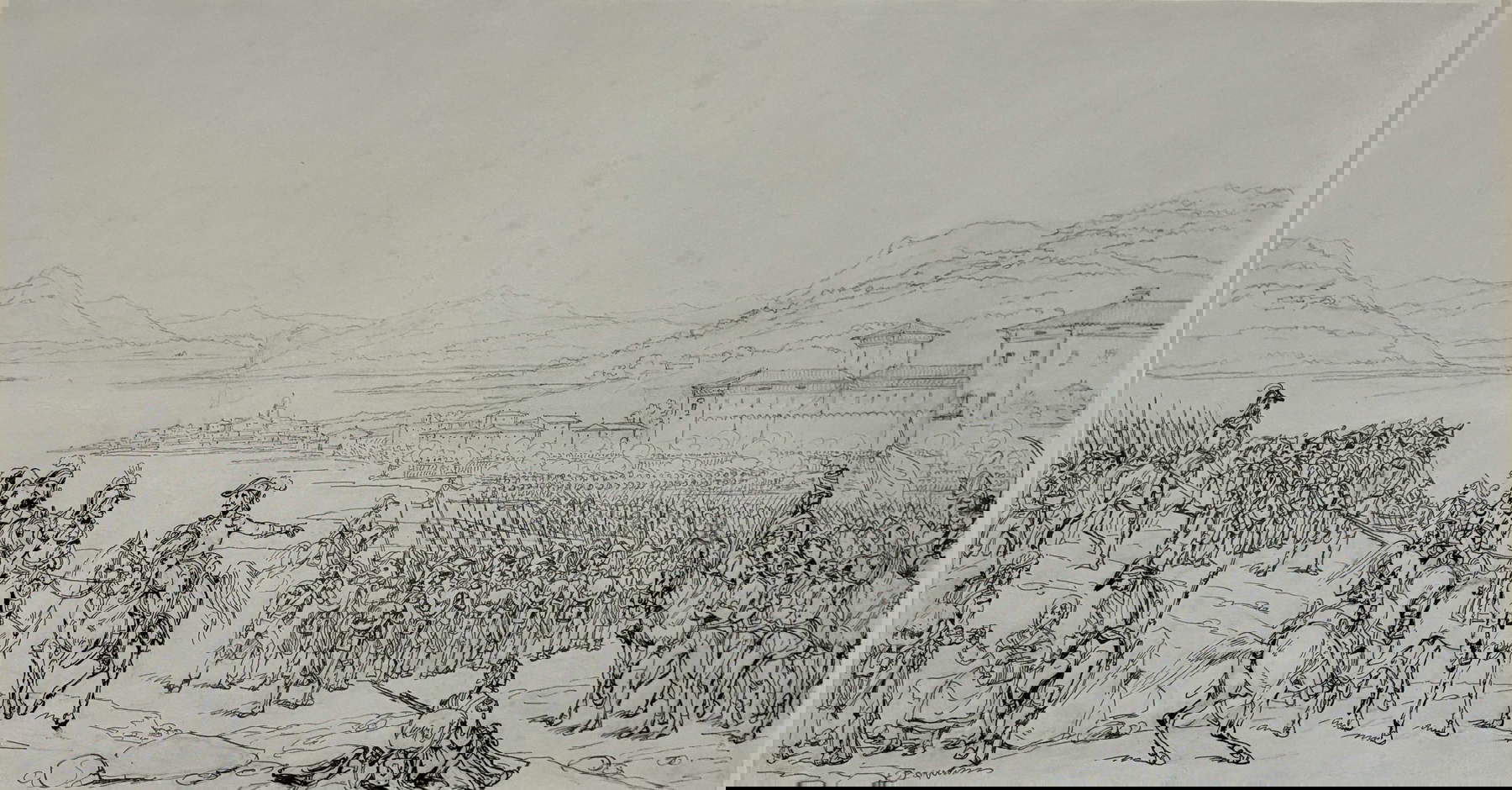
The work’s acquisition stems from a recent discovery: in fact, the drawing resurfaced in 2025 from the private collecting circuit and arrived on the Viennese antiques market after having belonged to a Swiss collection. The report by Brescian scholar Bernardo Falconi reached the director of MuSa, who immediately grasped the historical and documentary value of the sheet. The Fondazione Opera Pia Carità Laicale e Istituto Lodroniano, which manages the museum under the leadership of President Stefano Zane, decided to act quickly to bring the work back to the context that gave it its origin, recognizing in its presence an element capable of enriching not only the collection but also the museum narrative of the area.
Before arriving in Salò, the drawing underwent a conservative restoration in Vienna, made possible thanks to the support of an English benefactor. The patron, after visiting MuSa during the summer, chose to contribute to the institution’s activities by bearing the expenses necessary to ensure the proper preservation of the work. The recovery of the sheet has also paved the way for a far-reaching exhibition project: in 2027 the work should in fact form the original nucleus of an exhibition dedicated to the battle of 1796 and its artistic representation. The museum is considering bringing in the large Versailles canvas as well, thus creating a dialogue between the preparatory drawing and its monumental pictorial transposition, an opportunity that could draw scholars, enthusiasts and visitors to the Garda.
The historical event depicted by Lecomte finds its setting in the complex military context of the Italian campaign of 1796. In the spring of that year, the Army of Italy led by the young Napoleon Bonaparte, after occupying Milan, had begun to pursue the imperial forces into the Venetian Oltre Mincio, despite the fact that the Serenissima had declared its neutrality. On July 28, 1796, a sturdy Austrian column had descended from the Valle Sabbia, splitting into two branches headed for Brescia and Salò. The latter was invested by the imperial vanguard: if the French initially managed to repel the assault, they were then forced to fall back toward Desenzano when the bulk of the enemy troops arrived.
In this scenario, the French contingent stationed at Barbarano, consisting of about four hundred soldiers under the command of General Guyeux, failed to rejoin the rest of the retreating troops. After requisitioning food and supplies from the bakeries and stores in Salò and Barbarano, the soldiers entrenched themselves inside Palazzo Martinengo. The building thus became the focus of the two-day siege, during which the French were surrounded by land and attacked from the lake by an Austrian flotilla of twelve armed boats. The defenders could only return fire with two cannons, while the Austrian forces tried to sap their resistance. Meanwhile, Napoleon had defeated Quosnadowich’s and Wumster’s imperial troops at the battles of Lonato and Castiglione, forcing them to retreat toward Brescia and Gavardo. It was precisely this advance that enabled General Suaret to open his way to Salò and free the besieged garrison, and then return to Lonato. These episodes preceded by a few days the pitched battle of Lonato on August 3 and 4, which forced the Austrians to leave eastern Lombardy for the second time.
The return of Lecomte’s drawing to Salò not only has symbolic value, but also helps complete the picture of artistic evidence relating to a crucial passage in the territory’s history. The MuSa, opened in 2015 in the rooms of the former Santa Giustina monastery, has established itself over the years as a cultural center dedicated to the history, art, science and memory of the city. The rooms, carved out through a careful restoration of the monastery spaces, house collections ranging from Roman archaeology to the Venetian history of the Magnifica Patria to scientific sections such as the Seismic Weather Observatory and the Anatomical Collection of Dr. Giovan Battista Rini. Since 2023, the itinerary has expanded with the opening of the section dedicated to the six hundred days of the Italian Social Republic, entitled “The Last Fascism (1943-1945).” The new design entrance further enriches the museum’s identity, serving as a connecting point between the military events of the eighteenth century and the political-territorial transformations that marked the history of the Garda area.
Stefano Zane, President of Fondazione Opera Pia Carità Laicale and Istituto Lodroniano, says, “We proudly conclude this year full of great achievements with the announcement of an acquisition, something not usual for Museums of our size. This not only enriches the permanent collection of our museum but also offers visual evidence of a crucial episode linked to our territory. This is a valuable opportunity to enhance local memory from an international perspective, strengthening the role of the Salò Museum as a custodian of the history and culture of Lake Garda and a frontline actor in spreading historical and cultural awareness among our Communities.”
|
| Salò, Museo della Città acquires Lecomte's Battle of Salò and prepares an exhibition for 2027 |

Warning: the translation into English of the original Italian article was created using automatic tools. We undertake to review all articles, but we do not guarantee the total absence of inaccuracies in the translation due to the program. You can find the original by clicking on the ITA button. If you find any mistake,please contact us.

























 IT
IT FR
FR DE
DE ES
ES CN
CN


