




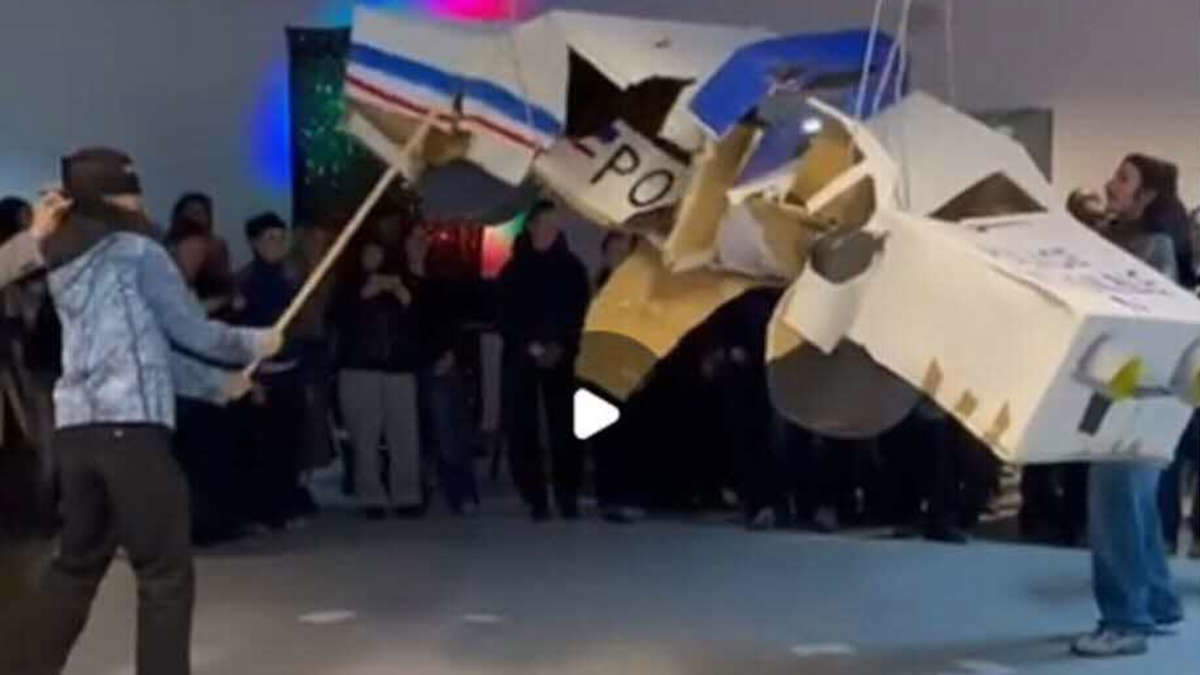
Outrage in France over an artistic performance by a group of students from the Haute École des Arts du Rhin (HEAR), a major art academy located in the city of Mulhouse, Alsace: the students in fact staged a piñata where, instead of the traditional piñata, a cartoon of a police car was placed, resulting in the participants in the action clubbing the fake law enforcement vehicle. A video was circulated on social media showing some blindfolded students hitting the cardboard car with the words “POLICE,” “police.”
Outraged first was the mayor of Mulhouse, Michèle Lutz, of the Républicains party, who a few hours ago wrote a long post on her social accounts condemning the incident, calling the performance a “particularly shocking scene.” “As part of what was described as an ’artistic performance,’ the audience, including one of my deputies,” the first citizen said, “witnessed a display of bad taste with a giant piñata depicting a police car. Several students were invited to destroy the vehicle with sticks, encouraged by a cheering crowd. I believe that freedom of expression, including artistic freedom, cannot allow or justify such outrageous behavior. I also learned that the initial plan was to set fire to a replica of a fire truck before opting for this ’police pot’. Last night I informed the Subprefect of Mulhouse of this situation, who immediately went to the site to make appropriate observations. I also summoned the director of HEAR to express my total disapproval of these serious events, which occurred in an institution of higher education financed largely by public funds, including that of the city of Mulhouse. In addition, today I will file a complaint with the Public Prosecutor’s Office.” The mayor’s post closes with a message of support for law enforcement.
The prefecture of the Upper Rhine department, where the city of Mulhouse is located, issued a statement calling the work “outrageous.” “Staging an act of vandalism against a police vehicle is shameful,” said Prefect Emmanuel Aubry, “and does not reflect the services that law enforcement provides to our citizens. The matter is now before the courts, which will do their job. The national police deserve praise, not denigration.”
Also displeased was French Interior Minister Laurent Nuñez: “These are frankly unacceptable acts,” he said. “Committed by students in a public school, these acts are even more shocking. We must not let this anti-police ideology go unnoticed.” The case, in short, has already gone national. Meanwhile, an investigation was opened in the afternoon, entrusted to the Mulhouse police, on charges of contempt of public authority and insulting the French flag. There then followed numerous messages of condemnation from various political figures. Notable in particular was the condemnation of former Interior Minister Bruno Retailleau, president of the Républicains, who said, “This is where the far-left ideology that is corrupting part of our institutions leads. Shame on those who normalize violence against our law enforcement agencies.” However, there are also those who defend the students: the group Mulhouse Cause Commune, a left-wing civic list, expressed “dismay at the controversy stirred up by the mayor of Mulhouse following a symbolic artistic performance held at HEAR. [...] This sequence reveals a desire for manipulation; by its very nature, and at the very least, art is meant to question, if not disturb. One can disagree with the purpose of a performance, or not appreciate it at all. It should challenge us: that is the purpose of culture. To control it or stifle it by invoking public funding is to establish a political subjugation of artistic creation.”
HEAR director Stéphane Sauzedde also spoke in the evening, opposing the reasons of public authority with those of art. Sauzedde expressed regret “that this proposal may have been interpreted as degrading or offensive.” He went on to reiterate “that the proposal by three students-an unrealistic and symbolic cardboard representation of a police vehicle designed in the shape of a piñata-is about Carnival. As such, it falls fully within the realms of creativity, experimentation and aesthetic debate that permeate art history.” Meanwhile, the controversy has moved to social media where there are already countless comments from users who are weighing in on this case: does the freedom of art prevail, which can therefore afford to be disturbing, or must art also have limits?
|
| France, controversy over a performance: piñata with a fake police car |

Warning: the translation into English of the original Italian article was created using automatic tools. We undertake to review all articles, but we do not guarantee the total absence of inaccuracies in the translation due to the program. You can find the original by clicking on the ITA button. If you find any mistake,please contact us.

























 IT
IT FR
FR DE
DE ES
ES CN
CN