





The news of Russia ’s participation in the Venice Biennale 2026, which was officially confirmed this morning when the Biennale organization released the list of national participations, is already arousing, for now on social media, outrage among Ukrainians who see the Russian Federation welcomed with an official participation in a major international exhibition. The title of the exhibition(The Tree is Rooted in the Sky) and the list of artists have been announced. The participation was anticipated by Mikhail Shvidkoy, who since August 1, 2008, has been the Special Representative of the President of the Russian Federation for International Cultural Cooperation, a position established by then-Russian President Medvedev to manage Russia’s international cultural cooperation initiatives and to promote the country’s image beyond its borders. Shvidkoy also served, from 2000 to 2004, as minister of culture, and lately he has often reiterated, in statements and interviews, his positions. Last July, in his column in Rossiyskaya Gazeta, the official newspaper of the Federation, Shvidkoy argued in favor of censorship on art, believing that it should be practiced by professionals: while acknowledging that “reviving the institution of censorship is an expensive undertaking that requires not hundreds but thousands of enlightened servants of the state,” he wrote in his article, censorship “can preserve a healthy environment in the creative community.”
Still, Shvidkoy, on Nov. 23, 2023, declared to TASS that the decision to return Scythian gold to Ukraine, sanctioned by a Dutch court (several Scythian artifacts from Crimean museums are in fact still in the Netherlands, where they were displayed for an exhibition in 2014, have no longer returned to their institutions because in the meantime Crimea had been occupied by Russia and there is therefore a fear that the Russians might appropriate property that belongs to Ukraine), would be legally unfounded and is politically motivated by “Russophobia” and “anti-Russian media fervor.” Shvidkoy has repeatedly claimed that the West is moving on Russophobic positions and is advocating a kind of erasure of Russian culture. Last Dec. 30, Shvidkoy said it will take time before an “artistic interpretation” of what is called a “special military operation” in Russia (the invasion of Ukraine that began Feb. 24, 2022: Shvidkoy has always explicitly supported it, and on at least one occasion, in February 2024, stated that artists who left Russia in disagreement with the war would “react emotionally to the launch of the special military operation: they are not politicians or strategists and do not understand the deep and long process that led to the launch of the special military operation.” One could then add an additional, curious position: on December 26, reached by TASS, he praised Vladimir Putin’s appearance in a popular children’s cartoon believing that such an appearance, “if done respectfully,” can be “a form of expression of love.” And it could be a way to introduce the president to children.
The commissioner of the Russia Pavilion will be Anastasiia Karneeva, class of 1982, serving as commissioner since 2021 (term lasts eight years). The daughter of Nikolai Volobuev, a retired FSB general (and, in the days of the USSR, in the ranks of the KGB), and former deputy general director of Rostec (a state holding company active in the defense sector, founded in 2007 by Putin himself, and since 2014 subject to sanctions by the US and the European Union), she comes across as a collector and patron. She was the owner of an art production and exhibition organizing business called “Smart Art” and founded in 2016 together with Ekaterina Vinokourova, daughter of current Russian Foreign Minister Sergei Lavrov and wife of Aleksandr Vinokourov, a businessman and current majority shareholder of Magnit, one of the country’s largest food retailers, hit by European sanctions as early as March 2022. Anastasia Karneeva’s husband, Dmitry Karneev, her contemporary, has long been a man of the apparatchiks: he worked for a long time for Rosspirtprom, the state-owned company that controls Russia’s spirits industry, before becoming its director in 2024 and then giving up all parastatal activities and going into the restaurant business privately.
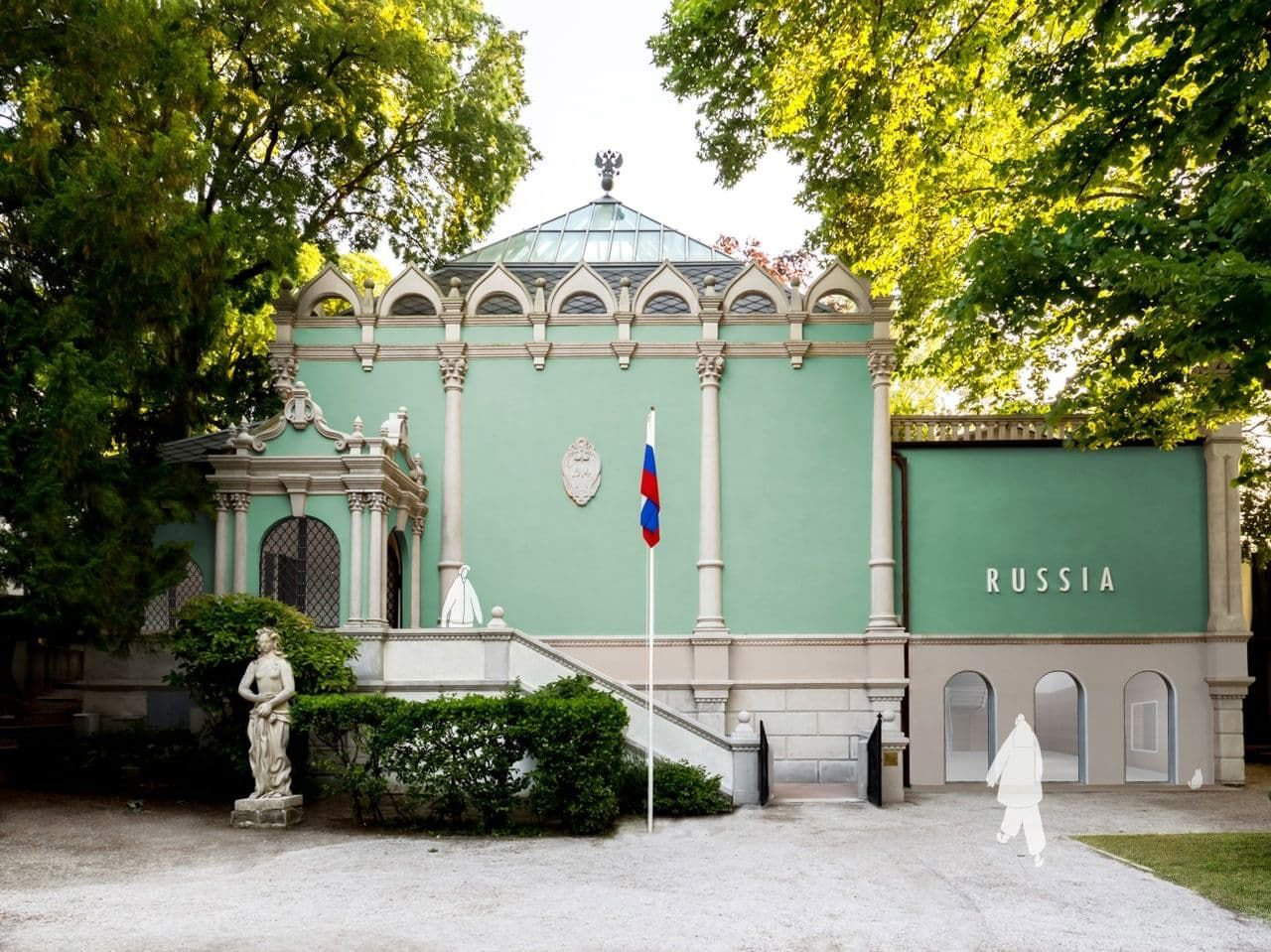
As for the artists, there are several names announced for the Russian pavilion: they are mostly Russian artists, with a few scattered international presence. They were presented as “young” by Shvidkoy. Among the best-known names are those of Maria Vinogradova (a famous Bolshoi solo dancer who, during the years of the war in Ukraine, continued to work in Russia, even participating, in April 2022, in a concert as part of a campaign organized by the Russian Ministry of Culture in support of the war) of some members of theTolokaensemble , a Russian folk group that, through its social channels, has expressed its closeness to the Russian soldiers (most recently on February 23 to bid farewell to one of the group’s members, who was leaving for military service, with a post on V Kontakte in which the rest of the ensemble missed no opportunity to congratulate “all the defenders of the Fatherland”), and Alexey Retinsky, a Ukrainian-born musician.
The Russian project has also already been presented on Instagram, on the pavilion’s official account: "The Tree Is Rooted in the Sky,“ it reads, ”is conceived as a wide-ranging cultural initiative: a real music festival will come to life inside the pavilion, with musicians from different regions of Russia and countries such as Argentina, Brazil, Mali and Mexico. The event will highlight the creative potential of peripheral areas and practices, enhancing traditions, musical languages and experimental approaches that emerge far from large cultural centers, but precisely because of this they retain an authentic and innovative expressive power. Through the encounter of different cultures, the project aims to create a space for dialogue and exchange, where local roots can intertwine with global visions, generating new artistic perspectives and strengthening a sense of international community."
|
| Venice Biennale 2026, Russia returns: here's who's behind the regime pavilion |

Warning: the translation into English of the original Italian article was created using automatic tools. We undertake to review all articles, but we do not guarantee the total absence of inaccuracies in the translation due to the program. You can find the original by clicking on the ITA button. If you find any mistake,please contact us.


























 IT
IT FR
FR DE
DE ES
ES CN
CN


