




by Redazione 19/03/2026



Categories: News / Disclaimer
Venice, completed the restoration of Valentin Lefèvre's painting in the vault of Longhena's Scalone at San Giorgio Maggiore: new scientific analysis and an unpublished archival document restore the work's reading, colors and meanings.

Twelve meters high, on the vault of Longhena’s Scalone in the monumental complex of San Giorgio Maggiore in Venice, Valentin Lefèvre ’s The Dream of Jacob (1642-1677) becomes legible again today after a restoration that has restored to the work elements that had long been concealed. The painting, made in 1671 and subject to only one documented intervention so far, now presents itself with renewed chromatic and compositional clarity, making the complexity of the subject and its symbolic construction once again perceptible.

The work depicts the biblical episode of Jacob’s dream at Bethel, interpreted as a prophecy of the chosen offspring and visually translated into the famous staircase populated with angels. With dimensions approaching four and a half by more than two meters, the painting was relocated to its original position, within the painted wooden frame designed to accommodate it. The work was supported by San Marco Group SpA and carried out by the Venetian firm Seres Srl under the direction of Paolo Roma, in a workshop set up at the Giorgio Cini Foundation.
Prior to the conservation operations, the painting was the subject of a scientific investigation campaign entrusted to Mauro Missori, a CNR physicist, who employed an innovative remote spectroscopy technique. The project also involved Ca’ Foscari University Venice and the Giorgio Cini Foundation’s ARCHiVe Digital Center, contributing to the development of analysis tools capable of extracting data not accessible through direct observation alone. The integrated approach between scientific research and conservation represents one of the most relevant aspects of the intervention, with potential spin-offs for future conservation activities.


Jacob’s Dream constitutes Valentin Lefèvre’s only Venetian public work and ranks among the most important of his short career. Originally from Brussels, the painter moved to Venice in the 1750s to study the Renaissance masters, particularly Paolo Veronese. His Venetian production reflects a classicist imprint, also matured through his activity as a copyist, combined with suggestions from the painting of the so-called tenebrosi. The work is coeval with the cycle of canvases made by Coli and Gherardi for the Benedictine library of San Giorgio Maggiore and is cited by Marco Boschini in 1674 inRicche minere della pittura veneziana as “the work of the virtuous brush of Monsù le Fevre, shrewd observer, and admirer of the great Paolo Veronese.”
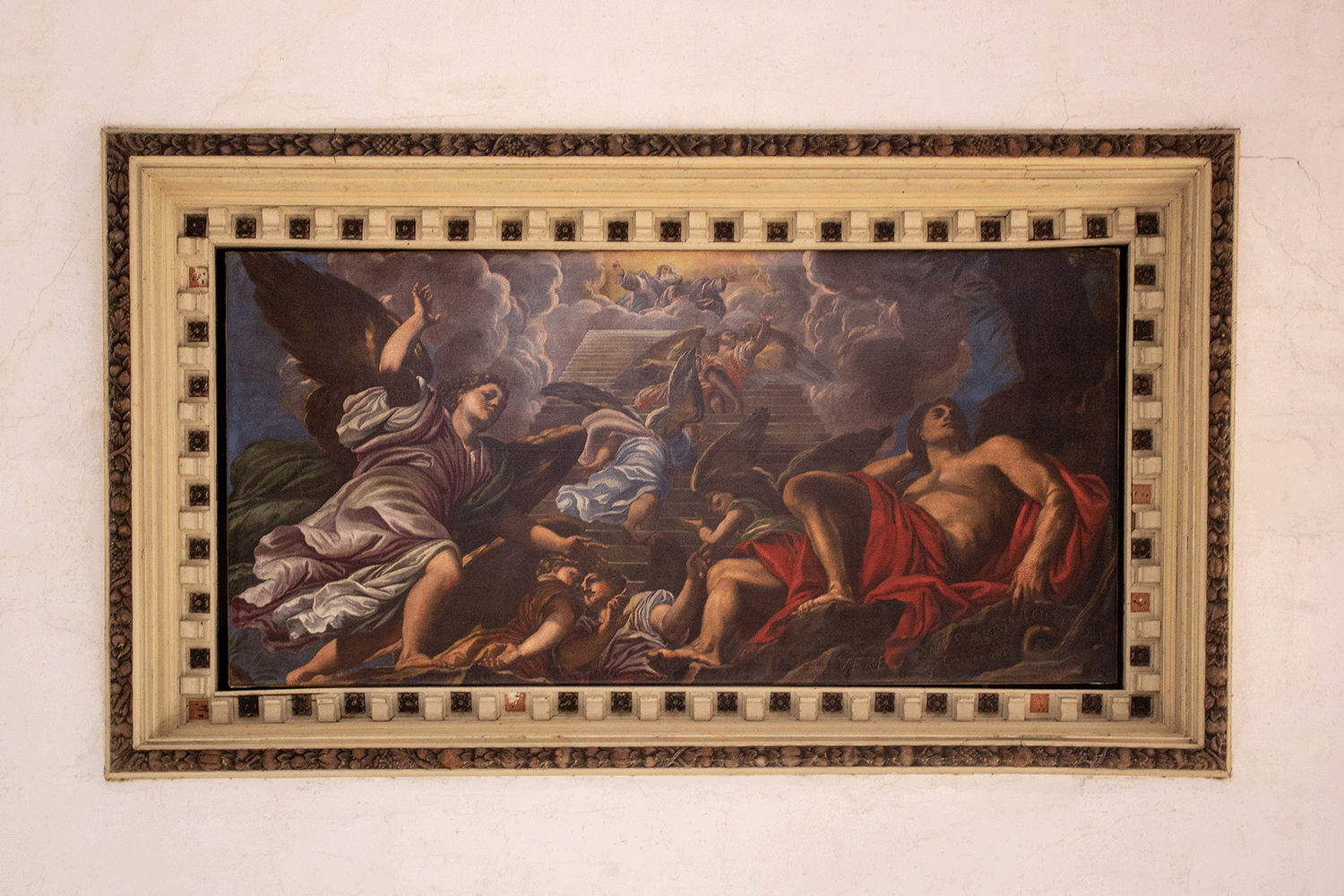
A remarkable contribution to our knowledge of the work comes from the discovery of a document in the State Archives of Venice, dated December 16, 1671. It is the “poliza,” an appraisal approved by Baldassarre Longhena, author of the staircase and designer of the Basilica della Salute. The document makes it possible to reconstruct the type, quantity and cost of the materials used for the installation of the painting in the vault, also providing precise indications on the wooden elements used for the creation of the frame and carved decorations. The placement of the work in the access staircase to the abbot’s apartment fits into one of the most representative spaces of the Benedictine monastery of San Giorgio Maggiore, intended for the public ceremonial of the order and, until the Napoleonic suppression, linked to the dogal protectorate. In this context, the subject of the painting takes on a significance that goes beyond the strictly religious dimension.
Reports on the state of conservation of the work are fragmentary. One account dates back to 1806, when Pietro Edwards described the canvas as “a work of merit but [...] for the most part worn,” in a report cited by Antonio Cicogna. Further traces emerge from photographic documentation preserved in the IUAV Project Archive, relating to the island’s restoration work promoted by Vittorio Cini in the twentieth century. The images show the painting temporarily removed and lowered onto a work surface, but there is no evidence of an actual restoration, suggesting rather verification or surface cleaning operations.
The intervention initiated in 2024 thus represents the first complete conservation overhaul since the work was created. The initial conditions showed numerous critical issues, including color falls, detachment of the paint film, and widespread blurring due to dirt deposits. After dismantling the canvas and protecting the paint surface, the painting was transferred to a laboratory set up in the Napoleonic Wing of the Giorgio Cini Foundation. Operations focused first on the structural support, with the removal of the reinforcing canvas, cleaning and consolidation of the original support, and application to a new synthetic support. The old wooden frame was replaced with a metal structure equipped with an adjustable tensioning system to ensure the stability and flatness of the painting.
The aesthetic restoration phase involved a progressive and selective cleaning of the pictorial surface. The thick layer of dirt, altered varnishes and residues of previous interventions, including animal glues that had fixed additional deposits on the surface, were removed. The removal of these materials made it possible to recover the legibility of the original colors and to bring to light key compositional details, including the central staircase. Upon completion of the cleaning, widespread gaps in the pictorial film emerged. Integration was conducted with criteria of recognizability and reversibility, limiting itself to the areas necessary to restore unity to the reading of the image without altering its fragmentary nature. The plastering mainly affected the areas of support already compromised, while the final painting was done with suitable materials to protect the surface and restore tonal balance.
Statements
“The work on the Lefèvre painting was conceived from the beginning as an intimately conservative operation,” says Renata Codello, Secretary General of the Giorgio Cini Foundation. “A work that respects the nature of a pictorial work exposed to the lagoon environment, which has come down to us as a result of the metamorphosis of time and events. This is why we can say that it was more than a restoration, it was a delicate scientific investigation and care. The restoration operations brought to light a number of elements that the patina of time had concealed and that open up new avenues of research. Now the painted scene, in which the dream is the prophecy of the chosen offspring, visualized by a staircase populated by angels, is back in view. The very staircase in the center of the canvas had disappeared from view: now we see it connecting earth to heaven, almost a continuation of the Staircase leading to the Abbot’s apartments and the Library. In this sense, one may think that the religious subject is actually a sophisticated metaphor about the dimension of power; the chosen descendants who recur in the dream seem to refer to the wise, between religious and secular dimensions of wisdom. It is no coincidence that in this large room of stairs, designed so that light would enter from all four walls, stands the statue by Francesco Cavrioli, which depicts Venice with a scepter in one hand (later removed by Napoleon) and temperance in the other. A place, then, that encompasses painting, sculpture and architecture and has religious, civic and political wisdom in it.”
“It is precisely the care of people and things,” argues Mariluce Geremia, Vice President of San Marco Group, “one of the most important principles that guide each of our projects: preserving the beauty that surrounds us, in addition to being consistent with our vision, thus allows us to emphasize the works that tell the history and identity of the territory, for the benefit of the community. This commitment is rooted in the unbreakable bond between San Marco Group and Venice: a path traced by my grandmother, Alessandrina Tamburini, who has always believed in the active protection of the city’s artistic heritage. With this new intervention we wish to continue her path so that such precious masterpieces can be experienced and appreciated by all, today and in the future.”
“The location in a semi-open place, as the Longhena’s Scalone is, increases its vulnerability: the painting is exposed to two large volumes of air, that of the Scalone’s vestibule and the attic, which cause unavoidable climatic stresses,” says restorer Paolo Roma.“The remote analysis allowed us to have a preliminary diagnostic apparatus before moving the painting, thanks to the amount of data that is not usually available. It also gave us knowledge about the nature of pigments and dyes. The remote operation, therefore, innovates the research work on the works, because it allows us to go and investigate them even when they cannot be moved or accessed directly or by creating scaffolding. The painting had a canvas put on for reinforcement, glued with animal adhesives and which it was deemed appropriate to remove because it was very degraded at the edges and because it prevented the restoration of the original support. Upon removing this lining, we discovered that the painting has a very thin and fragile original fabric that, however, still exhibits strong responsiveness to changes in humidity. Before the varnishes were removed we assumed that the paint film had undergone more intense degradation, that the blue had been lost. Instead, we found very rich reds and blues. Looking at the perimeter of the painting, protected under the frame, where the colors were best preserved, we can get an idea of the original chromatics, such as the purples, the least preserved because they are lacquer-based and not pigment-based. Which is unusual in Venice, where the use of lacquers, in fact, was world famous for the chromatic stability of the backgrounds.”
“From remote colorimetric analysis, it was possible to have in detail the state of conservation of the varnishes and materials, providing essential indications for restoration,” says Mauro Missori, CNR physicist.
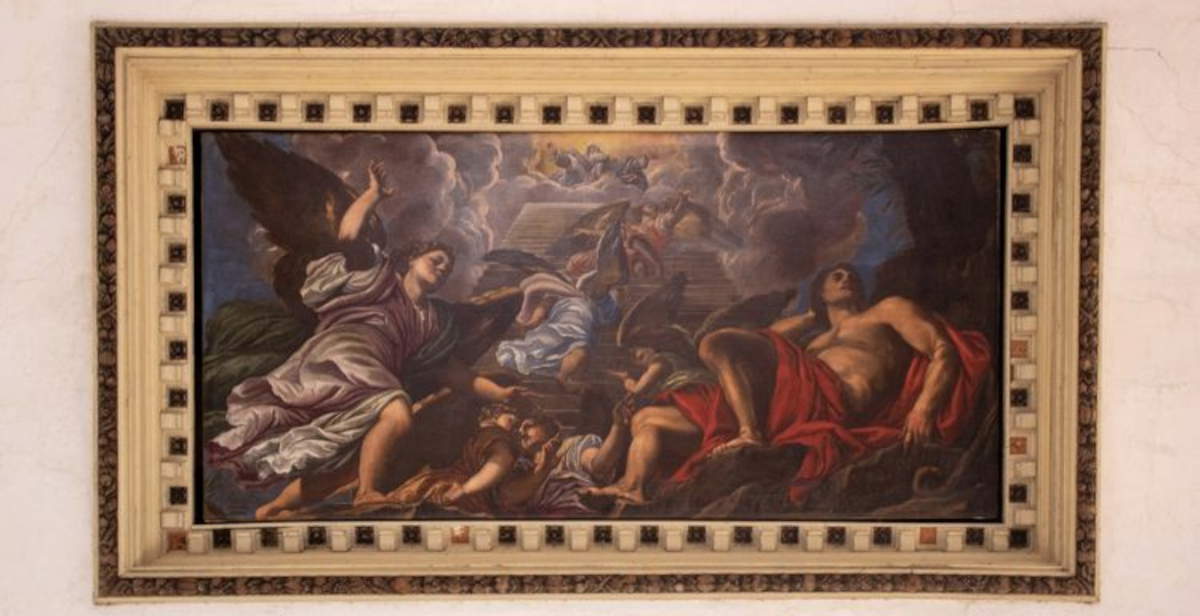 |
| Venice, restoration of Lefèvre's Jacob's Dream in San Giorgio Maggiore completed |
Warning: the translation into English of the original Italian article was created using automatic tools. We undertake to review all articles, but we do not guarantee the total absence of inaccuracies in the translation due to the program. You can find the original by clicking on the ITA button. If you find any mistake,please contact us.