





A few years ago, we were in the midst of Covid, Angela Merkel said during a speech to the Bundestag that as a young woman she had chosen to study physics at university because scientific evidence cannot be abolished. A seemingly unassailable assertion but actually problematic, for at least two very good reasons. The first: Angela Merkel has never been a cultural assessor. The second: perhaps she has never even been to Versilia, specifically to Pietrasanta, a town whose municipal administration has set out to reinvent the laws governing mathematics. In fact, it happens that in the coastal town there is the custom of starting the year with a press release in which the previous year’s museum visitor figures are reported, with numbers that nevertheless follow whimsical equations in force only in these parts. The local press has probably never felt the need to subject the data provided by the municipality to even too careful a scrutiny (otherwise their colleagues in Versilia would not be touched in the least by the temptation to attribute the numbers even to the effects of “cultural tourism.” We will come to this point later), because the 2026 commencement note was copied everywhere without anyone having any objections to the oddities that someone used to handling cultural statistics should have immediately noticed.
It should be noted at once that the communiqué refers to an “annual report,” but on the page of the City Council website transmitting the note, it is not provided as an attachment. And searching through the meanders of the site, the report turns out to be nowhere to be found. However, the reader should take this information with the benefit of the doubt: it may be the case that we were not good at plumbing the depths of the official site, or that perhaps the document was sent as an attachment to colleagues who received the note by e-mail. However, that is not the point: first, because a municipality should make the documents mentioned in a note easily available to everyone. And second, because even if the report had been linked everywhere on the page with the press release, it would have had little effect, since all the local newspapers merely reported the numbers referred to in the meager, confusing note from the administration.
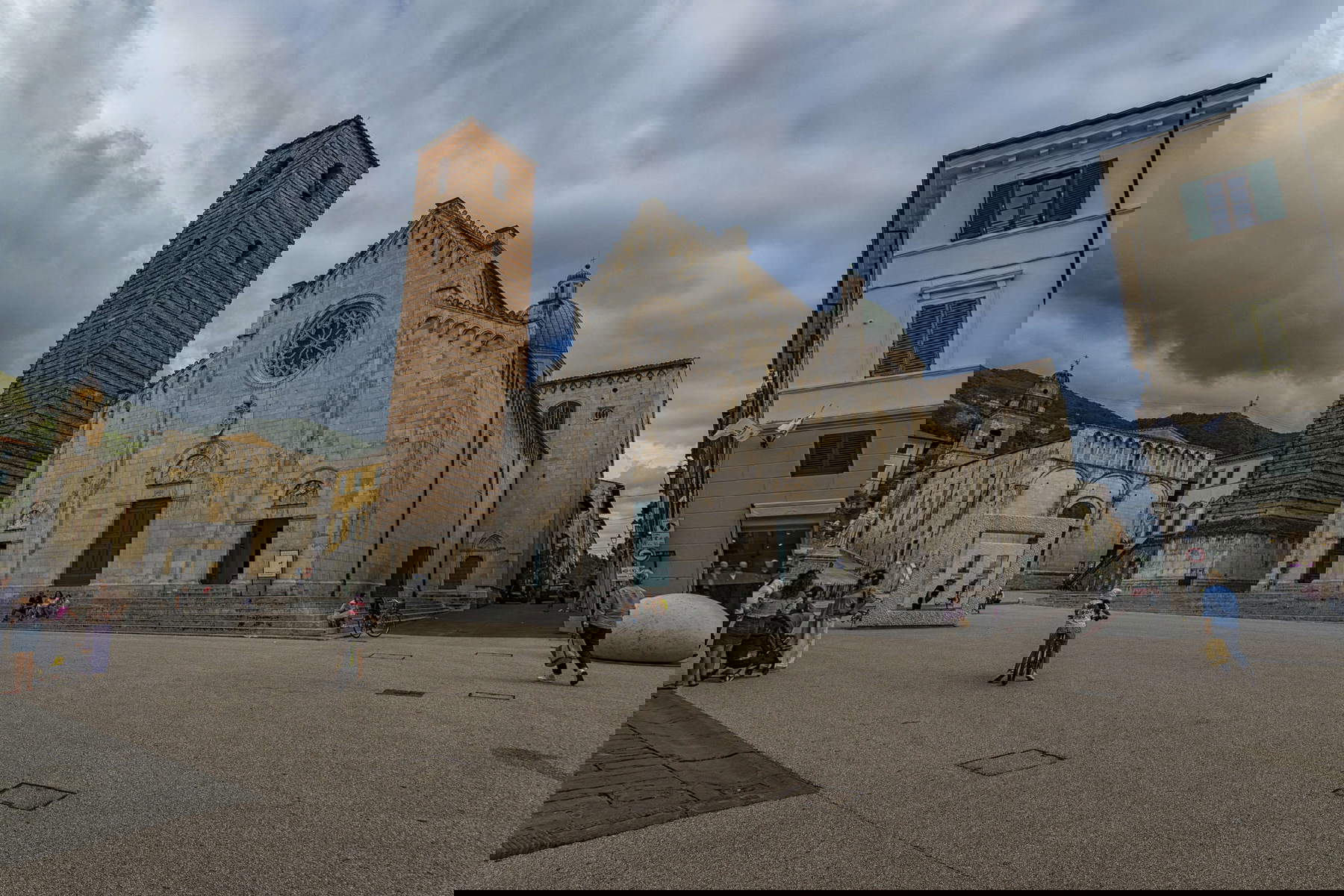
Let us then see in detail what information the Pietrasanta Municipality forwards. To summarize: the “Pietrasanta culture-system” (sic) in 2025 recorded 204,602 “presences” (we will also get to another topic in a moment, namely how irritating, ambiguous and inappropriate this term is), “marking a +10,600 compared to 2024 and exceeding the 2023 quota by more than 22 thousand.” The “culture-system of Pietrasanta,” we learn from the statement, is composed as follows: the Municipal Library, Sketch Museum, Archaeological Museum, Palazzo Panichi (home of the Barsanti Museum), Archaeological Museum, Carducci House, and “major exhibitions.” The numbers in detail: the Sketch Museum made 64,849 admissions, the Municipal Library “exceeded 17,500,” the Archaeological Museum 9,825, and the major exhibitions “attracted over 111 thousand people to the exhibition venues of the ’Luigi Russo’ cultural center.” Meanwhile, the minimally attentive reader will have noticed the most glaring (but also the least important) distortion, beyond the fact that the note lacks the numbers for Palazzo Panichi and Casa Carducci (which are usually in the range of a few hundred anyway, so they don’t shift the tally by much): millimeter, precise, retail numbers are given for some sites, and instead for others the figures are approximate (“over X visitors,” “exceeded X visitors,” and so on). Then, the sum total (which, should it be missed, can never come back with just the numbers in the communiqué, so one has to be content with a spannometric calculation) would seem to take library users into account as well, but adding museum visitors and library users into a single calculation, unless one goes to a library to see exhibitions or monumental environments (and this is not this is the case with the Pietrasanta municipal library), is to mix apples with chairs, for the simple fact that the motivations that drive a person to visit a museum and to go to a library are, and it would not even be necessary to specify this, radically different. Otherwise, if it all counts, one could include in the total calculation, while we’re at it, also cinema-goers in Pietrasanta, spectators at the Patty Pravo concert at the Versiliana and those who go to the tordello festival in Capezzano Monte.
But there is also more. In Pietrasanta, the museums and exhibitions are all free. The point, however, is that when you enter the Museo dei Bozzetti or the exhibitions at the “Luigi Russo” center, there is no one to issue an admission ticket, nor do you go through turnstiles, nor are there, at least on the surface, systems for marking visits. A further element must be added: Museum of Sketches and the “Luigi Russo” center are located in the same complex, the former St. Augustine Convent, with the consequence that when there are exhibitions there are many visitors who, being already on site, also go to visit the Museum of Sketches. The municipality’s communiqué does not say either by what method the visitors to the exhibitions and museum are counted (so it does not tell us, for example, whether the number is an estimate, or whether there are people counters, whether there are staff counting with the index finger use shepherds with sheep, whether the masses storming theformer convent on opening days are counted or are unbundled, and so on and so forth), nor does it make it known whether the same person who went to see the Kan Yasuda exhibition this summer and then went upstairs to visit the Sketch Museum is counted once or twice. And that’s not all: if you cross-check with other data, you find that the rules of mathematics follow different directions in Pietrasanta than in the rest of the world. The 2025 communiqué, for example, said that in 2024 “attendance” was 241,449. The city administration should then explain how it is possible that in 2025, with 204,602 admissions, Pietrasanta’s “system-culture” had, the city council’s words, an increase of 10,600 people over the previous year. Theoretically, at least the way addition and subtraction work above Montiscendi and below at Focette, 2025 should have given a -37 thousand or so, but probably the City Council from this year’s account has discarded something from 2024: for example, the communiqué of a few days ago does not mention the initiatives at the Salone dell’Annunziata (where lectures, classes, presentations and so on are hosted), which last year were made part of the calculation, while this round they are not mentioned. Which, however, confuses the ideas even more. And again, the 2024 figure on visitors to the Museo dei Bozzetti spoke of “over 61,500 admissions,” when the Tuscany Region’s report on museums (compiled anyway from data coming from the institutes and their administrations) records a total of 73,048 visitors.
In the face of so much presumptuousness and so much ease in drafting communiqués reporting numbers, there are only two certainties: the first, is that the Municipality of Pietrasanta, in its communiqués on visitor figures for the beginning of the year, goes out of its way to be unclear and imprecise since it transmits confusing and approximate data, does not explain its calculation methods, mixes museums and libraries (and last year it also mixed museums, libraries and conference rooms), and does not attach complete tables and reports to its notes (or at least to those available on its website). The second is that such vagueness is nonetheless accompanied by an overpowering triumphalist rhetoric that does not shy away from extolling “growth trends,” “great exhibitions”, the “high-level reception” of the city that, in the declamatory exuberance of municipal press notes, does not fail to be pompously recalled as “the little Athens.”
Finally, speaking of reception. It should be noted that the municipal press note, in referring to museum visitors, adopts a term, “attendance,” which is by no means neutral or aseptic, since it can be easily confused with the same noun, which, if we are talking about tourism, has an extremely precise meaning, so much so that when presenting statistics on culture numbers and wanting to be serious and clear, we talk about “visitors” for museums. Not “attendance.” Or at most they use this word, moreover rarely, as a synonym for “visitors” but never as the main unit of measurement, because the risk is to confuse readers: in tourism, “presences” typically denotes the number of nights tourists spend in accommodations (whereas to refer to individual tourists checking into hotels or vacation homes we speak of “arrivals”). A check-in, to put it brutally, is equivalent to an arrival. If that check-in is followed by a three-night stay, it will be referred to as three presences. Here, talking about “attendances” in relation to museum visitors is the best way to mess with the composition of flows by exploiting the closeness of the terms, especially if the notes then reach a local press that is non-specialized and thinks that those over “200 thousand admissions” are related to “cultural tourism,” as Il Tirreno clumsily headlined a few days ago, publishing an unsigned article that screamed “Cultural tourism in the city brings over 200 thousand visitors.” No: cultural tourism has nothing to do with it here, because that number is a figure that, however slipped into a narrative frame characterized by obvious semantic duplicity, is poor in meaning. And even if it were an accurate and reliable number, it would certainly have to be handled with all the necessary tongs, because the municipality does not reveal anything about the composition of the flows: therefore, we cannot know whether of those 200,000, imaginary or real, the bulk is made up of foreigners eager for culture or regulars of the Pietrasanta exhibitions who live in Querceta or Tonfano. We don’t know. We have no data on the compositions. The only certain data are those recorded in the Istat reports on Tourism, which speak of 132,153 arrivals in Pietrasanta in 2024 (and given the trends and structural capacities of the city we believe that the 2025 numbers are not so different). Here, attributing to Pietrasanta’s “culture system” a number that equals the totality of tourists arriving in the city during the year, plus (we have to assume, following the reasoning) a few tens of thousands of “hit-and-run” tourists apparently motivated by the exhibitions at the Sant’Agostino, seems to us frankly a bit excessive. The municipality is obviously responsible for what it writes and not for what the newspapers understand, but since it is now out of fashion for the press to look with a microscope at communiqués, a legacy of a mythological past, a compromise could at least be found by transmitting clear and complete data. But perhaps that is a naive wish.


The author of this article: Federico Giannini
Nato a Massa nel 1986, si è laureato nel 2010 in Informatica Umanistica all’Università di Pisa. Nel 2009 ha iniziato a lavorare nel settore della comunicazione su web, con particolare riferimento alla comunicazione per i beni culturali. Nel 2017 ha fondato con Ilaria Baratta la rivista Finestre sull’Arte. Dalla fondazione è direttore responsabile della rivista. Nel 2025 ha scritto il libro Vero, Falso, Fake. Credenze, errori e falsità nel mondo dell'arte (Giunti editore). Collabora e ha collaborato con diverse riviste, tra cui Art e Dossier e Left, e per la televisione è stato autore del documentario Le mani dell’arte (Rai 5) ed è stato tra i presentatori del programma Dorian – L’arte non invecchia (Rai 5). Al suo attivo anche docenze in materia di giornalismo culturale all'Università di Genova e all'Ordine dei Giornalisti, inoltre partecipa regolarmente come relatore e moderatore su temi di arte e cultura a numerosi convegni (tra gli altri: Lu.Bec. Lucca Beni Culturali, Ro.Me Exhibition, Con-Vivere Festival, TTG Travel Experience).
Warning: the translation into English of the original Italian article was created using automatic tools. We undertake to review all articles, but we do not guarantee the total absence of inaccuracies in the translation due to the program. You can find the original by clicking on the ITA button. If you find any mistake,please contact us.















 IT
IT FR
FR DE
DE ES
ES CN
CN


