





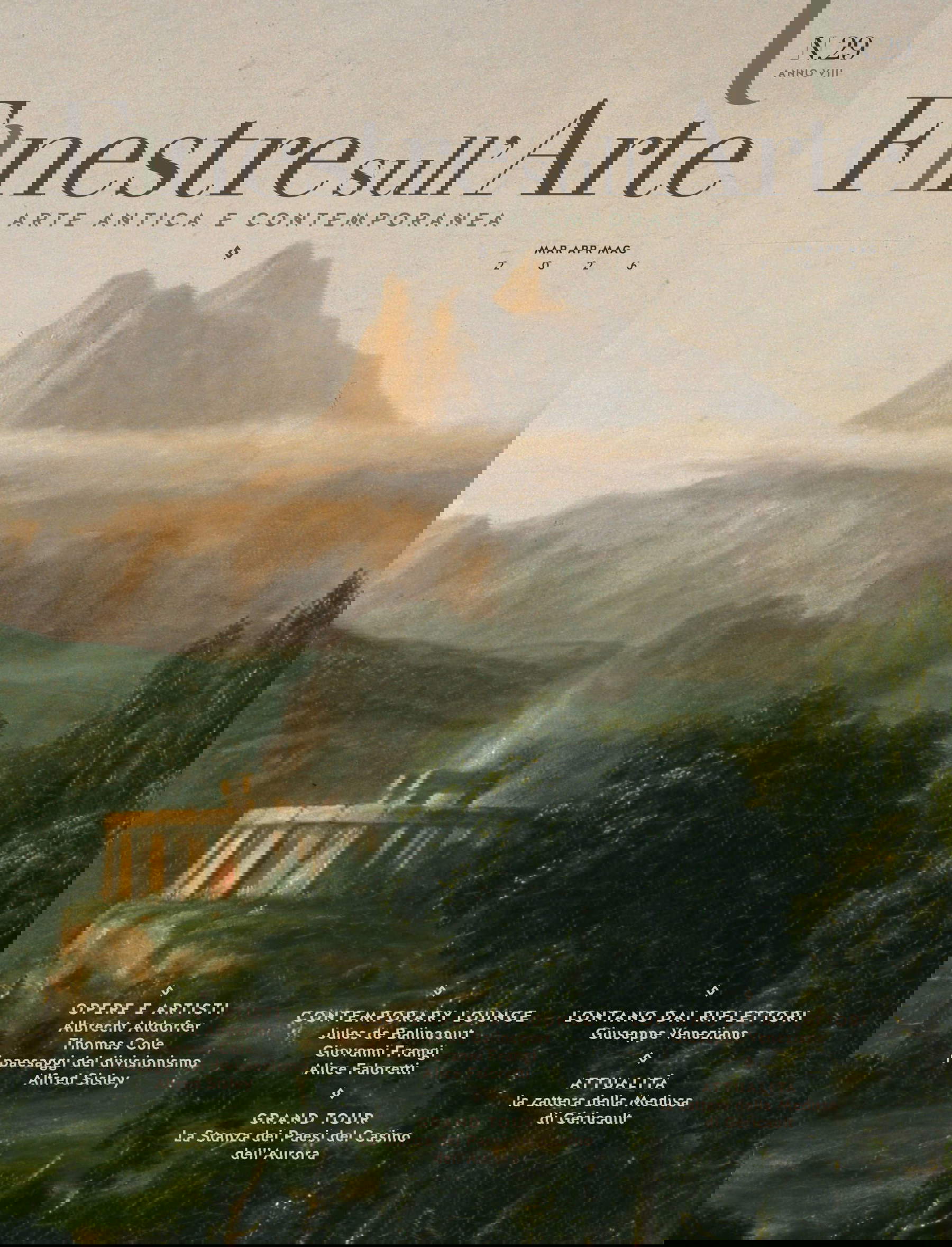
Issue 29 of Finestre sull’Arte Magazine, Finestre sull’Arte ’s quarterly print magazine, is out in March, and for this new issue it chooses to devote its entire issue to the vast and crucial topic of landscape. A subject that spans the centuries, changes with sensibilities and ideologies, is charged with political and moral meanings, and that today more than ever stands out as a confrontation ground between history and contemporaneity.
With its 176 pages bound in fine paperback, accompanied by high-quality print images and monographic articles, the new issue confirms the magazine’s editorial approach: in-depth study, scientific rigor and a gaze capable of interweaving different eras and languages. You can subscribe(by clicking here) at a cost of €39.90 per year, receiving four issues, or purchase a single copy for €10.90. For subscriptions and pre-orders there is time until Feb. 22.
The issue opens with current events. Ilaria Baratta signs an analysis on the remounting of Ancona’s Pinacoteca Civica, an intervention that becomes an opportunity to reflect on how the new museum itinerary constructs the city’s narrative. Also in the News section, the debate on the recognizability of contemporary Italian art abroad begun in issue 28 continues, a discussion involving scholars and professionals in the field that returns an articulate picture of the tensions and opportunities of the national art system.
The heart of the issue, however, is entrusted to the “Works and Artists” section, where the landscape becomes a mirror of the restlessness and visions of the world. The cover story, signed by Noemi Capoccia, is dedicated to Thomas Cole, founder of the Hudson River School. In his landscapes, the grandeur of nature is intertwined with meditation on the transience of civilizations: the rising and declining utopia becomes a universal parable, a moral tale entrusted to the light and vastness of spaces.
Jacopo Suggi, on the other hand, addresses the theme of paysage moralisé, questioning the moment when the landscape stops being mere scenery to take on an ethical and symbolic value. Ilaria Baratta returns with an in-depth study of Alfred Sisley’s Impressionist landscapes, amid suspended atmospheres and luministic variations that restore the fragility of the instant. Giorgio Dellacasa goes to the origins of landscape painting, leading the reader into the universe of Albrecht Altdorfer and the Danubian School, where nature imposes itself as the absolute protagonist, capable of overpowering human presence and redefining the relationships between figure and environment. Finally, Federico Giannini rediscovers the figure of Antonio Fontanesi , reading him as a pioneer of a landscape painting that anticipates Divisionist sensibilities and paves the way for new research on atmospheric rendering.
The journey continues with the Grand Tour, which leads to the Stanza dei Paesi in the Casino Ludovisi, a place where landscape becomes cultured decoration and a tool for representing power and aristocratic taste. A room that testifies how the depiction of places, real or imaginary, has been over the centuries one of the privileged languages of European culture.
The Contemporary Lounge section brings the discourse into the present, demonstrating how landscape remains a fertile field of experimentation. The emotional cartographies of Jules de Balincourt, narrated by Emanuela Zanon, oscillate between a desire for escape and a sense of alienation, in a globalized and fragmented world. Carlo Alberto Bucci focuses on Giovanni Frangi’s research, where landscape transcends its traditional limits to become vibrant pictorial matter. Tristana Chinni explores the work of Alice Faloretti, who pushes “beyond landscape” by questioning how it becomes an open visual tool, while Federica Schneck analyzes the iconic and disorienting scenarios of Giuseppe Veneziano, where pop culture and art history intertwine in a reflection on the present.
Closing the issue, in the Far from the Spotlight section, is an essay by Maurizio Cecchetti dedicated to Théodore Géricault’s Raft of the Medusa. The famous painting is reread as a metaphor for the West at the mercy of the Ocean: a seascape that is not simply a backdrop but a tragic theater, a symbolic space in which the drift of an entire civilization is consummated.
With this issue, Finestre sull’Arte Magazine confirms its vocation to build solid and coherent thematic paths, capable of uniting past and present under a single critical lens. Landscape, far from being a minor or purely descriptive genre, emerges as a privileged key to read the transformations of artistic sensibility and, in watermark, of society itself. An invitation to look not only at what surrounds us, but at the way we choose to represent it.
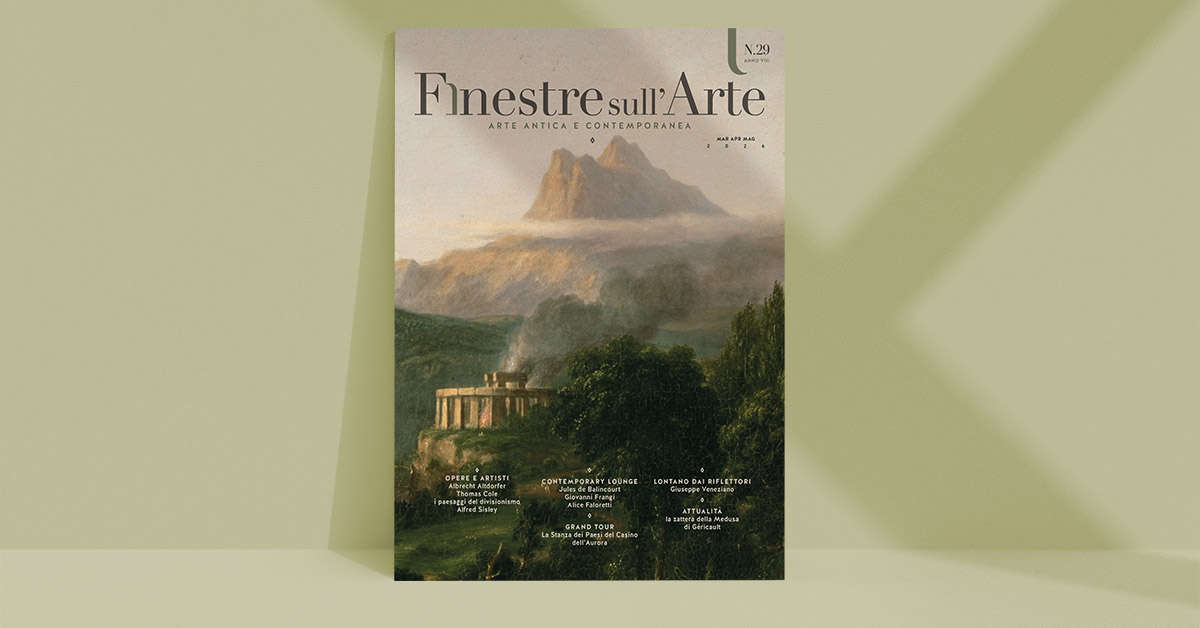 |
| Issue 29 of Finestre sull'Arte Magazine, dedicated to landscape, is out now. |

Warning: the translation into English of the original Italian article was created using automatic tools. We undertake to review all articles, but we do not guarantee the total absence of inaccuracies in the translation due to the program. You can find the original by clicking on the ITA button. If you find any mistake,please contact us.






















 IT
IT FR
FR DE
DE ES
ES CN
CN


