





The blood slid to the ground in thin threads, each with a rhythm all its own, the moment Perseus severed Medusa’s head. The ground, hit by that heat so intense it seemed like breathing, changed consistency with a speed that does not belong to things down here. It absorbed the substance, made it run within its own fractures, held back the red handwriting that descended to the bottom, and, the instant that liquid met the skin of the world, Pegasus came into being, a creature born of a wound and called, from the beginning, to rise from the ground.
This birth already contains within itself the core that will allow the figure to traverse centuries of imagination: a being generated from a fracture, destined to move upward, a body that belongs to the earth only long enough to detach itself from it. In the Greek world, Pegasus is linked to the ordering force of the cosmos and the discipline of ingenuity; it is he who opens the Hippocratic fountain with his hoof, it is he who becomes the companion of poetic inspiration, the bridge between matter and vision. Not surprisingly, his image, which later became a symbol of Tuscany, runs through ceramics, reliefs and votive objects, spreading across the Mediterranean as a figure belonging as much to myth as to the daily practice of workshops and sanctuaries.
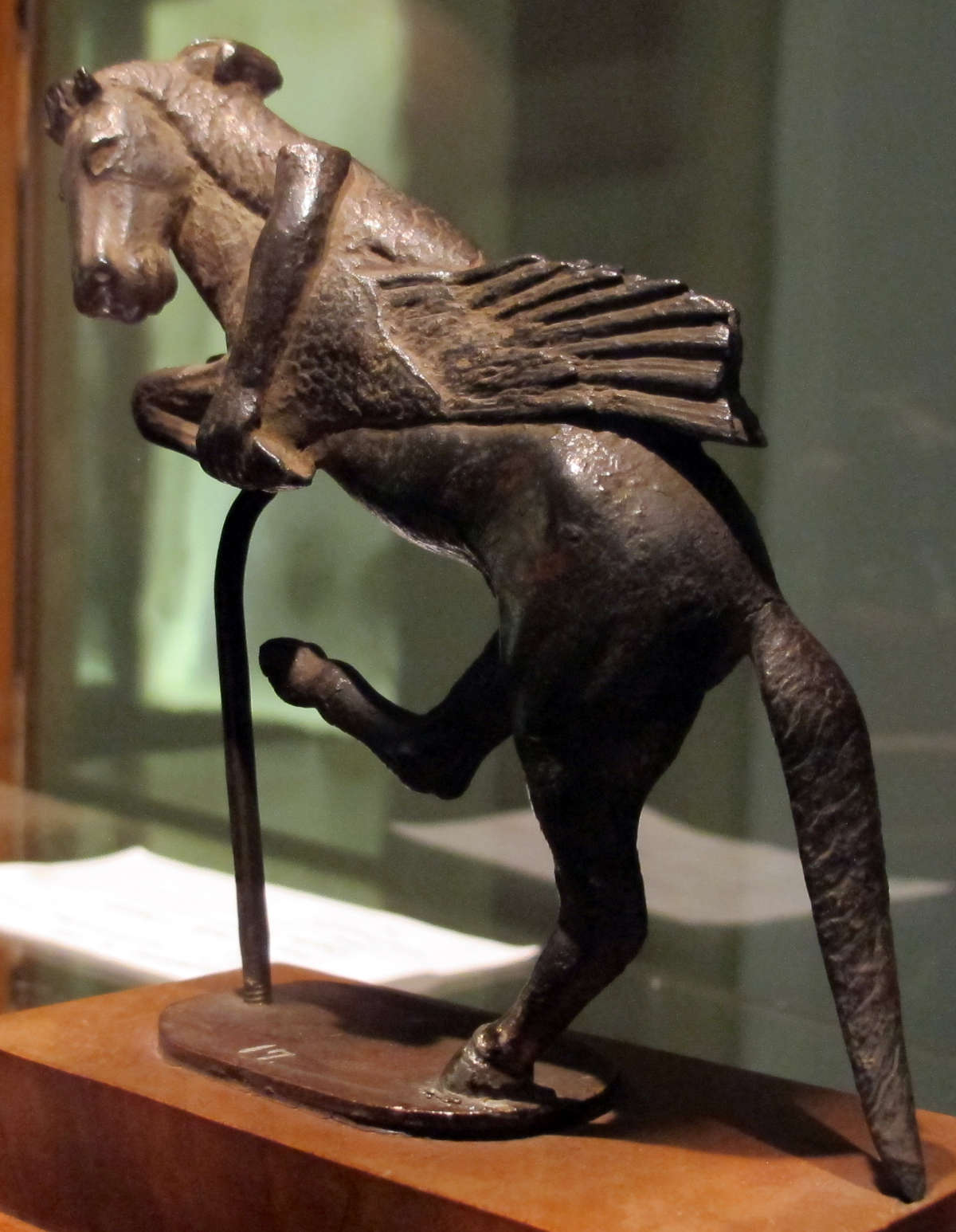
The National Archaeological Museum in Florence holds some of the oldest and most tangible traces of the translation of Pegasus from the domain of myth to that of image, from the transparency of oral narrative to the density of matter. It is here, in the heart of one of the most stratified Etruscan-Italic collections, that one encounters a small votive bronze depicting the winged horse. An essential form, flattened to the size of a few centimeters, with the wings stretched just above the line of the back, the neck forward, and the body gathered into a functional compactness. It is an object designed for ritual. The bronze, probably placed in a votive or funerary context, testifies to the adoption of Pegasus in the Etruscan symbolic landscape as an intermediary between the world and beyond, as a figure of the threshold. This small bronze, neither signed nor dated exactly, is now displayed in the room that also houses the famous Chimera of Arezzo. Its placement, which is not accidental, evokes the ancient iconographic link between the two creatures, a legacy of the legend in which Pegasus flanks Bellerophon in the fight against the monster.
Next to this work, the museum presents another find of special interest: anoinochoe, or wine jug, Etruscan-Corinthian from the 6th century B.C., decorated with black figures, in which Pegasus appears in full flight. The animal is, in fact, flanked by several winged horses, and the image suggests the moment when the creature emerges from Medusa’s decapitated body, as described in the archaic version of the myth. Here form becomes language; the sharp stroke of the black line etches the outline of the animal on the light clay background, defining its mane as a graphic sequence, while the wing serves as a vertical element evoking the creature’s upward potential. This pottery, from an Etruscan background but influenced by the Corinthian Greek tradition, shows a Pegasus already accomplished in iconography. The figure, in fact, is fully recognizable but still linked to the sphere of domestic ritual or tomb offering.
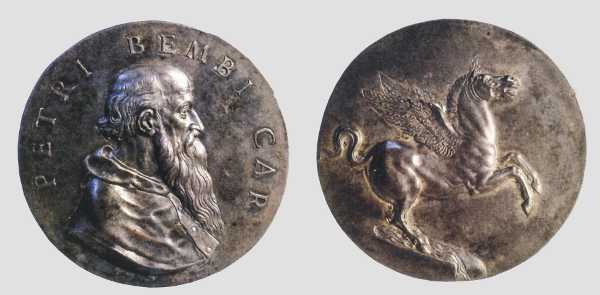
When Pegasus returns to the visual imagination of Tuscany, it does so through a form thatHumanism recognized without hesitation. The Renaissance, which in myth identifies a grammar of thought, entrusts figures like this with the ability to represent the nobility of the intellect and the tension that leads it from confusion to clarity. The medal made by Benvenuto Cellini for Pietro Bembo around 1537 is one of the earliest and most accomplished modern translations of that passage. On the reverse, the horse touches with a hoof the rock from which Hippocrene, the source of poetic inspiration on Mount Helicon, springs. The image, concentrated in a minute, measured relief, replaces all emphasis with geometric severity. No narrative scene, no allusion to the ferocity of the original myth: only the gesture remains, delicately etched with the precision that is due to symbols.
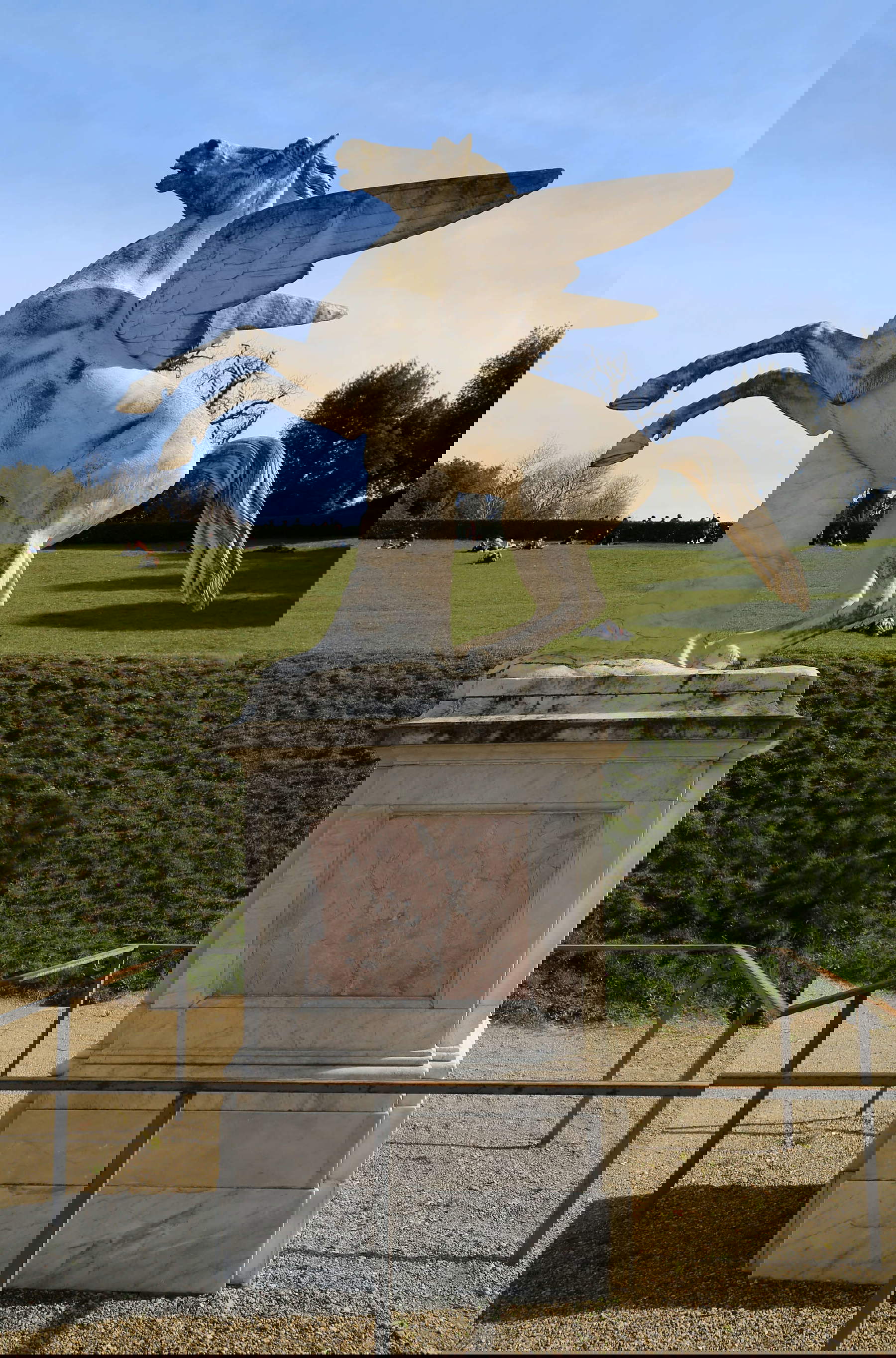
From this model comes a visual genealogy that reappears, three centuries later, in the monumental work of Aristodemus Costoli. His Pegasus now placed in the heart of the Boboli Gardens was not born as a work intended for the celebration of myth in the strict sense, but as a cultured and public exercise of plastic translation of a symbol that, as seen earlier, had found a high measure in the medal coined for Pietro Bembo and attributed to Benvenuto Cellini. That small surface, chiseled with rigor, concentrates in a few millimeters the entire allegorical potential of the creature.
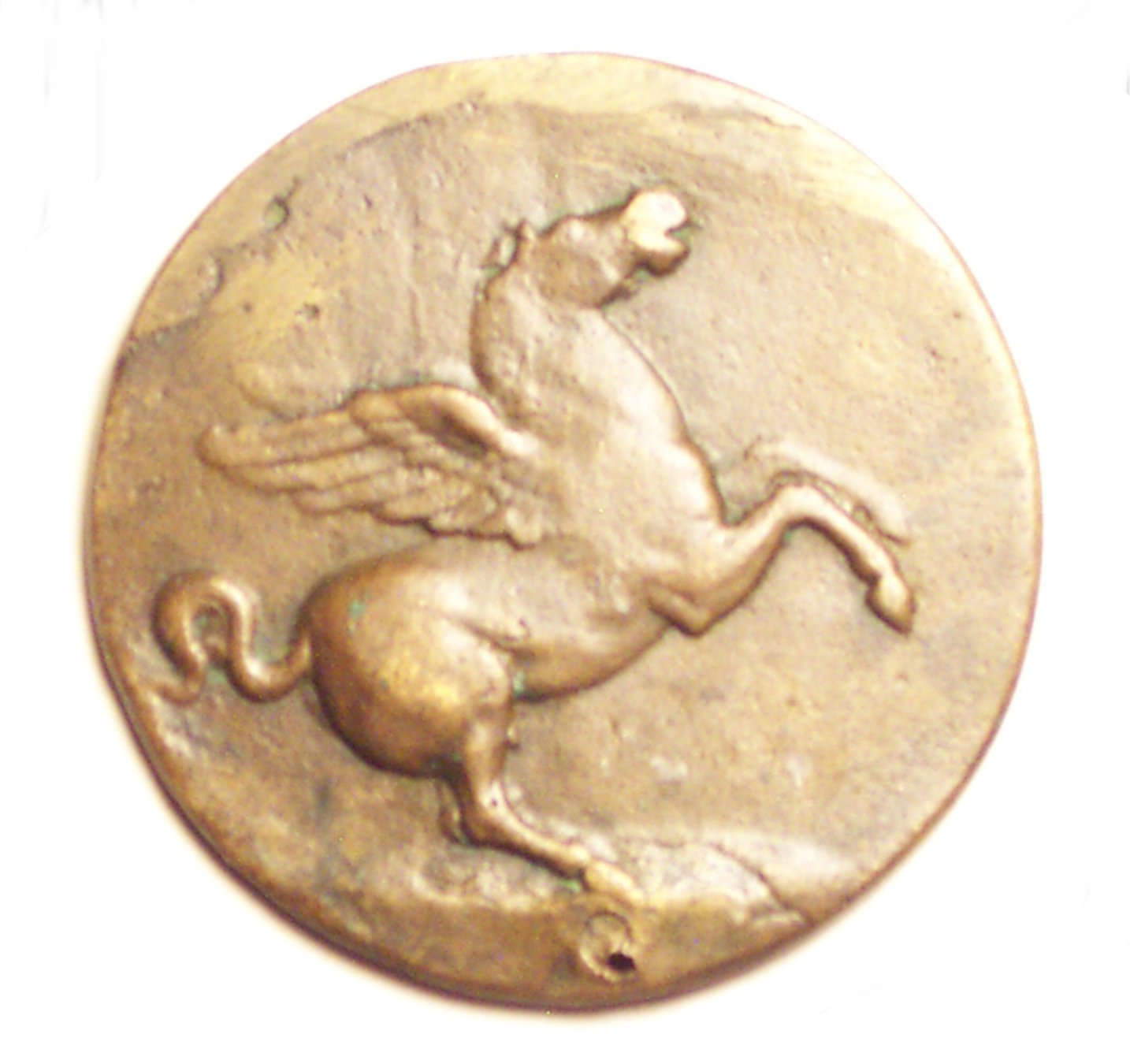
Costoli looks at that form with an attention that is never literal quotation but continuous sculptural reasoning. The occasion that gives rise to his Pegasus dates back to 1827, when the artist, still a student at the Accademia, was commissioned to model a new winged horse for the Cascine Park, replacing a now-deteriorated terracotta specimen. The time of execution (almost twenty-five years) corresponds not only to the technical and formal difficulties of the work, but also to a change in the status of the image itself: from an element of urban decoration to a figure capable of assuming a monumental weight and a much broader representative function. When the sculpture is finally ready in 1851, the place initially thought to accommodate it turns out to be inadequate, and the proposal to move it inside the Prato della Meridiana in Boboli, approved in 1854, becomes the premise for a new centrality of the work in the garden space.
The sculptural execution reflects this awareness. The white marble, treated with an expertise that eschews all ornamental concessions, is arranged according to a severe arrangement, in which every detail responds to an internal logic of tension and measure. The wings, spread without emphatic amplitude, outline an almost architectural balance; the neck, stretched forward expressing orientation; the hind legs, gathered in an oblique position, concentrate in gesture the force of an impending detachment that will never be staged. The horse is all in power, fully aware that the energy of ascent is affirmed in its preparation. The base, designed specifically for the Meridiana Meadow, does not accompany the figure, but absorbs its latent verticality, holding up the visual pressure of a body that, while firm to the ground, imposes an ascending trajectory on the eye.
In the restrained and polished body of this creature, sculpted to withstand time and its changes, we read the premises of the long iconographic adoption that would lead Pegasus to become, first, the symbol of the Tuscan Committee for National Liberation during the Resistance and, then, the emblem of the Tuscan Region in 1970. But already in this late nineteenth-century version, the winged horse has taken on a function that goes beyond mythological narrative to inscribe itself in a culture of thought that asks forms to be, first and foremost, content.
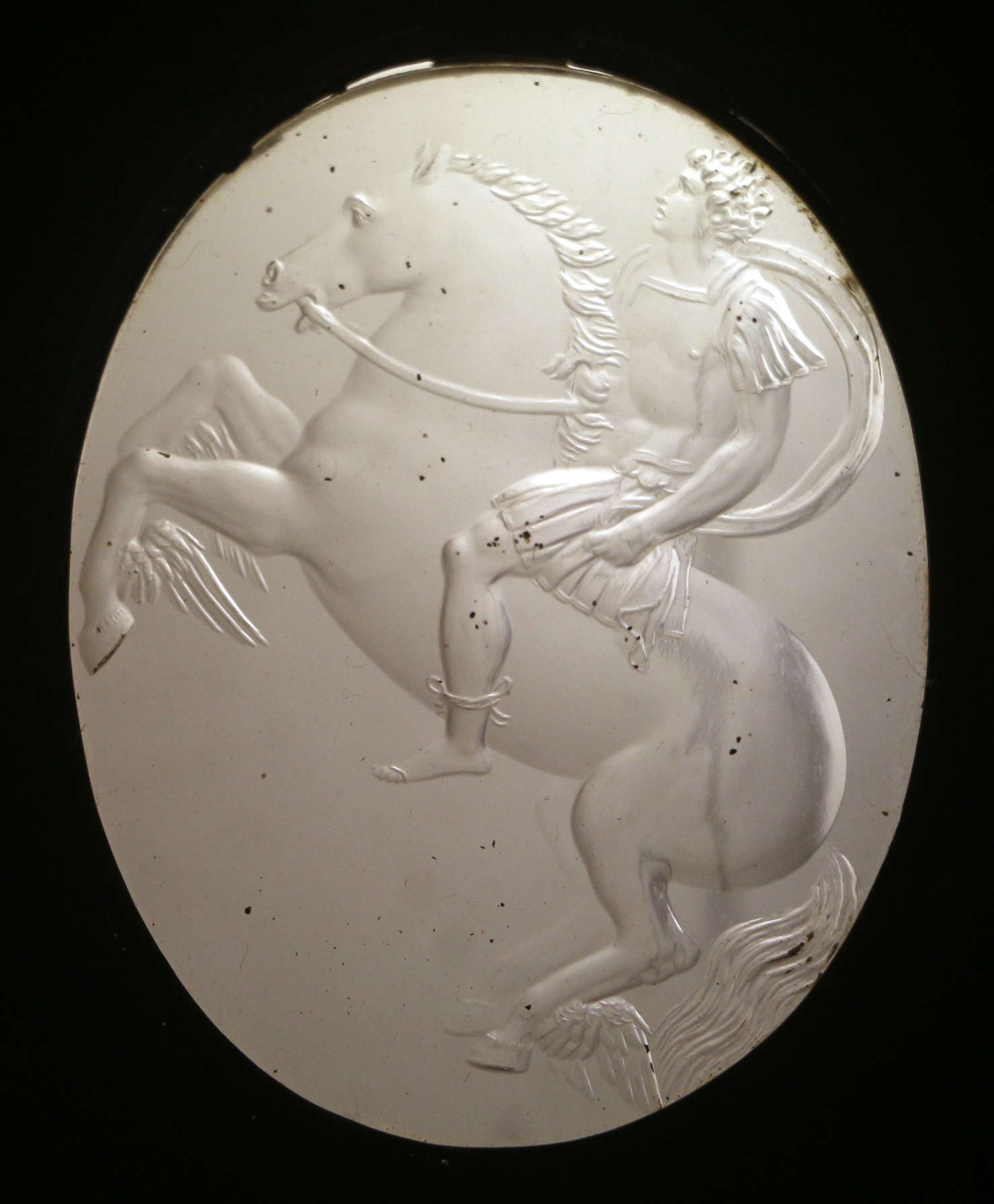
Going back in time, long before the monumentality of the 19th century entrusted Pegasus with the task of presiding over open spaces, the winged creature had already made its way into the more reserved and selective circuits of Medici culture, embodying a different idea of elevation: more collected and reflective. Among the objects preserved in the Tesoro dei Granduchi (once known as the Museo degli Argenti) is a cameo engraved on rock crystal, mounted in gold, in which Pegasus appears together with Bellerophon. Datable to the transition between the 16th and 17th centuries and likely from an Italian workshop, the work was part of the collection of semiprecious stones that the Medici had elevated to the pinnacle of their symbolic diplomacy.
The engraved image, enclosed in a few centimeters of surface, concentrates the myth in the silent gesture of a frozen ascent. Bellerophon does not ride with impetus, but grafts himself into the figure of the horse in a kind of guarded fusion in which both are revealed to be upwardly oriented, but without momentum. The carving, fine and regular, adheres to the crystal with a precision that translates narrative into presence. This Pegasus, contained in the palm of a hand and intended for the pleasure of a few, is placed on a different plane than Costoli’s large sculpture: where the latter projects myth into civic space, the cameo distills it into cabinet form, designed for collection and contemplation, for recollection rather than public impact.
Throughout the 20th and 21st centuries, Pegasus continues to re-emerge in the Tuscan landscape as a layered identity sign, declined according to new grammars, where industrial matter replaces marble and artificial light replaces the aura of myth. The winged creature, already sedimented in the symbolic fabric of the region, becomes available for new formal translations, entrusted to the hand of artists who recognize its evocative potential and reshape it according to the urgencies of the present.
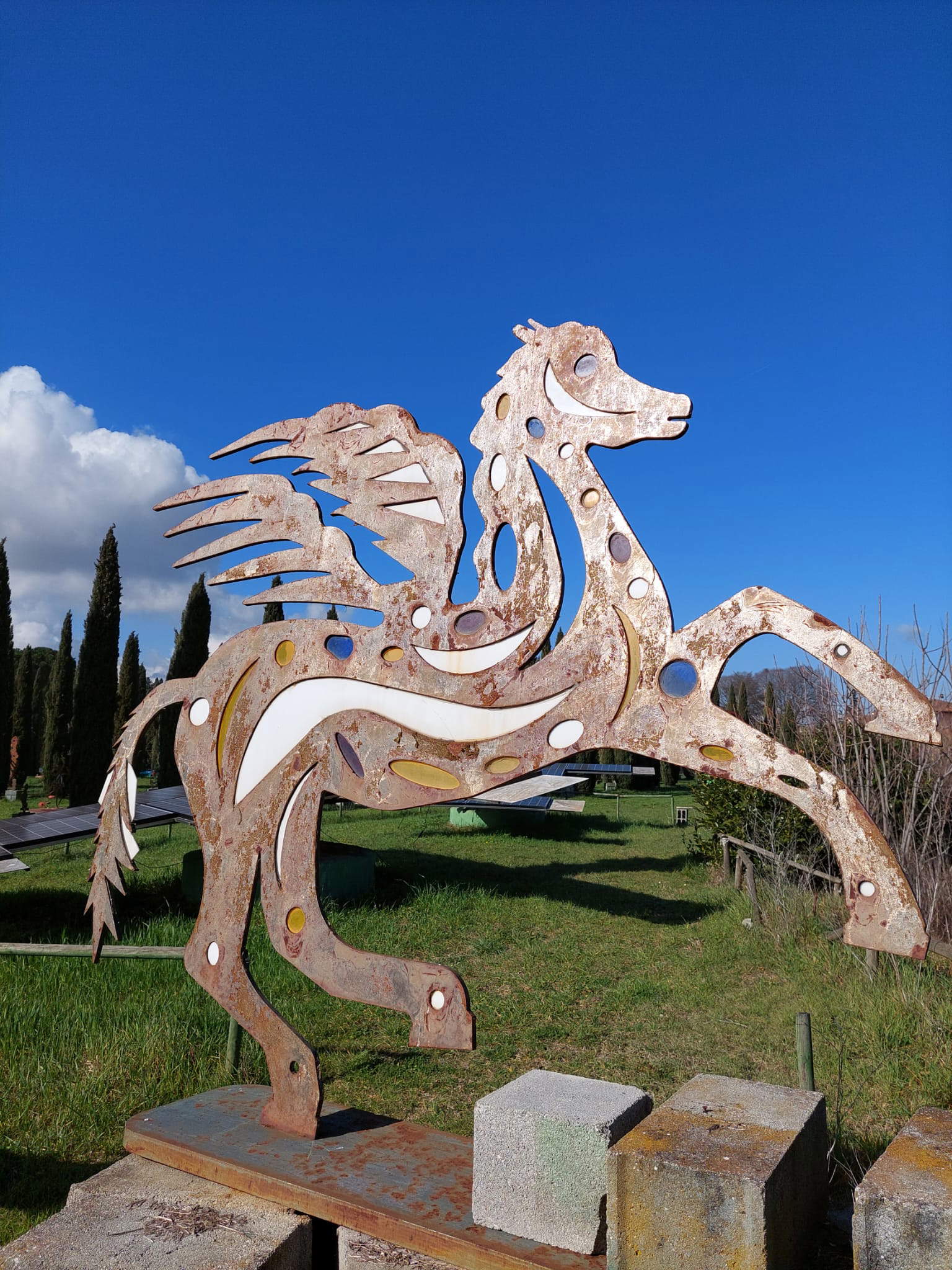
In 1983, Enzo Pazzagli, a Tuscan sculptor attentive to the tension between formal synthesis and environmental monumentality, created a Rampant Pegasus in bronzed steel, intended for the garden in front of the headquarters of the Region of Tuscany on Via di Novoli in Florence. The work, about two meters high, imposes itself as a vigilant presence at the entrance to the institutional offices. The figure, forged in a metal that holds light with controlled opacity, embodies the leap into an industrial key, foreign to any emphatic mythography. In 2015, Pazzagli himself intervenes with a restoration that introduces colored Plexiglas inserts into the wings, updating the image with a gesture that does not alter the balance of the work, but amplifies its urban legibility. The result is a Pegasus that does not hide behind the rhetoric of the past, but grafts itself into the visual functionality of public architecture, making itself immediately recognizable as a symbol of the region and, at the same time, as a plastic organism that absorbs light and redistributes it.
The same artist transformed, a few years later, that vision into a permanent installation in the Art Park that bears his name in Rovezzano, along the Arno River. Here, on an area of twenty-four thousand square meters, among more than two hundred sculptures, Pegasus returns with an even more declared presence: a winged horse in polychrome steel that stands not only as a tribute to the land of its origin, but as an attempt to inscribe the myth in a contemporary visual grammar, freed from all nostalgia and placed in the dimension of the park as a civic, participatory, everyday space. In this context, Pazzagli’s Pegasus loses the solemnity of the monument to take on the features of a familiar presence, constantly renegotiated by the gaze of those who cross the landscape.
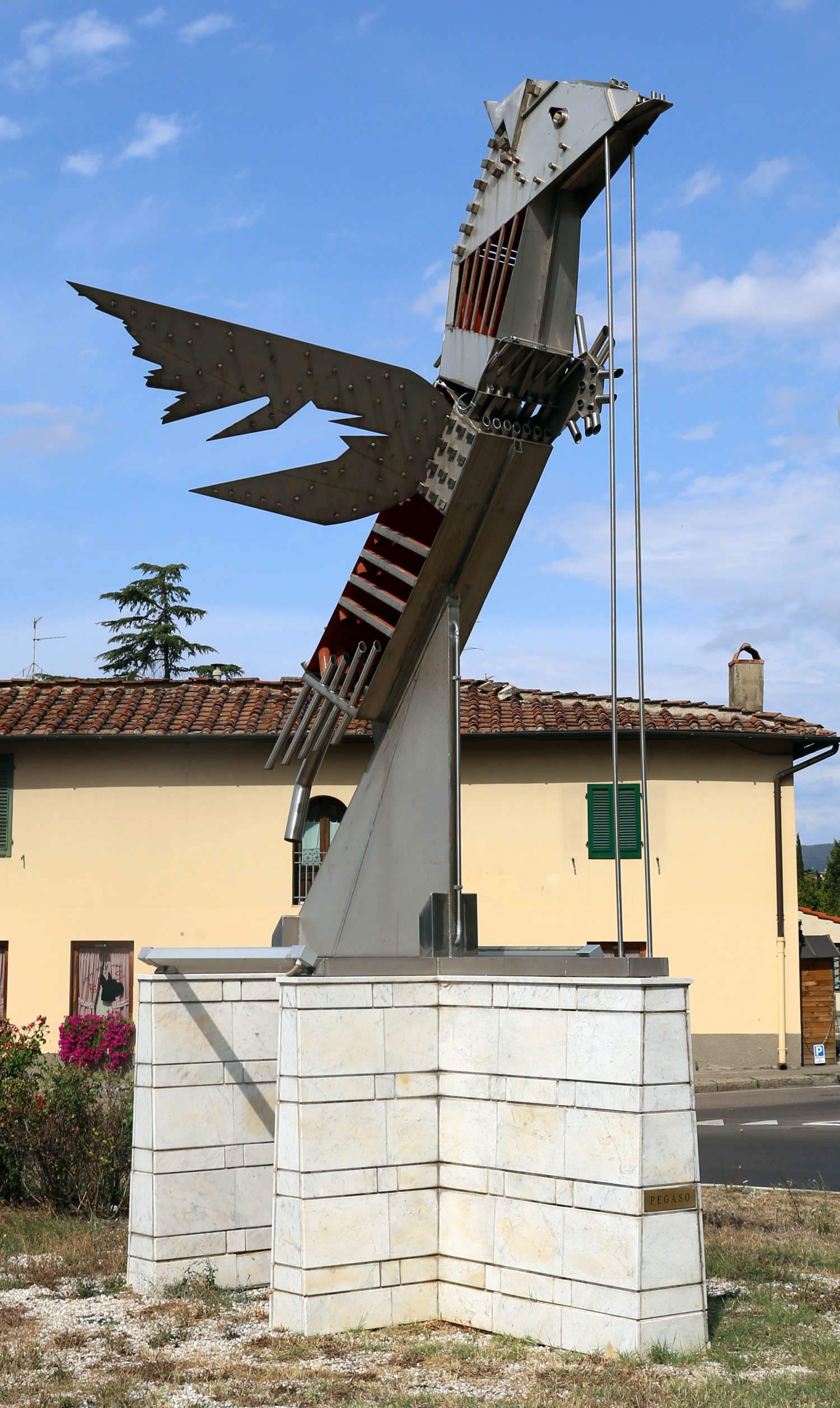
Different is the formal approach chosen by Giampiero Poggiali Berlinghieri for the Pegaso created in 1999 in Sesto Fiorentino, installed in a traffic circle along Via di Quinto, in the neighborhood of Piazza 30 Novembre. The work, constructed of polychrome stainless steel, stretches into space with taut lines and sharp angles, a sign that prefers stylization to volumetry and reads myth through the filter of urban graphics. In this case, Pegasus emerges not from the earth but from asphalt, not from a wound but from an intersection. The placement, deliberately devoid of scenographic rhetoric, restores to the figure a signaling function, but not for this reason a weak one: the winged horse becomes the fulcrum of an expanding territory, a symbol not so much of an abstract freedom as of a tension toward the future, integrated into the urban development and identity design of a community.
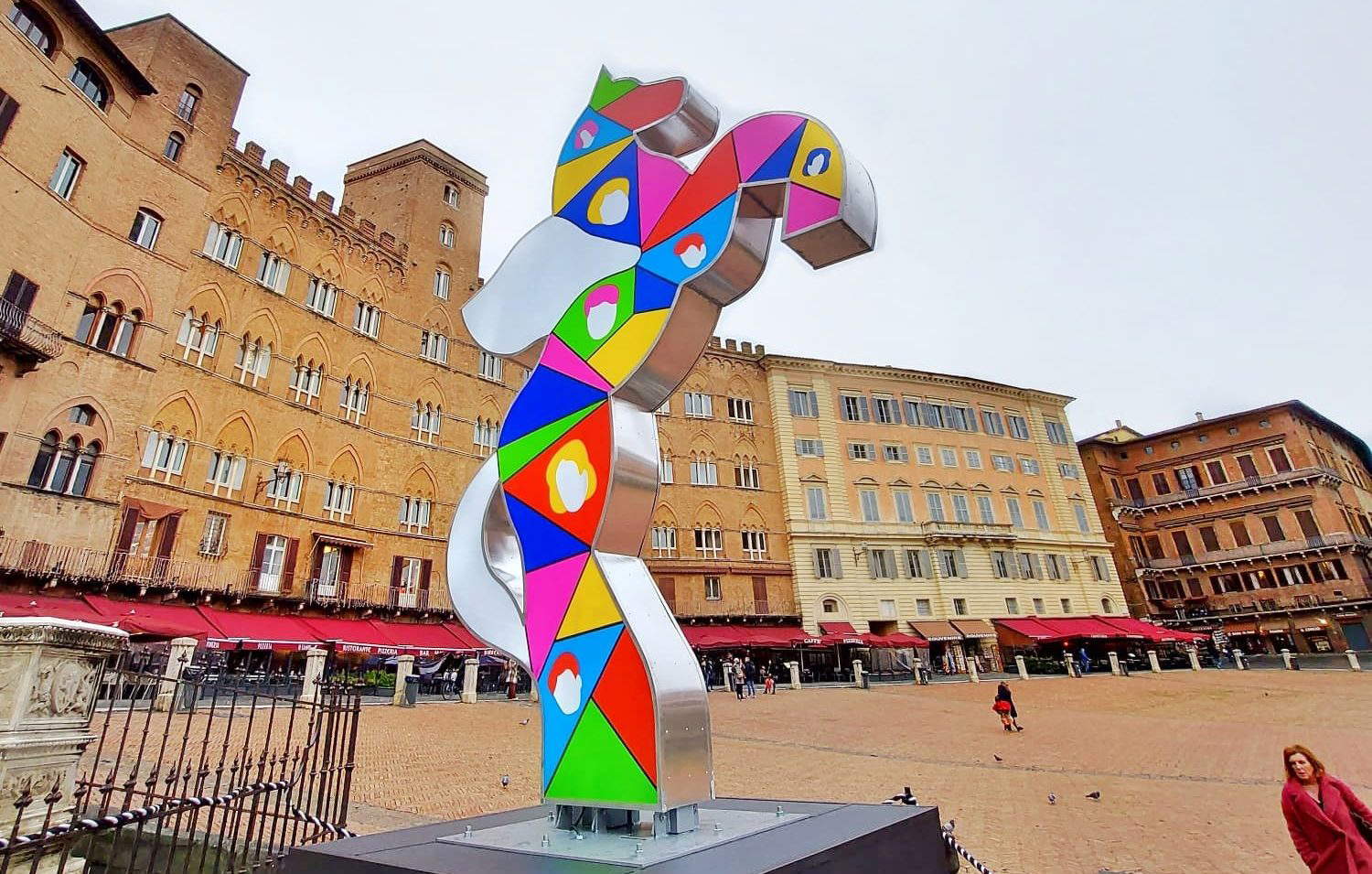
Finally, the most recent and avowedly pop declination of the myth comes from Siena, where Marco Lodola has donated to the city a three-meter-high light sculpture, placed since 2025 in the traffic circle between Via Bianchi Bandinelli and Via Lombardi, in the Due Ponti district. The work, created as a temporary installation for the 2023 exhibition Dames, Knights and Noble Steeds, has become an integral part of the cityscape, visible even at night thanks to backlighting. Lodola, an artist who has always been interested in the collective imagination and visual culture of the present, builds his Pegasus out of colored Plexiglas panels, shaped according to the silhouette of a prancing horse, defined more by light than by matter. Here the myth is not evoked, but traversed and returned as an icon. It is an immediate image, intended for quick transit, but capable of condensing, in an essential structure, the gesture of ascent and the utopian vocation of a regional identity projected toward the sky.


The author of this article: Francesca Anita Gigli
Francesca Anita Gigli, nata nel 1995, è giornalista e content creator. Collabora con Finestre sull’Arte dal 2022, realizzando articoli per l’edizione online e cartacea. È autrice e voce di Oltre la tela, podcast realizzato con Cubo Unipol, e di Intelligenza Reale, prodotto da Gli Ascoltabili. Dal 2021 porta avanti Likeitalians, progetto attraverso cui racconta l’arte sui social, collaborando con istituzioni e realtà culturali come Palazzo Martinengo, Silvana Editoriale e Ares Torino. Oltre all’attività online, organizza eventi culturali e laboratori didattici nelle scuole. Ha partecipato come speaker a talk divulgativi per enti pubblici, tra cui il Fermento Festival di Urgnano e più volte all’Università di Foggia. È docente di Social Media Marketing e linguaggi dell’arte contemporanea per la grafica.Warning: the translation into English of the original Italian article was created using automatic tools. We undertake to review all articles, but we do not guarantee the total absence of inaccuracies in the translation due to the program. You can find the original by clicking on the ITA button. If you find any mistake,please contact us.























 IT
IT FR
FR DE
DE ES
ES CN
CN


