



by Redazione 03/12/2025



Categories: Ancient art / Disclaimer
Giovanni Bellini's Pietà, from the City Museum in Rimini, returns to Venice after its last exhibition in 1949 thanks to a major restoration sponsored by Venetian Heritage. A dossier exhibition places it alongside Mantegna's Saint Sebastian, the first stop on a journey between Venice, New York and Rimini.

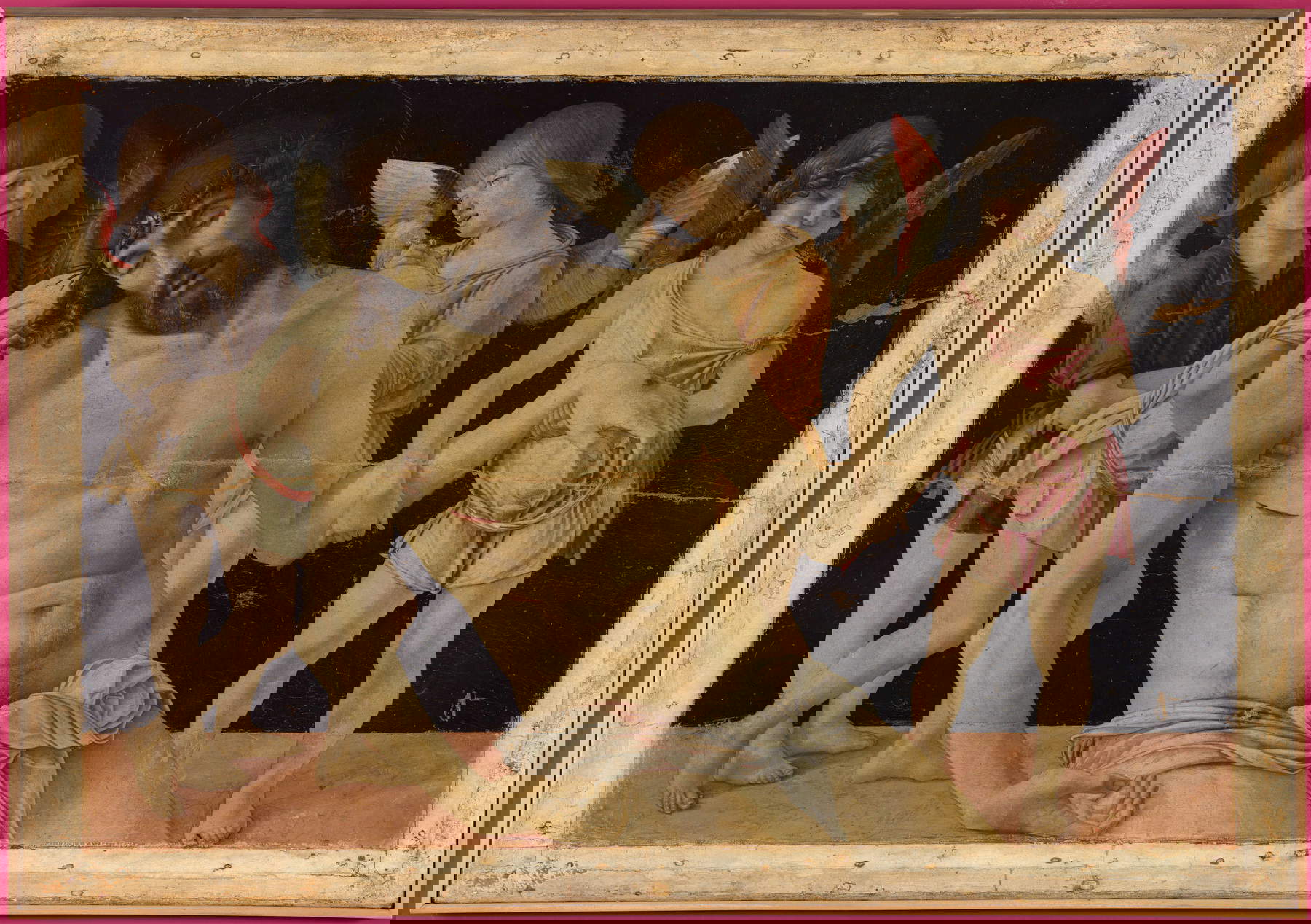
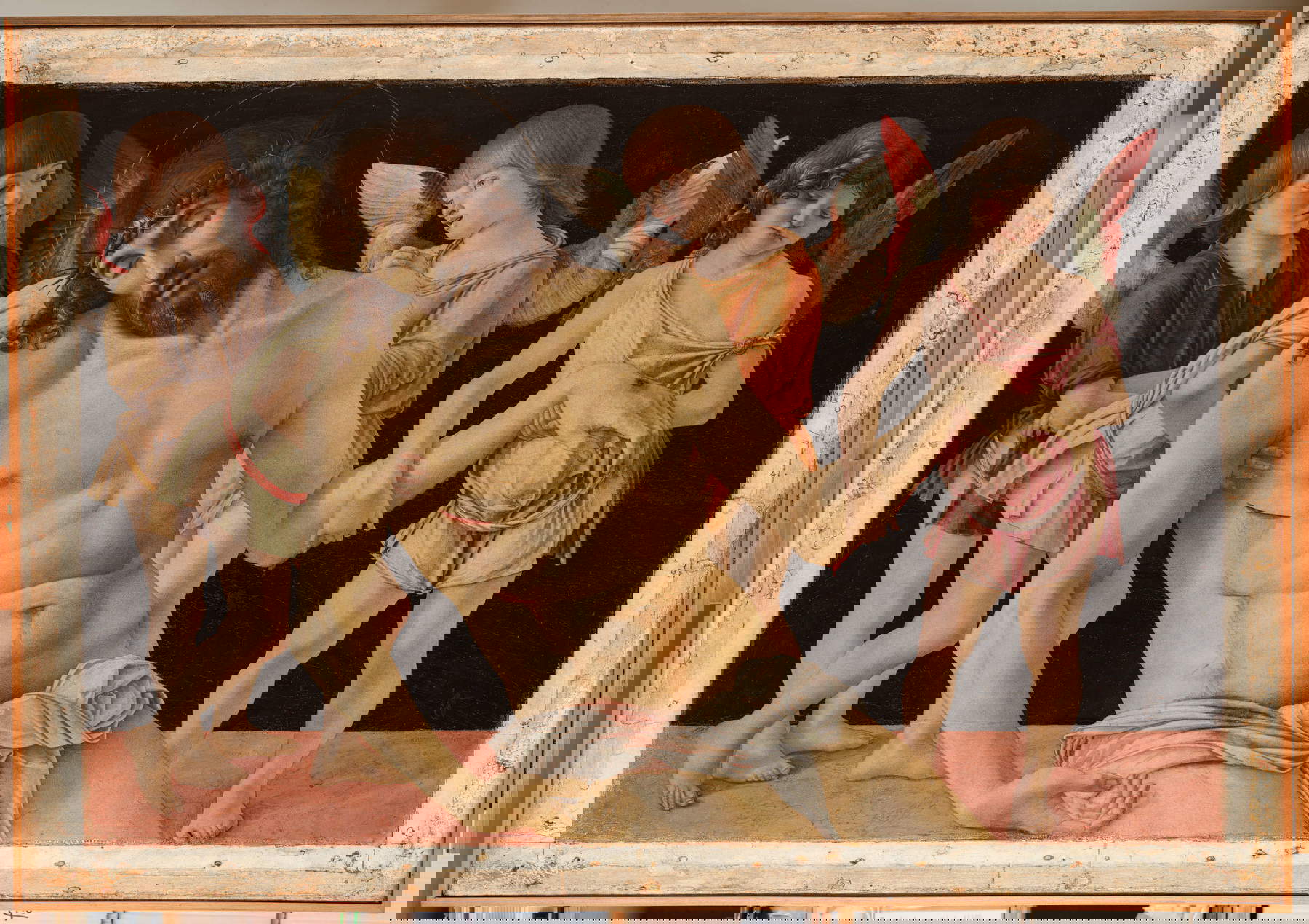
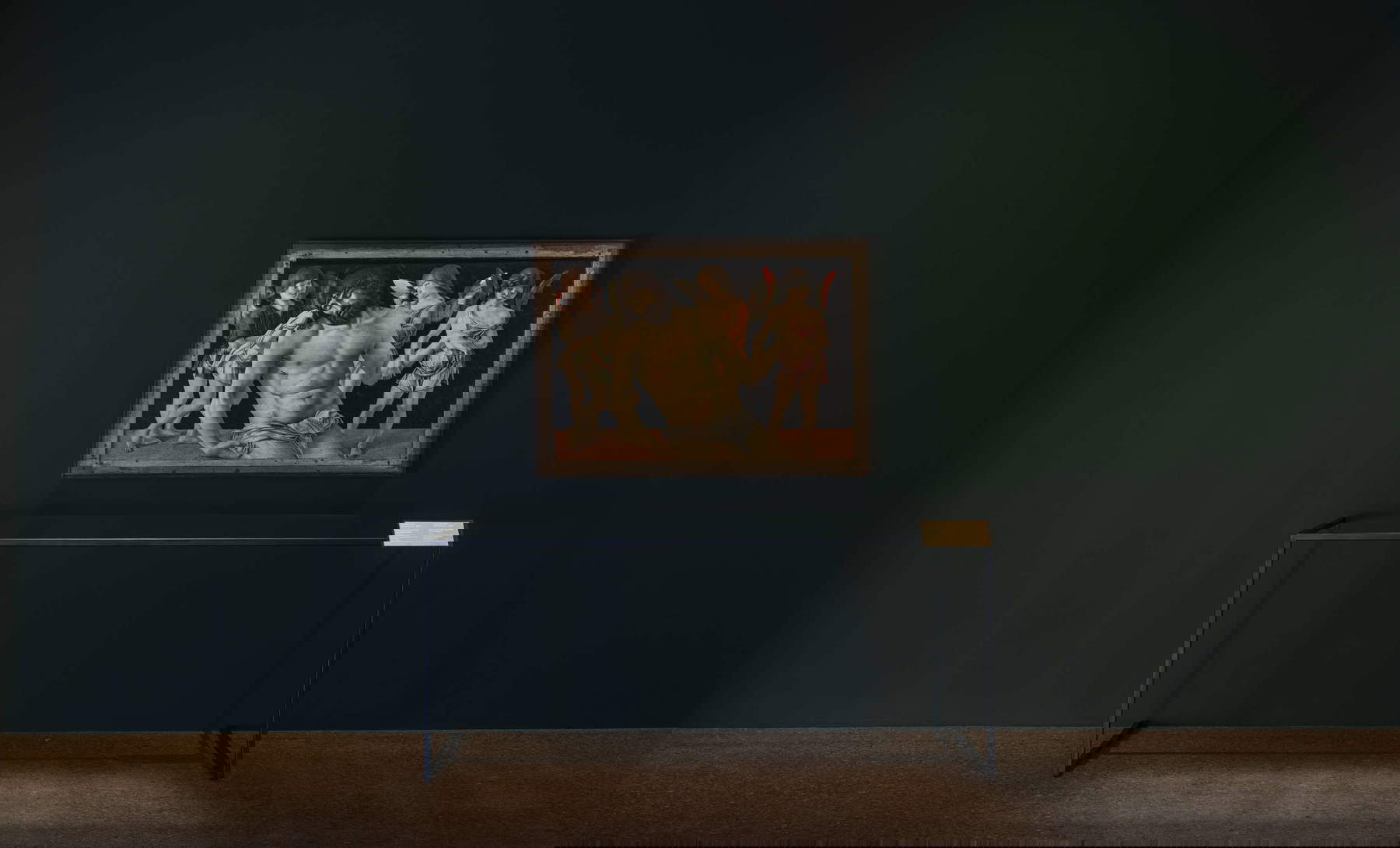
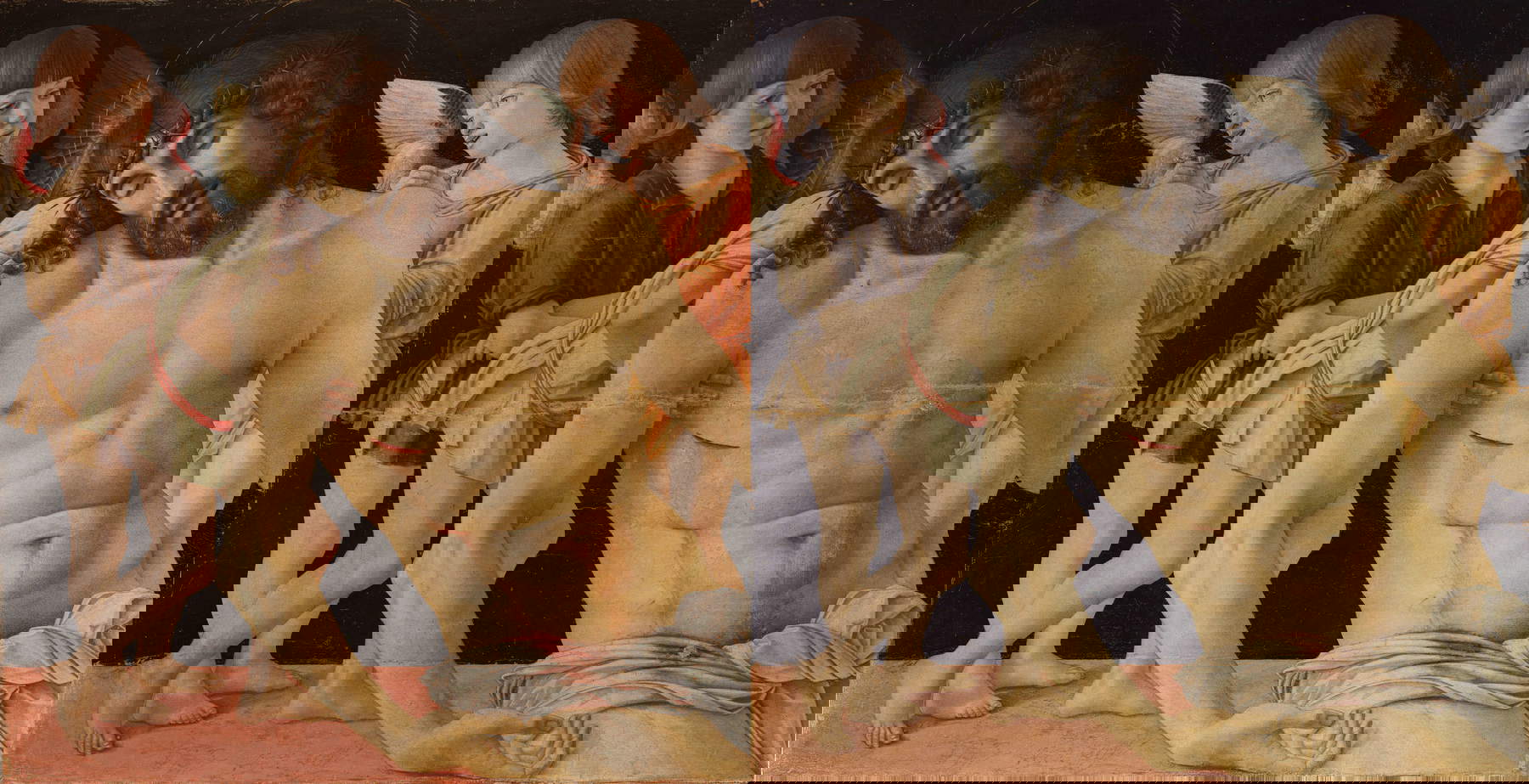
An important masterpiece of the Venetian Renaissance returns to Venice after more than 70 years. The Pietà, or Dead Christ Supported by Four Angels, by Giovanni Bellini (Venice, c. 1430 - 1516), housed at the City Museum in Rimini, is presented to the public in the spaces of the Giorgio Franchetti Gallery at Ca’ d’Oro thanks to an extensive restoration project promoted and funded by Venetian Heritage. The international nonprofit organization, which has been active for twenty-six years between Venice and New York, is committed to supporting cultural initiatives geared toward enhancing the artistic heritage of the Serenissima through restoration, exhibitions, studies, research and publications. The work, the last example of a youthful production by Bellini that profoundly marked 15th-century Venetian painting, had been missing from the lagoon city since 1949, when it was displayed at the Doge’s Palace in the major exhibition dedicated to the master and curated by Rodolfo Pallucchini with staging by Carlo Scarpa.

The return to Venice is accompanied by a dossier exhibition, open from Nov. 21, 2025 to Jan. 6, 2026, that relates the Pietà to Andrea Mantegna’s Saint Sebastian, also from the City Museum in Rimini. The curatorial project is entrusted to Toto Bergamo Rossi, director of Venetian Heritage, and Giovanni Sassu, former director of the Museum of the City of Rimini and now head of the Museums of Cento. The initiative is promoted by Venetian Heritage in collaboration with the Veneto National Museums Regional Directorate, the Giorgio Franchetti Gallery at Ca’ d’Oro, Rimini Musei and the Morgan Library & Museum in New York, an institution that will in turn host a leg of the exhibition from January 15 to April 19, 2026. At the end of this international journey, the Pieta will return permanently to Rimini, once again juxtaposed with Mantegna’s San Sebastiano, in a final stage that will take place in conjunction with the temporary closure of the Ca’ d’Oro for the final phase of renovations funded by Venetian Heritage.


The history of the painting
The historical story of the painting has its roots in the mid-15th century. In fact, the Pietà was commissioned from Giovanni Bellini by Rainerio di Lodovico Migliorati, advisor to the Malatesta family and a central figure in Rimini’s cultural and political life. The work can be dated to the 1470s and already appears in the commissioner’s will drawn up in 1499. Style, iconography, and format suggest that it was intended for private devotion in the Migliorati residence and that only after Rainerio’s death did it find its place in the family’s funerary chapel in the church of Sant’Antonio, located next to the church of San Francesco, now known as the Malatesta Temple, a celebrated architectural work by Leon Battista Alberti. The commission reflects the intense relations between Rimini and the Republic of Venice, developed precisely thanks to figures such as Migliorati himself, who traveled to the Serenissima several times. It is likely that it was precisely on the occasions of those meetings that the decision to entrust Bellini with a subject so charged with devotional significance had matured.
The Pietà was soon transferred from the Migliorati chapel to the church of San Francesco, where Giorgio Vasari saw it and mentioned it in the 1550 edition of the Lives. It remained there until the early 19th century and later entered the Pinacoteca Comunale of Rimini. Appreciated as one of the pinnacles of the city’s collection, the panel left Rimini for the first time in 1929, when it was loaned to the Royal Academy of Arts in London for the prestigious exhibition Exhibition of Italian Art 1200-1900. There were numerous subsequent loans, including the 1949 loan to the Palazzo Ducale, the last Venetian appearance before the current project.
The restoration
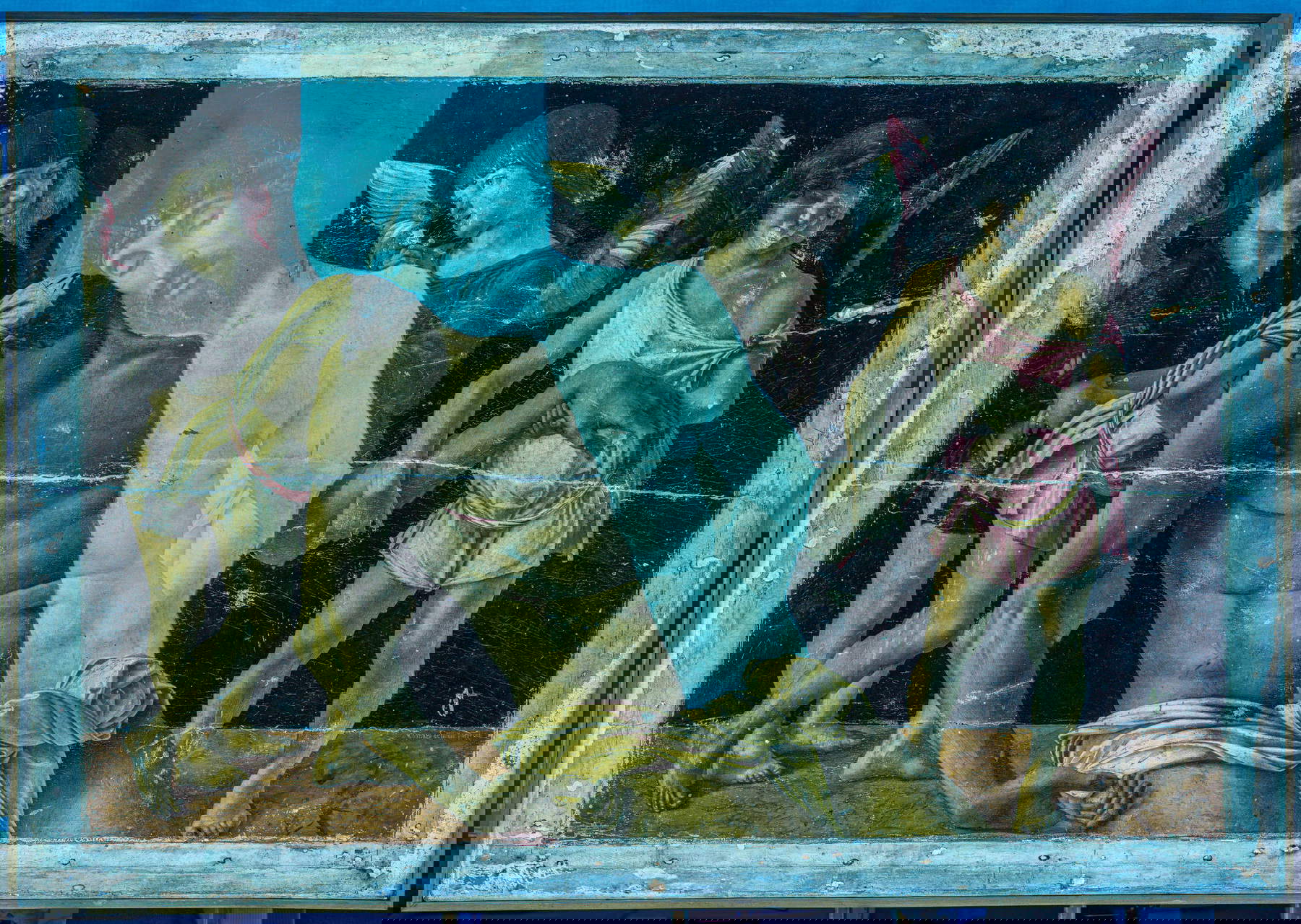
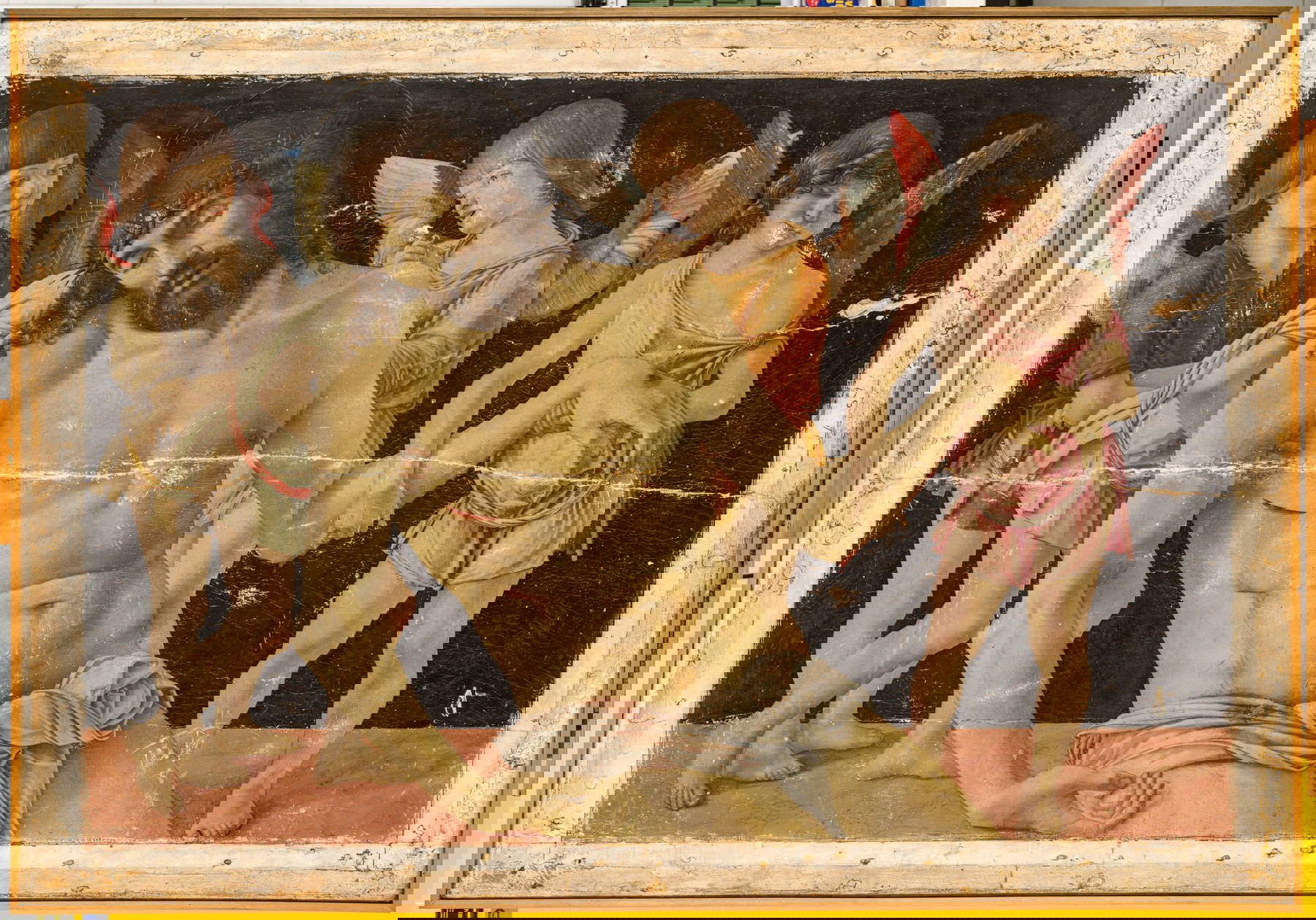
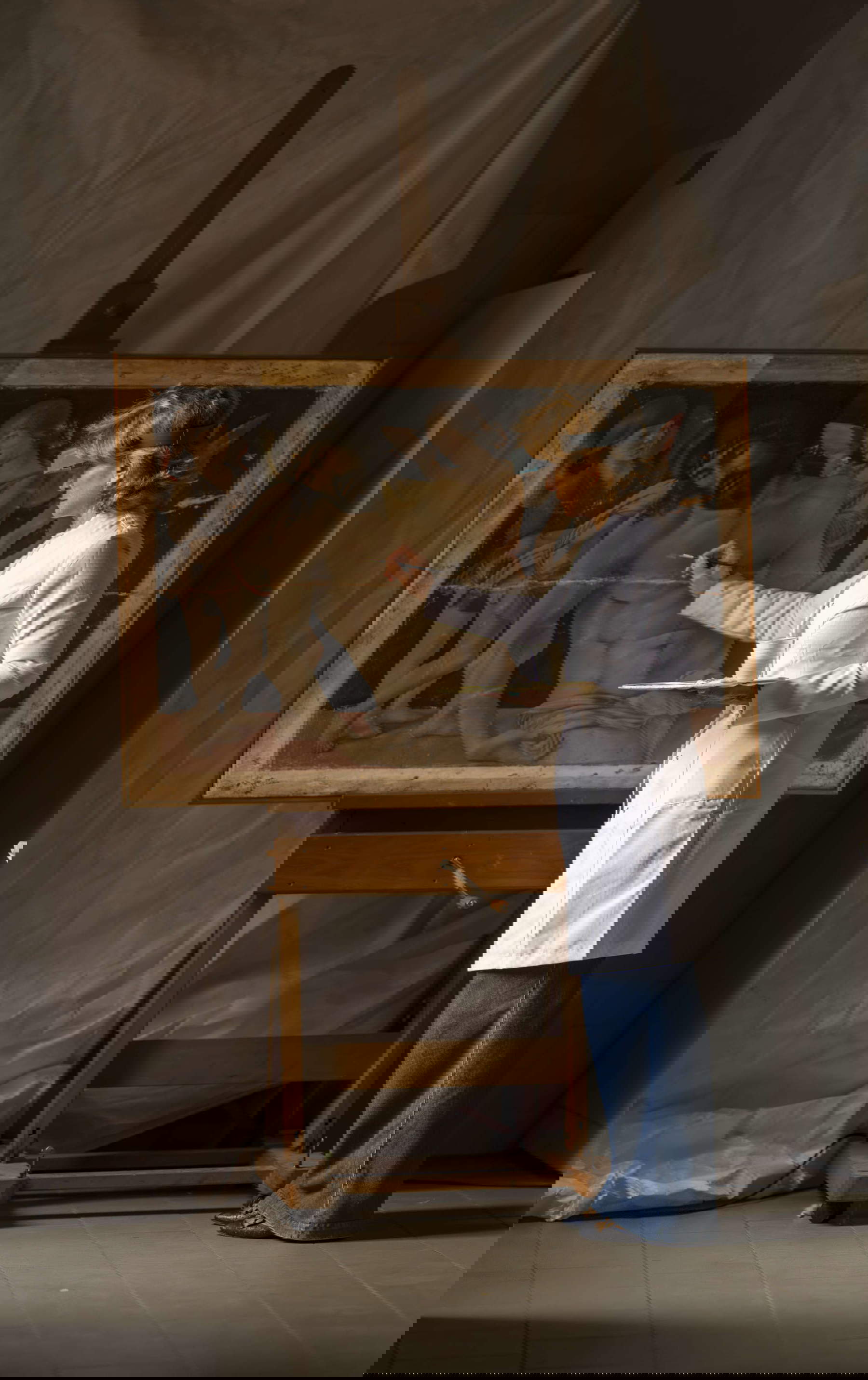
The painting is marked by a very complex conservation history. Fundamental was the 1969 intervention conducted by Otello Caprara and Ottorino Nonfarmale, which entailed the removal of the original wooden support severely compromised by woodworm and a “Florentine-style” parchettatura applied in 1930, which was responsible for an aggravation of the deterioration. The pictorial surface was then transferred to a new aluminum lattice support. The most recent restoration, carried out by Lucia Tito of the CBC firm in the Ca’ d’Oro workshops and supported by Venetian Heritage, focused on cleaning and aesthetic revision, verifying the full stability of the modern support. Ancient invasive repainting and a heavily yellowed varnish that altered the original chromatic perception were removed. The reinstatement of the central crack and the correction of a misinterpretation of an angel’s gesture, initially thought to be intent on grasping a nail, restored iconographic clarity to the work. Preliminary scientific investigations have also confirmed the consistency of Bellini’s palette and documented the presence of the preparatory brush drawing, recovering legibility and balance to a painting of the highest value.
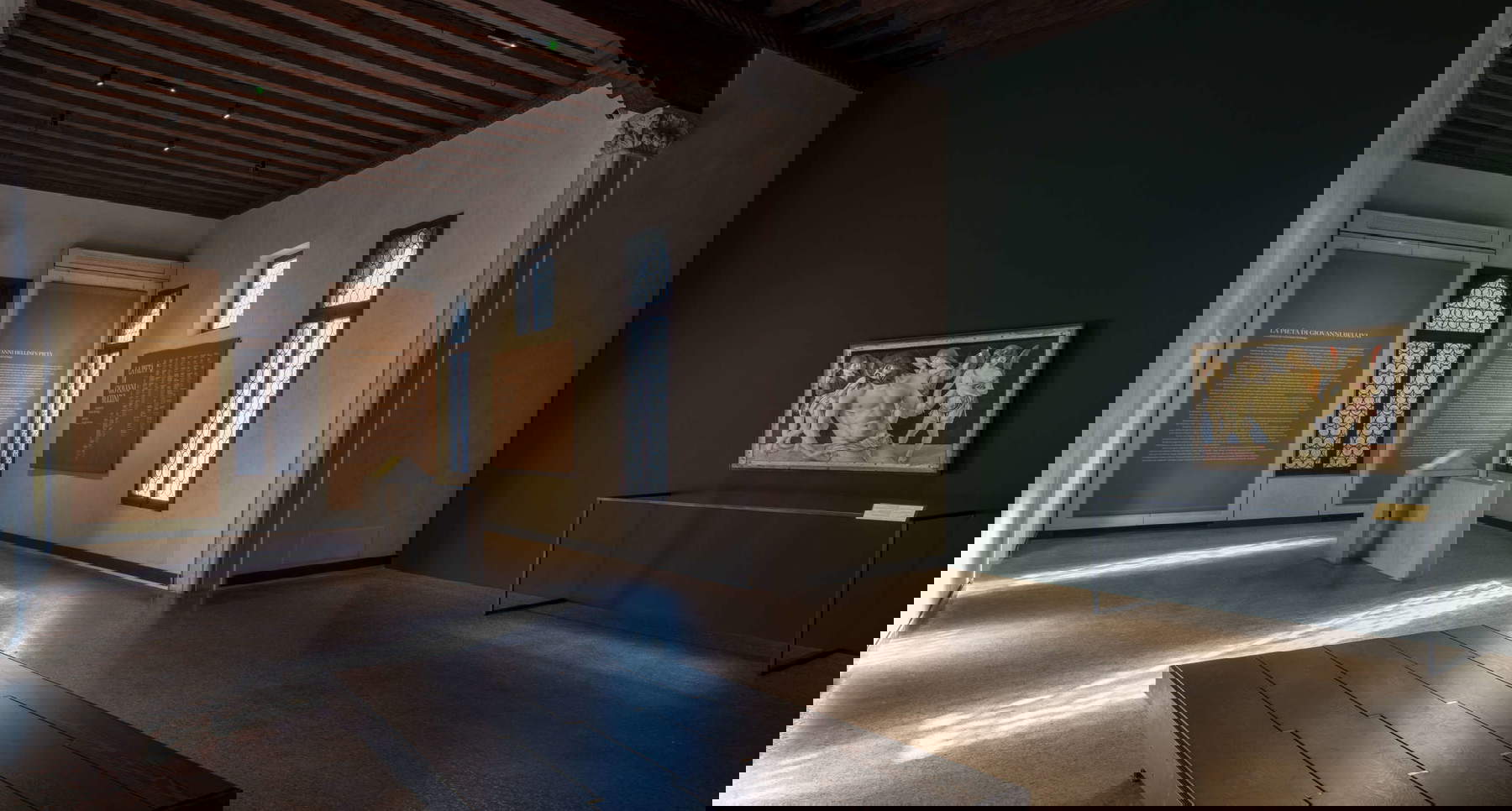
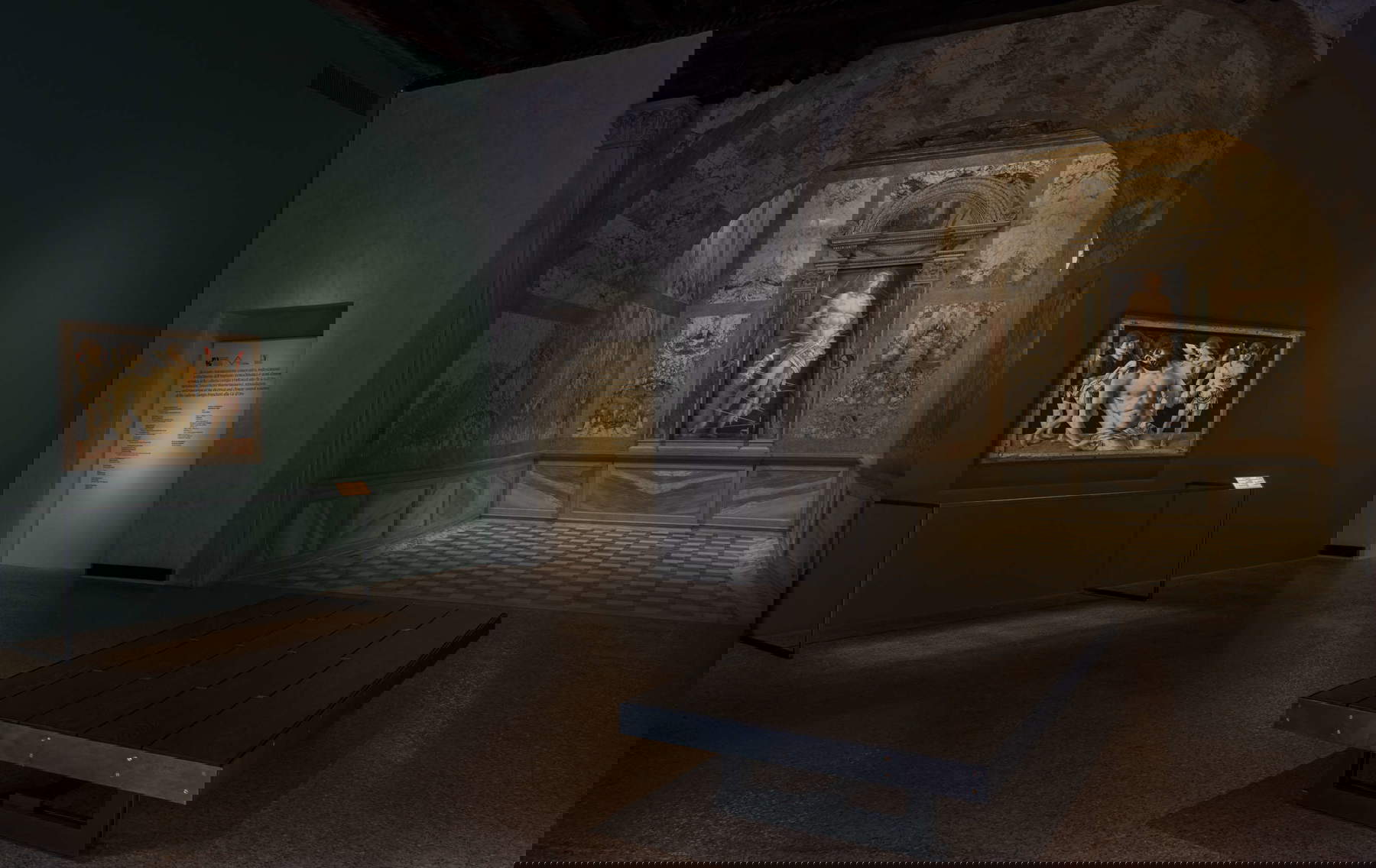
The dossier exhibition at the Ca’ d’Oro thus becomes an opportunity for a close comparison between two pinnacles of Renaissance art and an analysis of the relationships that united their respective cultural experiences. Shared influences, from the lessons of Piero della Francesca to the fundamental presence of Donatello in Padua between 1443 and 1453, emerge in the dialogue between the two works. The family relationship that bound the two artists through Mantegna’s marriage to Nicolosia, Bellini’s sister, offers an additional element of reflection. The installation includes a darkened environment with precise light inserts that will bring out the Pieta and, next to it, the restored chapel where the San Sebastiano is displayed, so as to amplify the expressive power of the two works.
From January to April 2026 the exhibition will land at the Morgan Library & Museum in New York, where the Pieta will be placed in the West Room, Pierpont Morgan’s former private studio. Here it will dialogue with sculptures by Antonio Rossellino, paintings by Perugino, Francesco Francia, and Cima da Conegliano, as well as works by Nordic masters such as Hans Memling, whose influence profoundly marked 15th-century Italian painting. The comparison of the Franchetti and Morgan collections underscores an ideal thread related to the protection of the Renaissance artistic legacy.
During 2026, the Pietà will return to Rimini, where it will find Mantegna’s San Sebastiano, allowing for a further opportunity to learn more about the cultural exchanges that united Venice and the Adriatic area. The return will take place as the Ca’ d’Oro faces the final phase of restoration and refitting work, a massive project launched in 2023 and financed by Venetian Heritage together with the Giulio and Giovanna Sacchetti Foundation, for a total investment of eight and a half million euros. Work on plasterwork, wooden ceilings, marble apparatus, Venetian floors and technological systems affected the first piano nobile, while a total closure of the museum is now essential for work on the second floor and the new entrance staircase.
Statements
“This exceptional restoration work pursues the objectives of the Venetian Heritage Foundation, which since 1999 has been financing, coordinating and promoting important restoration projects, exhibitions and publications dedicated to Venetian art not only in Venice, but also in its ancient territories,” says Toto Bergamo Rossi, director of the Venetian Heritage Foundation. “The Pietà was commissioned from Giovanni Bellini by a Rimini notable even though the master most likely never visited Rimini. This testifies to the importance and fame of Venetian painting during the second half of the 15th century, which was exported well beyond the borders of the Serenissima.”
“The cultural operation realized thanks to the prestigious synergy with the Venetian Heritage Foundation is of great significance for our City for more than one reason,” says Rimini Mayor Jamil Sadegholvaad. “In addition to the objective value of the restoration work that now allows, thanks to the skill and expertise of the experts, the rediscovery of one of the masterpieces that our Museum is privileged to preserve, this ’journey of the Bellini’ is for Rimini the sign of a renewed awareness of how art and culture can be an engine of growth and a foundation for the future of a community. Landing then in New York, a cosmopolitan metropolis that is a symbol of infinite possibilities, gives us the opportunity to boost this narrative and nurture this vision.”
“The restoration of Giovanni Bellini’s Pieta and the dossier exhibition,” says Daniele Ferrara, director of the Regional Directorate of National Museums Veneto, “are an opportunity to enhance the virtuous collaboration between public and private entities, fitting into the larger project of renovating the Giorgio Franchetti Gallery at Ca’ d’Oro, which the Ministry of Culture is carrying out with the support of Venetian Heritage. The exhibition initiative is part of a broader operation of collaboration between the Veneto National Museums Regional Directorate and Rimini Musei, aimed at studying the historical, cultural and artistic relations between Venice and Rimini in the Renaissance.”
“This operation,” adds Claudia Cremonini, director of the Giorgio Franchetti Gallery at Ca’ d’Oro, “is also a concrete sign of the reactivation of the restoration laboratory at Ca’ d’Oro, which was created after the 1966 flood and is now being reorganized at the same time as the museum’s renovation.”
 |
| Bellini's Pietà finally restored returns to Venice after 70 years, in dialogue with Mantegna |
Warning: the translation into English of the original Italian article was created using automatic tools. We undertake to review all articles, but we do not guarantee the total absence of inaccuracies in the translation due to the program. You can find the original by clicking on the ITA button. If you find any mistake,please contact us.