





In recent days, in Aquileia, not far from the forum, in the garden of the former police barracks on Leicht Street, which recently became part of the Aquileia Foundation’s patrimony, the mosaic of the “flower carpet” came back to light during preliminary operations for the renovation of the building. It is one of the finest examples ofAquileian mosaic art. The mosaic had been discovered more than sixty years ago, between 1962 and 1963, during archaeological investigations conducted by the Superintendency under the direction of Luisa Bertacchi, during the construction of the Carabinieri barracks. The importance of the find made it necessary to change the initial plan, which called for the construction of the building right at the intersection of Via Leicht and Via Gemina, by setting its location back. The mosaic floor, extending for about 76 square meters (10.10 x 7.60 m), has in its center a panel decorated with a refined floral composition made of polychrome tesserae, from which it derives the name “flower carpet,” assigned to it by Bertacchi herself, who dated it at first to the beginning of the second century AD. When the investigations were completed, the mosaic was buried again to ensure its preservation; the recent rediscovery confirmed that the mosaic floor was in perfect condition.
The building will be converted into a 24-bed campus-forester for students, faculty and scholars engaged in excavation and research activities at the archaeological site of Aquileia. At the same time as the project to rehabilitate the former barracks, work on which will begin shortly, the Foundation is also drawing up a plan to protect and cover the mosaic, in close synergy with the Friuli Venezia Giulia Archaeology, Fine Arts and Landscape Superintendency. Visitors will soon be able to admire the magnificent mosaic surface.

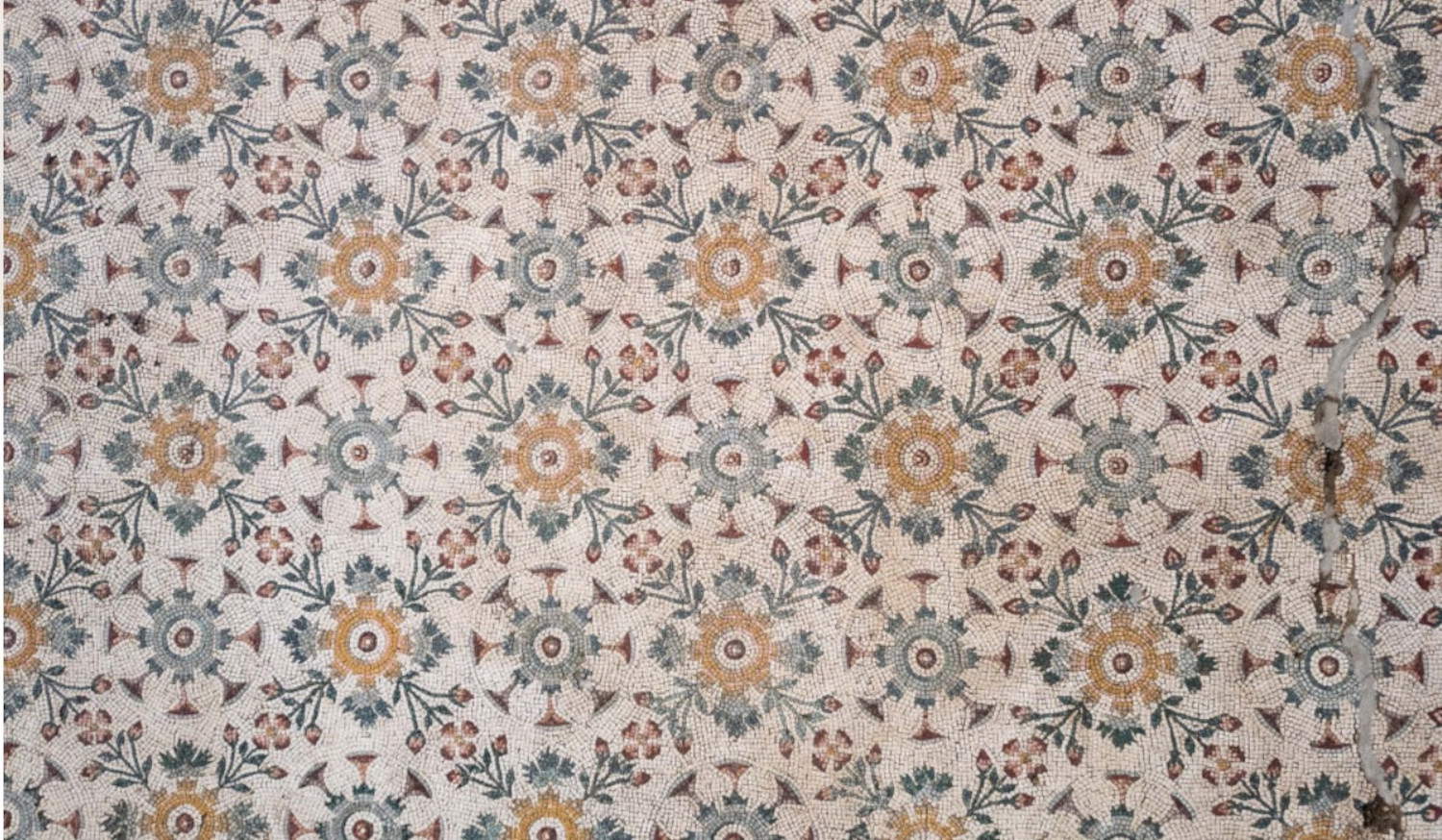
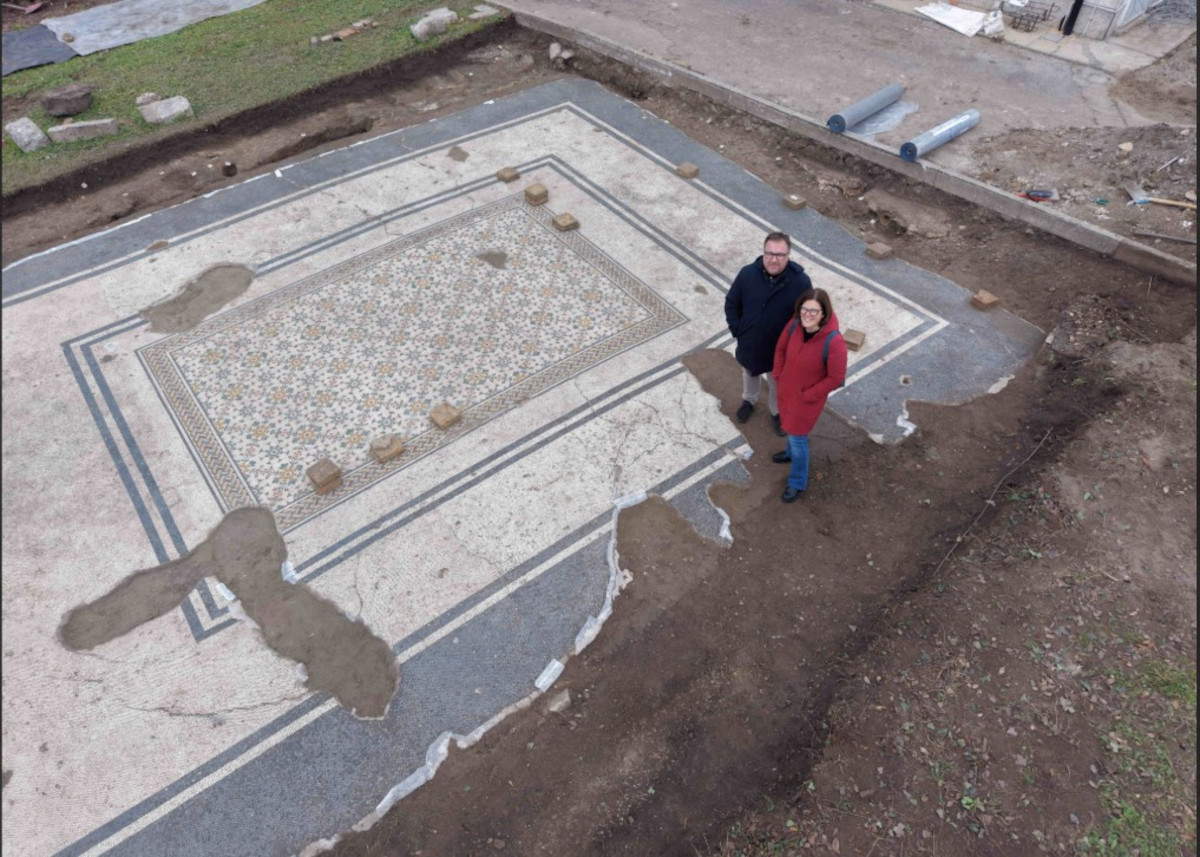
“It was an extraordinary thrill to see this spectacular mosaic come to light again,” said Aquileia Foundation President Roberto Corciulo. “The subsoil of Aquileia really never ceases to amaze, continually returning to us precious fragments of the great Roman city. We have therefore decided to immediately undertake the design of the roof, according to a modular, flexible and sustainable system, already agreed with the Superintendence, whom we thank for their always fruitful collaboration, within the framework of the Strategic Plan approved by the Foundation’s Board of Directors last year. The construction site will proceed hand in hand with the renovation of the former barracks and its transformation into a campus, a project we care a great deal about because it will allow us to accommodate students and faculty from universities who collaborate with us on excavations in the archaeological areas under our management and carry out work of the highest cultural profile. The spaces of the former barracks will, of course, also be available to scholars who are involved in enhancing the history, art, and architecture of our city. The mosaic of the ”flower carpet“ will undoubtedly be an unfailing point of interest for visitors along the route from the forum to the river port.”
“The combination campus-mosaic of the ”flower carpet“ will represent an added value for Aquileia, both in the perspective of the infrastructuring of the archaeological site with the recovery of a now disused building and for the enhancement of one of the most original and refined mosaics of the ancient center,” said Aquileia Foundation Director Cristiano Tiussi. “The removal of the interro, carried out by archaeologists Massimo Calosi and Massimo Fumolo under the direction of the Superintendency, has returned to us a mosaic surface in excellent condition, although 62 years have passed since its discovery. It may seem unbelievable to us, but this mosaic was at some point covered, and thus protected, by a new floor surface, perhaps a simple wooden plank, supported by the pillars that can still be seen resting on the tiles. It will now be important to reunite this extraordinary artifact with the adjacent archaeological area of the Cassis funds and the domus ”of the dancing putti,“ and, for this reason, the small fence wall that now exists between the former barracks and the area being excavated by the University of Trieste will be demolished. This will make it possible to verify whether we are dealing with a single, large residence belonging to a wealthy Aquileian from the 4th century. In the investigations made in these days for the first time, we have been able to ascertain the very high proportion of the ”flower carpet“ mosaic, which seems more compatible with its dating to the 4th century, as Prof. Fontana, late director of the excavation on the Cassis funds, had guessed.”
The official of the Soprintendenza Archeologia belle arti e paesaggio for FVG Serena Di Tonto added: “The Soprintendenza shares the extraordinary excitement of seeing this spectacular mosaic, a testimony of exceptional historical and artistic value, return to light. Despite the long time that has passed, the mosaic has re-emerged in good condition and will undergo restoration and consolidation work by the AreCON company, under the supervision of Micol Siboni, restorer for the Superintendency. At the moment it has been necessary to re-cover the mosaic to ensure its best preservation during the winter season, but as soon as milder weather conditions allow, the planned interventions will be carried out and the artifact will be enhanced directly in the place where it was found.”
The official in charge of the Soprintendenza Archeologia belle arti e paesaggio for FVG, Roberto Micheli, said, “It is only right to remember the work of Luisa Bertacchi, then director of the National Archaeological Museum, whose investigations in the 1960s brought to light the mosaic of the ”flower carpet“ and imposed the setback of the Carabinieri barracks to ensure its preservation. It was she who had the far-sighted intuition to carry out exploratory trenches in the adjacent Cassis bottom, demonstrating the presence of important archaeological remains. This action actually made it possible to block an already planned residential subdivision, thanks in part to the intervention of Franco Marinotti, president of Snia Viscosa and of the National Association for Aquileia, who anticipated the funds necessary for the state to purchase the land. If today we can admire these splendid artifacts and can return them to the community of Aquileia, we owe it to his fundamental protective action.”
|
| Aquileia, flower carpet mosaic resurfaces after more than 60 years |

Warning: the translation into English of the original Italian article was created using automatic tools. We undertake to review all articles, but we do not guarantee the total absence of inaccuracies in the translation due to the program. You can find the original by clicking on the ITA button. If you find any mistake,please contact us.
























 IT
IT FR
FR DE
DE ES
ES CN
CN


