





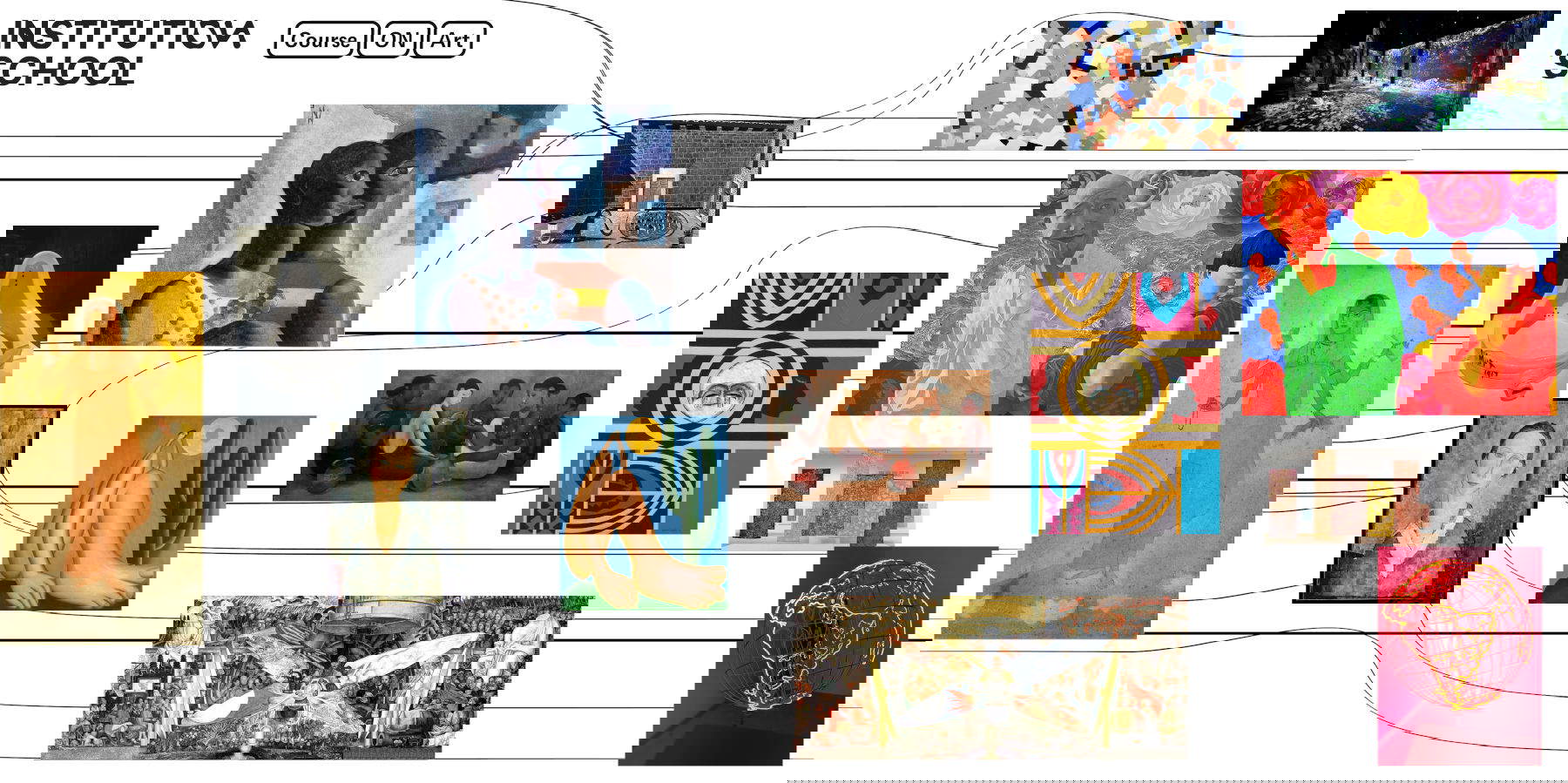
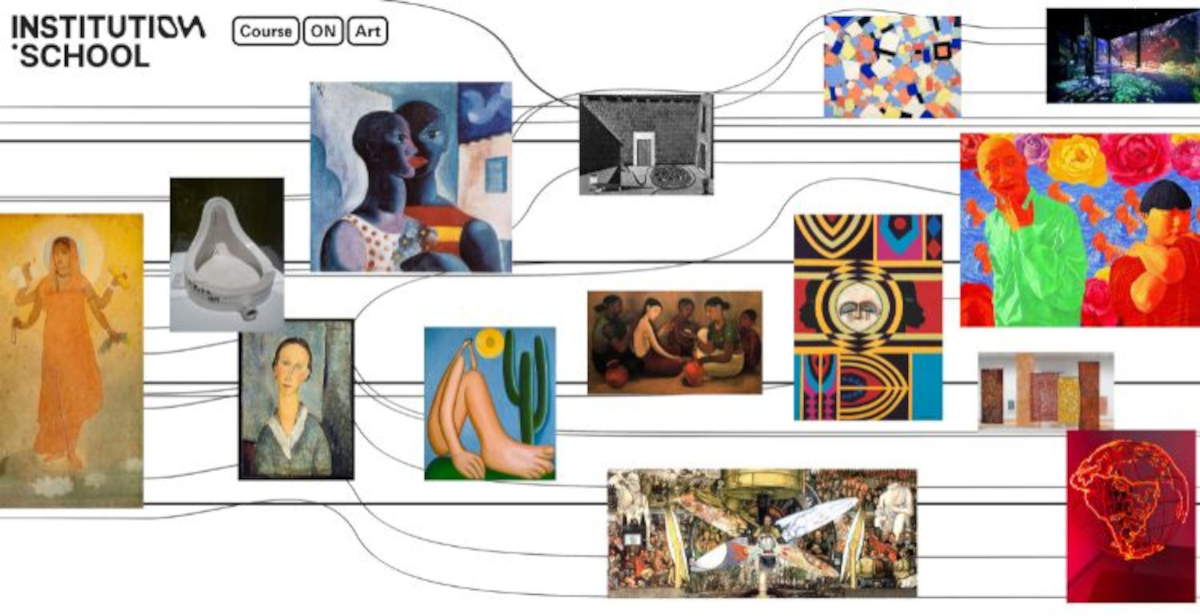
From January 17 to April 22, 2026,History of Decolonized Art: Global Narratives from 1900 to the Present, a 12-week online course organized by Institution School, will kick off. Designed for art professionals, curators, students and enthusiasts, the course offers a critical and global analysis of modern and contemporary art history, addressing the artistic narratives of the 20th century up to major contemporary trends. With a total of 24 lectures, the course will run live on Zoom twice a week, on Wednesdays at 6 p.m. CET and Saturdays at 3 p.m. CET, with recordings available for three months with subtitles in multiple languages.
The program is distinguished by its decolonial approach, which avoids a Eurocentric, linear view of art history. Lectures analyze the European avant-gardes and the construction of the modern canon, from Futurism to Dadaism and Surrealism, and explore their interactions with international movements and artists. The Bengal School and Santiniketan modernism in South Asia, the New Negro Movement and the cultural renaissance of the black diaspora, to the art scenes of EastAsia are studied to understand how local traditions were intertwined with global influences.
The course continues by examiningpost-World War II art, a period marked by political and social tensions and intense creativity. Latin American muralism, Brazilian Concretism, the Khartoum School in Sudan, and Eastern European neo-avant-gardes are analyzed to understand how artists reacted to censorship, repression, and social change. The 1960s and 1980s are read as a period when art and activism intersected: Fluxus, Conceptual Art, and feminist art challenged established Western institutions, while in Latin America Neoconcretism and Tucumán Arde developed participatory forms to confront political domination. In the unofficial scenes of Eastern Europe, figures such as Tadeusz Kantor and Sanja Iveković made subversive performances, while in Africa and Asia movements such as the Sudanese Modernists or the Minjung collectives in Korea addressed issues of postcolonial identity and social justice.
In the last decades of the 20th century, the focus shifts to globalization and new artistic practices. Relational aesthetics and participatory practices in Europe and the United States are examined, as is the focus on memory and archives in European post-socialist contexts. The post-independence period in Africa and democratic transitions in Latin America have stimulated works related to history and cultural identity, while in East Asia movements such as Political Pop and Superflat have created hybridizations between local traditions and global culture. Indigenous Pacific art is presented as an example of practices rooted in ancestral knowledge and traditional cosmologies.
The final module examines more recent trends, showing how artistic experimentation is linked to technology, ecology and the use of innovative materials. Digital and artificial intelligence-based projects engage with history, materiality and local knowledge, offering new perspectives on the relationship between art and the contemporary world. The goal of the course is to provide a broad and multifaceted view of global art, showing how conflicts, cultural interchanges and experimentation have shaped international art production. Institution School, organizer of the course, is an international startup operating in arts and cultural education, offering courses ranging from contemporary art to design and music. The training offering is designed for both a broad audience and professionals in the field, with the aim of providing concrete tools to navigate the art world and develop specific skills.
Lectures in the course will be taught in English and will last two hours each, comprising 1 hour and 45 minutes of frontal lecture and 15 minutes of Q&A. Lecturers include Charles Esche, R. Siva Kumar, Samantha A. Noël, Eileen Legaspi-Ramirez, Christian Kravagna, Shukla Sawant, Nada Shabout, Natalia de la Rosa, Midori Yoshimoto, Barbara London, Beáta Hock, Raphael Chikukwa, Gaudêncio Fidelis, Morad Montazami, Viktor Misiano, Nicolas Bourriaud, Anda Rottenberg, Tandazani Dhlakama, Đỗ Tường Linh, Cecilia Fajardo-Hill, Pauline J. Yao, Caroline Vercoe, Junghyun Kim, and Ute Meta Bauer.
Aim: To analyze how Western historical avant-gardes shaped the modernist canon and contributed to the definition of the “Other,” comparing these practices with African American, Caribbean movements and South and East Asian artists.
Lecture 1: European avant-gardes and the construction of modern art
Date/Time: Saturday, Jan. 17, 3:00 p.m. CET
Lecturer: Charles Esche
Focus: Critique of the Western canon of modern art; dynamics of appropriation and exclusion; analysis of Cubism, Futurism, Expressionism, Constructivism and Surrealism; problematic interactions with non-European art; role of U.S. cultural hegemony; Soviet experiments.
Lecture 2: Art, anticolonial activism and the struggle for independence in South Asia
Date/Time: Wednesday, Jan. 21, 6 p.m. CET
Lecturer: R. Siva Kumar
Focus: Bengal School and Santiniketan; modernism rooted in local cultural tradition; key figures such as Abanindranath Tagore, Nandalal Bose, Amrita Sher-Gil; dialogue between visual arts, literature, philosophy, and pedagogy; cultural autonomy and resistance to colonial aesthetics.
Lecture 3: The New Negro Movement, cultural nationalism and modernism in the black diaspora
Date/Time: Saturday, Jan. 24, 3:00 p.m. CET
Lecturer: Samantha A. Noël
Focus: Harlem and Caribbean cultural nationalism; African American and Caribbean visual artists (Aaron Douglas, Archibald Motley, Pedro Figari, Wifredo Lam); diasporic identity formation; formalist innovation and the politics of belonging.
Lecture 4: Between birth and decline: the actions of artists in mid-twentieth-century East and Southeast Asia
Date/Time: Wednesday, Jan. 28, 6 p.m. CET
Lecturer: Eileen Legaspi Ramirez
Focus: Modernism in China, Japan, Vietnam, the Philippines and Singapore; hybridization of local and Western techniques; Nanyang School; social realism and local collectives; intersection of tradition and innovation.
Aim: To analyze how post-World War II art responded to decolonization, political autonomy, and global art scenarios.
Lecture 5: The construction of post-World War II modernism between Eurocentrism and decolonization
Date/Time: Saturday, January 31, 15:00 CET
Lecturer: Christian Kravagna
Focus: Abstract Expressionism and civil rights; postcolonial migration; confrontation between Afro-Asian artists and Western institutions; Norman Lewis, Rasheed Araeen, Frank Bowling, David Medalla.
Lecture 6: Institutions, associations and disconnections: art worlds in South Asia after 1947
Date/Time: Wednesday, Feb. 4, 6:00 p.m. CET
Lecturer: Shukla Sawant
Focus: Post-independence art groups (’43 Group, Bombay Progressive Artists’ Group, Madras Art Movement); social realism, modernist painting, calligraphy; biennials and experimental galleries.
Lecture 7: Spirituality, secularism and modernist visions in post-independence West Asian art.
Date/Time: Saturday, Feb. 7, 3:00 p.m. CET
Lecturer: Nada Shabout
Focus: Modernism in North Africa and the Middle East; horoufiya, modern calligraphy; artists such as Madiha Omar, Shakir Hassan Al Said, Baya Mahieddine; balance between local identity and global avant-garde.
Lecture 8: Latin American avant-gardes: hemispheric networks between wars and transatlantic dialogues
Date/Time: Wednesday, February 11, 6:00 pm CET
Lecturer: Natalia de la Rosa
Focus: Latin American avant-gardes and post-Mexican revolution; muralism, indigenismo, painting of the Río de la Plata; postwar art: surrealism, kineticism, Nuevo Realismo and Neofiguración.
Lecture 9: Transformations in East Asian art after 1945.
Date/Time: Saturday, Feb. 14, 3:00 p.m. CET
Lecturer: Midori Yoshimoto
Focus: Maoist China, Japanese Reportage, Gutai, Mono-ha, Dansaekhwa in South Korea; postwar modernism and conceptual and material experimentations.
Aim: To explore postmodern, decolonial and radical practices in Europe, the United States, Africa, the black diaspora, Latin America, the Middle East and the Soviet space.
Lecture 10: Expanded art, critique of institutions and postmodernism between Europe and the United States
Date/Time: Wednesday, Feb. 18, 6:00 p.m. CET
Lecturer: Barbara London
Focus: Fluxus, Conceptual Art, Land Art, Performance Art; institutional critique; video art; International Transavantgarde; postmodernism.
Lecture 11: Art beyond official doctrines in Central and Eastern Europe.
Date/Time: Saturday, Feb. 21, 3:00 p.m. CET
Lecturer: Beáta Hock
Focus: “Unofficial” practices; mail art, performance, actions and happenings; female protagonism; key artists: Tadeusz Kantor, IRWIN, Natalia LL, Orshi Drozdik, Victor Vasarely.
Lecture 12: Artistic revival and processes of decolonization in Africa and the black diaspora
Date/Time: Wednesday, Feb. 25, 6 p.m. CET
Lecturer: Raphael Chikukwa
Focus: Modern post-independence African art; World Festival of Black Arts; art education; practices of cultural emancipation; crisis of national art schools.
Lecture 13: Repression, resistance and spirituality in Latin America.
Date/Time: Saturday, Feb. 28, 3:00 p.m. CET
Lecturer: Gaudêncio Fidelis
Focus: Art during authoritarian regimes; Brazilian modernism, Neo-Concretism, political performance; VAN movements, Tucumán Arde, Las Arpilleras; strategies of resistance and collective memory.
Lecture 14: Modern (post)colonial Arab art: subjectification, independence and emancipation
Date/Time: Saturday, March 7, 15:00 CET
Lecturer: Morad Montazami
Focus: Abstractionism, symbolism and figuration as tools of autonomy; Saloua Raouda Choucair, Mohammed Chabâa, Ahmed Cherkaoui, Ramsès Younan; negotiation between tradition and international modernism.
Lecture 15: Art practices in Soviet and post-Soviet space.
Date/Time: Wednesday, March 11, 6:00 p.m. CET
Lecturer: Viktor Misiano
Focus: Nonconformist art; Lianozovo School; Sots Art, Russian Actionism; video and new media; contemporary social and political art (Pussy Riot, Pyotr Pavlensky).
Aim: To analyze contemporary art in a globalized context, valuing historically marginalized voices and new artistic poles.
Lecture 16: From mass culture to social practices between Europe and the United States at the turn of the century.
Date/Time: Saturday, March 14, 3:00 p.m. CET
Lecturer: Nicolas Bourriaud
Focus: Relational aesthetics; participatory and social art; archives, documentation and research; interventions in mass culture; globalization and cultural hybridity.
Lecture 17: Contested memories and contemporary languages in Central and Eastern Europe in the post-socialist transition (1989-2010)
Date/Time: Saturday, March 21, 3:00 p.m. CET
Lecturer: Anda Rottenberg
Focus: Redefining memory, ideology and identity; critical art and performance; artists: Zbigniew Libera, Mirosław Bałka, Ion Grigorescu, Jaan Toomik, Marina Naprushkina.
Lecture 18: Art and practices of subjectification in Africa in the post-independence period.
Date/Time: Wednesday, March 25, 18:00 CET
Lecturer: Tandazani Dhlakama
Focus: African art 1990-2010; Afro-feminism and black diaspora; art collectives and community practices; resistance, the everyday and globalization.
Lecture 19: Stories without footnotes: contemporary art in Southeast Asia
Date/Time: Saturday, March 28, 3:00 p.m. CET
Lecturer: Đỗ Tường Linh
Focus: Modern and contemporary art in South and Southeast Asia; censorship, state repression, cultural memory and globalization; post-colonial art development.
Lecture 20: Post-1980 Latin American art: intercultural, trans-theoretical, and politically situated
Date/Time: Saturday, April 4, 3:00 p.m. CET
Lecturer: Cecilia Fajardo-Hill
Focus: Artistic production in Latin America during crises and democratic transitions; response to the legacy of dictatorship, social inequalities, and colonial legacies; strategies of resistance, cultural reappropriation, and collective engagement; performative and corporeal practices addressing violence, trauma, gender oppression, and collective memory; analysis of political conceptualism and reworking of colonial, African, and indigenous aesthetics.
Lecture 21: Artistic transformations and global repositioning in East Asia.
Date/Time: Wednesday, April 8, 6:00 p.m. CET
Lecturer: Pauline J. Yao
Focus: Art production in Korea, China, and Japan from the 1980s to the 2000s; Minjung Art Movement and Dansaekhwa monochrome painting in Korea; New Wave ’85, Political Pop, and Cynical Realism in China; Superflat in Japan; contemporary art practices in response to political change, social transformation, and global cultural exchange; role of art in contexts of urbanization and postmodernity.
Lecture 22: Indigenous art and Pacific cosmologies.
Date/Time: Saturday, April 11, 3:00 p.m. CET
Lecturer: Caroline Vercoe
Focus: Art production in Australia and the Pacific; indigenous artists’ use of art to maintain connections to land, cosmologies and ancestral histories; storytelling, place-making and spiritual connection; performative and visual practices to address colonial history and contemporary geopolitics; transnational dialogues and negotiation between heritage, identity and global art networks.
Aim: To explore how contemporary art addresses ethical, ecological, and technological challenges, promoting cultural justice, decolonization, and new epistemologies, including digital art and artificial intelligence.
Lecture 23: Digital art, artificial intelligence and new ecologies
Date/Time: Saturday, April 18, 3:00 p.m. CET
Lecturer: Junghyun Kim
Focus: Contemporary art practices between technology, AI and ecological thinking; reflection on perception, identity and environment in a posthuman era; critique of extractivism, gender, race, politics and ecology; technological media, virtual environments, avatars and data-driven aesthetics; imagining sustainable futures and critiquing anthropocentric paradigms.
Lecture 24: Cultural justice and return to matter in contemporary art
Date/Time: Wednesday, April 22, 6 p.m. CET
Lecturer: Ute Meta Bauer
Focus: Artistic practices that negotiate historical legacies and socio-political structures; restitution and decolonization of cultural property; exploration of collective political and economic infrastructure; materiality, process and sensory experience; sculptural, textile, performance and pictorial art to articulate memory, collective identity, historical consciousness and material resistance.
Costs include a single lesson at 25 euros (18 euros for students under 26 and residents of low- and middle-income countries), while the full 24-lesson package is available at 350 euros with Early Bird promotion at 250 euros until Dec. 28. Reduced prices are also available for students and teachers. Registration is open on Eventbrite at the dedicated link.
 |
| Decolonized art history: off to a global online course, here's how to enroll |

Warning: the translation into English of the original Italian article was created using automatic tools. We undertake to review all articles, but we do not guarantee the total absence of inaccuracies in the translation due to the program. You can find the original by clicking on the ITA button. If you find any mistake,please contact us.



























 IT
IT FR
FR DE
DE ES
ES CN
CN


