





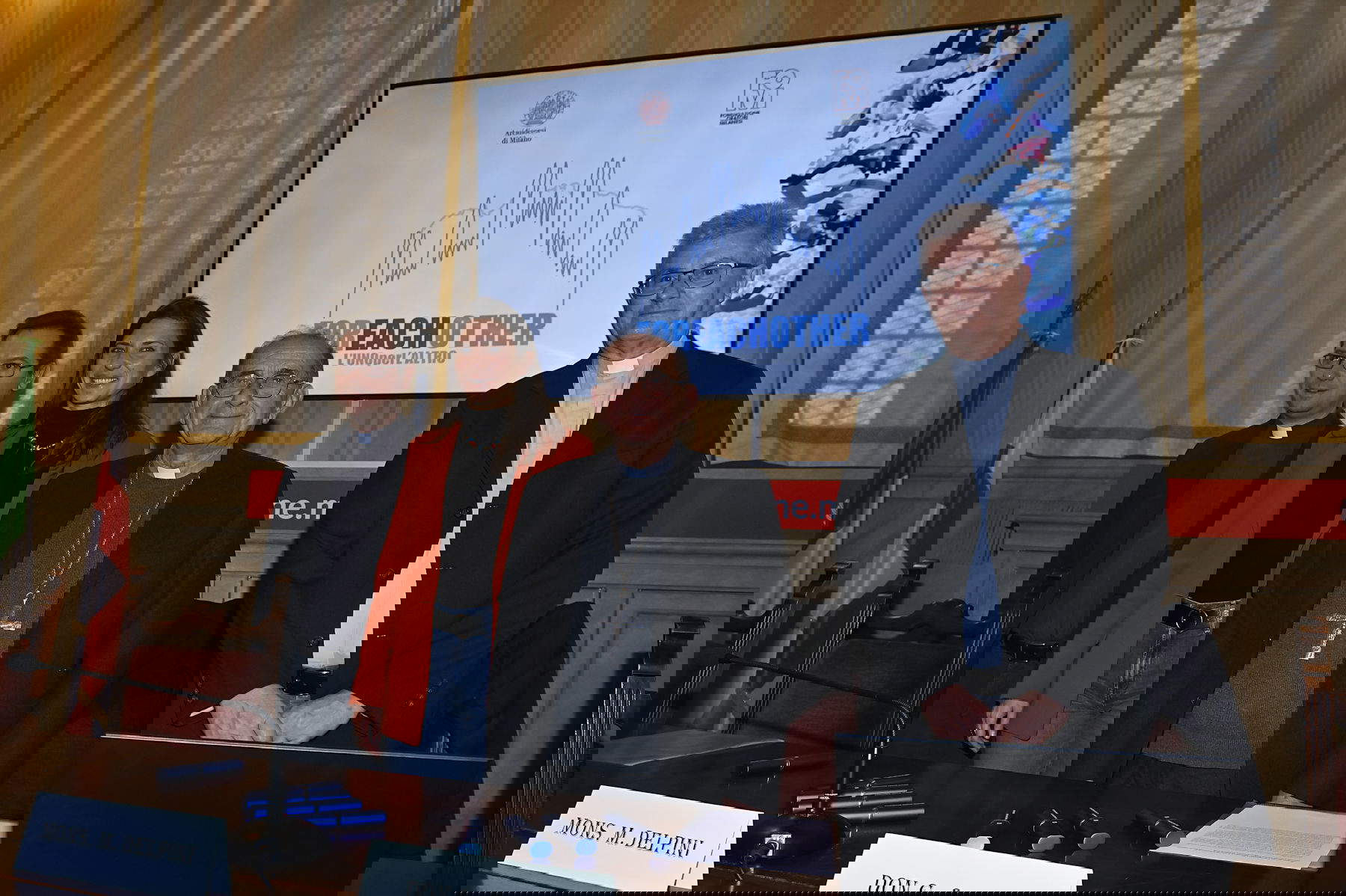
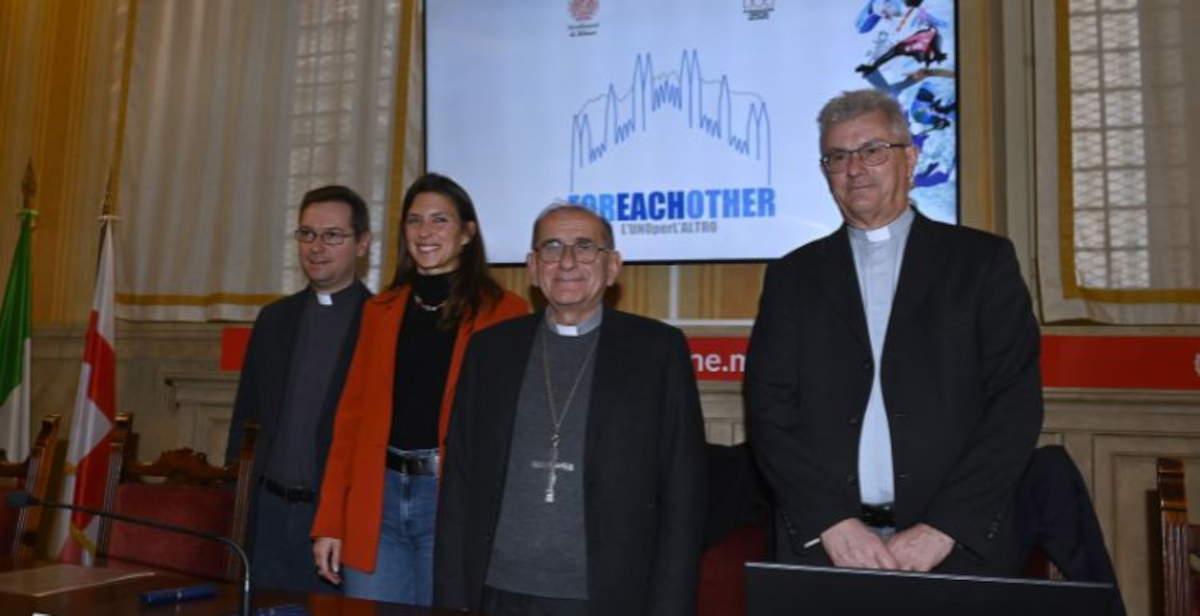
Milan is preparing to welcome the Milan-Cortina Winter Olympics and Paralympics with an extensive program of initiatives promoted by the Diocese of the Lombard capital. The project, titled For Each Other - L’uno per l’altro - was presented Wednesday, Jan. 23, at Palazzo Marino, with the sponsorship of the City Council and the Diocese, specifically through the Fondazione Oratori Milanesi (FOM) and the Servizio per l’Oratorio e lo Sport. The calendar includes dozens of events that will take place from January 29 to mid-March, and includes educational, cultural, sports and awareness-raising activities aimed at children, adolescents and adults.
During the press conference, after a greeting by Councillor for Sport, Tourism and Youth Policies Martina Riva, the main representatives of the initiative’s promoters and partners took the floor. Fr. Giuseppe Como, president of FOM and episcopal vicar for Education, Celebration of Faith and School Pastoral Care, and Fr. Stefano Guidi, director of the Foundation, explained the structure of the project. Speakers also included Erica Tossani, co-director of Caritas Ambrosiana; Fr Mauro Santoro, head of the diocesan Council for Christian Community and Disability; Massimo Achini, president of CSI Milan; and Fr Michele Gianola, undersecretary of the Italian Bishops’ Conference and acting director of the Office of Tourism and Sport. The archbishop of Milan, Monsignor Mario Delpini, concluded the presentation with a reflection on the educational and inclusive value of sport.
“The contribution that the Church intends to offer to the world of sports: not to deny the value of competition, but to orient it so that it is not dominated by an individualistic logic, but rather open to the dimension of the common good,” Cardinal José Tolentino de Mendonça stressed.
"For Each Other,“ stresses Councillor Riva, ”is a project that speaks deeply to our city and to the moment we are living. Milan Cortina 2026 is not just a great organizational or sporting challenge, but an educational and community opportunity: sport as a universal language capable of uniting, including, and creating bonds. This widespread calendar of initiatives, aimed especially at young people, reminds us that the Games leave a true legacy when they become shared experience, growth of people and attention to the last. As the Municipality of Milan, we are proud to support a path that focuses on the values of sport, solidarity and a sense of community."
“The Christian community feels part of the enthusiasm of our cities for the upcoming event,” says the Archbishop of Milan, Monsignor Delpini, “because it has a long tradition of integrating sports activity into the educational proposal. In church structures, sport is promoted as a practice that trains people to develop their skills, to weave team relationships built on respect, friendship, and the search for the best possible results, according to Olympic principles. The Christian community, however, feels the responsibility to be a critical voice and lucid denunciation of those degenerations that ruin sports in the idolatrous cult of success, money, exhibitionism, and exasperated competition. Will we win the Olympics and Paralympics? Yes, Milan will win, Cortina will win if everything that precedes, accompanies and follows the event confirms that sport is good for people and for society. It is the most difficult victory. It is the most necessary victory.”
As part of the project, 150 young volunteers between the ages of 20 and 25 will be involved in the activities, identified by a sweatshirt given to Monsignor Delpini and Councillor Riva themselves. The project also enjoys the patronage of the Vatican’s Dicastery for Culture and Education. At the center of the opening celebrations, on Jan. 29 at 6:30 p.m., the Basilica of San Babila will host the Mass with the Sportsmen’s Cross, a symbol delivered by Athletica Vaticana to all dioceses hosting the Olympics since 2012. The celebration will be presided over by Archbishop Delpini and concelebrated by Monsignor Paul Tighe, secretary of the Vatican Dicastery, and Fr. Gianola, with the reading of a prayer composed by the archbishop on the occasion of the Games.
The Basilica of San Babila will become a central point for the Games, assuming the role of “Church of the Sportsmen.” Sunday celebrations on Feb. 8 and 15 and March 15 will be multilingual, English, French, German and Italian, to facilitate the participation of international delegations and tourists in Milan. The church will also be the starting point of the Sports Values Tour, an educational route that will involve about 13,000 young people enrolled in schools, oratories and local sports clubs. The route will touch on St. Anthony’s Church and St. Euphemia Oratory, where three Values Villages dedicated to Excellence, Friendship and Respect, inspired by the principles of the Olympic Charter, will be set up.
In detail, St. Anthony’s Church will host the Excellence Village, with an exhibition created by high school students and meetings with athletes, former athletes and coaches. The Oratory of St. Euphemia will be home to the Friendship and Respect Villages, with sports activities by the CSI and educational workshops, while Caritas Ambrosiana will organize a workshop for adolescents and educators on Feb. 9 and 16 based on the board game Breaking the Rules, aimed at raising awareness of the risks of gambling.
The program also includes cultural and theatrical events. On Feb. 24, Citius, Altius, Fortius, a play sponsored by the John Paul II Foundation for Sport and the Italian Bishops’ Conference, will be staged at Collegio San Carlo. The play, intended for adolescents, deals with bullying and the pursuit of perfection, interweaving the ideals of Henri Didon, a Dominican friar mentored by Pierre de Coubertin, founder of the modern Olympic Games.
Special attention is given to interreligious dialogue, with events organized on Feb. 12 by the Regional Council for Interreligious Dialogue and on Feb. 17 at the Milano-Bicocca University, focusing on the theme The Meaning in Sport. During the Paralympics, the project includes inclusive activities: on Feb. 18 and March 11 in St. Anthony’s Church there will be a concert Come lievito nella pasta (Like yeast in dough); on March 11 there is an inclusive soccer experience at the Milano-Bicocca University and on March 14 an inclusive walk in Parco Sempione entitled O tutti o nessuno. There will be no shortage of artistic itineraries designed for visitors: from Saturday, Feb. 7 to Sunday, Feb. 22, and from Saturday, Feb. 7 to Sunday, March 15, young people trained by the Diocese will accompany citizens and tourists free of charge on the guided tours Le Vie della Bellezza, which pass through the main churches of the historic center: Basilica di San Babila, Basilica di Sant’Eustorgio, Basilica di San Lorenzo Maggiore and Church of Santa Maria presso San Satiro.
Among other initiatives, five online meetings by the “C.M. Martini” Pastoral Center of the Milano-Bicocca University will delve into the history of the Olympics, while sports competitions between inmates, prison police, magistrates and citizens will be held in the Bollate prison house. IULM University will host a screening of the film Il Maestro followed by a debate. Two traditional appointments of the Ambrosian Church will be included in the Games program: on February 14, the Assembly of Oratories and Sports Clubs will focus on the educational value of sports and will present guidelines for the educational commitment of young people; on February 21, the Ambrosian Carnival will take place with widespread initiatives in parishes and oratories, linked to the Olympic theme, under the title NOFROST - The Great Game We’ve Been Waiting For!. The For Each Other project enjoys the patronage of the Vatican Dicastery for Culture and Education, Athletica Vaticana and the City of Milan. Partners in the initiative include the CEI’s National Office for the Pastoral Care of Leisure, Tourism and Sport, Caritas Ambrosiana, the Youth and University Service, CSI Milan and the Diocesan Council “Christian Community and Disability.”
 |
| Milan, here is the diocese's cultural schedule for the Winter Olympics |

Warning: the translation into English of the original Italian article was created using automatic tools. We undertake to review all articles, but we do not guarantee the total absence of inaccuracies in the translation due to the program. You can find the original by clicking on the ITA button. If you find any mistake,please contact us.


















 IT
IT FR
FR DE
DE ES
ES CN
CN


