





From Dec. 13, 2025 to Jan. 6, 2026, the Sala delle Grasce at the “Luigi Russo” Cultural Center in Pietrasanta will host Doppia Essenza, an exhibition that brings into dialogue the research of Floriana Gerosa and Barbara Visciano, two artists united by a profound attention to matter as an active and generative element of the work. The exhibition project, curated by Jacopo Suggi, does not limit itself to presenting two distinct paths, but builds a close confrontation between different practices, sculpture and painting, which find common ground in the reflection on the dual nature of materials, understood as a place of tension between what offers itself to form and what, instead, resists.
The title of the exhibition recalls an original condition of matter, conceived not as a mere passive support, but as an entity endowed with its own will, memories and internal forces. In this sense, the form does not appear as an external imposition, but as the result of a process of listening and negotiation between the artist and the material. Double Essence is based on a more concrete and sobering observation: every material contains within itself a dual nature, that which reveals and that which holds back, that which allows itself to be shaped and that which resists.
It is in this intermediate space that the dialogue between Floriana Gerosa and Barbara Visciano takes place. Although the two artists move in different territories in terms of language, method and tradition, they share a common vision of matter as a living organism. In their practice, the material is never neutral or inert, but becomes an interlocutor that suggests, directs and sometimes determines the final outcome of the work. Form thus arises from an open process, never completely predetermined, in which the artist’s intention is intertwined with the unpredictable responses of the material itself.
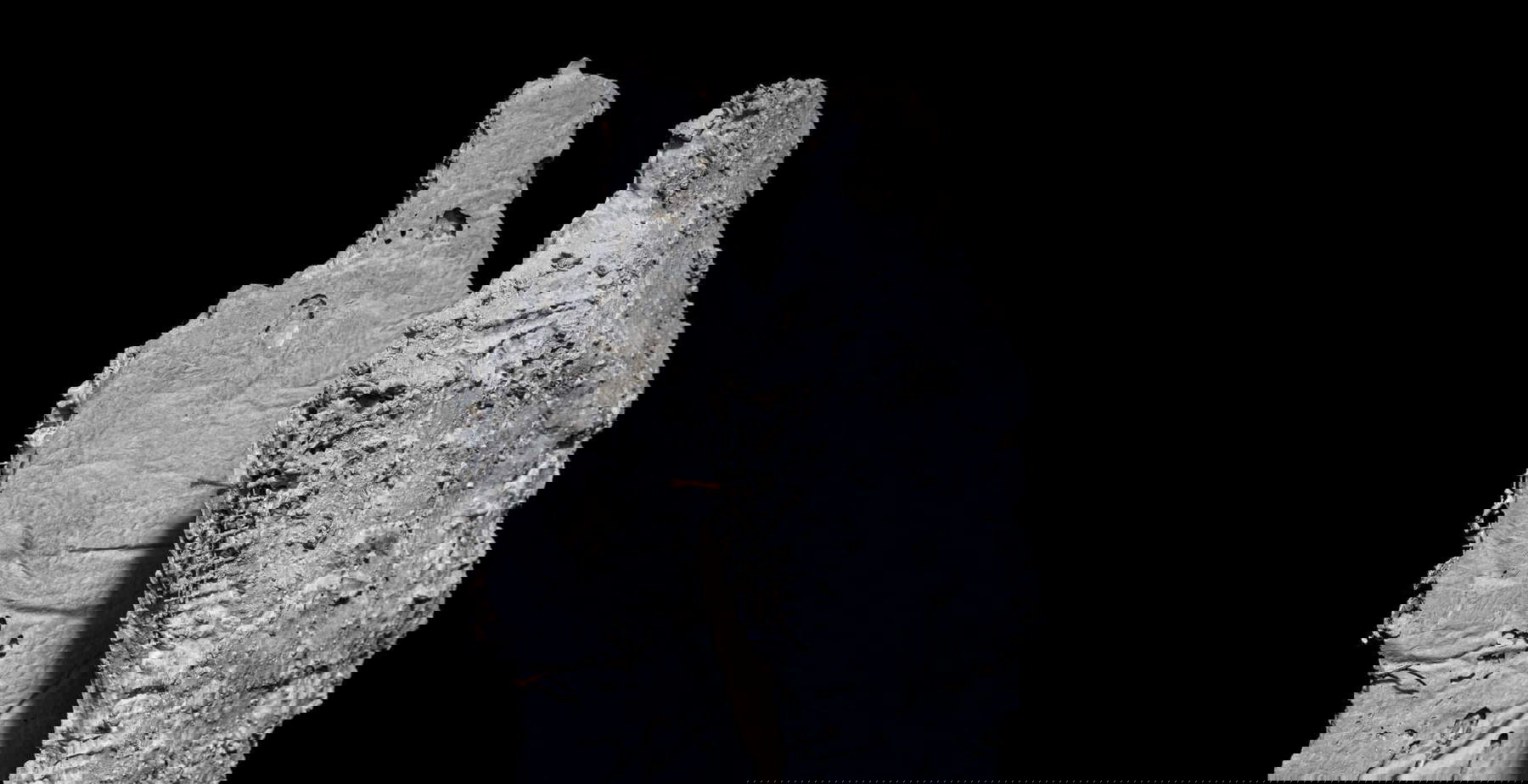
Floriana Gerosa’s sculptures seem to emerge from within the earth, like presences emerging from an ancient stratification. Her sculptural practice is based on a direct and physical relationship with terracotta, a material that the artist knows and experiments with in depth, mixing different earths to obtain specific plastic qualities and letting the firing phase, deliberately not rigidly controlled, introduce elements of randomness and transformation. Form, in this process, is never completely dominated, but is progressively extracted, sought and pursued, accepting the autonomous reactions of matter.
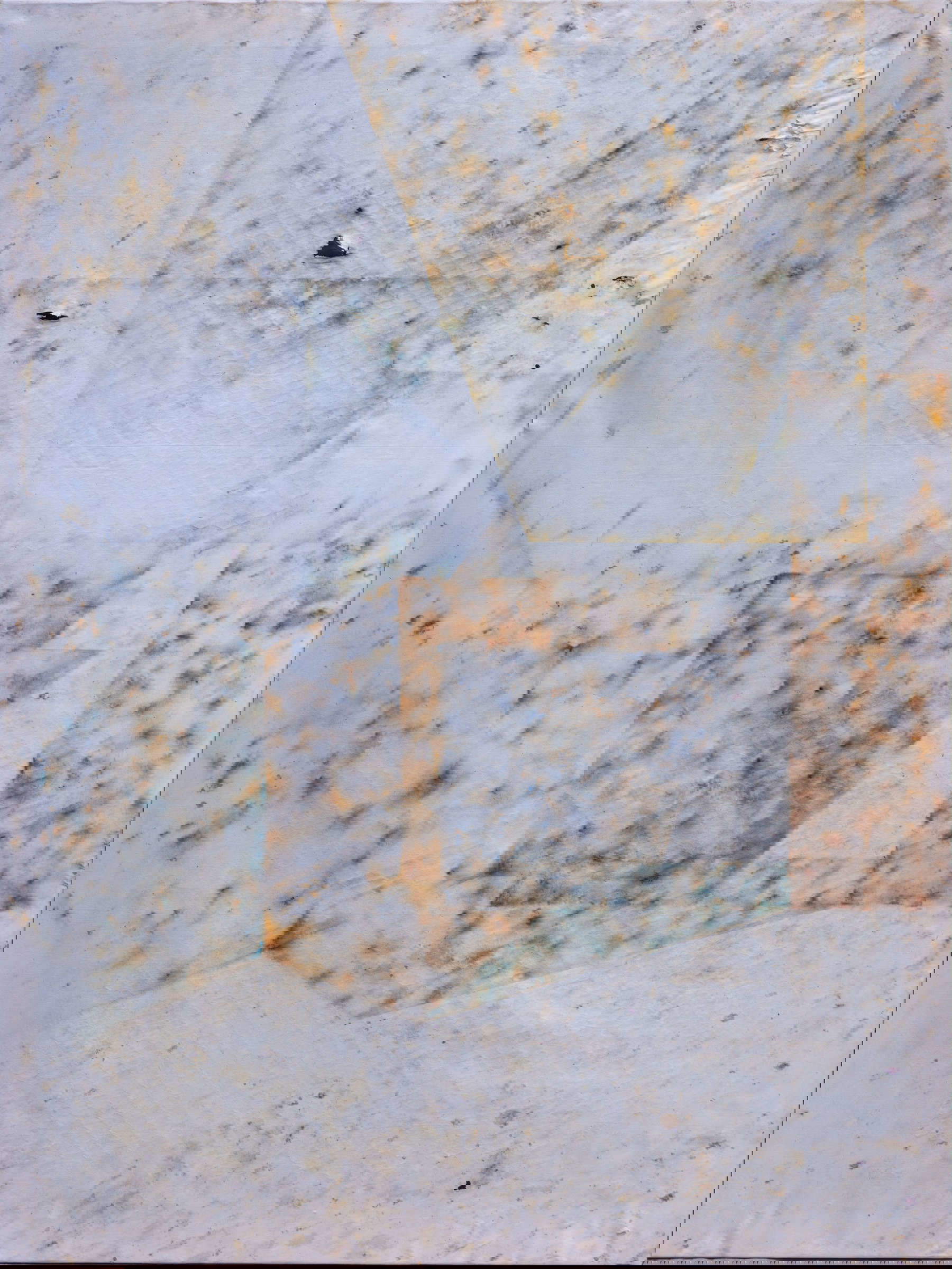
Barbara Visciano’s pictorial works, on the other hand, follow an opposite but complementary path. If in Gerosa’s sculptures the form seems to arise from within, in Visciano’s canvases it emerges on the surface as a trace of time and natural processes. His painting is not limited to the application of color, but incorporates organic elements, moisture, sedimentation and processes of decomposition and regeneration, entrusting the earth with an active role within the artistic procedure. In this way, the pictorial surface becomes the place where memories and transformations are deposited, a slow writing that records the passage of time.
From the encounter of these two attitudes comes the profound sense of “double essence,” understood not as conflict or contradiction, but as coexistence and balance. The exhibition stages a continuous cross-reference between gesture and waiting, between intervention and listening, between construction and sedimentation. The work is configured as a liminal space, the result of an ongoing negotiation between the artist’s goal and the will of the material, rather than as the outcome of a closed and a priori defined project.
The duality runs through the entire exhibition project, manifesting itself in the confrontation between Gerosa’s sculptural construction and Visciano’s patient layering, but also in the relationship between the sculptor’s calibrated gesture and the painter’s conscious waiting. If in Gerosa’s work the form is extracted from the material, in Visciano’s it seems to self-determine, emerging as a consequence of natural processes left to act over time. Despite their differences, both recognize the earth as a central reference, both as a plastic material and as an active agent of transformation.
Barbara Visciano, born in Livorno, initially pursued a course of study in computer science, later choosing to follow her artistic vocation. Trained at schools and painting studios, she developed a practice based on experimentation and a constant dialogue between personal sensitivity and perception of the world. After an initial phase related to figurative painting, centered on the human figure and the relationship between gesture and emotion, her research has gradually moved toward abstraction. The series of Quadri Indeterminati represents a key moment of this path, in which the artist’s intentionality is confronted with the unpredictability of materials and the environment, generating works suspended between form and vibration, between control and chance.
Floriana Gerosa, who was born in Milan and lives in Livorno, was educated in the humanities but soon turned to art studies. After a diploma in Advertising Graphics at the Cappiello Academy in Florence and professional experience in the field, she embarked on a decisive sculptural path starting in 1995, thanks to her meeting with sculptor Anselma Ferrari. With her she learned the techniques of terracotta modeling, developing a personal language that has been enriched over the years through further educational experiences in Carrara and Pietrasanta, as well as through the study of drawing and painting. Also active in writing and poetry, Gerosa has been a member of the Pietrasanta Sculptors Association ASART since 2011.
Double Essence thus fits into the cultural context of Pietrasanta as a project that reflects on contemporary art making, relating two distinct but converging paths in the awareness that the work always arises from a fragile balance between human will and the strength of matter. In this space of tension, between revelation and resistance, the exhibition invites the viewer to observe form not as a definitive result, but as the outcome of a living process in continuous transformation.
 |
| Double Essence, matter and form in the dialogue between Gerosa and Visciano in Pietrasanta |

Warning: the translation into English of the original Italian article was created using automatic tools. We undertake to review all articles, but we do not guarantee the total absence of inaccuracies in the translation due to the program. You can find the original by clicking on the ITA button. If you find any mistake,please contact us.




















 IT
IT FR
FR DE
DE ES
ES CN
CN


