




Twenty years after the death of Mimmo Rotella (Catanzaro, 1918 - Milan, 2006), the Palazzo Ducale in Genoa is dedicating a major retrospective to one of the most influential protagonists of 20th-century Italian and international art. The exhibition Mimmo Rotella. 1945-2005, curated by Alberto Fiz and realized in collaboration with the Fondazione Mimmo Rotella, will be open to the public from April 24 to Sept. 13, 2026, and will offer a broad rereading of the artist’s entire creative path, restoring its complexity, internal coherence and surprising topicality.
Staged in the spaces of the Ducal Palace, the exhibition traces more than sixty years of activity, from the first post-World War II experiments to the works of recent years, highlighting Rotella’s ability to intercept and radically interpret the transformations of the image society. Through more than one hundred works from international museums, foundations and public and private collections, the exhibition builds an articulated narrative that allows us to follow the evolution of a language capable of profoundly affecting the relationship between art, visual communication and consumption.
The exhibition path starts from the research of the 1940s and 1950s, when Rotella confronts abstraction and surrealist suggestions, experimenting with formal solutions that already reveal a tension toward overcoming the traditional boundaries of painting. It is in these years that a critical attitude toward image and matter is outlined, destined to find full expression in later developments.
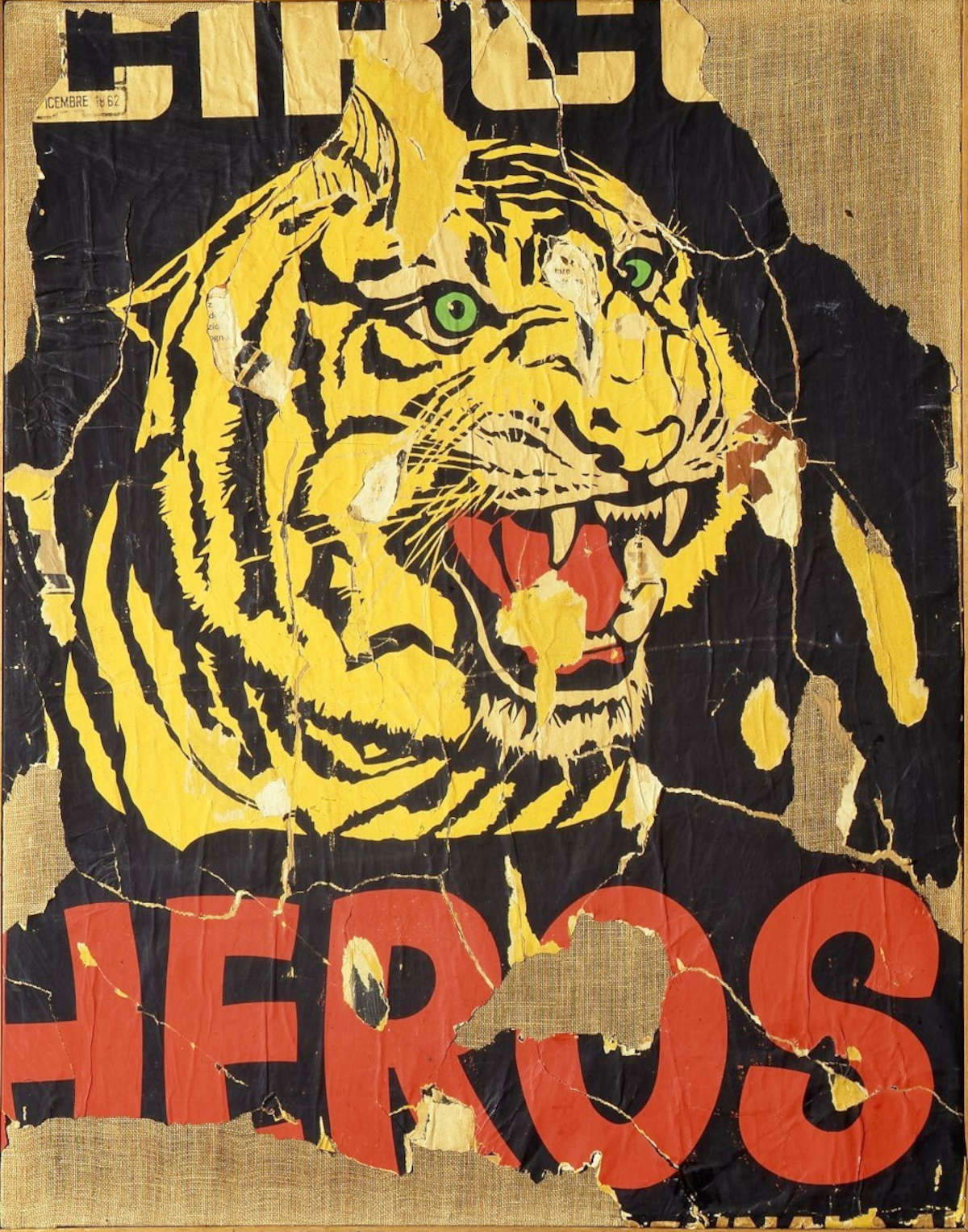
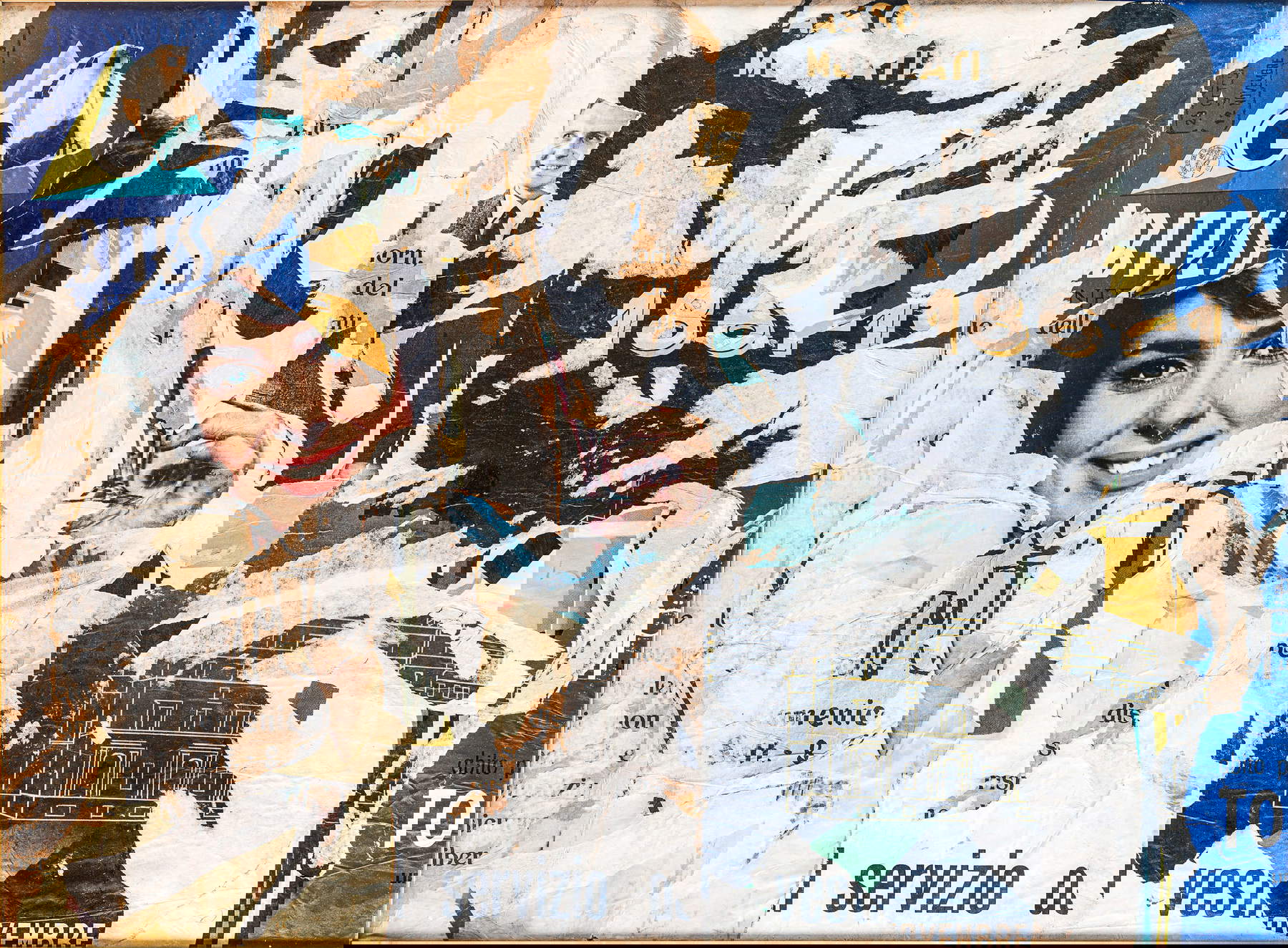
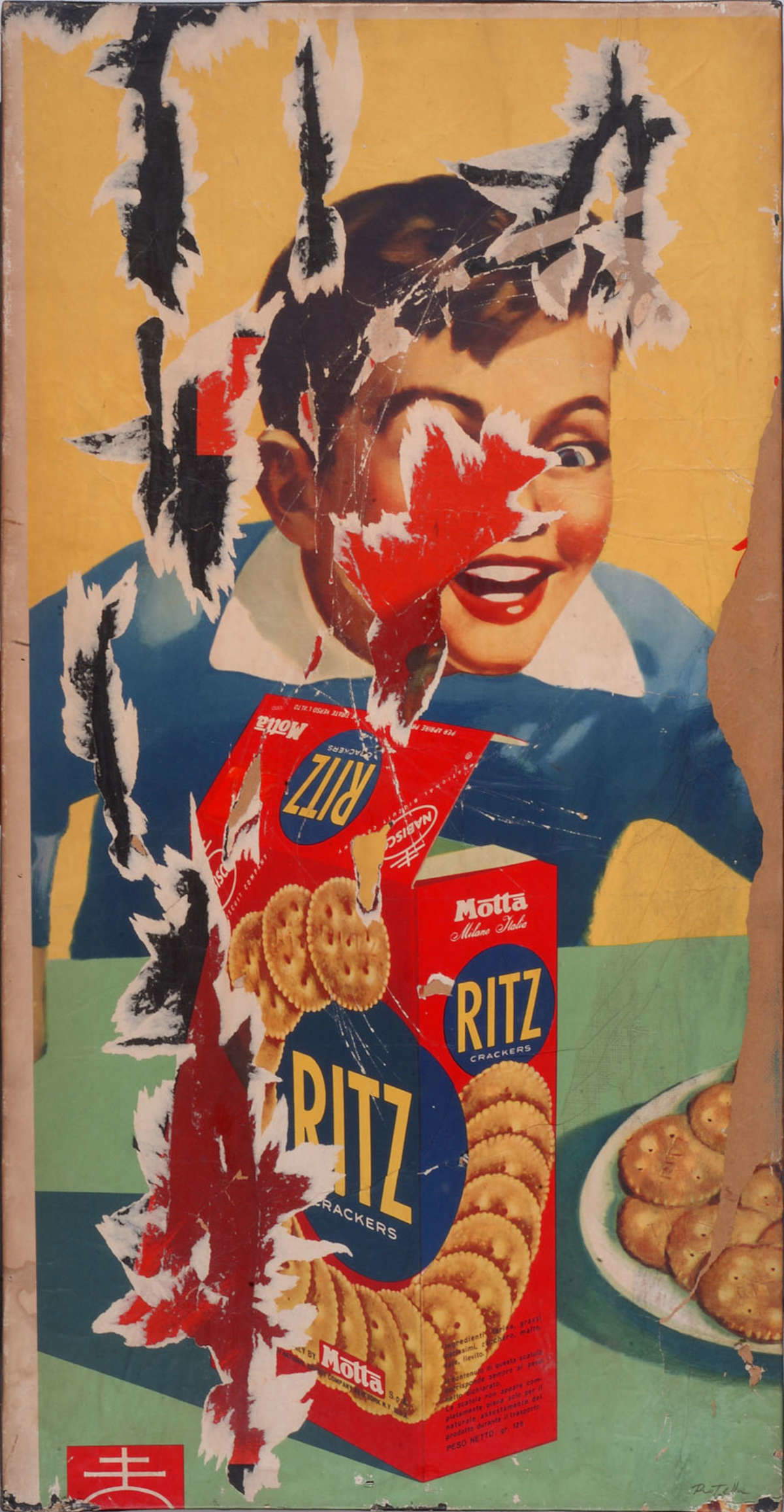
The heart of the exhibition is devoted to décollage, the gesture that more than any other made Rotella a central figure of the European avant-garde. The tearing of advertising posters taken from the street becomes an aesthetic and at the same time political act, an action capable of overturning the original meaning of the image and transforming what is destined for rapid consumption into artistic matter. As curator Alberto Fiz points out, “what is on the surface no longer matters, but the fragmentary and fragmented aspect of a real dimension destined to change under the complicit gaze of the observer.”
Through décollage, Rotella intercepts the birth of media society and unmasks its mechanisms, revealing the fragility and transitory nature of the images that populate it. Torn, overlapping posters consumed by time and human action become the site of a new aesthetic, in which disorder and stratification become tools of knowledge. In this sense, tearing is never a destructive gesture, but an act of revelation that lays bare the truth hidden behind the seductive veneer of visual communication.
The exhibition includes some of the artist’s most emblematic works, which mark the fundamental stages of his research. These include Naturalistic of 1953, a collage on canvas with mirrors and glass that testifies to the phase of material experimentation, The Tiger of 1962 and The Point and a Half of 1963, among the first direct interventions on the world of advertising, and Tenera è la notte of 1962. Special attention is given to works dedicated to Marilyn Monroe, the icon par excellence of the media imagination, whose image is reiterated, lacerated and transformed into a symbol of mass culture.
The path continues with a selection of works from the following years, which document Rotella’s constant ability to renew his language without ever giving up the coherence of his research. Prominent among the later works is a large untitled décollage on sheet metal from the 1990s, three meters long, which restores the monumentality and physical force of the gesture, and Attenti, the last large décollage made by the artist, extreme testimony to a practice that remained vital until the end.
Alongside décollage, the exhibition delves into the many experimental techniques developed by Rotella over the course of his career, from artypo to effaçage, frottage to emulsified canvases, photographic carry-overs to extroflexions. These investigations, far from being mere formal variations, reveal an abiding interest in matter, the fragment and the processes of image transformation, and confirm Rotella’s role as a lucid witness to the technological and media revolution of the twentieth century.


In the 1980s, this tension toward the beyond leads the artist to overpaintings, which stand in autonomous dialogue with the return to painting promoted by various European experiences, including the Transavanguardia. Even in this phase, Rotella maintains an independent position, capable of confronting the movements of the time without ever adhering to them programmatically. Likewise, his interest in graffiti art demonstrates a continuity with the attention to the street and urban languages that had already characterized his research in the 1960s, in parallel with the emergence of Pop Art.
The display in the medieval rooms of the Doge’s Palace is enriched by archival materials and audiovisual documents that help to render an articulate portrait of the artist and his context. These materials make it possible to closely follow the evolution of his research and to understand the constant dialogue between the work and the historical time in which it was produced, offering the public an in-depth and immersive key to understanding it.
Celebrating Mimmo Rotella 20 years after his death means once again questioning the role of images in contemporary society and their ability to influence collective perception. In an age dominated by social media and the incessant circulation of visual content, Rotella’s work continues to offer critical tools for reading reality, highlighting the fragility of memory, the power of the fragment and the possibility of transforming disorder into aesthetic form.
The exhibition is accompanied by a bilingual Italian and English catalog, which includes an extensive critical and iconographic apparatus and delves into the different moments of the artist’s career. The exhibition project is produced by the Palazzo Ducale Fondazione per la Cultura in collaboration with the Fondazione Mimmo Rotella, confirming the Genoese institution’s commitment to the valorization of the great figures of twentieth-century art and the critical reinterpretation of their legacy.
|
| Genoa, a major retrospective on Mimmo Rotella at Palazzo Ducale 20 years after his death |

Warning: the translation into English of the original Italian article was created using automatic tools. We undertake to review all articles, but we do not guarantee the total absence of inaccuracies in the translation due to the program. You can find the original by clicking on the ITA button. If you find any mistake,please contact us.

























 IT
IT FR
FR DE
DE ES
ES CN
CN


