





In today’s contemporary art world, especially the Italian one, where consensus has often replaced judgment and reputation has taken the place of value, the figure of Luca Rossi, an art collective active since 2009, continues to move like a foreign body and over time has become a critical tool that aims to cross and challenge all the roles of the art system: artist, curator, critic, viewer. A necessary strategy, according to Luca Rossi, to remain independent in a closed, self-referential context that is increasingly unwilling to confrontation. His practice stems from criticism, understood not as an academic exercise but as an operational tool, “the brush” with which to intervene on a system incapable of distinguishing quality, differences and responsibility. In this interview with Camilla Fumo, Luca Rossi wants to bring out clearly the fractures that run through the present: an anachronistic education, an increasingly managerial curatorial power, an art reduced to institutional decorum, an inclusive rhetoric that often masks the absence of content. At the center, however, the same issue always returns: the lack of a criticism capable of guiding, selecting and creating value. Without tools to differentiate, art falls flat, the best fall away, and the system continues to sustain its mistakes. All this is discussed in an interview that offers no reassuring solutions or shortcuts, but proposes a change of posture: recovering a critical vision as a formative, ethical and political act, capable of restoring to art its potential for risk, complexity and imagination.
CF. How would you tell the Luca Rossi project and the Documenta blog to people who don’t know you?
LR. Luca Rossi was born 16 years ago as a fictional character where all the roles of the art system converge. This was because already at that time it was evident that there was a lack of critical confrontation in the art world and a closed environment that created problems for art and artists. To be independent, it was necessary to play all the roles. Luca Rossi is the critic, the artist, the curator and also the viewer. The first tool we used was comments on Exibart, as a viewer critiquing an article; a simple tool within everyone’s reach. The critique became “the brush” of Luca Rossi. Initially many people thought that Luca Rossi’s artistic aspect was the comments, then over the years independent art projects such as works and site-specific projects also developed, both in Italy and abroad.
Can you say that Luca Rossi was born out of criticism and then took a more active role?
I would definitely say yes. In my opinion today, as well as then, you cannot be part of the art system (artists, curators, etc.) without a critical vision, because if you are involved in contemporary art without a critical vision you risk slipping into “interior decoration,” what I call “evolved IKEA,” with pretentious design but missing opportunities. Criticism is fundamental to all roles in the system.
You often have a very critical opinion of large institutions and fairs because quality is placed second to other aspects, such as the reputation of the artists present. Despite your opinion, Luca Rossi has taken part in some of these events. How would you justify your presence? Can it be a way to rebel from within and take back those spaces?
Yes, in my opinion we should not destroy the system but change it from within. The challenge is to work within the system, critically, even participating in fairs but changing the way you participate. I for example created a gallery with this very purpose. It is stupid to want to destroy the system, because then another system would necessarily follow. You have to be in it in a different way and if they don’t allow you to be in it, organize things outside in a different way, as I am also trying to do now with two projects, in Rome and Turin. I think there are “highways” that no one is traveling because the system is stuck, the artists are afraid and all the roles are atrophied.
At the events you participated in (e.g. Biennale), how was your presence received, considering your position?
When people meet me in reality, I always agree with Luca Rossi. I have never found anyone to strongly oppose because these are all issues that are in the public eye. Criticism of the art world is also too easy, it is essential to have an alternative. Luca Rossi in recent years has defined a different way of thinking about the museum, the gallery, the artist. Of course, it is still a drop in the ocean however there are many people who think likewise. So in general I always do well when I am invited inside the system and people agree. I suffer a form of ostracism from many people who do not invite me and secretly obstruct me. I could be much more effective and faster if I did not suffer a form of ostracism from Luca Rossi. This is the ugliest aspect because it feels like being in a regime.
If you had to imagine the artist and museum of the future, reimagining the system, where would you start? What is the biggest obstacle in the art world?
Fundamentally, all problems stem from the wrong or improvised training of artists and curators. Many insiders have an improvised background. In Italian and international academies and schools there are programs of the anachronistic, old approaches; so much so that even the best masters in Fine Arts can no longer ensure anything for artists. Paradoxically, curators, being managers, can have almost more opportunities. To me it always makes me laugh when for a project there are many curators and for a year and a half we talk only about them. The artists are completely ancillary. Then at some point they (the institutions) have to announce the artists, which are the usual 100, 200, 300 similar to each other. In the end, the most important thing is to rethink training, and that’s exactly why I have an online academy for artists and curators.
You anticipated my answer to the next question: do you think universities are still significant for teaching art?
There are two issues. There is the training of artists that is anachronistic, very academic, didactic, tied to the last century, so a kind of art that must be harmless, little more than decorative. Then there is a whole rich seam of managers, that is, curators and museum directors, who use art in an ancillary way. Say, for example, you have to curate the LUMA in Arles: you have to find those ingredients to make the area seem modern, contemporary. You have to call the artists, organize the exhibitions, but in all of this, art is secondary. It becomes a kind of decorum, which has the task of demonstrating the modernity of a territory. The most sought-after role, perhaps, is that of the managers of these realities, rather than the artists. Luca Rossi rebels against this trend, and in fact many of my projects are born as a spectator. I go to a museum and do everything: the artist, the curator, the manager, the spectator; precisely the artist who rebels this suffocating situation in which the work of art and the artist are marginalized.
Your point seems very clear to me. On the one hand there is the very strong and intrusive presence of curators, and on the other hand there is the need to find work opportunities. How is it possible, given your experience, to make money without sacrificing one’s artistic integrity, especially at the beginning of one’s career?
Let me give you a concrete example to explain myself better. Try to imagine if in tennis there was no scoring or a way to measure who wins the match. If there was no scoring, we would never have seen tennis players like Sinner and Alcaraz because basically we would not know who is better than who. What is missing in the art world is the ability to differentiate, there is a lack of critical sense that would also help the artists themselves improve. If there were value scales, artists would be encouraged to develop their work. The added value would also be recognized by a community of collectors and audiences, and artists could live off their work. The total absence of criticism makes everything flat, kills differences. After so many years, the best artists go on to something else because they cannot emerge, as there is no system to make differences. Someone like Sinner could not have existed if there was no scoring; he probably would have done something else. The art system is a system of total critical absence that kills quality and gets worse and worse, it’s a dog biting fashion. If you think about it, collectors continue to support their own mistakes so as not to look stupid, then to pretend that they are not. Curators will support the artists they have chosen even if they are weak and worthless. It all stems from the critical absence and educational inability of the system.
Today with social media everyone has a platform where they can advertise themselves. The opinion of the public is also crucial to the success of emerging artists. They may not necessarily be the best, but they definitely become interesting for museums because of their following. In your opinion today, is there a figure who should be responsible for selecting and choosing?
The root of everything is the absence of critique, because it makes education less quality. If there were more criticism, the training of artists and curators would also change, as it has over the years. Of course, today we are no longer teaching what was taught in the late 19th century because there has been a change in education because of criticism, which would also feed into popularization. It is not just a matter of teaching how to understand works of art but creating a space of opportunity for the public to become interested and passionate. It is obvious that if there is a lack of popularization, and a lack of original criticism, people will follow artists like Jago who uses an instrument in a trivial and rhetorical way. To give an example, audiences who are not used to eating chocolate cannot recognize it. The same thing is true in art: people will be satisfied with Jago who produces a stereotypical and rhetorical kind of art. The problem is that then even Jago gets lost because he is supported by a great press office and public relations but there is not really such an overwhelming following of this artist. It always comes back to where we started: the inability to differentiate. There is this homologation where everyone has freedom of speech but nothing emerges. It’s like a hundred people in a room talking at the same time. Even if Jago speaks a little louder it doesn’t change much. In this situation the artist should recover new places, new rooms, take people elsewhere even if it is not easy. I wrote an article about it, Notes for a Guerrilla, about the need to recover means of production, places and public relations. I also try to invent new ways but anyone could do it.
At a time when we have so much access to the work of others I think the difficulty is to develop an original language. In the blog you often compare the works of contemporary artists to the works of artists from the 1970s-1980s. Do you think learning to be critical can help you be more original?
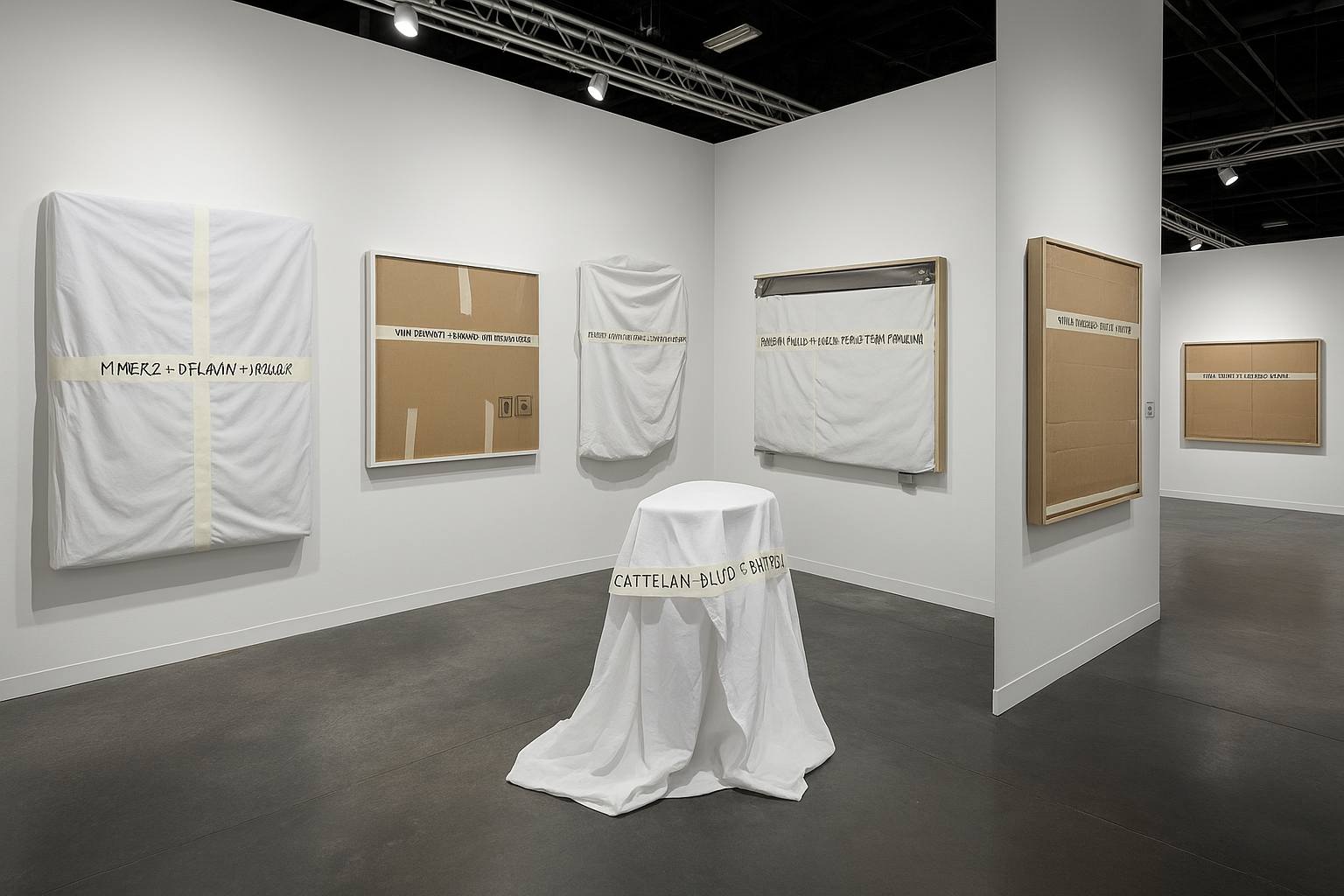
I think the artist’s formative moment should not teach them something but stimulate them to a critical view. Quotation is all very well, it is almost inevitable to quote the twentieth century, however, it has to become a bridge to go beyond, not a form of fetishism, otherwise, as I said, we fall back into the “evolved Ikea” that is fine for furnishing the living room, however, we miss opportunities. For example, I have this line of works, Hidden Works in which the quotation is blatant, even the artists in the work are stated above. However, the quotation becomes a bridge to deal with the present, the work is hidden, in a world where everything is visible and content bombards us. We cannot imagine, wait or be surprised by anything anymore. The quote is in the public eye but it becomes a bridge to the present, instead of being displayed on Instagram, the works are hidden. From my point of view, criticism, in the formative moment, would go to stimulate artists before they crystallize into weak forms. After you do the same thing for ten years, like Giulia Cenci for example, and everyone knows you one kind of work, after that it is exhausting to change, you crystallize in that form there.
I would like to ask you another question about the relationship between the “old” generation, of established artists, and the new generation, perhaps still in the process of formation. I have often noticed, both in academia and outside, a very listless and self-centered attitude on the part of those who should have been teaching us. Often leaving us “autonomous” was intertwined with a gradual absence of participation and support from faculty. Do you think there is, on the part of established artists, a form of elitism?
Definitely on the part of artists but also on the part of curators. I had written an article a few years ago where I told that these people (artists) in Italy have struggled so much to establish themselves that now they don’t feel like helping others or spending energy on others. They have already experienced a trauma that made them expend a lot of energy. In concrete terms then, who are the trainers? We have talked about reviewing training, but who works in these schools? They work either people who have been trained in the same way and therefore are not impartial, or artists who have a very individualistic view, based on public relations doping.
I would like to connect for a moment to what happened at the Biennale Cinema. I guess you heard the news about the protests against genocide that asked the institution and the participants to take a stand and exclude some actors from the festival. Without going into your opinion about this war, do you think there is a different expectation towards institutions, which are political places, and towards artists?
In my opinion, the only thing that an artist can do for Gaza, for the problems of the world, where ethics and morals are blown up, is to protect in private the very ethics and morals. Concretely, this is the only thing any of us can do: not to behave negatively in our own public-private dimension. Of course, symbolic signs are also useful to attract global attention, artists and institutions can take a stand; in any case, it is necessary to evaluate on a case-by-case basis.
Being asked to take a position can sometimes be inconvenient in case you do not think like the majority, in your opinion can the need to be politically correct become an obstacle to provocation?
Personally, I am always very independent so I have never been under such pressure, even from institutions. Certainly you have to avoid the stadium chorus, because it becomes a trivialization of the political problem. Then the situation in Gaza, and also in Ukraine, is a clear fury, so I think the Venice Biennale has to take a stand, it cannot pretend nothing is happening. None of us can pretend nothing. This is from the symbolic point of view. From the concrete point of view, everyone can work well in his or her own private life. To me, people who care about Gaza and then privately or in the workplace suck seem hypocritical. The art world has this tendency: they are all progressive but then in the workplace they have terrible attitudes from an ethical point of view. If these people were running a country, they would act exactly like dictators. To give an example: if someone is allowed to ride a bike and does minor damage, it is no less bad than someone who drives a Formula 1 and kills someone, it is the attitude that is wrong, what you can do is drive well regardless.
I find myself very much in agreement with what you are saying and at the same time I wonder, what happens the moment people who in private "suck" are the same ones who are in an institutional role and therefore have to show inclusiveness? One of your blog posts reflects precisely on the instrumentalization of diversity, perhaps at the expense of the quality of work.
The problem is always the same: a system that fails to differentiate cannot indicate the value and quality of a work, and so in order to do something interesting, we tie ourselves to the identity card of the artists. Curators, in order to attract audiences, fall back on issues that are now in my opinion established, fundamental. That said, if the exhibition is boring and trivial, it is because they have been working poorly for the last 15-20 years and quality artists in the meantime have devoted themselves to other things. This is also why we need to start from scratch. The best people have moved away because the system was working badly. With the Luca Rossi Academy I can find hidden talents, train them and bring them back to the center, however, it is a difficult job.
Would you like to tell us about how you work? What is, in your vision, quality and what do you consider interesting today?
In my opinion today, first of all, the artist has to take charge, rethink places and public relations, that is, rethink how to show their work and to whom. Then for me there are three paths to quality, which I have defined over the years. The first way is “alter-modern,” which means resisting the degeneration of our time and avoiding suffocating networks. These are works that try to resist the problems of contemporaneity. Next there is the second way, of “post-truth,” which means creating a reality more interesting than the truth, such as the flash mob. Nowadays what gets on the pedestal is not very powerful, because everyone is already in the spotlight and because reality is much stronger than any fiction. To attract attention you have to create something that seems real but is not, and that is why it stands out in the general homologation. Finally, the third way, is a certain kind of painting that can still create a moment of reflection, decompression, which can be useful and interesting.
How come precisely painting, which is often considered traditional, almost outdated? Yours is a counter position to the new expressive mediums.
Painting is the third way eh, the first two are much better! But though being a medium that is lost in the mists of time it is able to create a bubble that can still be interesting. Not all painting, a few types and a few painters. Being a historical tool it can still make us think.
This is more my curiosity: who are the three artists you like/interest you the most right now?
I really like Santiago Sierra, Tino Sehgal and Martin Creed, all artists from the 1990s, Tino Sehgal is a bit more recent. I like some of the projects of the American collective MSCHF, which was born in 2019. They do work that I think is interesting, sometimes they go too far with merchandising. I also like something by Maurizio Cattelan, for example Banana(Comedian, 2019) because it expresses a coherent vision. The question is not so much “I like it,” “I don’t like it,” but assessing whether an artist has an attitude in focus. Certainly Cattelan’s banana expresses his attitude perfectly. I also really like certain works by Damien Hirst, especially the early 1990s. Among the younger artists, Dahn Vo intrigues me.
Thinking back to Damien Hirst brings to mind artists whose work crosses the boundaries of morality. Marco Evaristti in the work Helena stages 10 blenders, containing live goldfish, that can be activated by the audience. Do you think it still makes sense to exploit certain boundaries of sensibility?
That sounds like nonsense to me, then it depends on the goal. Provocation must become a tool to go elsewhere. You know Aníbal Lopez, he is a South American artist who died young. During an exhibition he had presented a piglet with a bow on it that you could interact with. Eventually the piglet was taken to the slaughterhouse and became pork for the same people who had played with it. Here, this is interesting because Aníbal summarizes in exhibition what happens in reality. The provocation is interesting because there is no direct violence on the animal but what happens every day in slaughterhouses is recreated. Taking small fish and whipping them seems to me a bit of an end in itself.
I had the same impression even though Evaristti’s intention is to test the audience’s limit.
Marina Abramović did a performance with the same sense. She was in a room with different objects and people could do whatever they wanted to her. I personally would not have made the blenders active however, they are artists’ choices. It is a bordeline field.

Warning: the translation into English of the original Italian article was created using automatic tools. We undertake to review all articles, but we do not guarantee the total absence of inaccuracies in the translation due to the program. You can find the original by clicking on the ITA button. If you find any mistake,please contact us.





















 IT
IT FR
FR DE
DE ES
ES CN
CN


