





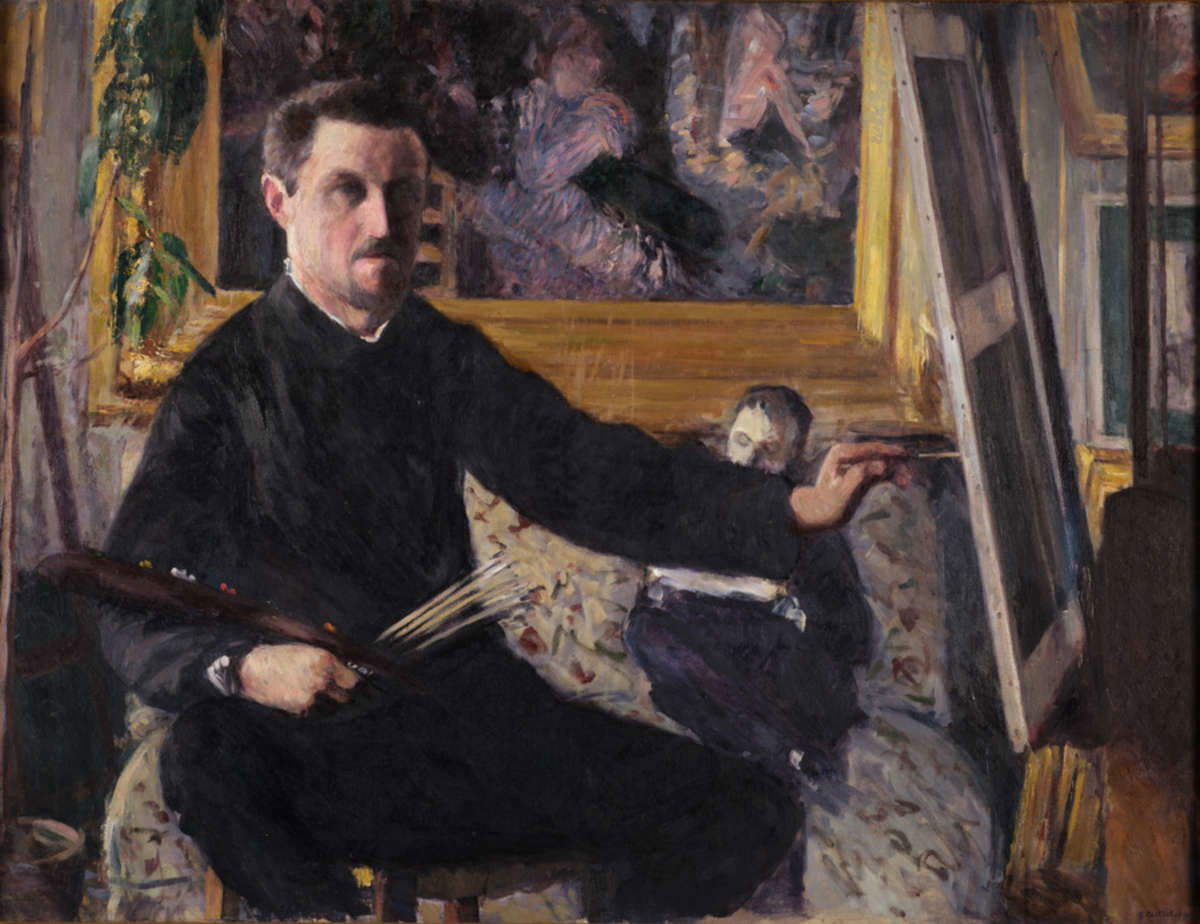
An important acquisition for the Musée d’Orsay in Paris: a masterpiece by Gustave Caillebotte (Paris, 1848 - Gennevilliers, 1894), Portrait de l’artiste au chevalet (“Portrait of the Artist at the Easel”), which occupies a central and unique position in the Impressionist painter’s oeuvre, as much for its size as for the symbolic and historical value it encompasses, arrives. Made and exhibited in 1879, the painting coincides with a decisive moment in the career of the then 31-year-old artist, now recognized as one of the leading figures of the Impressionist movement. In this self-portrait, the most important of those he painted, Caillebotte chooses for the first time to represent himself at work, in his own atelier, while he is painting the very picture the viewer has before his eyes. The atelier is not an idealized or abstract space, but coincides with his apartment on the boulevard Haussmann, a place of life and creation shared with his brother Martial between 1879 and 1887.
The iconographic choice breaks with the tradition of nineteenth-century depictions of the artist in his studio. Caillebotte is not shown isolated, nor surrounded only by working tools, but in the company of a friend and immersed among the works that made up his collection of Impressionist paintings. Prominent among them, in a position of absolute prominence, is Pierre-Auguste Renoir’s Bal du moulin de la Galette , the true jewel of his collection. The painting thus takes on a metapictorial dimension: the artist portrays himself while painting, in front of one of the masterpieces of Impressionism, openly declaring his role within the movement not only as a painter, but also as a supporter and collector.
By 1879 Caillebotte had made a gesture destined to have fundamental consequences for the history of art in France. Indeed, he had drafted a will in which he decided to leave his collection of modern works to the state, an unprecedented and daring choice for the time, which would contribute decisively to the institutional recognition of Impressionism. Portrait de l’artiste au chevalet, which entered the Musée d’Orsay’s collections today thanks to a dation (a mechanism that allows those who donate works of art to the state to receive substantial tax breaks) will be presented to the public in Room 33 from Feb. 17 to March 15, 2026.
Born in Paris in 1848 into an extremely wealthy bourgeois family, Gustave Caillebotte approached painting in the early 1870s. After a period of training in Léon Bonnat’s atelier and at the École des Beaux-Arts, he unsuccessfully attempted to exhibit at the 1875 Salon. The painting submitted, in all likelihood Raboteurs de parquets now in the Musée d’Orsay, was rejected by the jury. This episode marks a turning point in his career: Caillebotte chooses to join the Impressionist group, sharing their artistic battles and alternative exhibition methods to the official circuit.
His participation in the Impressionist exhibition of 1877, with large canvases devoted to the streets of the Europe district, attracted critical and public attention. In the years that followed, his role within the movement grew even stronger, eventually becoming one of its main organizational and financial pillars. The 1879 exhibition, to the realization of which Caillebotte was a major contributor, represents the culmination of this effort. On that occasion the artist presented the highest number of works ever exhibited up to that time, including a significant nucleus devoted to the theme of rowing, with paintings such as Partie de bateau, now considered a national treasure and acquired in 2022 thanks to LVMH patronage. Alongside these canvases appear portraits and views of Paris, but also the self-portrait, which although it does not appear in the exhibition’s official catalog is pointed out by a critic in La Vie parisienne, who emphasizes its pose “full of graceful nonchalance.”
In Portrait de l’artiste au chevalet, Caillebotte depicts himself seated on a small stool, facing a canvas mounted on a frame and resting on an easel. With one hand he holds a small paintbrush, while with the other he holds a palette and several brushes. The gaze, directed toward the viewer, establishes an immediate and conscious contact. The pictorial rendering, characterized by quick touches and drafting that hints at the appearance of draft and unfinished, testifies to the evolution of his style. After beginnings marked by an almost photographic realism, Caillebotte here approaches a technique more akin to that of Monet or Renoir, reaffirming his adherence to the Impressionist aesthetic.
At the same time, the painting is a self-portrait that chronicles Caillebotte’s role as collector and patron. Framed works appear around him that belong partly to his own production and partly to that of his artist friends. Beginning in 1875, thanks to the fortune he inherited from his father, Caillebotte began to build an extraordinarily important collection of modern art. Within a few years he acquired works by Cézanne, Degas, Manet, Monet, Pissarro, Renoir, and Sisley. By the time of his death in 1894, the collection numbered about seventy works, including both studies and absolute masterpieces such as Renoir’s La Balançoire , Monet’s La Gare Saint-Lazare , Degas’s L’Étoile (Ballet) , Cézanne’s Baigneurs au repos, Pissarro’s Les Toits rouges , and Manet’s Le Balcon. As early as 1876, when he was only twenty-eight years old, Caillebotte had decided to donate this collection to the French state, an unprecedented gesture among contemporary art lovers of the time. In the self-portrait, the presence of Renoir’s Bal du moulin de la Galette thus takes on an emblematic value, summarizing his commitment to Impressionism.
Over the course of his career Caillebotte produced five self-portraits. The last, painted shortly before his death in the early 1890s, is already in the Musée d’Orsay, where it entered in 1971. Portrait de l’artiste au chevalet stands out clearly from the others: it is the only one in which the artist depicts himself while painting, in his own domestic space, and in the company of a friend, Richard Gallo, one of his favorite male models. It is also the only self-portrait exhibited while Caillebotte was still alive. For these reasons, the work is considered one of the most significant artist self-portraits of the 19th century, capable of profoundly renewing the traditional iconography of the atelier.
French public collections today hold just over thirty works by Caillebotte, fifteen of them, including twelve paintings and three pastels, at the Musée d’Orsay. Since 2019, this holdings have been exceptionally enriched by the bequest of Marie-Jeanne Daurelle, great-granddaughter of the artist’s butler, who donated three paintings and two pastels, as well as two dations, Paysage à Argenteuil and Les Soleils, jardin du Petit-Gennevilliers, and the acquisition of the aforementioned Partie de bateau as a national treasure. The entry of Portrait de l’artiste au chevalet per dation fits fully into this dynamic aimed at strengthening Caillebotte’s presence at the Musée d’Orsay.
Today Caillebotte is recognized as one of the major artists of Impressionism and 19th-century painting, as reaffirmed by the recent exhibition Caillebotte. Peindre les hommes, organized by the Musée d’Orsay in collaboration with the J. Paul Getty Museum and the Art Institute of Chicago. The exhibition, which gave a central role precisely to the self-portrait, was staged 130 years after the artist’s death and accompanied by a tribute to the donor, with an accrochage that exceptionally brought together all the works in the bequest. This initiative was accompanied by the publication of the volume Caillebotte et les impressionnistes. Histoire d’une collection, released in 2024 by the Musée d’Orsay and Hazan editions, the first study entirely devoted to Caillebotte as collector and donor, a publication that fully reconstructed the fundamental role played by the artist in building the critical fortune of Impressionism.
|
| Musée d'Orsay acquires an important self-portrait by Gustave Caillebotte |

Warning: the translation into English of the original Italian article was created using automatic tools. We undertake to review all articles, but we do not guarantee the total absence of inaccuracies in the translation due to the program. You can find the original by clicking on the ITA button. If you find any mistake,please contact us.














 IT
IT FR
FR DE
DE ES
ES CN
CN


