





If it were a person, the Fiamme Gialle Bivacco of Cimon della Pala (Dolomites) would have stories to tell. Stories of mountaineering exploits and nights spent at 3,005 meters above sea level, on the Cimon Shoulder, in the heart of the Pale di San Martino Mountains. Tales of animals that inhabit the high peaks, of climate changes observed over decades, and of extreme events the facility has witnessed in over fifty years of operation. Built and managed by the Fiamme Gialle Section of the Italian Alpine Club (CAI), the bivouac has been a landmark in the central Dolomites for generations of mountaineers since its inauguration in 1968.
Recently replaced by a more modern structure, the bivouac has not completed its life cycle. Thanks to an agreement between the Guardia di Finanza and the Autonomous Province of Trento, the structure is being featured in a cultural operation that ensures its preservation and public enjoyment. On Monday, November 3, the structure was transported from the Dolomite peak to Passo Rolle by helicopter and then transferred by truck to the MUSE in Trento. A crane was used to hoist the bivouac onto the museum’s panoramic terrace, where it will be included in the permanent exhibits dedicated to the relationship between nature, science and society. In the coming months it will be further enhanced within the renovation of the permanent exhibition spaces undertaken by the museum. The initiative received the support of the Autonomous Province of Trento through the Department of Education, Culture, for Youth and Equal Opportunities and the Department of Crafts, Trade and Tourism, and was able to count on the collaboration of the Alpine School of the Guardia di Finanza in Predazzo and the CAI Sezione Fiamme Gialle.
“After months of planning the operation, it is exciting to see this precious bivouac land on the museum’s summit terrace,” says MUSE director Massimo Bernardi. “From the top of the Dolomites to the top of the museum building, the journey made by the bivouac materializes the permeability of a museum that is constantly renewing itself, even increasing its heritage, thanks to the constant dialogue with the territory, people and institutions to tell the contemporary evolution of our mountains, science, technology, nature. The acquisition of this bivouac, thanks to the agreement with the CAI Fiamme Gialle section and the Alpine School of the Guardia di Finanza in Predazzo, represents an important step for us toward the new permanent exhibition itinerary that, progressively, will transform our museum to offer an always contemporary and innovative visiting experience.”
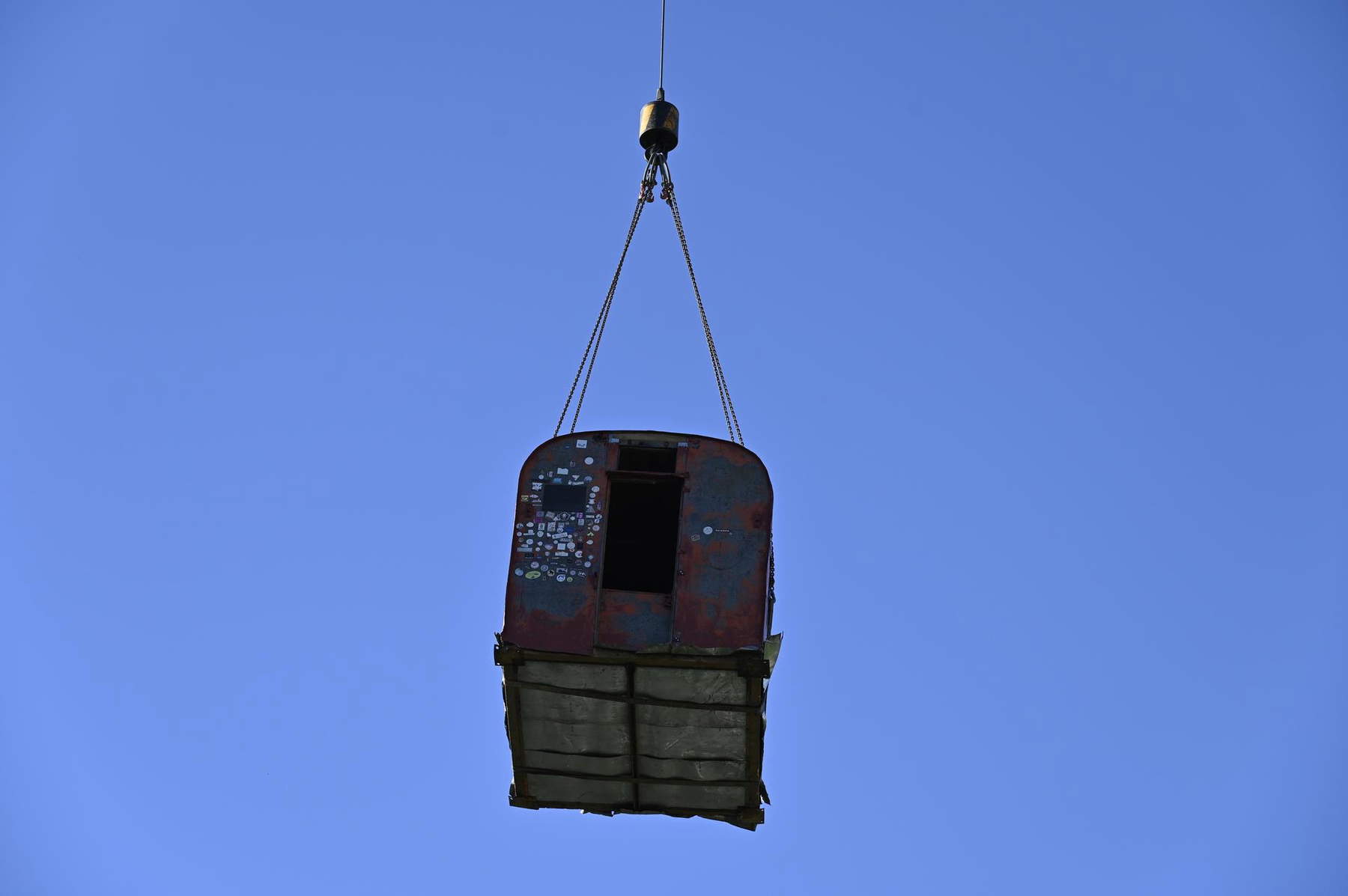
Transporting the bivouac, from the Spalla del Cimon along the normal route to the Cimon della Pala on the south side of the massif, was a complex operation. After being flown by helicopter to Passo Rolle, the structure was loaded onto a truck from the Employment Support and Environmental Enhancement Service of the Autonomous Province of Trento to the Museum, where a crane allowed its final positioning on the terrace. Here the bivouac will be included in the exhibition itinerary dedicated to high peaks, which includes the fourth floor and the panoramic terrace. It will be set up again in its original configuration, with eight cots and the blankets preserved from the period at high altitude, so that the public can observe exactly how the structure looked during its activity in the Dolomites.
The history of the Yellow Flames Bivouac has its roots in the 1920s. The idea was born by the Italian Academic Alpine Club (CAAI) in response to the need for minimal, though unguarded, shelters in remote areas where it was not economically viable to build larger structures. The design was inspired by the “corrugated sheet metal boxes” used as shelters at high altitudes during World War I. The construction of the bivouac in 1968 was made possible thanks to the collaboration between the CAI Fiamme Gialle Section and numerous territorial entities, with the support of the Antonio Berti Foundation of Padua. The structure belongs to the so-called Berti model, designed by engineer Giorgio Baroni, and is characterized by galvanized sheet metal painted red and a six-story roof with different inclinations. The interior area measures about eight square meters, with a total volume of twenty-one cubic meters, offering nine beds.
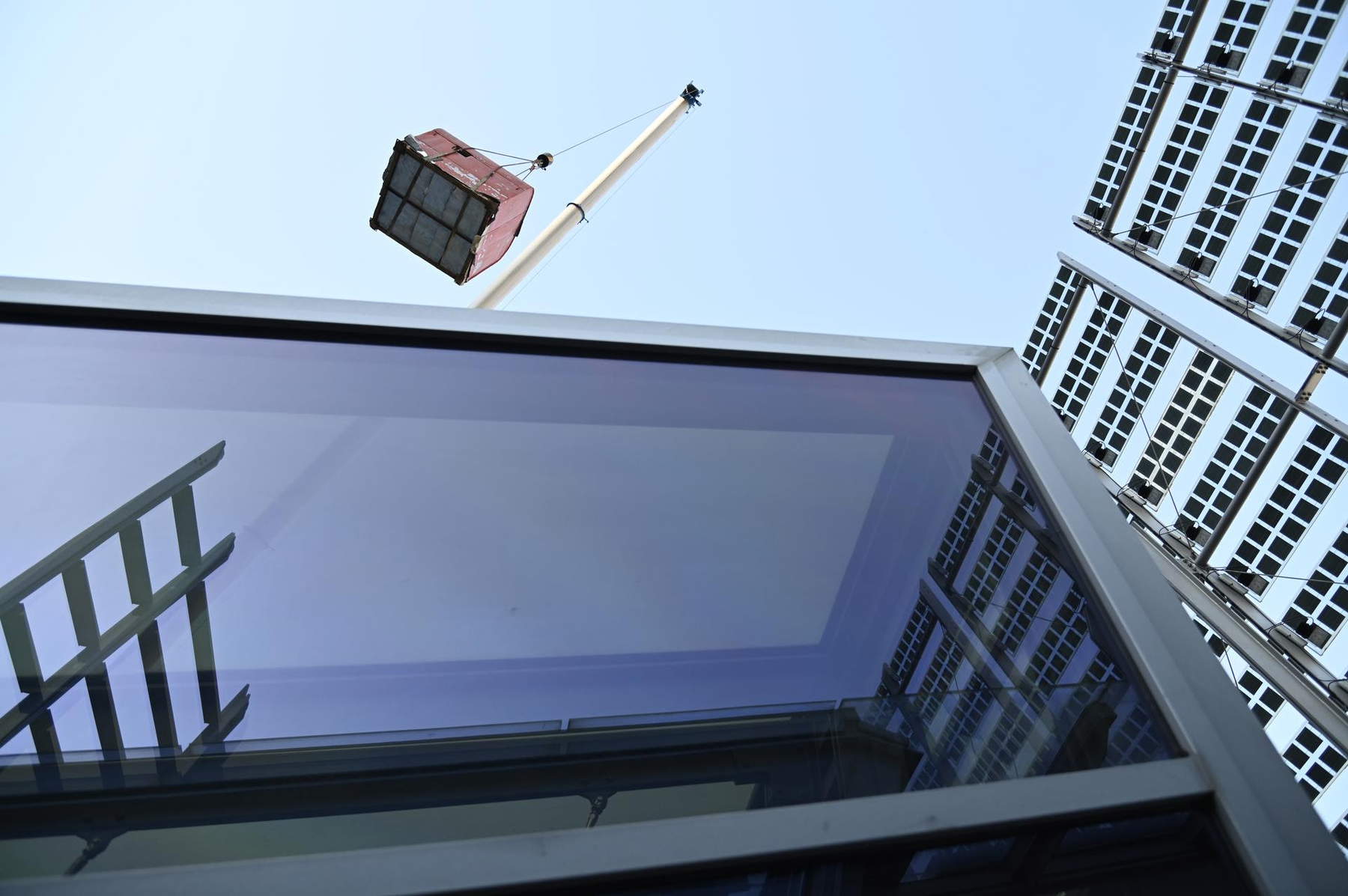 The arrival of the Bivacco Fiamme Gialle at MUSE in Trento.
“A new, important material evidence of activity in the mountains, becomes part of the Muse’s layout,” said Francesca Gerosa, Councillor for Education, Culture, Youth and Equal Opportunities, andRobertoFailoni, Councillor for Crafts, Trade, Tourism of the Autonomous Province of Trento. The old Bivacco Fiamme Gialle (Yellow Flames Bivouac) in Cimon della Pala, recently replaced by a more modern and now disused structure, moves from the Pale di San Martino and reaches the panoramic terrace, going to expand the museum’s already full-bodied educational offerings and at the same time ideally linking it to our mountains known worldwide for their unparalleled beauty, the Dolomites. A small but precious fragment of the history of our mountains is now available to the Muse and to visitors who, by observing it and listening to the testimonies of those who have experienced firsthand the experience of climbing a peak, will be able to discover and touch with their own hands what the effort of climbing means, but also the thrill of reaching the summit after so many sacrifices. Many have been the climbers who, over time, have found in the bivouac a place to shelter from the weather, eat a meal, rest a few hours before resuming the journey to the summits, and experience in the spaces invaluable moments of confrontation and sharing with friends, colleagues and climbers passing through from all over the world, perhaps met right inside the small building. Thanks to Muse for this original idea and to the Guardia di Finanza for granting the transport of the bivouac that will allow everyone to delve into the world of mountaineering and its values, made of respect, sharing and generosity. Finally, the bivouac will also be an opportunity to learn more about and approach our wonderful mountains, to learn to love and respect them as well as to see them with different eyes when one wants to walk the paths and routes that lead to their peaks."
“As a CAI Section, we wanted to donate to MUSE our historic bivouac that bears the name of the Section, a name that has always been synonymous with the Corps,” says Colonel Sergio Lancerin, Commander of the Alpine School of the Guardia di Finanza in Predazzo and President of the CAI Fiamme Gialle Section. “Realizing this happy union with MUSE, we give museum value to an artifact that has, since its location on the normal route to the Cimon della Pala, constituted a concrete example of the close link between alpine military training, mountaineering culture of rescue and care of the mountain territory cultivated by the Alpine School of the Guardia di Finanza, with its branches in Predazzo and Passo Rolle and its training environments of choice among the Val di Fiemme, Primiero, and Val di Fassa. For nearly sixty years, the bivouac has represented the primal functions of this type of structure: emergency shelter and a safe point of rest and protection for hikers and mountaineers who frequented the iconic peaks of the Pale di San Martino Mountains. The structure was also intensively used for the training activities of the Alpine School directed to the preparation of mountain rescue technicians of the Guardia di Finanza Mountain Rescue, whose 60th anniversary of foundation falls this year: generations of rescuers have used this and the other two facilities, also under renovation, of the Gialle Section, namely the Renato Reali Bivouac, in Val Canali, also in the municipality of Primiero San Martino di Castrozza, and the Aldo Moro Bivouac, on the Coston de’ Slavaci in the municipality of Predazzo. Thanks to this opportunity agreed upon with the Muse, thousands of visitors will be able to make contact with this historic structure, fully understand its functions, and imagine the continuous flow of mountain enthusiasts, who, thanks to its realization, have received shelter and comfort in times of difficulty. For this great gratitude is owed to Muse and to the Museum figures who have supported this project from the very beginning, first and foremost President Stefano Galli, Director Massimo Bernardi, and the Chair of the Scientific Committee, Prof. Anna Giorgi.”
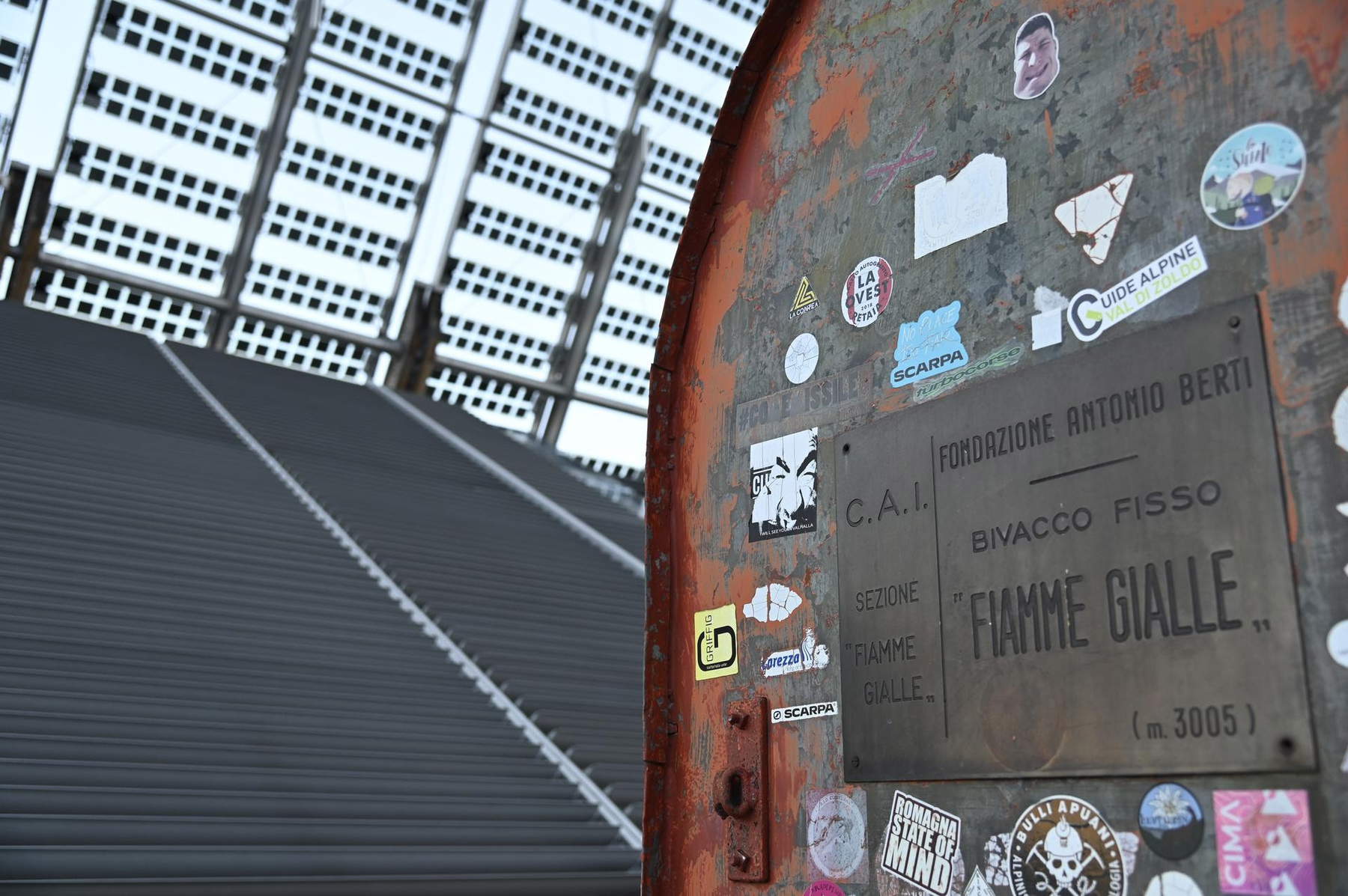
The management of the bivouac has always been entrusted to the Yellow Flames Section of the CAI, which has been responsible for checking the structural state, controlling the order and cleanliness of the interior, maintaining materials and monitoring access routes. Over the decades, the structure has seen hundreds of mountaineers pass through, becoming a silent witness to sporting experiences and life at altitude. The move to the MUSE in Trento represents a new chapter in the history of the bivouac, which will continue to dialogue with the public, but in a different, urban and museum context. The location on the panoramic terrace allows for the preservation of the connection to the high peaks, while providing an opportunity for visitors and researchers interested in mountaineering, the history of the Dolomites, and mountain-related heritage conservation practices to observe and study.
 |
| The Yellow Flames Bivouac from the Dolomites to the MUSE of Trento |

Warning: the translation into English of the original Italian article was created using automatic tools. We undertake to review all articles, but we do not guarantee the total absence of inaccuracies in the translation due to the program. You can find the original by clicking on the ITA button. If you find any mistake,please contact us.


















 IT
IT FR
FR DE
DE ES
ES CN
CN


