




There is controversy in Pietrasanta over the culture numbers released by the municipality and about which the director of Finestre sull’Arte, Federico Giannini, raised reservations in an editorial he published last Sunday. The day before yesterday came a response from the newspaper La Nazione, signed by journalist Daniele Masseglia, which headlined, “’War’ on exhibition numbers. Art magazine crushes the city’.” And in the caption, “Director Giannini believes the data are not demonstrable. But tables confirm upward trend.” “After the fuss over the lack of the title of capital of contemporary art, with a heated back-and-forth between the president of the galleries and the mayor,” Masseglia writes, “culture once again becomes the terrain of a long-distance controversy. With an ’opponent’, for Little Athens, that is anything but new: the magazine ’Finestre sull’Arte,’ already a protagonist in the past of attacks on the content of the city’s cultural offerings. The magazine’s founder and editor-in-chief, Federico Giannini, this time targeted the recent attendance figures of the exhibitions promoted in 2025, ’failing’ Pietrasanta in mathematics. In his opinion, in fact, the numbers pitted by the municipality, starting with the more than 204,000 attendances, are questionable for a couple of reasons: the lack of a people counter and the discrepancy with the 2024 numbers, according to Giannini higher than 2025 but defined as ’lower’ by the municipality.”
Masseglia then attributes to Giannini a quotation mark that is not reflected in his editorial (“Aside from the fact that the report does not find a match on the entity’s website, the attachments being unobtainable,” he writes, “it mixes museum and library data and it is not clear how those who visit the ’Luigi Russo’ center and the Sketch Museum are counted, since they are both at St. Augustine’s. Then how is it possible that 10,600 more visitors were recorded in 2025 if in 2024 the total number of visitors was 241,000? A confusing and approximate report.”), says that Giannini’s alleged “rejection” “in the city surprised a little bit of everyone because ”at the main venues of the ’Luigi Russo’ center and the ’Antonucci’ archaeological museum there is actually the staff of the cultural institutes that through a people counter system registers the admissions. The second reason is the fact that the counts take into account the major exhibitions at the ’Luigi Russo’." And he closes the article by spreading further data: in 2024, specifically, 105,141 visitors to the exhibitions, 55,268 to the Sketch Museum, 15,440 to the Archaeological Museum, 456 to the Barsanti Museum, 734 to Casa Carducci, and 16,875 users to the library. As for 2025, 111,080 visitors to exhibitions, 64,849 to the Sketch Museum, 9,825 to the Archaeological Museum, 539 to the Barsanti Museum, 771 to Carducci House, and 17,538 users to the library.
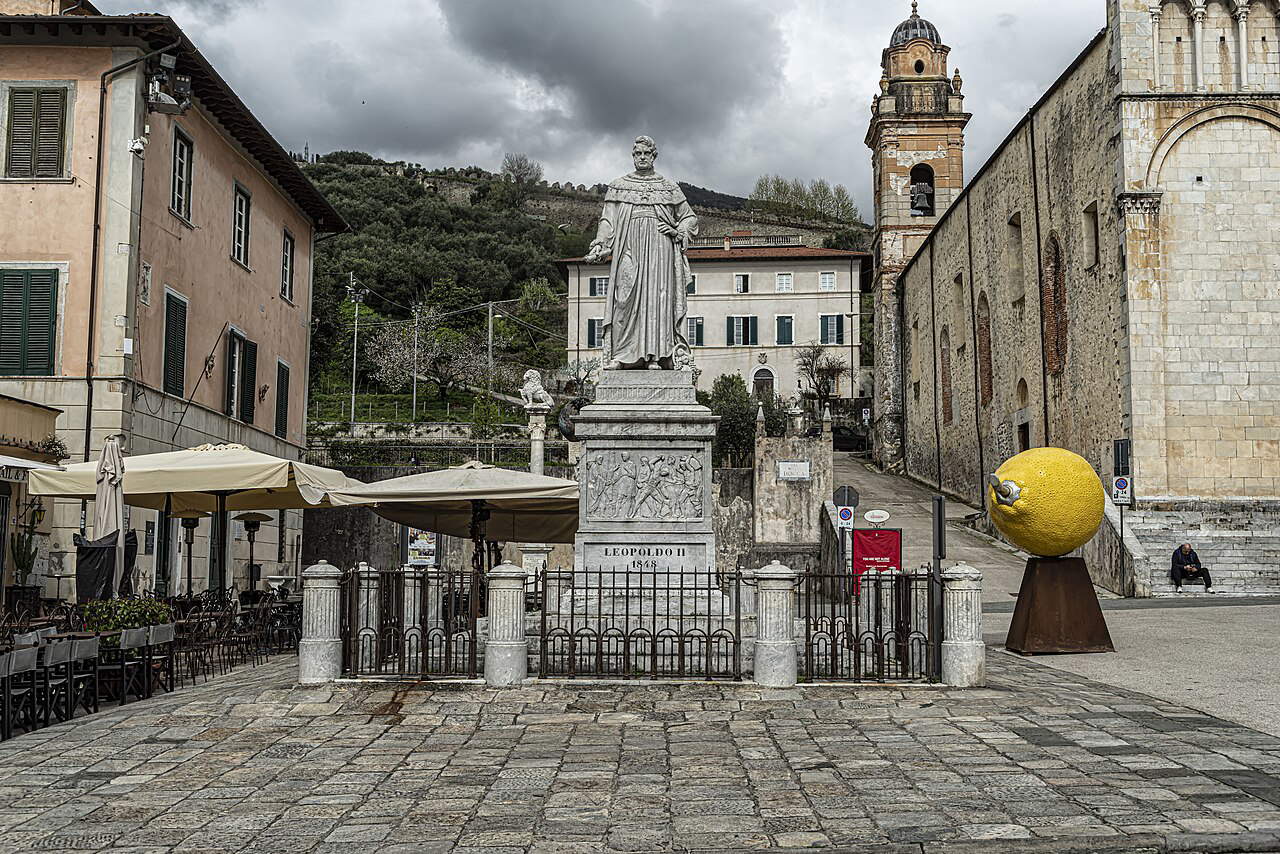
On the very same day, Giannini decided to respond to the La Nazione article with a post published on Enchiridion, his personal blog on the Substack platform, later also reported on his Facebook profile. The director of Finestre sull’Arte starts off harshly, urging “don’t write bullshit”: the reference to the narrative framework with which Masseglia framed the controversy, rejected with disdain by Giannini. “Passing us off as an ’opponent,’ albeit in quotes, of Pietrasanta, is as far from the truth as it gets,” he writes. “In fact, the aforementioned journalist forgets, or does not know, the numerous positive articles we have dedicated over the years to the exhibitions held in Pietrasanta. So we bring him up to date: the Chapman brothers’ exhibition, Bertozzi and Casoni’s exhibition, the ’Africa Tunes’ exhibition, Vladimir Kartashov’s exhibition at Ex Marmi, the designer Stefano Russo’s exhibition. Some deemed so good (Chapman, Bertozzi & Casoni, Russo) that they led us to interview the artists.”
Giannini then criticizes Masseglia for reporting a quotation mark that does not correspond to the original: “The quotation mark reported by the journalist,” he points out, “is made up out of whole cloth, and that quotation marks are reported identical to the original is something they teach in the first week of classes at journalism schools, all the more so if by mispronouncing the original you end up conveying incorrect information. And since Masseglia’s article brutally trivializes what I have written, I will now try to be as clear as possible so that other people’s listlessness does not become a pretext for further instrumental attacks.” The director then articulated his response in five points. On the first, Giannini clarified the target of his criticism: “I never said that the reason why it is not understood how visitors to the exhibitions and the Museum of Sketches are counted is that they are both based at St. Augustine. I said it is not understood how visitors are counted because the press release from the City does not explain it.”
On the second point, the director intervenes on an attribution by the journalist of La Nazione: “Nowhere did I write that there is a lack of people counting in the museums of Pietrasanta: this is information completely invented by Masseglia who for some reason thought to present a hypothesis of mine as an assertion (blue pencil stuff). I said that the municipality’s statement does not specify the method by which visitors are counted. That seems a little different to me.”
Still, Giannini lashes out as well at the local newspaper’s article’s deadbolt, in which the Finestre sull’Arte director is attributed with a claim that the data are not demonstrable: “Nowhere did I write that the data are not demonstrable in an absolute sense. I wrote that the data in that statement are poor in meaning because they are inaccurate and unclear: This is because the counting methods are not explained (which is not insignificant in those museums lacking a ticket office), because we do not know whether visitors to St. Augustine’s are counted twice (St. Augustine’s being home to the Sketch Museum and the Luigi Russo Center), because museums and libraries are mixed, because some numbers are reported accurately and others with formulas like ’over X visitors,’ ’more than Y attendance,’ because ambiguous terms are used (’attendance’ instead of ’visitors’).”
Finally, Giannini says he never denied the trends in the data, and notes further inaccuracies: “I did not deny the growth trends, I only said that between years the City Council has evidently changed the methods by which it adds up the data, saying that last year in all likelihood it included in the total those who attended the conferences in the Annunziata Hall, and this year it did not. Incidentally, it would be interesting for Masseglia to explain why in his article he talks about 105,141 visitors to the exhibitions in 2024, when the City Council’s January 2025 statement reported 122,474 visitors. Why a difference of almost 20,000 visitors? Which figure are we to believe? Last year’s communiqué or the data in the La Nazione article?”
In the finale, Giannini reiterates his extraneousness to any controversy of a local nature and the absence of any preconceptions about Pietrasanta: “Obviously,” the director concludes, “I do not hold it against Pietrasanta (and I reiterate this because it is the element I tend to emphasize the most): simply, in view of the work that I do and the audience that reads Finestre sull’Arte, it seems natural to me to devote some extra attention to a city that has long proposed itself as one of the capitals of contemporary art in Italy (and it is), as the ’little Athens,’ a city that has even nominated itself as the Italian Capital of Contemporary Art. Theme, moreover, brought up by the Nation’s article when we have not intervened at all on the subject. And I repeat, we are not opponents of anyone, nor ’protagonists of attacks’. Otherwise, following the same reasoning, we should be presented as allies of Pietrasanta when we write positive reviews. Or as opponents of Rome and Milan, who would also have more title to complain since, making a calculation, there are many more critiques we write of Roman or Milanese exhibitions than of Pietrasanta. Very trivially we, as an independent publication, do our job, which sometimes leads us to criticize what we feel we should criticize.”
|
| Controversy over Pietrasanta museums, Giannini responds to La Nazione: "I'm not mad at the city" |

Warning: the translation into English of the original Italian article was created using automatic tools. We undertake to review all articles, but we do not guarantee the total absence of inaccuracies in the translation due to the program. You can find the original by clicking on the ITA button. If you find any mistake,please contact us.

























 IT
IT FR
FR DE
DE ES
ES CN
CN


