



by Federica Schneck 19/12/2025



Categories: Opinions / Disclaimer
In the contemporary art market, novelty is often subordinated to rent: visibility, legitimacy and economic value matter more than creative risk. And genuine innovation struggles to emerge and be recognized. Federica Schneck's article.
In the business world,innovation is what shifts the balance. It is the force that designs the future, that breaks paradigms, that forces the system to reinvent itself. But in the contemporary art world, where everything seems unstable and in flux, where every artist seems to want to “break with the past,” where every biennial proclaims the new, is it really innovation that is rewarded? Or, more insidiously, is it rent that dominates, economic, symbolic, curatorial, disguised as avant-garde?
Theart market, like any other market, is built on precise dynamics: visibility, scarcity, reputation, expectation. And like any other market, the art market has developed its safety zones: established artists, established galleries, influential collectors, institutions that guarantee reliability. In this ecosystem, how much room is left for genuine risk, for radical experimentation, for the irruption of the unexpected?
It is a question that interrogates not only the functioning of the market, but also our very idea of “contemporary art.” And one that forces us to reconsider whether art today is still a laboratory of meaning or whether it has become just another field, subject to the logic of profit and the protection of capital.


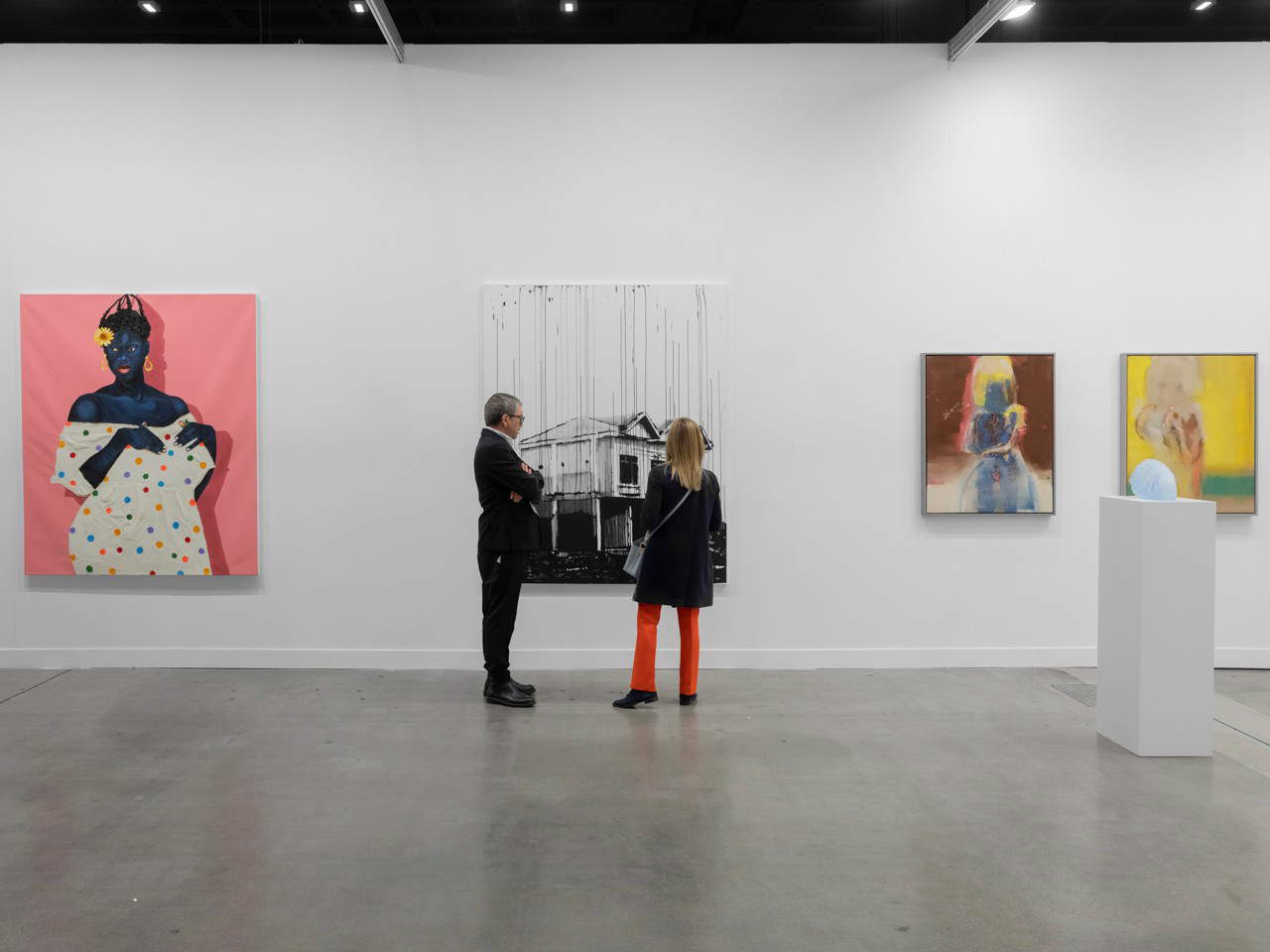
In words, the art world prizes novelty. Fairs present themselves as showcases of the new that is advancing, galleries as hothouses of young promise, magazines as radars of change. But those who regularly attend major international fairs, from Art Basel to Frieze, from TEFAF to FIAC, know that, beneath the surface, a profound homogeneity reigns. Languages are similar, techniques are repeated, aesthetics are uniform.
The phenomenon is well-known: as soon as an artist develops a recognizable and expendable language, imitators and variations on the theme quickly emerge. The style crystallizes, becomes a formula, a brand, a distinctive sign to be “mass produced.” Rather than innovation, it is the standardization of the new, a typically postmodern paradox, where even transgression is codified and put to value.
In this context, what really matters is not so much the innovative gesture, but its capitalization. An artist may come up with a disruptive work, but if he does not have a network of legitimacy behind him, curators, critics, gallery owners, advisors, he is unlikely to get attention or market. In contrast, an artist who has already established his name can afford to repeat himself without much consequence. The real question is not “who innovates?” but, “who derives income from innovation?” In many cases, it is not the most radical artists who benefit from their inventions, but those who manage to intercept the language and make it compatible with the market.
Think of street art, video art, performance: all initially marginal, experimental, sometimes antagonistic practices. Today they are perfectly integrated into the system, as long as they fit within certain visual codes, specific exhibition formats, and controllable contexts. It is no accident that many of the major contemporary performers now exhibit only in museums or fairs, in replicable, predictable, “curated” formats. Meanwhile, artists who work on the margins, who do not bend to the demands of the market, struggle to emerge. They often remain invisible, undervalued, excluded. Not for lack of quality, but for lack of adaptability to the system. Innovation, in the art market, is rewarded only if it is functional, if it generates attention without creating clutter, if it is new but not too new, if it breaks but does not break.
The crux of the matter is that the art market does not evaluate innovation by its cultural impact, but by itspotential profitability . An innovative work, if it is not already backed by a winning narrative, has no value. And a winning narrative, we know, is built with targeted investments: publications, exhibitions, strategic sales, institutional relations.
This system generates a mechanism of self-legitimization: those who have the means to build value get to decide what is valuable. Thus, critical evaluation is often replaced by financial evaluation. Price makes quality. If a work is worth millions, then it “must” be important. If an artist is at auction at Sotheby’s, then it “must” be innovative. The market is self-confirming and becomes authority. The risk is that art loses its deepest momentum: that of questioning, of misalignment, of friction. Because true innovation, the kind that disrupts paradigms, is never comfortable. And the market, by its very nature, prefers stability, continuity, rent.
Not everything, however, comes down to the here and now of economic value. Art history teaches us that true innovation often acts in the long run. Many revolutionary artists were ignored in their lifetime, and only time has revealed the extent of their contribution. Deep innovation is often invisible to immediate markets because it is designed not to please but to interrogate.
In this sense, historical judgment and market judgment rarely coincide. And for this very reason, the task of cultural institutions-museums, academies, journals, foundations-should be to cherish and promote complexity, even when it is not profitable. It should support art that takes risks, that does not bend, that does not generate immediate income but sows questions for the future.
The art market today is at a crossroads. On the one hand, it can continue to reward annuity, to value what works, to seek the short profit. On the other, it can choose to support riskier, deeper, slower practices. But this choice is not just up to collectors or investors: it affects all of us.
Because in the end, the question is collective: what kind of art do we want to support? The one that confirms the present or the one that challenges it? The one that fits the system or the one that deconstructs it? The one that generates capital or the one that generates thought? If we really believe that art is still a space of freedom and imagination, then we should have the courage to question the logics that govern it. Even at the cost of losing some certainty. Even at the cost, paradoxically, of undermining the market itself.
Warning: the translation into English of the original Italian article was created using automatic tools. We undertake to review all articles, but we do not guarantee the total absence of inaccuracies in the translation due to the program. You can find the original by clicking on the ITA button. If you find any mistake,please contact us.