





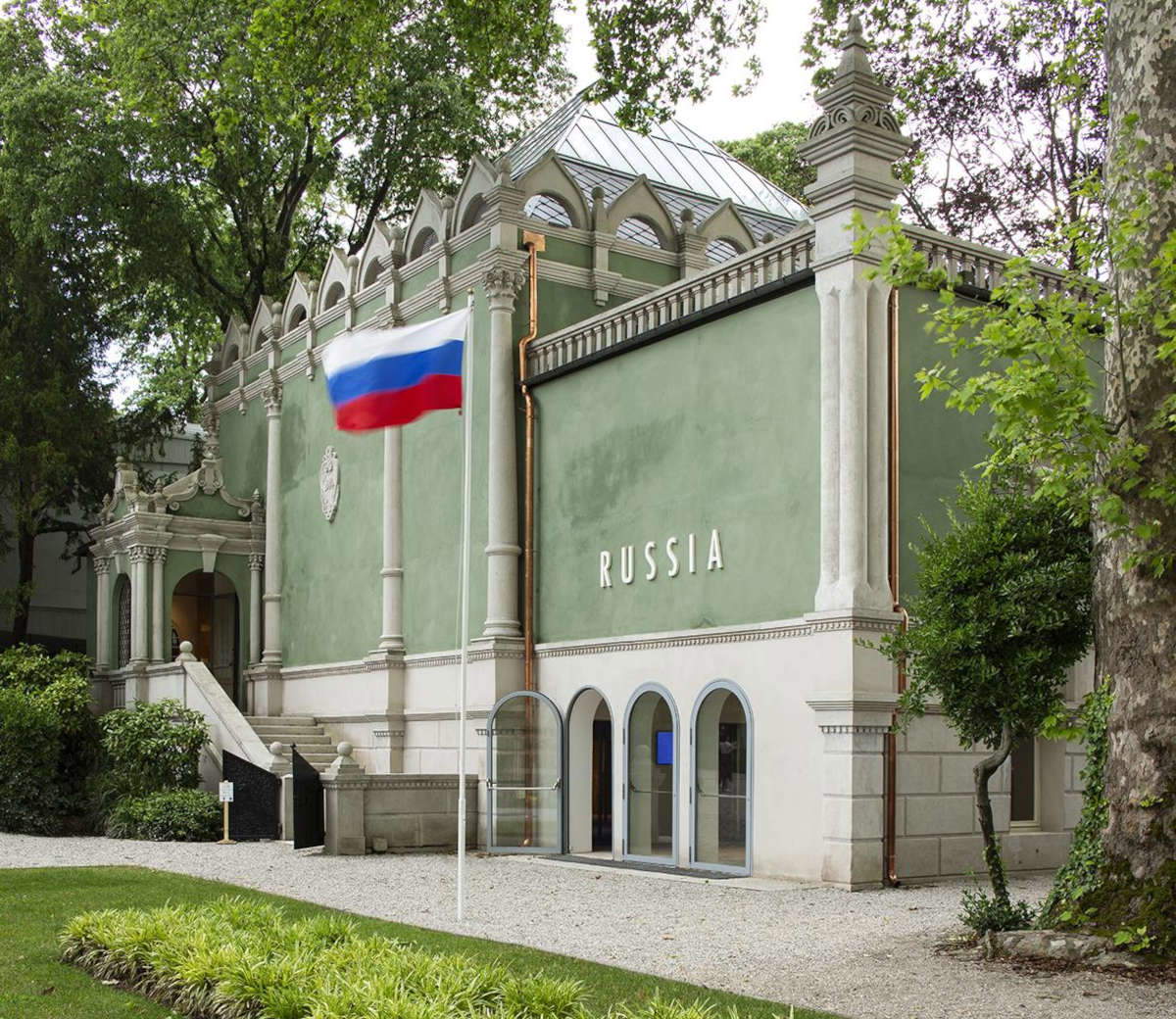
We could hardly have imagined, even a couple of weeks ago, that we would be forced to see a Venice Biennale this year that reopens its doors to Russia. A legitimization, a rehabilitation in all respects. Let’s start immediately with an observation: the national participations in the Venice Biennale are, essentially, expressions of the governments of the respective countries. It is usually the ministries of culture of the participating countries that choose the curators, and the pavilions of the Venice Biennale, ever since the world has been the world, are manifestations of soft power and cultural diplomacy even before cultural confrontation. Translated: at the Venice Biennale, reason of state typically comes before culture. At the Venice Biennale, a country does not usually choose its best curator, its best artist: it chooses the one that best responds to the idea the country wants to give of itself at that given historical moment.
Take, for example, the last edition, with Australia choosing Archie Moore (and winning the Golden Lion) to challenge itself on its whole history of ’injustices towards Aborigines and thus present itself as a country that is serious about confronting its past, with Spain choosing Sandra Gamarra to reread its colonial past, with the U.S. choosing Jeffrey Gibson to show itself as a country open to plurality, with Saudi Arabia choosing Manal Al Dowayan to show the world its progress on women’s rights.Therefore, given the significance of the Biennale for the countries taking part, one finds it hard to believe that the Russian Federation will try to use the Biennale as a forum for confrontation, as a moment of truce. Let us then imagine if anyone will be able to take seriously the words of the president of the Biennale, Pietrangelo Buttafuoco, when he says that “there is a time when weapons must stop.” Let alone whether anyone will really be able to think that the Biennale is, as he says, “a space of coexistence for the whole planet, both with old and new geographies.” This is trivial, naïve institutional rhetoric: likely, Russia will rather try to carry out a kind of sympathy operation (which, moreover, she is already doing), presenting herself as the victim of a deliberate cancellation, she who has given so much to the world and who will come to Venice to create, one reads in the presentation of her exhibition, “a space for dialogue and exchange.”We will not deviate from the rhetoric, for now: the hope is that they have at least changed their minds about the curious modes of dialogue they have repeatedly demonstrated in the diplomatic arena, but I fear I have some serious doubts about this. Buttafuoco candidly suggests that the history of the Biennale recalls pavilions capable of betraying, shall we say, their governments. It is true (and let us hope that it happens this time as well, that some of the selected artists manage to do so, in case we will be the first to acknowledge it), but these were sporadic cases, and usually occurred when a certain mess broke out during the process, not before. So I doubt, given also the people involved (starting with a former culture minister who wrote an editorial a few months ago vague about restoring official censorship), that we will see a Russian pavilion against the Kremlin.
I wonder then what was the point, four years ago, of setting up the “Ukrainian Square” in the center of the Gardens in order “to give voice to artists and the artistic community of Ukraine and other countries to express solidarity with the Ukrainian people in the aftermath of the brutal invasion by the Russian government,” as the official presentation read. I wonder what good it did to be moved by the determination of Pavlo Makov, who in order to honor the Pavilion of Ukraine at all costs had finished his work under the bombs in Kharkiv and loaded the pieces of his fountain into his car along with his team and faced a week-long journey in the midst of the war in order not to miss it. I wonder what good it did to stand petrified two years ago inside the large hall of the Pavilion of Poland, watching the work of Open Group, hearing the sound of missiles and drones repeated from the mouths of refugees. I wonder what was the point of all this if then, as if nothing at all, they give ease to those who come to Venice representing a country that has attacked, invaded, raped a democratic neighbor. In fact, they are even cheerfully sneering, since their representative for international cultural cooperation says, verbatim, that “we never went anywhere, so we are not ’coming back’: it is proof that Russian culture is not isolated and the attempts to erase it undertaken in the last four years by Western political elites have not been successful.” I wonder then why the art community at home, despite all that has been done in the past years to support Ukraine and its artists (let us also remember that Italy has been actively engaged in the reconstruction), in the face of this news, in the face of a substantial rehabilitation of the Kremlin disguised as a return of Russian art, when almost a week has now passed, has not yet uttered a single, paltry, feeble, drawling word.
Of course, in the face of the grievances of those who rightly believe that the choice to admit Russia is not exactly a brilliant brainwave, social media have already been filled with the comments of those who, just as rightly, wonder: what about Israel? What about the US? What about Iran, then? I will respond to this timely objection by trying, at least as far as I am concerned and as I think about it, to be brutally explicit. We may as well gloss over the myriad differences between Israel, the U.S., and Russia, starting with the fact that, hopefully within a few months for the former and a couple of years for the latter, both Netanyahu and Trump will be required to get the hell out of the way if their respective populations vote against them in elections (I don’t think the same can be said for Russia, however). Because that is not the point: we are not talking about either the form of government or the degree of moral presentability of the individual participating countries. For if we really were to admit participants on the basis of their decorum, then, depending on the elasticity of the criteria, we might end up with a Venice Biennale that, instead of at the Arsenale and the Giardini, could be more comfortably organized at the little bar on Viale Garibaldi. And it’s really not my intent to hand out patents of morality: I’m not able to and I don’t want to. I then make a much more pragmatic point, which can be reduced to two elements. First, there is a European Parliament resolution that recognized Russia as a sponsor country of terrorism because of the war crimes and atrocities committed by Russian forces against Ukrainian civilians. The resolution is not binding and does not produce any official statements, but it is nonetheless a formal call to isolate Russia until it comes to milder terms. Second: last Wednesday, on the very day the Biennial was making Russia’s participation official, the DIS (Department of Security Information) Annual Report 2026 was being presented in the House, i.e., the annual report of our intelligence according to which, and I quote, “in 2026, the Russian Federation will represent the main threat to the European continent” (for the reasons I refer to reading the document which can be easily found online).
Here: this is the subject that the Venice Biennale and its president Pietrangelo Buttafuoco are legitimizing under the guise of dialogue. True it is that the Biennale is not an appendage of the DIS, and true it is that the Biennale enjoys cultural autonomy, so much so that even the Ministry of Culture felt compelled to disassociate itself, but until theday before yesterday the Biennale followed a consistent line of support for Ukraine (I dread to think how Ukrainian artists feel these days), and above all, dialogue occurs where there is that minimum of flexibility to accept it. Otherwise it is not dialogue: it is cultural makeup. Buttafuoco wants to open the doors to Russia? Can’t we expropriate their Pavilion? Fine: I hope then that the Biennale will take action so that there will be a garrison of dissident artists in front of the Russia Pavilion. After all, four years ago “Ukraine Square” was put up at the last minute. The Biennale could open to such a possibility. Let Russia’s presence, if irrevocable, really become a space for serious critical friction, not a persuasive soliloquy masquerading as openness to dialogue. And let me make it clear: we are not against Russian culture, nor against Russian artists. We are against their current government. This seems to me a relevant difference, and I hope that artists, curators and critics, whether participating in the Biennale or going as spectators, will remonstrate on this difference. If it will not happen, patience: the news of Russian participation for now has been confined to the articles in the trade publications and in a few small paragraphs that have appeared here and there. It had made more news, to say, Gergiev’s concert at the Reggia di Caserta last summer. In that case, we had known what to do, and for much less.

The author of this article: Federico Giannini
Nato a Massa nel 1986, si è laureato nel 2010 in Informatica Umanistica all’Università di Pisa. Nel 2009 ha iniziato a lavorare nel settore della comunicazione su web, con particolare riferimento alla comunicazione per i beni culturali. Nel 2017 ha fondato con Ilaria Baratta la rivista Finestre sull’Arte. Dalla fondazione è direttore responsabile della rivista. Nel 2025 ha scritto il libro Vero, Falso, Fake. Credenze, errori e falsità nel mondo dell'arte (Giunti editore). Collabora e ha collaborato con diverse riviste, tra cui Art e Dossier e Left, e per la televisione è stato autore del documentario Le mani dell’arte (Rai 5) ed è stato tra i presentatori del programma Dorian – L’arte non invecchia (Rai 5). Al suo attivo anche docenze in materia di giornalismo culturale all'Università di Genova e all'Ordine dei Giornalisti, inoltre partecipa regolarmente come relatore e moderatore su temi di arte e cultura a numerosi convegni (tra gli altri: Lu.Bec. Lucca Beni Culturali, Ro.Me Exhibition, Con-Vivere Festival, TTG Travel Experience).
Warning: the translation into English of the original Italian article was created using automatic tools. We undertake to review all articles, but we do not guarantee the total absence of inaccuracies in the translation due to the program. You can find the original by clicking on the ITA button. If you find any mistake,please contact us.

















 IT
IT FR
FR DE
DE ES
ES CN
CN


