





It is perhaps one of the oldest feelings in existence:envy lurks in the minds of those who desire but do not possess, whether it be personal qualities, achievements, relationships or material goods, and arises from the awareness of one’s own lack or inferiority. It is a complex feeling that lurks in the deepest interiority of an individual, with greater or lesser intensity depending on his or her temperament, and combines desire, frustration and even resentment toward those who appear more fortunate or accomplished, including the discomfort or annoyance caused by that difference. Dante in his Comedy confines the envious in the second circle of Purgatory: seated with their backs leaning against the wall of the mountain, they hold each other up, listen to voices calling for charity, are clothed in cilice the color of stone, and have their eyes sewn with iron wire to prevent them, by counterpoise, from seeing, since while alive they have looked upon others with malevolence because of the supposed happiness of others.
Envy is said to be an ugly beast, and indeed even art over the centuries has not depicted it in a good light. In his Iconologia, first published in 1593, Cesare Ripa describes her as an old woman, thin, ugly and pale, with bleak eyes, dressed in the color of rust and scapigliata; in her hair she has some snakes, signifying the “evil thoughts, being she always in continuous rivolutione of others’ harm and always prepared to spread poison in the souls of those with whom without ever resting, devouring her heart by herself.” And she paints herself old because “to say the least, she has had long and ancient enmity with virtue.” While she is ill-dressed because this vice “takes place among low men and with the plebs.” “A poison is Envy,” we read again in Ripa’sIconology, “that devours the marrows, and the blood all sucks, whereby the envious has due pain, because while the other’s lot vexes him, he sighs, trembles and like a lion roars, showing that he has the miserable soul full of cruel hatred that’l leads him to see the other’s good with a crooked eye; however inside he becomes ice, and fury, bathing himself in sweat, that others may make of his sorrow shrewd, and with his tongue of poison armed he bites and always blames what he guata.”
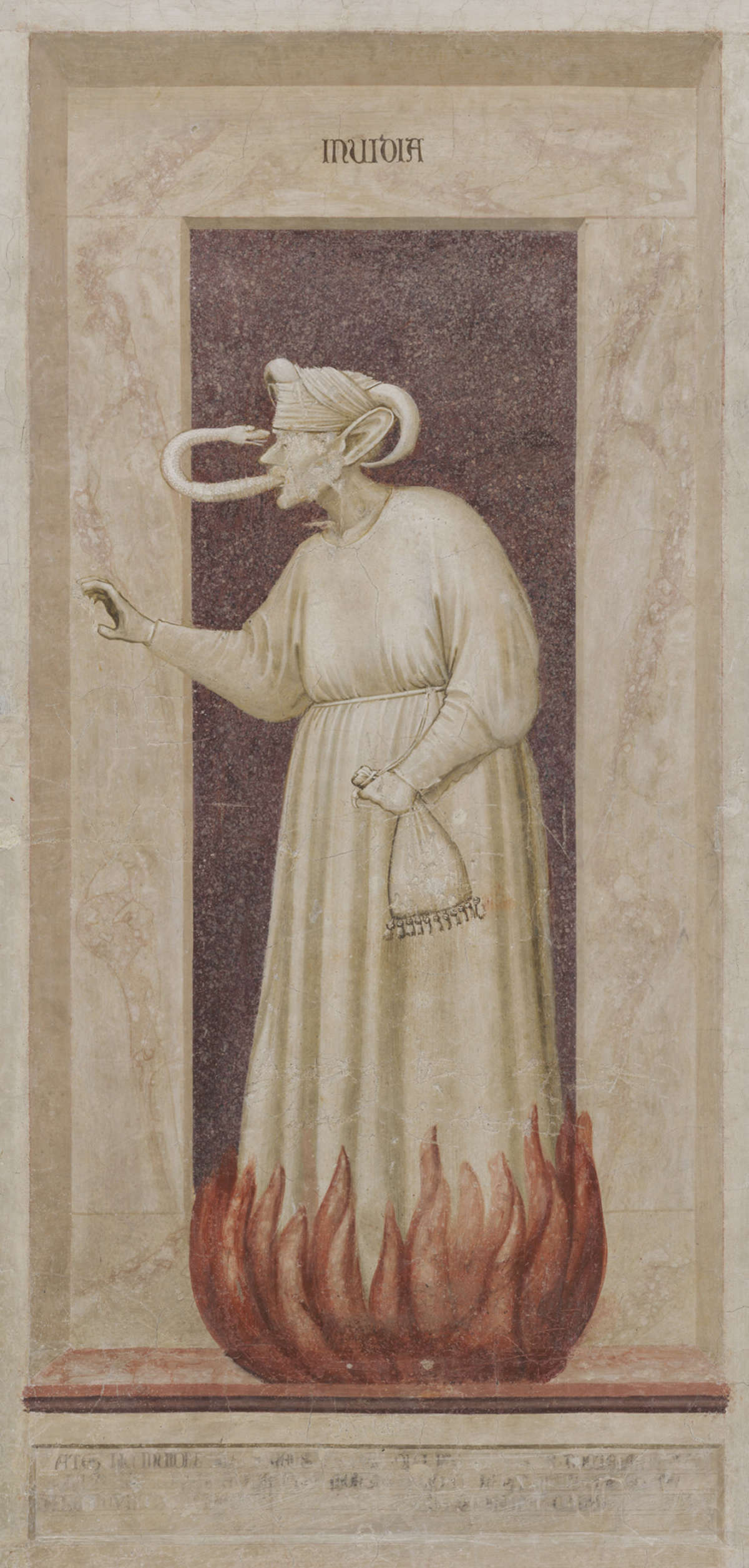
In the early fourteenth century, Giotto (Colle di Vespignano, Vicchio, 1267 - Florence, 1337) depicted her in a fresco in the Scrovegni Chapel in Padua, in the plinth of the left wall, dedicated precisely to the Vices, as opposed to the right wall dedicated to the Virtues. Painted in monochrome in a panel and surmounted by her name, Envy is depicted differently from the iconography that would have been codified by Ripa, or rather, as an old woman who does not have snakes in her hair, but a snake comes out of her mouth that turns against her, symbolizing the evil that returns on those who generate it. She has large, disproportionate ears to better catch others’ words and information, which feeds her; twisted horns sprout from her head and she is blind. Her feet are enveloped in high flames that burn her as the desire to possess other people’s things: for it is a feeling that burns first and foremost the one who feels it and never fulfills it. And the hand reaching forward as if to steal something also reinforces the concept of that desire. In the other hand, on the other hand, he clutches a bag with his belongings. Giotto’s depiction of her is thus one of moral condemnation and at the same time a warning that finds in the serpent and the fire two symbols of evil that affect her personally, since she is the first victim of her vice.
Also in Cesare Ripa’sIconologia , we learn that envy is also depicted with a bare breast drooping: she will then be an “old woman, thin, ugly, livid-colored, will have her left breast naked, and bitten by a serpent, which is coiled in many turns above the said breast, et a canto there will be a hidra, above which she will hold her hand. Envy is nothing other than to rejoice in the evil of others and to be attracted by the good with a torment that cringes, and devours the man in himself [...] The snake that bites the sinister udder notes the ramarico c’ha sempre al cuore l’invidioso del bene di altrui, as Horatio said in the Epistles ”invidus alterius macrescit rebus opimis." The envious person pines for the wealth of others, in other words.
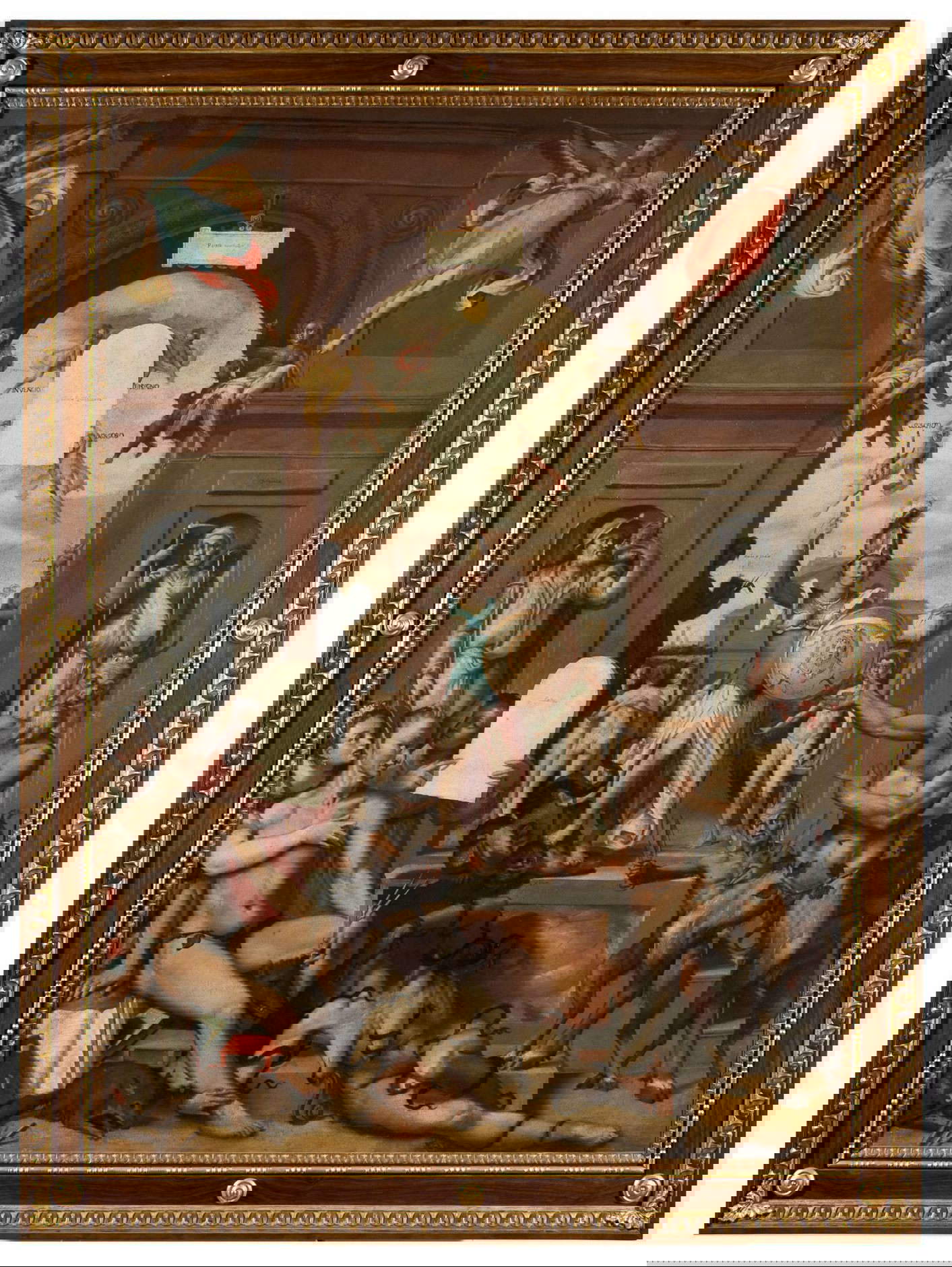
Naked and shrouded by snakes is the envy depicted on the ground in the center of Porta Virtutis by Federico Zuccari (Sant’Angelo in Vado, 1539 - Ancona, 1609), part of the permanent collection of the Galleria Nazionale delle Marche in the Ducal Palace in Urbino. The 1581 work was created by the artist as a result of a wrong he had suffered, namely the rejection by the commissioner Paolo Ghiselli, scalco of Pope Gregory XIII, of a work for the family chapel in the church of Santa Maria del Baraccano in Bologna on the theme of the procession of Gregory the Great, which neither he nor the Bolognese artists liked. Ghiselli then turned to another artist, Cesare Aretusi. At this point, to make up for the humiliation he had suffered, Zuccari together with Passignano produced a huge cartoon, the Porta Virtutis, which was displayed on the very day of St. Luke (the patron saint of painters) on the facade of the church of the painters’ guild. And on that occasion Zuccari explained the work in front of everyone. A small-scale painted version of the original cartoon, which the artist gave to Duke Francesco Maria II Della Rovere, is preserved in Urbino: it is a large allegory of Virtue triumphing over Vice. Minerva, in the center of the great arch that symbolizes the door of Virtue, does not let the approaching monstrous creatures, allegories of Vices, pass by. The boar and the fox symbolize ignorance, the woman with drooping breasts enveloped in serpents is envy, holding onto the ankle of King Midas recognizable by his donkey ears (a clear reference to the patron), while the fire-breathing satyr embodies the minister of envy. The personification of Presumption shows King Midas precisely the shovel of least quality, the one chosen by Ghiselli.
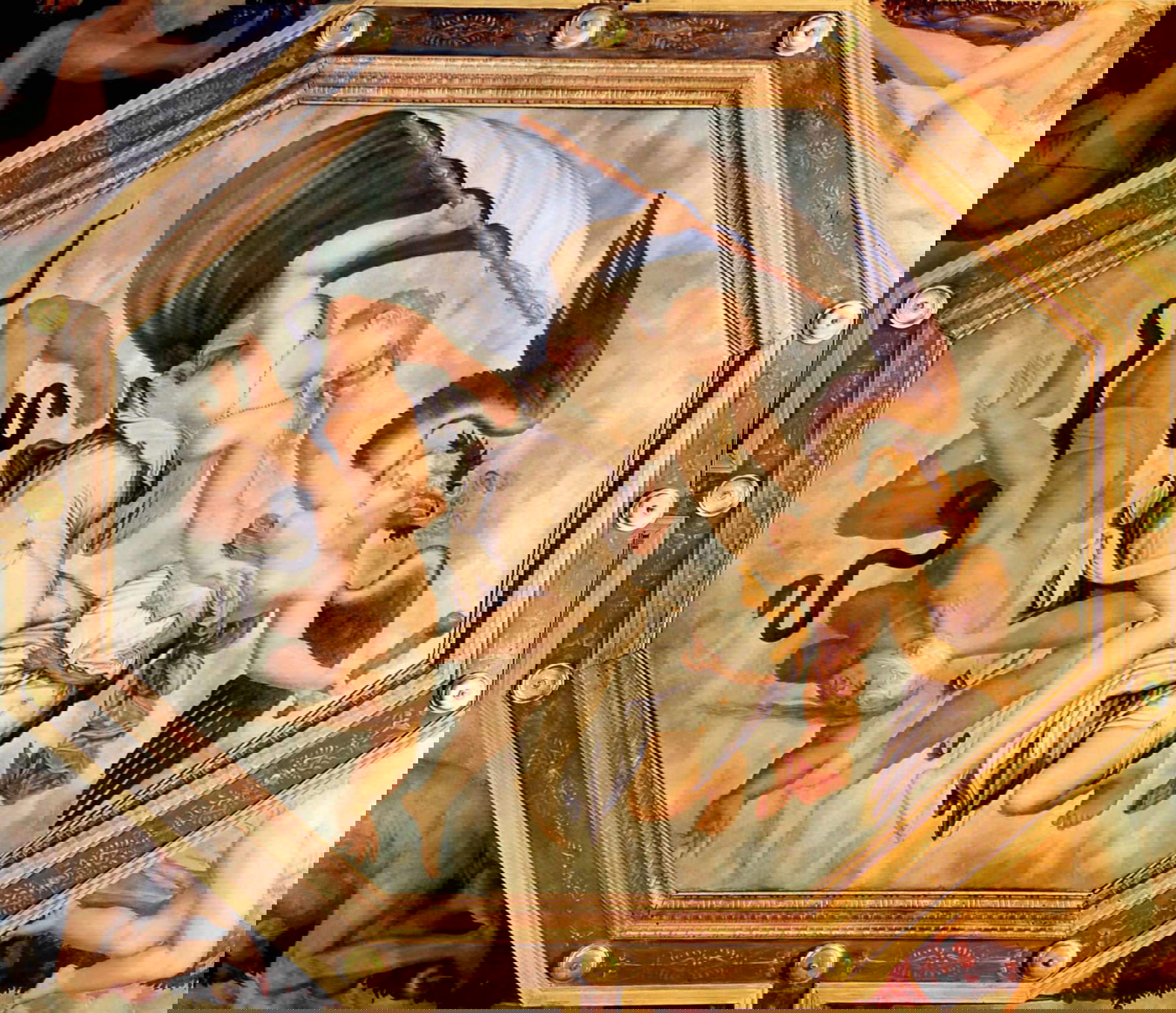
She has drooping breasts and is accompanied by snakes also the figure that seems to fall on us from the ceiling of the Hall of the Triumph of Virtue in the Casa Vasari Museum in Arezzo frescoed by Giorgio Vasari himself (Arezzo, 1511 - Florence, 1574) in the 1540s: “I remember how on dì 30 di luglio 1548 the stage was begun in the hall of my house for colorillo a olio, dove sono quattro anguli drentovi i quattro tenpi o le quattro età et atorno otto quadri a tenpera con Giove, Saturno, Marte, Mercurio, Venere, Cupido et il Sole et la Luna et 4 quadri dove sono putti drento et in uno ottangulo nel mezzo a olio, dove la Virtù et la Fortuna et l’Invidia che conbattono insieme,” the artist noted in his Ricordanze of the works he executed in his Arezzo home in Borgo San Vito. Indeed, the protagonists of the central octagon of the Room are Virtue struggling with Fortune and Envy: the latter, upturned, disheveled and ungainly, plunges downward in antithesis to Virtue soaring upward. There is no beauty or harmony: the features are contracted, almost animalistic, emphasizing the loss of humanity caused by Envy. She does not look up, but seems folded in on herself, and is overcome (a foot crushes the back of her head), unable to rise.
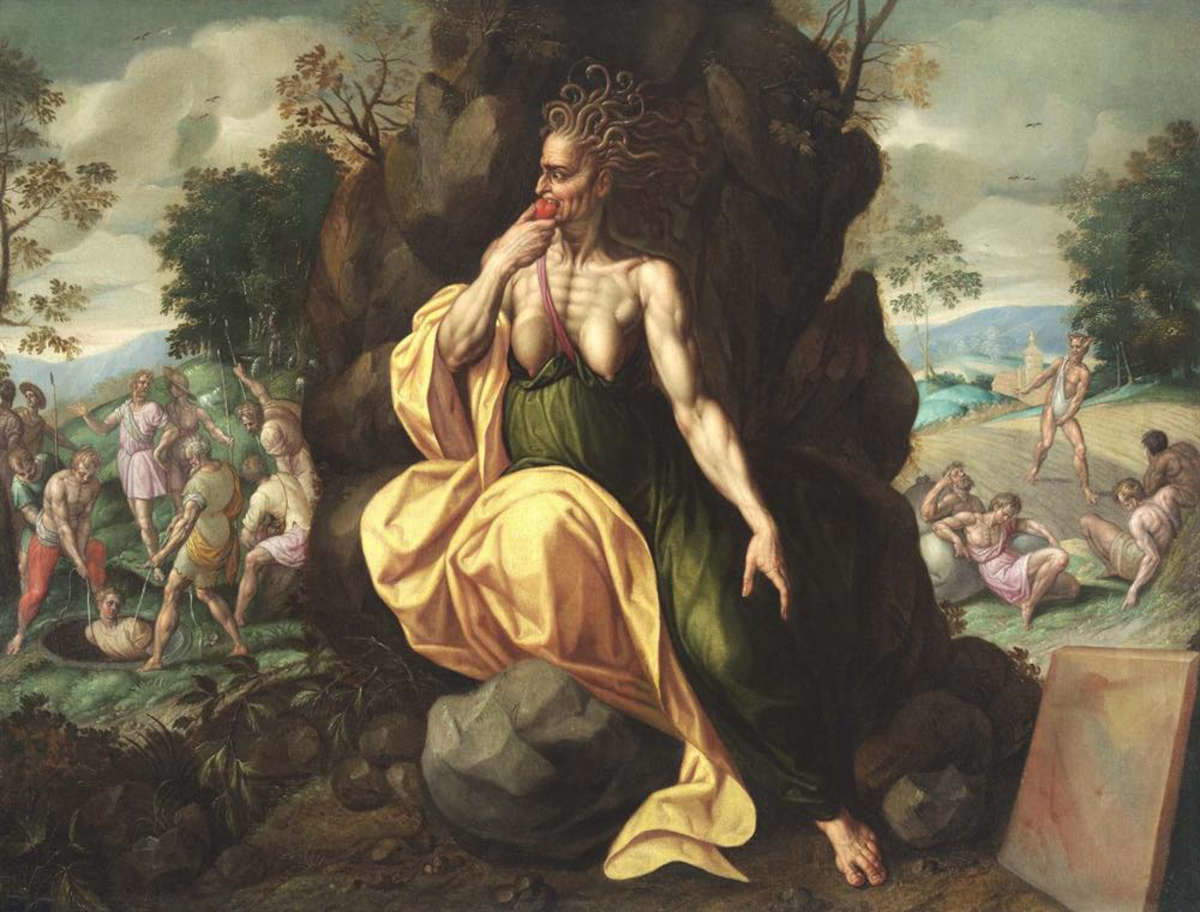
In contrast, the Capodimonte Museum and Royal Wood houses the painting belonging to the series of the seven deadly sins completed between 1570 and 1575 by the Flemish painter Jacques de Backer (Antwerp, c. 1555 - c. 1585), where the vices are depicted at the center of each work in the series and episodes from the Old and New Testaments appear in the background. Backer’sEnvy is a woman with a vigorous, muscular body but at the same time unnaturally deformed, and the first thing that is striking is her head: instead of hair she has tangled snakes, a direct reference to Medusa, a symbol of poison, danger and destruction. The face is contracted into a grim expression, the gaze is sideways, wary, as if constantly spying on others; with his mouth he is biting into a heart. The body is almost naked, with drooping breasts, and the colors of the fabrics she is wearing are also significant: the dark green of the robe recalls the traditional color of envy, while the dull yellow of the cloth alludes to moral illness and inner corruption. Indeed, a corrupt and nervous body is seen. She is depicted sitting on a rock; the gesture of her hand reaching downward suggests an attachment to what is petty and earthly, while her other hand brings her heart to her mouth, as if all her energy is directed toward devouring rather than creating. Biblical scenes related to envy appear in the background here: on the left, Joseph lowered into the well by his envious brothers, while on the right the devil sows tares.
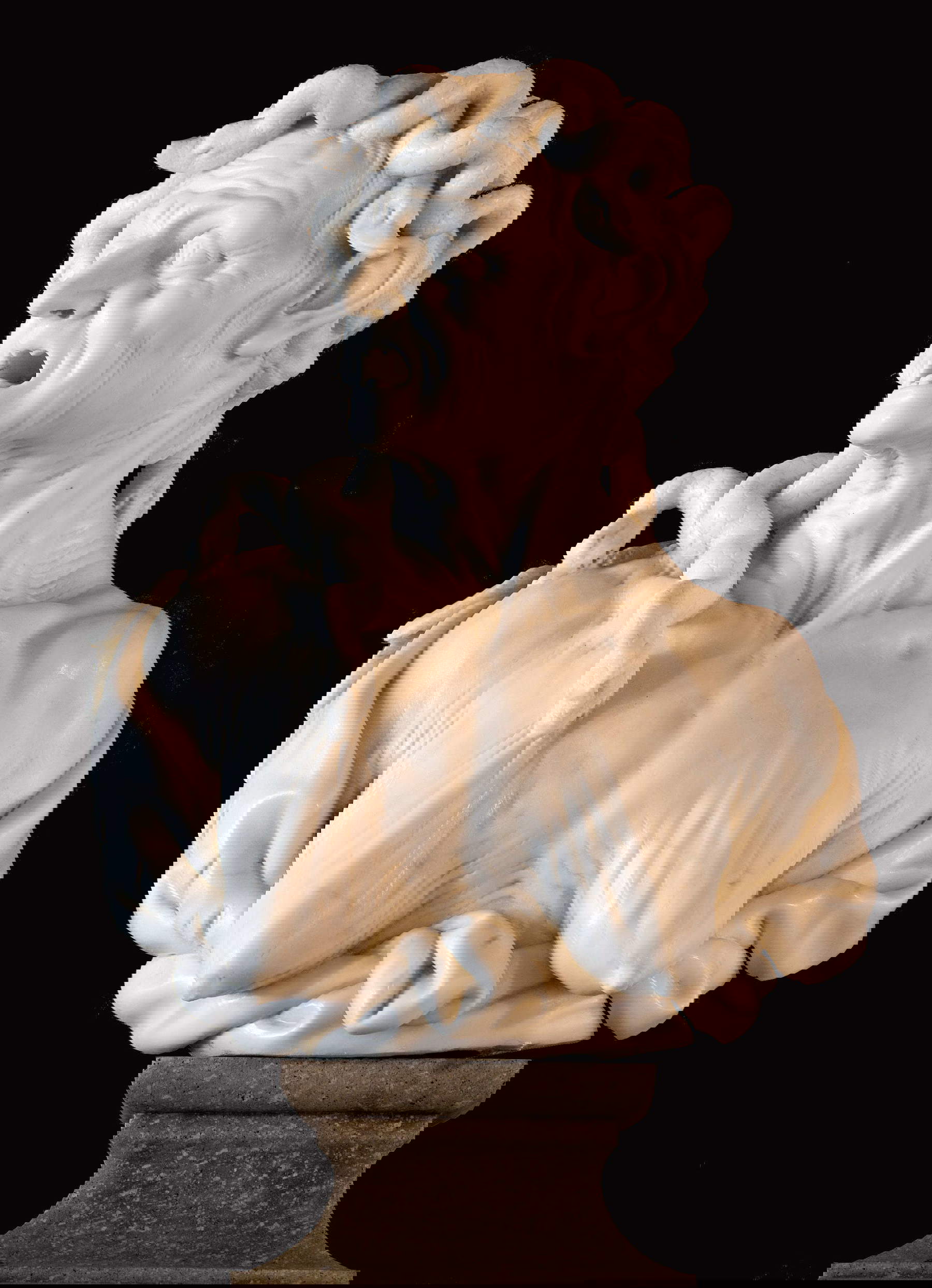

More crude and depicted with powerful naturalism is theEnvy depicted by Giusto Le Court (Ypres, 1627 - Venice, 1679), a Flemish sculptor active in Venice in the 17th century. The marble bust he made following the iconology of envy described by Cesare Ripa as an old woman, ugly, and pale, with a dry body, beady eyes, and in her hair some snakes, is now in the portego on the second floor of Ca’ Rezzonico (Museo del Settecento Veneziano), and the detail that immediately catches the eye is theterrifying scream of pain that seems to come out of the woman’s mouth because of the many snakes in her hair that are constantly biting her head and body (note the realism with which the snakes’ teeth sink into the old woman’s skin and then pull it).
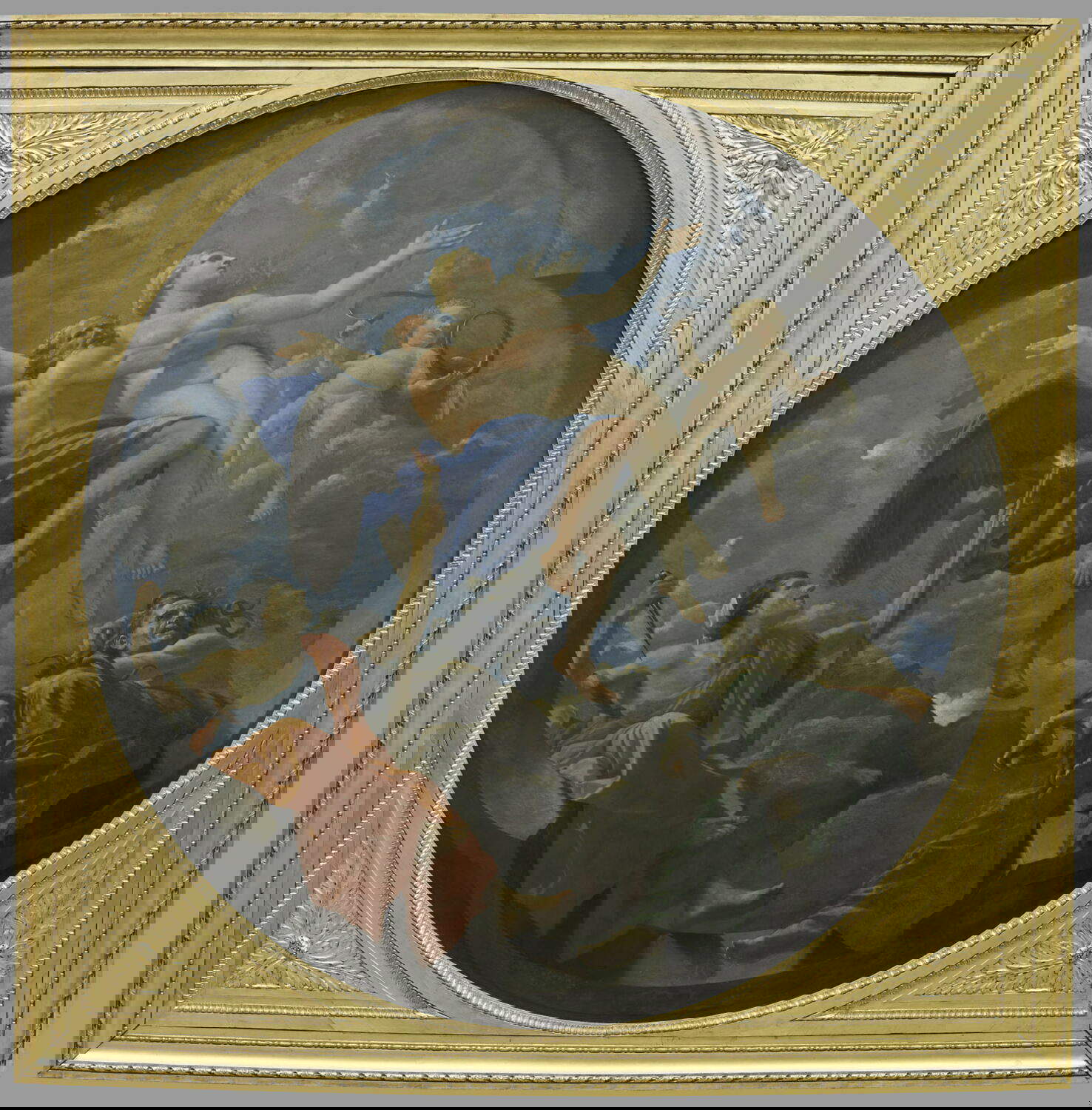
She also has snakes in her hair the one depicted by Nicolas Poussin (Les Andelys, 1594 - Rome, 1665) in The Time Protects Truth from the Attacks of Envy and Discord, now in the Louvre in Paris. Commissioned in 1641 by Cardinal Richelieu for the ceiling of the Grand Cabinet of the Palais-Cardinal, today’s Palais-Royal in Paris, the painting depicts Time (whose attributes, the scythe and the uroborus, are held up by a putto beside it) abducting Truth, depicted as a naked young woman, while in the foreground are seated, on the left, Discord, and on the right,Envy; the former characterized by a lighted flashlight and a dagger, the latter by her livid skin, snakes instead of hair, and the yellow and green colors of the draperies covering her. The work would be apolitical allegory in honor of Cardinal Richelieu for securing peace and concord for the kingdom, which had escaped the attacks of discord and envy over time.
It is clear from these works how envy is never something neutral or harmless, but a destructive force that leaves visible marks, like a poison that corrodes those who carry it within. So when we think about how ugly envy is in interpersonal relationships ... we can say that art has also expressed its concept well in images.


The author of this article: Ilaria Baratta
Giornalista, è co-fondatrice di Finestre sull'Arte con Federico Giannini. È nata a Carrara nel 1987 e si è laureata a Pisa. È responsabile della redazione di Finestre sull'Arte.
Warning: the translation into English of the original Italian article was created using automatic tools. We undertake to review all articles, but we do not guarantee the total absence of inaccuracies in the translation due to the program. You can find the original by clicking on the ITA button. If you find any mistake,please contact us.

























 IT
IT FR
FR DE
DE ES
ES CN
CN


