





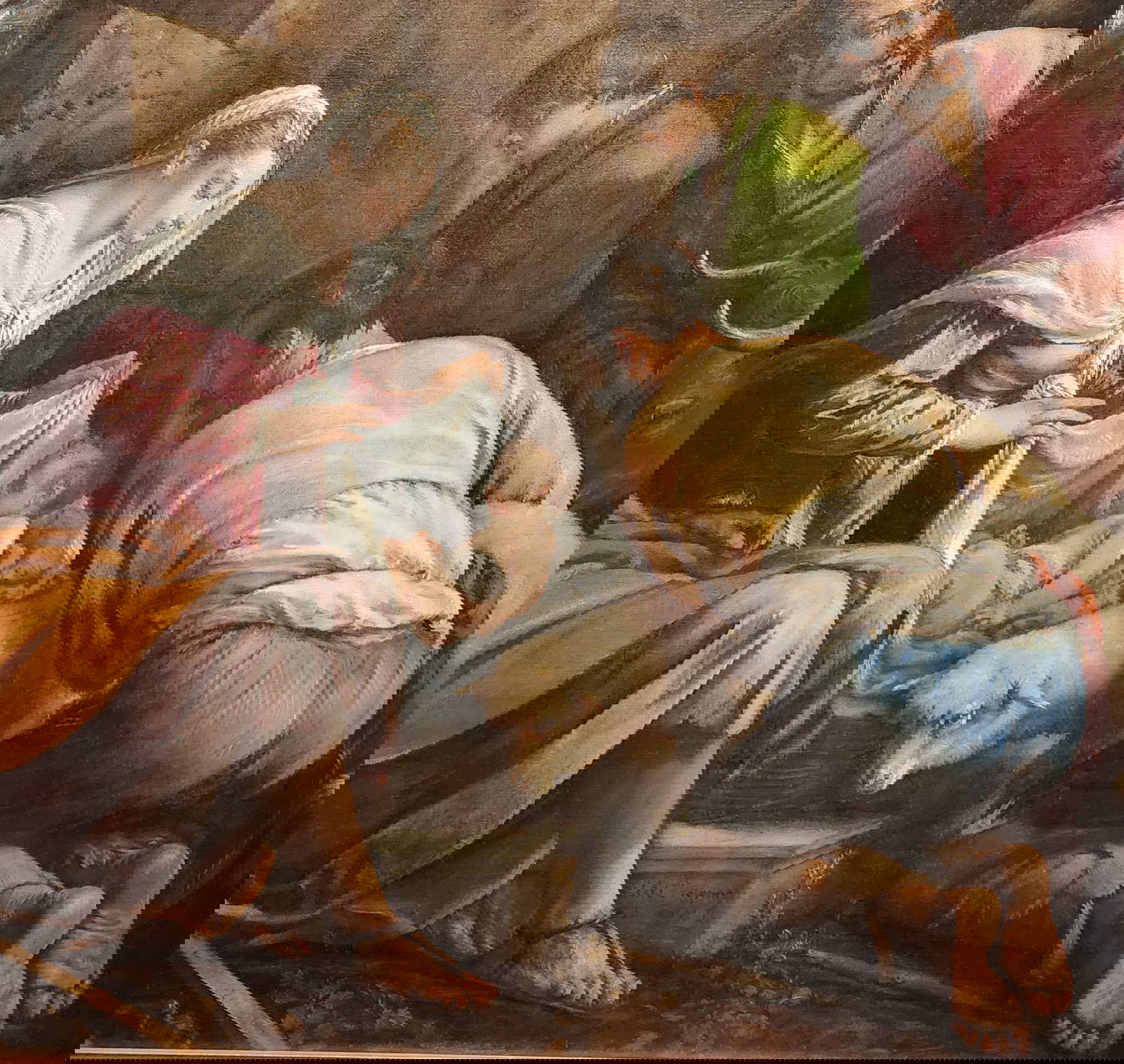
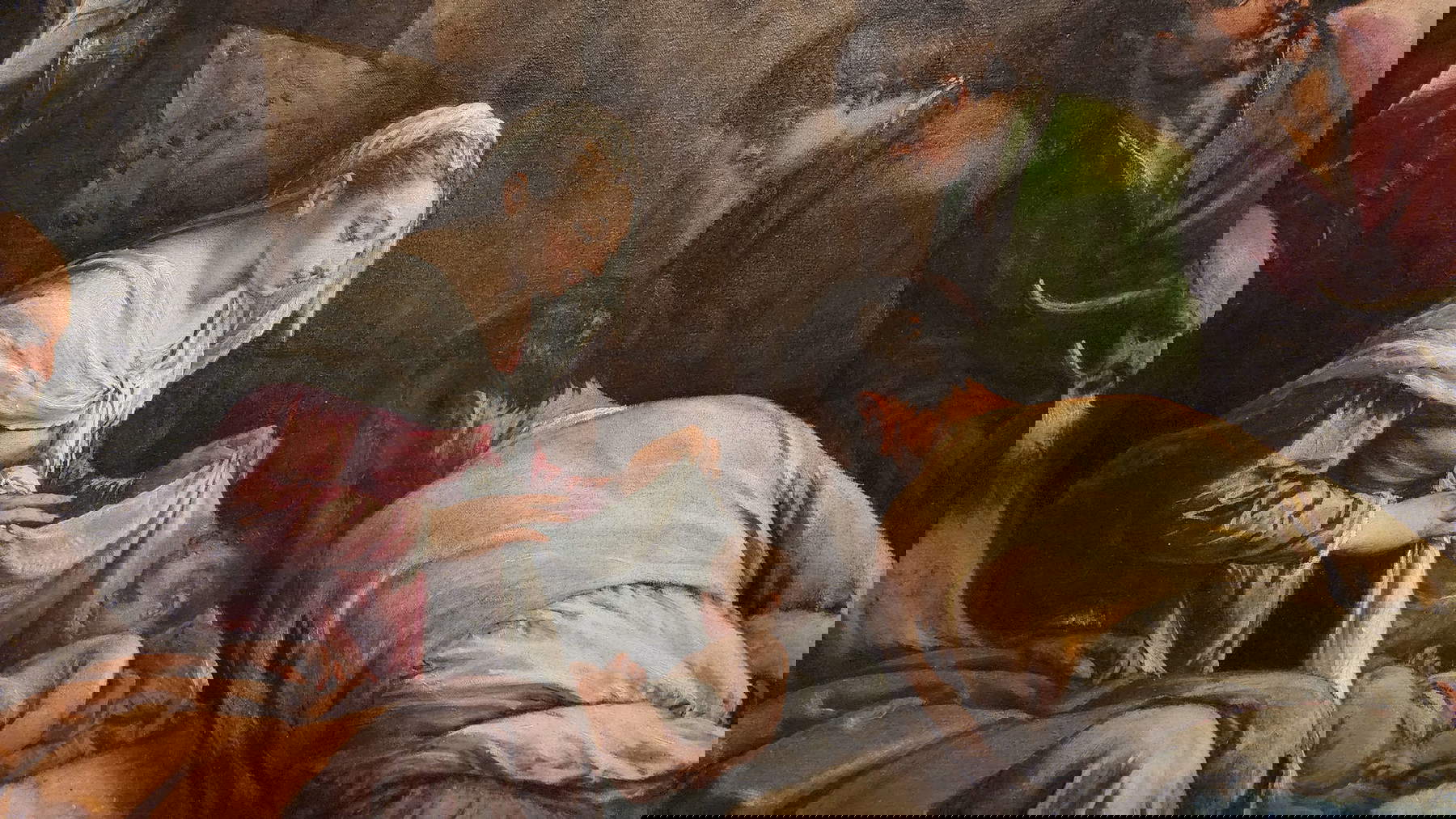
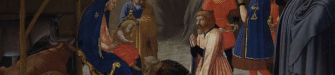
The happy event has taken place: the Virgin lifts two flaps of the white cloth covering the cradle inside which lies the sleeping newborn Child, to reveal Him to the shepherds who have come to adore Him along with their lambs, an ox and a dog. One, in order to see him better, kneels down and gets his face well in front of him, conspicuously leaving his dirty bottom and feet on display to the observer. Another, in a more backward position, remains standing admiring the new born; another neighbor, also kneeling, turns his gaze toward the ox by placing a hand on the back of the cattle in curiosity, while another shepherd in a feathered hat remains in the half-light with his instrument, probably a bagpipe, near his mouth, making no sound. There is silence in theAdoration, brightened by the glimpse of light that opens in the sky thanks to four little angels who, flying among the dark clouds, seem to contribute with their small arms to hold open that glimpse of light, the only ray of light, to let it enter and make room in the scene.
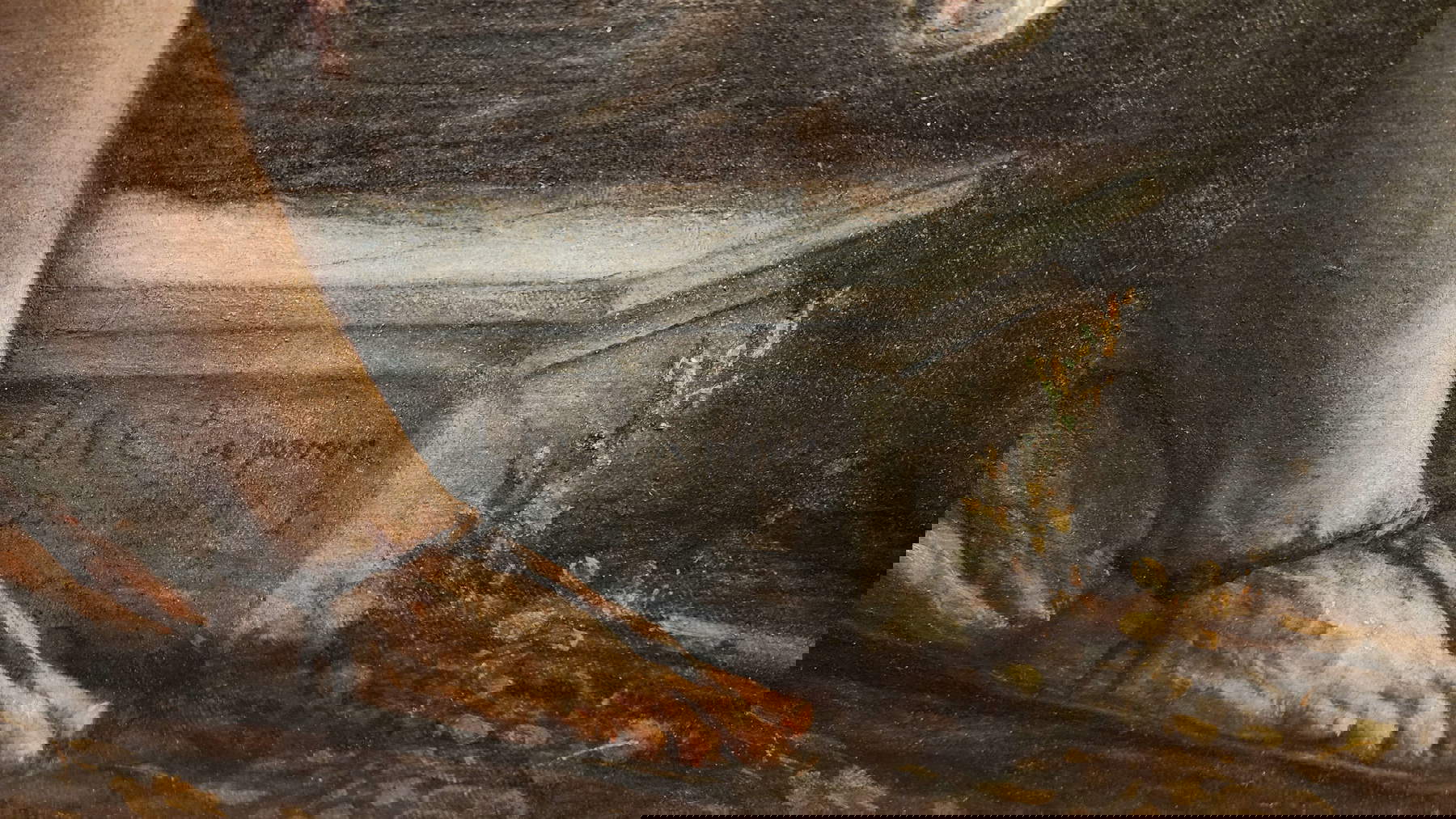
This is the monumental Adoration of the Shepherds with Saints Crown, Victor and a devotee made and signed (on the base of the cradle of the Child) in 1568 by Jacopo dal Ponte, known as Jacopo Bassano (Bassano del Grappa, c. 1515 - 1592) as an altarpiece for the church of San Giuseppe in Bassano del Grappa and since 1859 housed in the town’s Museo Civico, appropriately today in the room dedicated to the Bassanos, the dynasty of painters to which Jacopo himself belongs, at the center of painting in the Venetian Renaissance. The Hall boasts the largest collection of works by the artist, who is perhaps still somewhat underestimated today but was actually among the most original painters of the second half of the 16th century Veneto as well as a great painter of reality who anticipated Caravaggio.
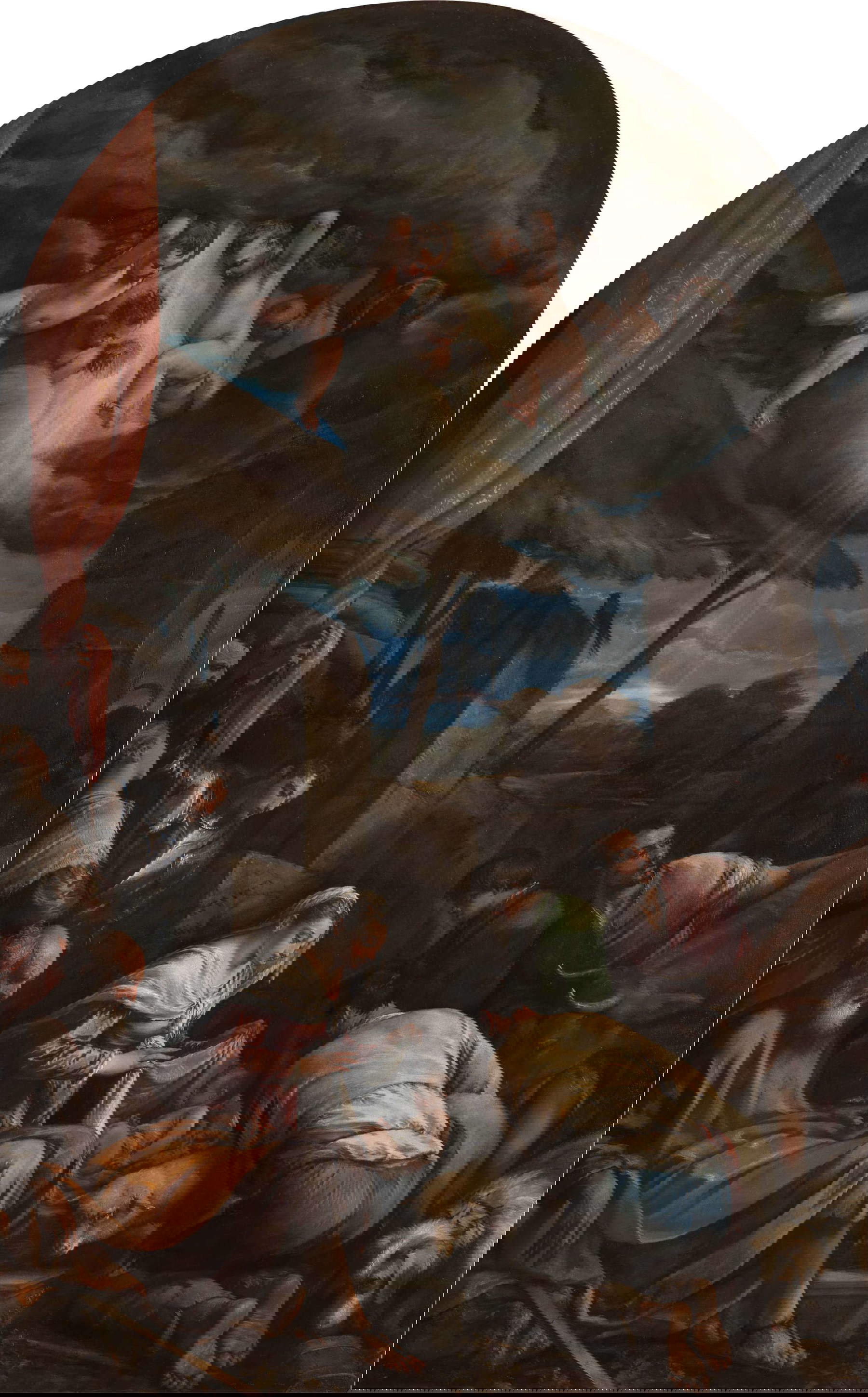
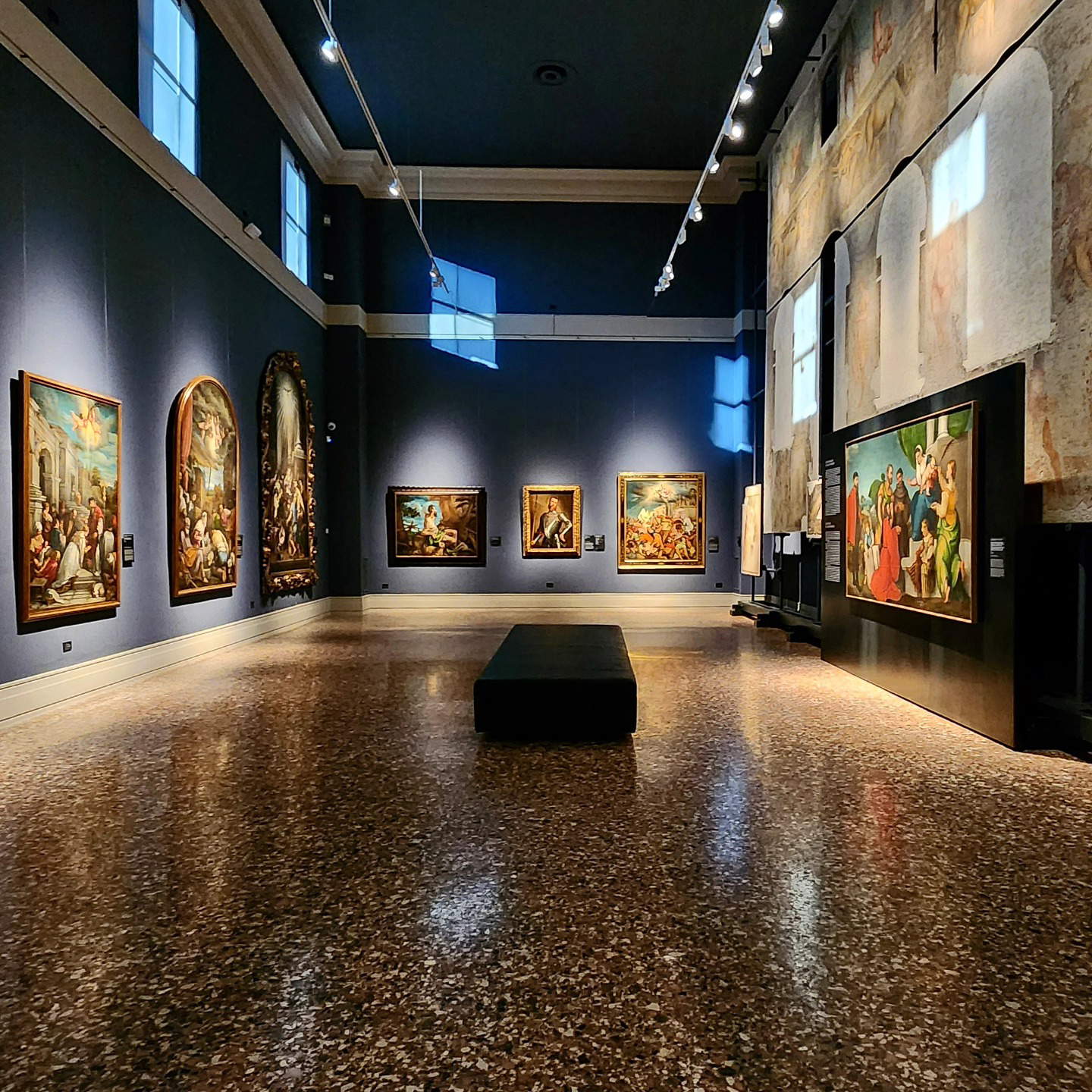
TheAdoration of the Shepherds preserved here constitutes precisely one of the high points of Jacopo Bassano’s mature production and stands out as one of the most emblematic works of his ability to renew the language of sacred painting through the grafting of elements drawn from the rural world. Conceived for the solemn context of the altarpiece, it in fact accommodates within it a vision of the sacred that is profoundly linked to therustic, the pastoral and the everyday: the scene does not take place in a pompous and monumental setting, but in the silence of a half-destroyed stable, open to the surrounding landscape.
The scene is built according to a carefully calibrated compositional layout, which develops in depth from a low vantage point: a choice that not only lends monumentality to the figures, but also reinforces the sense of participation of the viewer, who is ideally invited to kneel beside the shepherds. Each character occupies a natural space, defined more by gesture and gaze than by rigid perspective structures. Beyond the arrangement of the individual figures, what emerges in the painting is Bassano’s conscious renunciation of any rigidly monumental hierarchy: sacredness is not constructed through the centrality or monumentalization of the figures, but through a system of visual and luministic relationships that distributes spiritual value over the entire composition of the painting. In this way, the Sacred Adoration does not impose itself on the viewer as a distant image, but manifests itself diffuse, perceptible in the continuity between the humble gestures of the shepherds, who bend their bodies, tilt their torsos, bow their heads, caress and stand close to their animals, and the surrounding space, which is presented as a lived-in environment, made up of parts of walls and vaults and openings to the landscape. The choice to avoid emphatic or rhetorical accents reveals a profoundly modern conception of the sacred, based on proximity and sharing rather than separation between the divine and the human.
Even the Saint Joseph depicted here appears as a resigned and slumbering character, fully inserted into the everyday space of the scene, in a collected attitude. He appears as an ordinary man, sitting on the rock, weary, marked by time and fatigue, as shown by his wrinkled forehead and his clearly visible gnarled hands. He thus embodies a model of devotion based on humility, simplicity, and everydayness.
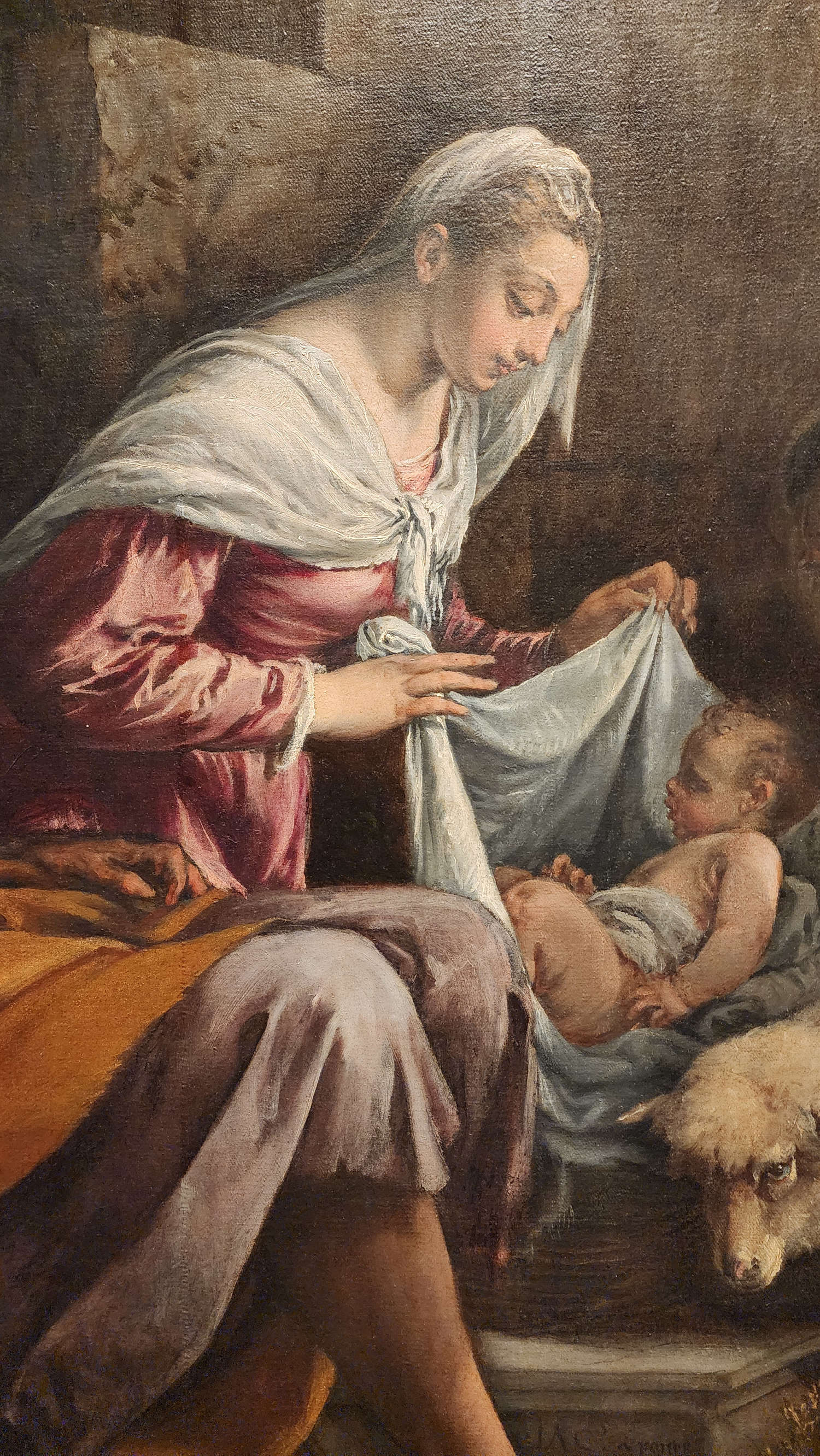
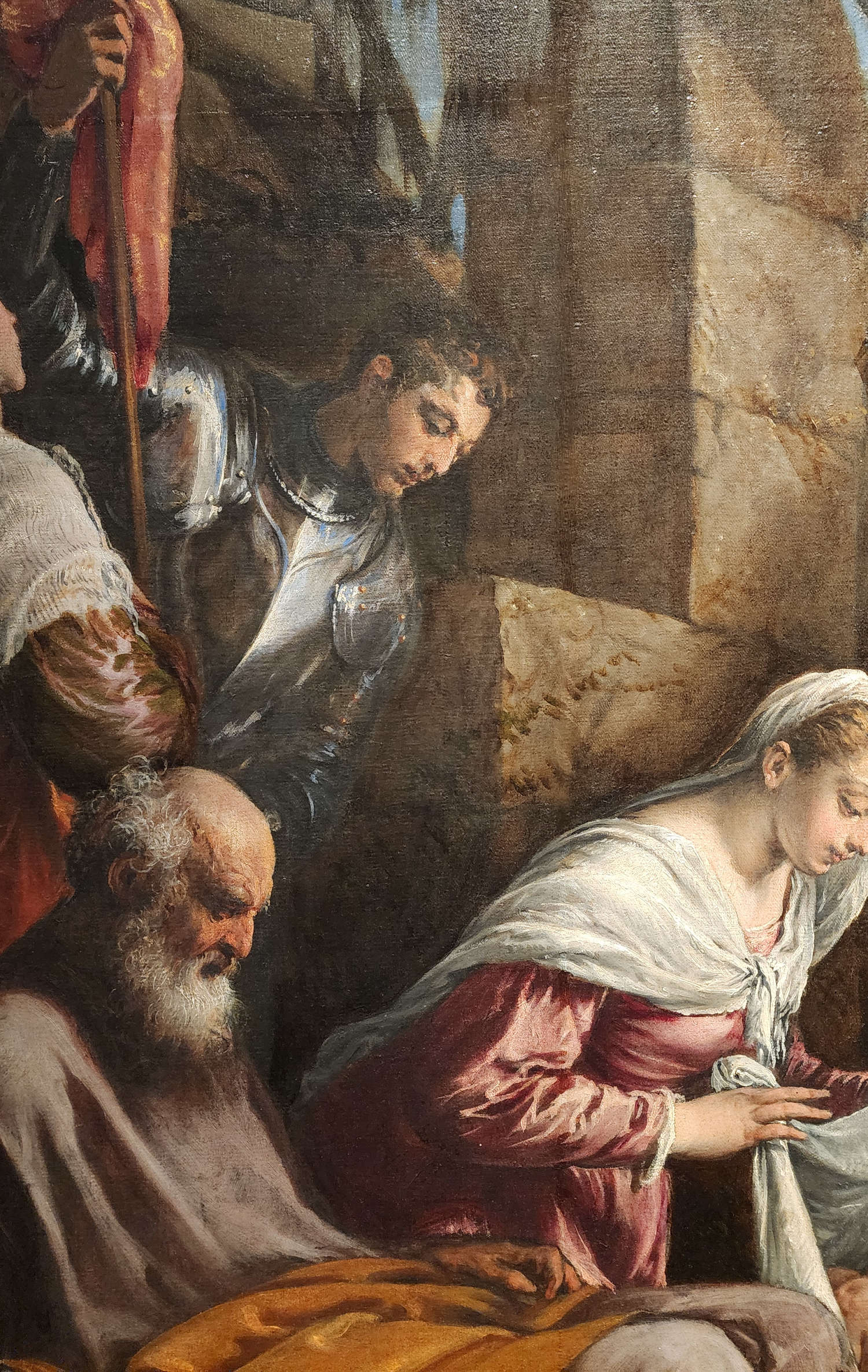
Attending the scene, standing behind St. Joseph, are the martyred saints Corona and Victor, co-patrons of the church of St. Joseph for which the altarpiece was made, and a donor portrayed realistically as was common in sixteenth-century art. The three are depicted as devout spectators of the sacred Adoration, probably to honor their local devotion. The two saints, side by side, participate in the event in a deliberately discreet and almost sideways manner, with a composed and silent devotion. St. Victor, clad in armor as a soldier, lifts or shakes off with his hand the red cloth decorated with gold that descends from above, suggesting the idea of a revelation: it is as if he is opening the sacred space to the gaze. Saint Crown , on the other hand, is turned in profile, making no obvious gestures, not guiding the gaze; her presence is more contemplative than active, she is a figure who participates with humility and silence. Both therefore do not impose themselves as saints, but rather as presences that accompany the sacred event, enter it almost covertly, sharing the same space as ordinary men. It is precisely this choice by Jacopo Bassano that makes the local tradition manifest: Corona and Vittore are not there to be seen, but to stand silently beside the mystery of the Nativity, as discreet and familiar protectors of the community that prayed before that image. From above, a slit rips through the cloud-laden sky, and the light coming from it invests the surfaces and the figures, bounces off the robes, Saint Victor’s armor, and the coats of the animals; it thus traverses space, making a physical continuity between heaven and earth perceptible.
Among the most significant aspects of the work, however, is the attention to the natural datum, which constitutes the most authentic feature of Bassano’s poetics. The shepherds are men marked by work, portrayed with a physical truth that can be grasped in their faces, their skin, their tattered clothes; striking are those dirty feet in the foreground, painted with a harshness that breaks all distance between the public and the work, as well as the meticulous rendering of the animals, with bowed heads, who share the sacred space without any symbolic separation. Elements such as the dirty feet or the bramble collar that protects the dog from wolf attacks, the latter datum revealing the artist’s knowledge of the peasant world and his willingness to transpose it integrally within the sacred narrative, are details that hold the gaze, slow it down, force it to a close and attentive view. They are realistic inserts that affirm a vision of the sacred deeply rooted in the concreteness of human experience.
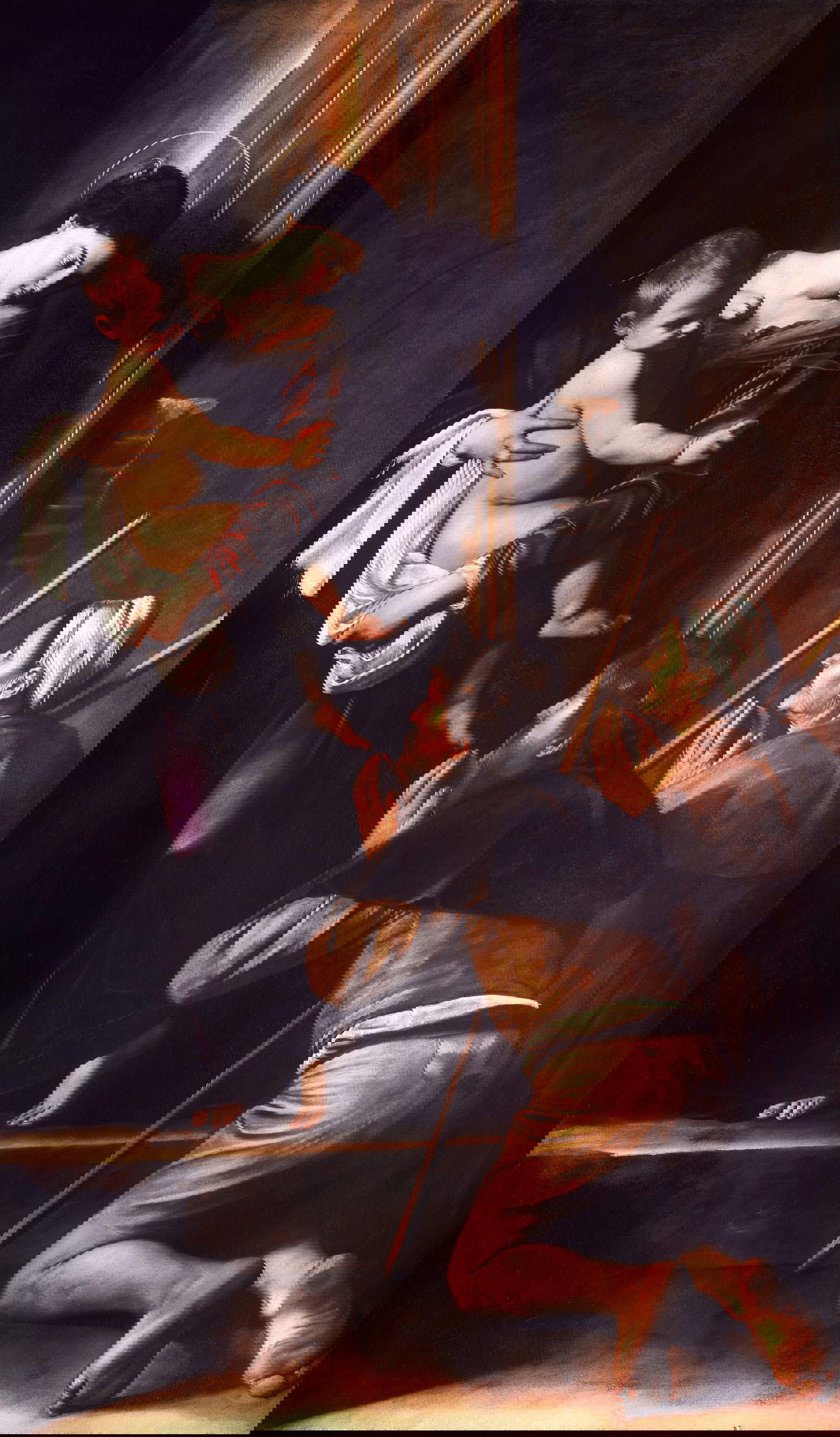
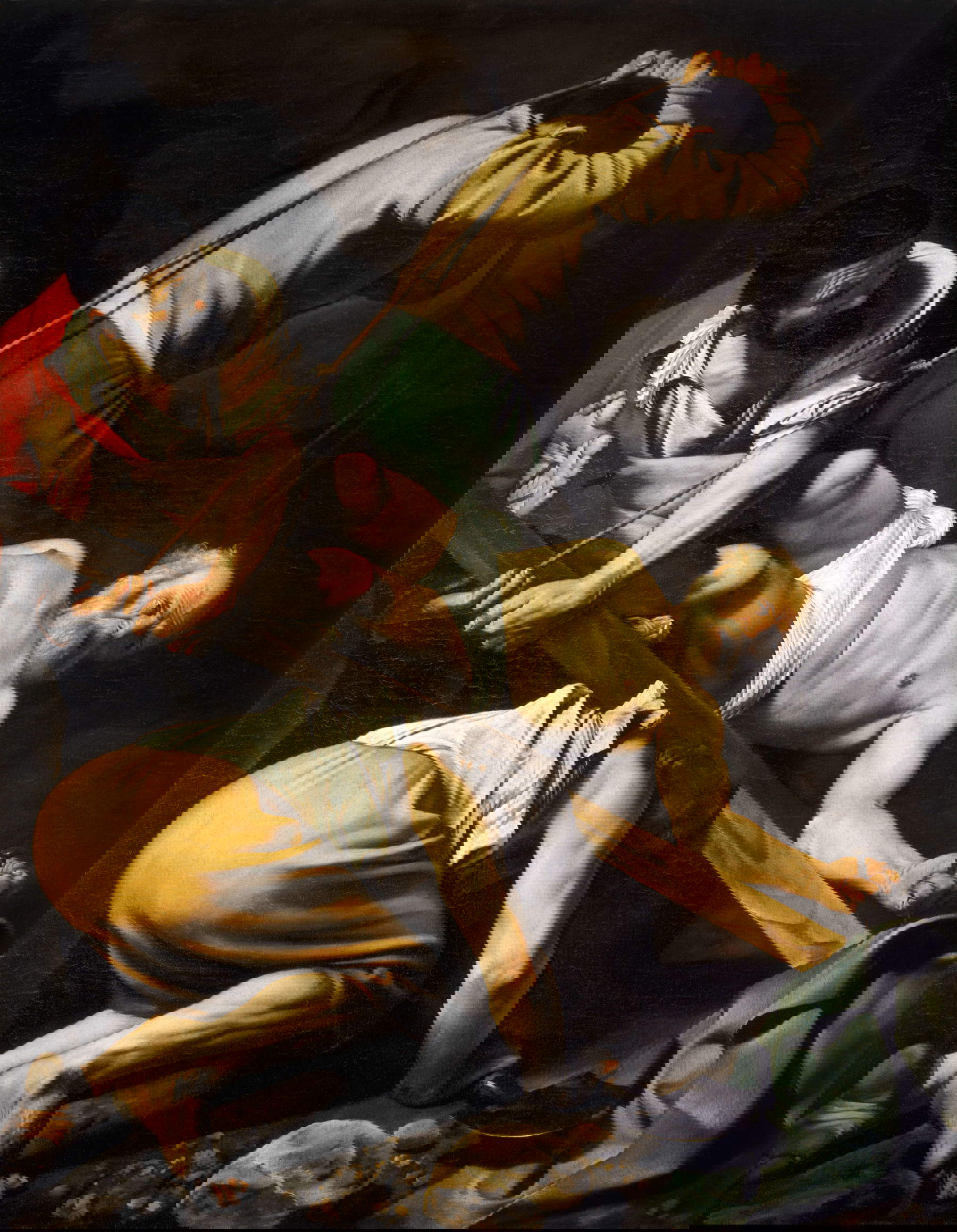
It has already been mentioned how Jacopo Bassano was a great painter of reality who anticipated Caravaggio: in particular, this anticipation is here well expressed by the bare, dirty feet in the foreground, which are reminiscent precisely of the “muddy derriere feet,” as Giovanni Baglione described them, of the kneeling pilgrim in Merisi’s famous Madonna dei Pellegrini, which together with the woman’s “frayed and filthy cap” created “extreme uproar” among the people when it was placed in the Basilica of Sant’Agostino in Rome. Bassano thus anticipated Caravaggio by nearly forty years, although other dirty feet but in a more diagonal position are found in the Crucifixion of St. Peter in the Cerasi Chapel, painted a few years earlier.
In this fusion of the sacred and the everyday, of solemnity and spontaneity and attention to naturalistic details, Jacopo Bassano’sAdoration of the Shepherds emerges as one of the most mature expressions of his art, testifying to a conception of the sacred that is not distant, but close and profoundly human, capable of speaking to the viewer through the simplicity of rural life.


The author of this article: Ilaria Baratta
Giornalista, è co-fondatrice di Finestre sull'Arte con Federico Giannini. È nata a Carrara nel 1987 e si è laureata a Pisa. È responsabile della redazione di Finestre sull'Arte.
Warning: the translation into English of the original Italian article was created using automatic tools. We undertake to review all articles, but we do not guarantee the total absence of inaccuracies in the translation due to the program. You can find the original by clicking on the ITA button. If you find any mistake,please contact us.

























 IT
IT FR
FR DE
DE ES
ES CN
CN


